

*
Part Three closed on a cultural front whose legitimacy survived the exposure of its funding. This last part turns to the instrument India built to meter foreign money after the fact, and to the one statute that social media insists the money wrote.
*
ON 4 OCTOBER 2026, on the platform X, writer Madhu Purnima Kishwar stated that the Scheduled Castes and Scheduled Tribes (Prevention of Atrocities) Act, 1989, was “forced down our throats with the help of foreign-funded NGOs backed by the Conversion Mafia.” That is the claim. The paper trail says otherwise.
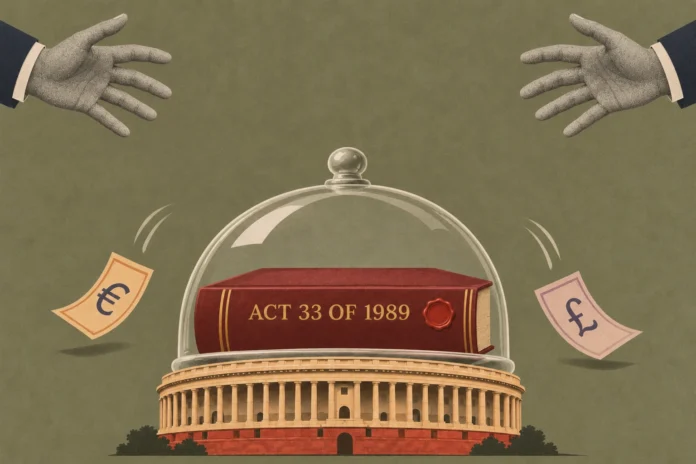
The Scheduled Castes and the Scheduled Tribes (Prevention of Atrocities) Act is Act 33 of 1989. The President assented to it on 11 September 1989. It came into force on 30 January 1990; the Rules followed in 1995. Its Statement of Objects and Reasons, dated 7 August 1989 and signed by Dr Rajendra Kumari Bajpai, is a domestic document. It says the Scheduled Castes and Scheduled Tribes “remain vulnerable” despite earlier measures, are denied civil rights, and suffer serious crimes for historical, social and economic reasons. It finds the Protection of Civil Rights Act, 1955 and the ordinary Penal Code “inadequate.”
The Statement names no massacre. Kilvenmani (1968), Belchi (1977) and Karamchedu (1985) are the cases usually cited as proof of that inadequacy, but the Statement does not mention them. Indian pressure shaped the Act at every step. The Elayaperumal Committee report of 1969 had examined untouchability and the law. Rajiv Gandhi publicly emphasised the issue in 1987. No foreign organisation appears in the Statement of Objects, and none has been shown from the bill files or the debates to have drafted or advised on the text.
AFTER 1989, European church-linked and development agencies funded Indian Dalit and tribal organisations. Misereor and Brot für die Welt of Germany, Christian Aid of Britain and HIVOS of the Netherlands are the names that recur. A HinduPost analysis of FCRA data traces Misereor receipts to Indian NGOs; Christian Aid’s India pages describe partner work on caste. The money paid for atrocity documentation, legal aid and monitoring of how the Act worked on the ground. Some grantees litigated cases and sat on official consultations. That is real influence, exercised after the statute was already on the books. It is a different thing from sitting where the drafters sat.
| Organisation | Country of origin | Typical later role in India | Character |
| Misereor | Germany | Funding for Dalit rights work, atrocity documentation | Catholic bishops’ development agency |
| Brot für die Welt (Bread for the World) | Germany | Support for social-justice and Dalit programmes | Protestant |
| Christian Aid | United Kingdom | Grants to Indian partners working on caste issues | Ecumenical |
| HIVOS | Netherlands | Human-rights and development grants | Secular humanist |
Clause 3 of the Constitution (Scheduled Castes) Order, 1950 says no person professing a religion different from Hinduism shall be deemed a member of a Scheduled Caste. Sikhs were added in 1956 and Buddhists in 1990. Christians and Muslims were never. Scheduled Tribe status runs under a different Order with no equivalent religious bar. In Chinthada Anand v. State of Andhra Pradesh (2026 INSC 283), the Supreme Court applied Clause 3 to the 1989 Act. A Madiga pastor who openly professes Christianity was held unable to invoke the Act as a Scheduled Caste member. That ruling concerns legal status. It does not find that caste abuse ends at baptism; critics at The Leaflet argue it ignores the lived reality of Dalit converts. It also says nothing about who wrote the Act.
That bar is what church-linked networks later campaigned to lift. On 6 October 2005, Joseph D’Souza, then president of the All India Christian Council and the Dalit Freedom Network, testified before a US House subcommittee and submitted the council’s appeal to amend the 1950 Order so that Dalit Christians would enjoy “all the benefits reserved for the Scheduled Castes”. The campaign sits uneasily with Ambedkar’s own choice. His biographer Dhananjay Keer records his avowal to embrace a religion that would neither “denationalise the Depressed Classes” nor harm “the ancient culture of this land”. In 1956 he took Buddhism, not Christianity or Islam. None of this touched the drafting. It came after.
THE RIGHTS STATUTE that met organised, sustained opposition was the Forest Rights Act, 2006. Its own Statement of Objects names historical injustice. The Campaign for Survival and Dignity, several left parties and tribal MPs drove it through; the vote in Parliament was wholly Indian.
In 2008, Wildlife First, the Nature Conservation Society and the Tiger Research and Conservation Trust went to the Supreme Court asking that the Act be declared unconstitutional. Wildlife Trust of India was also a petitioner and withdrew in 2019. These domestic conservation groups argued that the Act conflicted with the Wildlife (Protection) Act, 1972, and the Forest (Conservation) Act, 1980. No one has shown that foreign money paid them.
The 1989 Act met nothing comparable at birth. Its first serious setback came three decades later, when the Supreme Court, in Dr Subhash Kashinath Mahajan v. State of Maharashtra (20 March 2018), required a preliminary enquiry before arrest. Parliament answered the same year with Section 18A, restoring the Act’s original force. The Rajya Sabha passed it unanimously.
THE FOREIGN CONTRIBUTION (Regulation) Act dates to 1976, was rewritten in 2010 and tightened in 2020. It was tightened again by the Amendment Rules of 2026, which Human Rights Watch argues tighten state control over civil society. Each round followed its own scandals and administrative experience; none followed a single grand design.
The next round is already before Parliament. The FCRA (Amendment) Bill, 2026, referred to a 31-member Joint Parliamentary Committee on 12 August, would let a government-appointed authority take over the foreign contribution and assets of any organisation whose registration is cancelled or lapses. Where the asset is a place of worship, its religious character is to be kept. Church bodies have led the objections.
In Noel Harper v. Union of India (2022), the Supreme Court held that there is no fundamental right to receive foreign contributions, reasoning that unregulated inflows could affect the country’s socioeconomic structure and politics. The committee’s chairman, Sanjay Jaiswal, said in Shillong on 2 November 2026 that churches and other faith-based bodies receive only about 6 per cent of the roughly Rs 22,000 crore in foreign contributions, and that the rest goes to NGOs and other organisations. That is a chairman’s remark before the committee has reported; the detailed breakdown by purpose sits in FCRA returns and the Home Ministry’s annual reports.
The Home Ministry cancelled the FCRA registration of the Rajiv Gandhi Foundation in October 2022 after an inter-ministerial inquiry, citing violations of the Act. Ford Foundation was placed on a watchlist in 2015 and taken off in 2016. Open Society Foundations was put on the prior-permission list in 2016. Neither was cancelled. The NewsClick prosecution is a separate case on its own facts and remains pending; no court has returned a final finding.
Funding reaches research bodies too. FCRA returns list foreign foundations among the funders of think-tanks such as CPR, CSDS and CSE. That is a fair accountability question, and the state has asked it: the Home Ministry cancelled CPR’s FCRA registration in January 2024, citing violations, a decision CPR called “incomprehensible”. Even there, the charge was a breach of the licence, not a covert programme. In 2026, the Gates Foundation signed a memorandum with Nalanda University for a “Kautilya Global Centre for State Capacity,” announced before a Union minister. India kept the open half of the old model running and wrote FCRA to govern the rest.
ACROSS SEVEN DECADES, the trail was caught each time after the money had moved on. The 1989 Act belongs to none of this. It was an Indian answer to Indian atrocities, passed on an Indian record. Church-linked funders paid the monitors who came after. Wildlife groups challenged the Forest Rights Act in court. India was never simply bought. Authorship is what a Statement of Objects records; a petition filed years later records something else.