
*
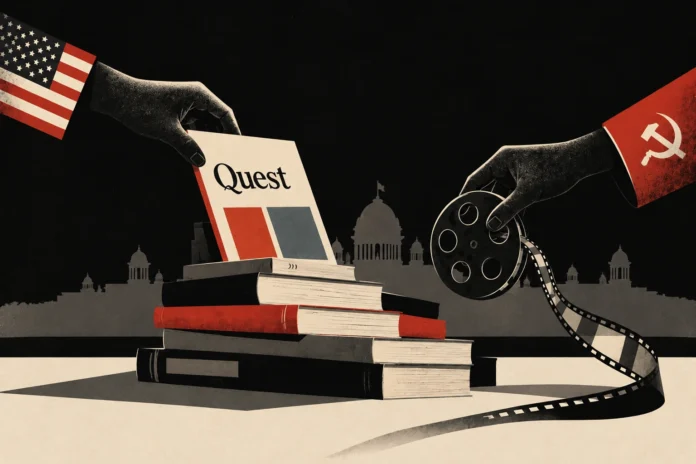
Part Two closed on invited technical assistance curdling into coercion. This part turns to a softer and, in some ways, more durable instrument: the magazine nobody quite owned, the book crate that arrived with a mission statement, and the cinema screen two empires fought over without either directing a single frame. Neither Washington nor Moscow needed to write India’s arguments. They needed only to choose which ones got printed, funded and screened.
*
In the early 1950s, the contest was fought on the wooden platforms of street theatre and the pages of literary magazines. On one side stood the Indian People’s Theatre Association, using folk art to carry the left’s message; on the other, the Indian Committee for Cultural Freedom, the local wing of the CIA-funded Congress for Cultural Freedom.
IN 1950, THE CIA helped found the Congress for Cultural Freedom in Berlin, to contest the cultural ground the Soviets held through their peace congresses. Thomas Braden’s International Organizations Division ran it, and the agency paid for it secretly until 1966. In 1951 Nehru refused to let it convene in Delhi, so its Asian congress met in Bombay that March instead. The Indian Committee for Cultural Freedom that grew out of it brought Minoo Masani, Jayaprakash Narayan, Asoka Mehta and A.D. Gorwala to one table. Masani’s Freedom First, launched in 1952, was already running when Quest launched in 1955, with Nissim Ezekiel as its first editor. The Democratic Research Service, founded in November 1950 with Sardar Patel’s blessing, worked alongside them to counter communist propaganda. Quest itself sold three or four thousand copies.
When the funding came out in 1967, Minoo Masani, by then president of the Congress’s General Assembly, said it had received CIA money “unknowingly”: “We are annoyed that this trick should have been played on us.” The money, he said, had stopped in January 1966. Quest’s answer was that it had never dictated its opinions. “A journal is as good as what it publishes,” Abu Sayeed Ayyub wrote in a Quest editorial. Believe that as psychology, if you like. As an account of the magazine, it is incomplete. Without the CIA’s money, Quest is a thinner magazine, or no magazine at all; the arguments inside it were still Indians’ own. Jayaprakash Narayan’s later line is the adult one: he and the others had not been told where the money came from, and “the Agency was only doing what it must have considered useful for itself”. Quest closed during the Emergency, when the phrase “cultural freedom” had become a risk to print.
The Asia Foundation was the blunter instrument. It grew out of the Committee for a Free Asia and ran on CIA money under the project name DTPILLAR. A 1966 CIA memorandum calls it “a Central Intelligence Agency proprietary”; in 1967 the agency ordered the covert funding ended. Its Books for Asia programme began in 1954; press training and scholarships followed. The anthropologist David Price, who has documented the Foundation’s dealings with the American Anthropological Association, found that the association at times, “secretly, or unwittingly”, gave the CIA lists of its members and area specialists.
Its money also went into a national reference work. By August 1971, Calcutta’s Institute of Historical Studies had received Rs 6,01,184 towards its Dictionary of National Biography. Its director’s annual report breaks that down: Rs 2,43,184 from the Asia Foundation, Rs 1,99,000 from the Government of India and Rs 1,59,000 from the state governments. The Foundation’s share was the largest of the three, about forty per cent of everything received. When the Foundation grants stopped in 1968–69, the report says, the Institute’s finances were “gravely affected”. The money did not write the NCERT’s textbooks from Langley. It did help decide who got an entry in a national reference work.
In February 1968, India ordered the Foundation to wind up; of its 14 Asian programmes, India’s was the only one ended over the CIA link. The Press Institute of India and Delhi University had already turned its grants down, and a parliamentary inquiry into CIA-linked funding had been announced the year before. By May the Foundation had stopped paying out, and applications worth $240,000, one MP said, died with it. MPs noted that the CIA money had reportedly stopped. The government’s answer was that there could be “no guarantee” the Foundation “would not accept funds from suspect sources in future”.
In February 1970, after Moscow asked to open a cultural centre in Trivandrum, Delhi reviewed every foreign cultural centre in the country and shut the five American ones operating in cities with no US consulate: Ahmedabad, Nagpur, Chandigarh, Ranchi and Varanasi. India cited “political and other undesirable activities”; Washington denied any.
Books travelled the same road. Franklin Book Programs (1952–1978), started with US government money and close to the USIA, sold its translations rather than giving them away, through offices from Cairo and Tehran to Kabul and Dacca. It took Asia Foundation money while insisting it had “not knowingly received CIA money”. Progress Publishers in Moscow ran the Soviet version of the same trade. In cinema, the traffic ran the other way.
INDIAN CINEMA’S LEFT grew on Indian soil and answered first to a Communist line, not a Soviet one. The Progressive Writers’ movement dates to 1936 and the Indian People’s Theatre Association to 1943, both born inside India’s own anti-colonial and wartime left. IPTA was founded in Bombay on 25 May 1943, inspired by the Party’s general secretary, P.C. Joshi. Nabanna and the Bengal famine plays grew from that soil, as did K.A. Abbas’s Dharti Ke Lal (1946). Chetan Anand, Balraj Sahni, Salil Chowdhury, Sahir Ludhianvi, Ritwik Ghatak and Mrinal Sen passed through the Communist Party’s cultural front, or close to it. Nobody has shown that any of them took Soviet money. They decided on their own that serious art carried a social duty, and for them that duty came through the lens of communist politics. The Party supplied the halls; Moscow, from the 1950s, adopted what the Party had already built.
Utpal Dutt shows how loose the attachment was. He joined IPTA’s Bengal unit in 1950 and left a year later to run his own Little Theatre Group. In 1965 West Bengal’s Congress government jailed him for several months, fearing what Kallol, his play about the 1946 naval mutiny, might stir up. A Marxist playwright was jailed by an Indian state for an Indian play. No foreign service was needed for either.
What Moscow added was an audience. Soviet distribution took in some 300 Indian films over the decades, against a few dozen American ones, dubbed or subtitled. Awaara became, on most estimates, one of the most-watched foreign films in Soviet history. Pardesi (1957), co-directed by Abbas and Vasili Pronin for Naya Sansar and Mosfilm, starred Nargis, Prithviraj Kapoor and Balraj Sahni and was made in two versions, a colour Russian cut and a Hindi cut that survives only in black and white. It was nominated for the Palme d’Or at Cannes in 1958. Abbas was the hinge figure: an IPTA veteran, and Raj Kapoor’s screenwriter from Awaara to Bobby.
Bilateral agreements wrote film quotas into relations between the two governments, and the 1971 Indo-Soviet Treaty supplied the strategic cover. India’s own censors, throughout, were a reminder that a friendship treaty was never a creative visa.
At home, the IPTA and Progressive Writers’ generation staffed Indian cinema’s first prestige economy. Early state awards favoured social-realist and composite-secular pictures over religious ones, while popular cinema ran happily on dharma, family melodrama and an Islamicate lyric and costume tradition. Nobody needed to stuff the juries. That generation had already defined what counted as serious art.
The KGB did not direct Shree 420. Moscow chose the word “progressive”. In the Gulf, the word is harmony.
TODAY THE CHOOSING is done in the Gulf. In 2013 the UAE’s National Media Council banned Kamal Haasan’s Vishwaroopam because, its director of media content said, the film “links Islam with terrorism”; Islam, he added, “is based on tolerance”. The boards seldom explain themselves so plainly now. In December 2025 Bahrain, Kuwait, Oman, Qatar, Saudi Arabia and the UAE all barred Dhurandhar, which the trade said was seen as an “anti-Pakistan film”. Fighter was denied release across most of the Gulf in 2024; its makers re-cut it, and the revised version failed too. Call it harmony: no film that ties Islam to terror, or embarrasses Pakistan, reaches the screen. The Gulf also pays. In 2017, Yash Raj Films shot Tiger Zinda Hai in Abu Dhabi on the film commission’s 30 per cent rebate; in it, a RAW agent and an ISI agent fight side by side. Saudi Arabia now refunds up to 60 per cent of a production’s local spend and Abu Dhabi up to 50, but Saudi Arabia’s regulator reviews scripts before it issues a filming permit, and content must align with “Islamic principles”. A producer who needs that money, or that market, learns to hear the verdict long before the final cut is locked.
The cultural front never needed to direct a single frame or write a single verse to be real. It needed only to decide which quarterly got a subsidy, which dictionary got its entries funded, which film queue got a treaty, and which editor found that the money simply arrived each month with no origin attached. Legitimacy made this way survives the exposure of its funding, because the arguments printed under it were never dictated by the cheque. That is what made it worth paying for.
Part Four turns to the one instrument India eventually built to meter all of this after the fact: a statute, not a raid.