

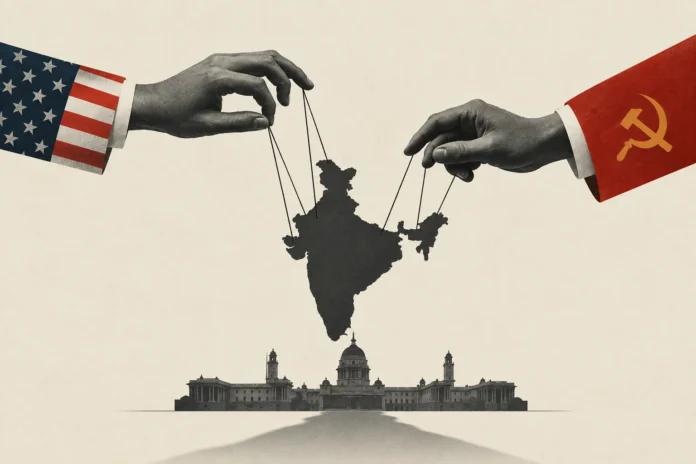
A note on this series: Part one of four. Read this as history, not as a brief against anyone now in public life. It is a four-part ledger of the open file after 1947: the state, the institutions, the cultural front and the law. The sources are books, declassified papers, treaties, statutes and court records, and they do not weigh the same. A sailing calendar is not a defector’s notebook. A jury’s verdict that a writer was not liable is not a finding of fact. Where the file is closed, it stays closed.
A new country with weak disclosure and an open market took tools it needed and money whose origin was often opaque. That is not the same as being ruled from elsewhere. Invitation is not authorship. Indians chose, bargained, inflated, resisted and sometimes sold.
“It seemed like the entire country was for sale; the KGB and the CIA had deeply penetrated the Indian government.” — Oleg Kalugin, quoted in Andrew and Mitrokhin, The Mitrokhin Archive II (2005)
In 1967, the American press named the payer behind the Asia Foundation and the Indian Committee for Cultural Freedom, and India learned how much of its intellectual life had been on the CIA’s books. The republic that read those headlines still had an American wheat pipeline it could not do without and a plutonium-powered listening pack lost on a mountain that feeds the Ganga.
The soil was sovereign. The hardware was not.
This part of the story is the state itself: the intelligence services that worked both sides of it, the political money that moved through it, and the wheat that leashed it.
Oleg Kalugin, once the youngest general in Soviet foreign intelligence and, from 1973, head of the KGB’s counter-intelligence directorate, later said it on the record, without much drama. He remembered India as a model of KGB infiltration of a Third World government. The KGB and the CIA had penetrated the Indian government so thoroughly, he said, that after a while neither side entrusted sensitive information to Indians, since each knew the other would have it by the next day. That is not a television line. It sits beside Christopher Andrew and Vasili Mitrokhin’s The Mitrokhin Archive II (2005), a declassified December 1985 CIA assessment later reported as “The Soviets in India,” several ambassadors’ memoirs, books by India’s own former intelligence officers, and a Chicago courtroom where one version of this allegation faced a jury.
Keep the shape of the argument in view before the names arrive. The through-line that survives scrutiny, once the myth-making is stripped off both sides, is not that every Indian institution was a controlled asset. It is that an open, cash-heavy democracy with weak disclosure repeatedly accepted money whose origin and purpose were opaque, and then built the reflex of blaming “the foreign hand” instead of opening the files that would have settled the question.
THE STATE THAT LEAKED. From 1947 the new republic was non-aligned on paper and a crossroads on the map. Non-alignment was a speech. Geography was a fact. Two blocs wanted India as a prize, a market, a vote inside the Third World, and a roof from which to listen to China.
Intelligence Bureau director T.G. Sanjeevi worked with the CIA against Communist China from close to the Bureau’s founding years, well before the rhetoric of non-alignment and the “foreign hand” hardened into a public reflex. After the 1962 war the cooperation with Washington deepened. Nehru’s government opened Indian airspace to American overhead reconnaissance, and U-2 aircraft staged out of Charbatia in Odisha. Paul McGarr’s Spying in South Asia (Cambridge, 2024) places that staging in the same file as the wider effort to watch Tibet and Lop Nur. The base closed in 1967. Closure is not a confession that the relationship never existed. Indian leaders were clients and partners as often as they were targets, and that undercuts two slogans at once: that the CIA secretly ran India, and that India stayed hermetically sovereign the moment the Union Jack came down.
In October 1965 a joint CIA and Intelligence Bureau team tried to plant a SNAP-19C plutonium-powered listening pack on Nanda Devi to eavesdrop on Chinese nuclear testing. A blizzard forced the climbers off the mountain and the pack was left behind. A team sent back in 1966 could not find it, and later searches with neutron detectors found nothing. A replacement pack placed on nearby Nanda Kot in 1967 worked for a time. The first was never recovered. When the story broke publicly in 1978, Prime Minister Morarji Desai confirmed the operation in the Lok Sabha, said there was no cause for alarm, and named a scientific committee whose members included H.N. Sethna, Raja Ramanna and M.G.K. Menon. In 1979 the committee judged the radiation hazard negligible on the evidence available. Negligible is the laboratory’s sentence. The mountain’s sentence is still open. The pack is a serial number sitting somewhere in ice that feeds a sacred river.
THE SOVIET PAYROLL. The thickest public file on the Soviet side is Andrew and Mitrokhin, The Mitrokhin Archive II: The KGB and the World (Allen Lane / Penguin, 2005). It is a defector’s handwritten copies of KGB files, not an Indian white paper, and it has to be read as what it is: officers reporting upward to Moscow, with every incentive to inflate their own results. Andrew’s own account notes that the Centre overestimated its ability to manipulate Indian opinion. When the book appeared, L.K. Advani demanded a government paper of India’s own. Congress called the report baseless. No inquiry of record followed.
Indira Gandhi’s KGB communications name was VANO. The service had taken an interest in her since her first visit to the Soviet Union in 1953, months after Stalin’s death, and the files describe an attentive social surround, which is how a service treats a useful future. By the late 1960s and into the 1970s the same files describe money.
Suitcases of banknotes were said to be routinely carried to the Prime Minister’s house to feed her wing of the Congress. The book is careful on the point that matters: some of that money came from Moscow through the KGB, and she probably did not know its source. Substantial sums reached her principal fundraiser, Lalit Narayan Mishra, delivered by Leonid Shebarshin, then head of the residency’s Line PR, in meetings arranged so the transfer could not be observed from the road.
In 1969 Andropov asked the Politburo to approve a protest demonstration of up to twenty thousand Muslims outside the American embassy, at a cost of five thousand rupees. Brezhnev wrote, simply, Agreed. In April 1971, two months after Indira’s landslide, the Politburo approved a secret fund of 2.5 million convertible roubles, codenamed DEPO, for active measures in India over four years.
Andropov asked. Brezhnev wrote, simply, Agreed.
The files record 10.6 million roubles spent in 1975 on active measures to strengthen her position and undermine her opponents. A separate line in the same archive puts secret subsidies to state CPI units, individuals and sympathetic media at least 1.5 million rupees. Officers were reporting upward. Treat the numbers as what Moscow was told, not as audited outgo. Files Mitrokhin copied identify by name twenty-one non-Communist politicians, four of them ministers, whose campaigns the KGB subsidised in the 1977 election, and describe nine Congress (R) candidates in that same election as agents. The most senior agent in the files from the 1967 period was a minister codenamed ABAD, regarded as extremely influential. Most real names remain unpublished for the reason Andrew gave at the time: English libel law. The published volumes will not hand over the list a curious reader actually wants. Honesty, in this file, is the redaction.
A December 1985 CIA assessment, reported from the declassified stack in 2017 by Business Standard, put the figure as high as forty per cent of Congress MPs in Indira Gandhi’s last government receiving Soviet political contributions of some kind. It added that the embassy kept a large rupee reserve for clandestine payments, and that the trend continued into Rajiv Gandhi’s years even as he tried to thin Moscow’s hold on the party. That is an Agency estimate, heavily redacted. M.K. Dhar, who retired as an Intelligence Bureau joint director, gave a far smaller count in his memoir Open Secrets: four Union ministers and over two dozen MPs identified as being on the KGB payroll. The gap between two dozen and forty per cent of a party’s MPs is itself the story. Neither number comes with a roster.
The Communist Party of India was the clearest long-term beneficiary. Direct cash moved through officers of the New Delhi residency to a senior National Council member codenamed BANKIR: packages of banknotes were passed through the window of his car on a stretch of road neither side could observe, and the CPI’s general secretary from 1964, Rajeshwar Rao, later supplied receipts for the sums received. Further substantial sums reached the Communist-led trade union federation headed by S.A. Dange. By 1973 the KGB claimed ten Indian newspapers and a press agency on regular payment, and 3,789 planted articles in 1972 alone — probably, in the files’ own estimate, more than in any other country in the non-Communist world. By 1975 the claimed figure had risen to 5,510 articles. Andrew would not name the papers.
When Gandhi suspended the Constitution in 1975, the CPI stood with her. The CPI(M) did not. A party that had taken Soviet money for years backed the leader Moscow had spent those same years cultivating. That split is Indian politics making use of a foreign wallet, not a foreign wallet inventing the Emergency.
Some of the activity went past propaganda. The archive describes a campaign of forged American documents, moved through third-country channels, built to convince Gandhi that the CIA was plotting her overthrow.
Active measures do not need to be true to work. They only need to be useful to a prime minister already living inside the sentence “foreign hand.”
Kalugin recalled one occasion on which Andropov personally turned down an offer from an Indian minister to provide information in return for $50,000, on the ground that the KGB was already well supplied with material from the Indian foreign and defence ministries.
THE AMERICAN COLUMN. It would be convenient, and wrong, to tell this as Soviet infiltration set against Indian innocence. Washington’s usual instrument was an institution with a mailing address, which is where Parts Two and Three pick up the thread. But the briefcase exists in the American file too.
Daniel Patrick Moynihan, ambassador in New Delhi from 1973 to 1975, wrote in A Dangerous Place (1978) that the CIA had twice funnelled money to the Congress Party to head off elected Communist governments — the first time in Kerala during the first Communist ministry of the late 1950s, the second time in West Bengal in the 1960s — and that on one occasion the money passed directly to Indira Gandhi in her capacity as Congress Party president. An earlier American ambassador, writing in the same period, described the same underlying calculation: Moscow was funding the Communists, and Washington answered in kind. That is an American ambassador describing his own country’s interference in print, not an anonymous leak — though Gandhi herself denied ever receiving such funds.
“We had twice, but only twice, interfered in Indian politics to the extent of providing money to a political party… Once it was given to Mrs Gandhi herself, who was then a party official.” — Moynihan, A Dangerous Place, as summarised in later reporting on the book.
Seymour Hersh, in The Price of Power: Kissinger in the Nixon White House (1983), placed Morarji Desai in the American column as a paid CIA informant drawing roughly twenty thousand dollars a year from the Johnson years through 1971. Desai, then 93, called the claim baseless and sued Hersh for $100 million in federal court in Chicago. In October 1989 a six-member jury cleared Hersh after five hours of deliberation over two days. Desai, as a public figure, had to show not merely that the statement was false but that Hersh knew it was false or seriously doubted it. The jury found he had proved neither. Hersh testified that six highly placed American sources had independently named Desai to him, and Judge Charles Norgle ruled he did not have to identify them. Henry Kissinger testified for Desai and said he doubted Desai had been an informant. The verdict is that Hersh was not liable. It is not a finding of fact that Desai drew a CIA stipend. Neither side ever printed a payroll. Hold the transcript. Do not stamp the man with a verdict the jury never delivered.
Hope Cooke, the American-born Gyalmo of Sikkim before the 1975 merger, was widely branded a CIA agent in the Indian press of that era, largely for advocating Sikkimese sovereignty. Unlike the Desai case, this one never faced a jury, and historians who have examined it closely have found no documented funding trail; Cooke herself denied it in her memoir. It belongs here as the foreign-hand reflex operating against a private person with no paper trail at all, not as an open question of the Desai type.
Desks in Delhi were sold in more than one currency. In 1985 investigators cracked one of India’s largest espionage rings, run out of the Delhi office of a Bombay trading firm by Coomar Narain, who recruited staff across several ministries and passed classified papers to foreign missions for money. It is a rare case the republic prosecuted to conviction, though not until 2002, when a special CBI court sentenced Yogesh Maneklal, the firm’s managing director, to fourteen years’ rigorous imprisonment and twelve co-accused to ten years each. The leak Kalugin described was never only a KGB romance.
McGarr’s Spying in South Asia is the best recent synthesis of a partnership official memory on both sides would prefer to forget. After 1947 the Intelligence Bureau leaned on Britain’s MI5. India cooperated with Washington on watching Tibet and kept working channels open even while Gandhi denounced the foreign hand in public. The picture that emerges is a contested marketplace, not a colony wearing new flags. B.N. Mullik’s own memoir remains the clearest Indian-authored voice on the early years of CIA cooperation, and should be labelled plainly as a memoir, not an official history.
“…buy time… and still keep India on a mighty short rein.” — Robert Komer to McGeorge Bundy, 2 July 1965, FRUS
WHEAT AS A LEASH. Before the suitcase was official grain. Public Law 480 shipped American surplus wheat to India from the mid-1950s, and at its peak India took millions of tonnes a year. The red wheat entered the national memory as lal gehun — and as dependence in the same breath.
Lyndon Johnson broke Eisenhower’s multi-year contracts into slices. The short-tether period, July 1965 to early 1967, is documented in Foreign Relations of the United States, 1964–1968, Volume XXV (South Asia). A presidential yes was never wheat in Bombay the following week; roughly nine weeks separated decision from arrival, so a delayed signature in September showed up as an empty berth in December.
Robert Komer’s memo to McGeorge Bundy on 2 July 1965 states the policy in one sentence: a two-month, one-million-ton extension would buy time and still keep India on a mighty short rein. Johnson approved one million tons, about sixty days’ worth, and signed the agreement on 26 July. Then came the war with Pakistan. On 29 September the first post-hostilities agreement was only 500,000 tons. On 9 and 10 December Johnson announced 1.5 million tons plus fertiliser money. In early 1966 Indira Gandhi thanked him for a further allotment that, in her words, set at rest immediate anxieties. It was still a presidential allotment made slice by slice, not a return to Eisenhower’s longer contracts.
The May 1966 Title I deal ran into a bookkeeping trap of its own making: approvals were denominated in tons, agreements in dollars, and when wheat prices rose the dollar ceiling no longer bought the tonnage that had actually been authorised. By November Chester Bowles was telling Dean Rusk that the short-tether approach had made rational long-term planning in India impossible. Internal tallies from the period show monthly arrivals sliding through the autumn — roughly 918,000 tons in October, 820,000 in November, collapsing toward 320,000 in December. The last ship contracted under the then-current agreements was to leave port on 7 December 1966 and berth in mid-January. After that the Title I pipeline sat empty unless the President signed again.
On 22 December 1966 Washington announced 900,000 tons, split evenly between wheat and sorghum, against an Indian request for two million tons to cover the January shortfall. The same day Moscow announced a 200,000-ton gift — about a week of India’s total import burn, and useful mainly as a talking point. After the February 1967 Indian election the American files shift toward half-year packages and a self-help checklist: fertiliser plants, procurement prices, buffer stocks.
On 6 June 1966 India devalued the rupee by 36.5 per cent, from 4.76 to 7.50 to the dollar, under pressure associated with the World Bank’s Bell Mission and the Aid India Consortium. The follow-on aid that had been promised alongside devaluation arrived late and thin, and Congress paid the political price at the 1967 polls. This sequence is the direct ancestor of the 1991 conditionality story so often told in isolation — except that the hammer here was official finance, negotiated in the open, not a covert operation. Bihar and eastern Uttar Pradesh sat at the human end of the arithmetic, as ration shops in the cities were cut back so grain could move east. Official starvation counts for 1966–67 are still argued over by historians. The tether itself is not a matter of interpretation. It is a sailing calendar, and it can be read off the page in FRUS like any shipping schedule.
WHAT PART ONE WILL NOT SAY. MI6 did not run India from the British High Commission after 1947. Residual liaison is not colonial remote control by another name. The KGB did not appoint everyone in Indian public life through the 1970s; it bought into a thick, penetrable slice of an open market, and by its own reporting inflated what it got there. The CIA did not own the remaining slice outright either. Both services, from opposite directions, fed the same sentence that every Indian party would later learn to reach for: the foreign hand, invoked when the actual villain needed to be someone conveniently not in the room.
No government has opened the Mitrokhin payroll for public inspection. Advani asked in 2005; Congress called the report baseless; no white paper came. The 1985 CIA figure remains a percentage without a roster. Hersh’s Chicago jury remains a First Amendment result, not a finding that a former prime minister took CIA money. The pack on Nanda Devi remains, as far as the public record shows, unrecovered.
Those three unfinished objects are more honest than any finished myth this subject could be dressed up in.
The country that refused to become anyone’s formal pact became, in practice, a market. It lent a runway at Charbatia and a peak in the Garhwal Himalaya. It took cash after dark and, by the KGB’s own count, carried planted copy by the column. And twice a year, it waited on a wheat berth in Bombay harbour to see whether Washington’s yes would still be a yes by the time the ship arrived.
Part Two turns to the institutions that never had to hide in a suitcase at all.
Editor’s note: Part two can be read here.