
*
The second of a two-part series. The first can be read here.
*
ON 6 SEPTEMBER 2022, a judge of the Supreme Court stood on a stage at IIT Delhi and told the country’s most selective engineering school that it had misunderstood the thing it was built on. Justice D.Y. Chandrachud had come to give the inaugural address for the institute’s new Office of Diversity and Inclusion. “The way we understand merit should not be limited to individual agency or ability,” he said. When excellence is treated as a personal trait, “we often mask the historical acquired privilege that each of us shares.” We needed, he said, to redefine our notions of merit.
To make the point he reached for a sociologist. Citing Satish Deshpande of the Delhi School of Economics, he argued that the upper castes had converted their caste advantages into modern merit, so that they are “naturalised as the legitimate inheritors of modernity.” In an auditorium full of students who had got there by cracking the JEE, the message was plain: the rank on your admission letter is, in part, an inheritance.
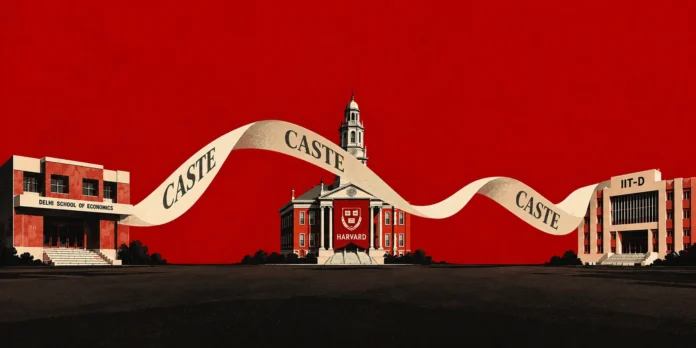
That sentence had made a long journey before it reached the stage at IIT Delhi. It began in a Delhi journal as a hypothesis whose own author said the evidence was missing. It went to Harvard, where it acquired footnotes and a university press. It went to California, where it was tried in a courtroom and lost. And it came home, with a Harvard citation and an American lawsuit behind it, to be spoken by a judge who would become Chief Justice of India. Four years later its logic turned up in a regulation for every college in the country. At every stop it gained authority. At none of them did it gain the evidence it set out without. The caste question was exported as a hypothesis and re-imported as a fact.
IN APRIL 2013, Deshpande published a paper in the Economic and Political Weekly called “Caste and Castelessness: Towards a Biography of the ‘General Category’.” It deserves to be stated fairly, because it is a serious piece of work. Its argument is that caste is most powerful where it is least visible. The reserved categories are marked by caste at every turn; the upper castes, he wrote, had “converted” their traditional caste capital into property, credentials and professional strongholds, and could now present themselves as casteless. For them caste was “a ladder that can now be safely kicked away.” The “general category”, on this view, is not the absence of caste but its most successful disguise.
It is an arresting idea. It is also, by its author’s own account, an untested one. When he comes to the mechanism — how exactly an upper-caste upbringing turns into what an exam measures — Deshpande is candid. “We lack detailed accounts of processes and modalities,” he writes, “the concrete ways in which an upper caste identity secretes and synergises the dispositions and embodied competences that add up to that abstract term: ‘merit’.” What was needed, he said, was “not one but many detailed biographies” of the general category.
That is an honest sentence, and the right one for a scholar to write. It describes a hypothesis and a research programme. It does not describe a finding. Hold on to it, because nothing that follows supplied the biographies he asked for. What followed instead were citations.
AT HARVARD the hypothesis found its most influential home. In 2015, Ajantha Subramanian, a professor of anthropology and South Asian studies, published “Making Merit: The Indian Institutes of Technology and the Social Life of Caste” in Comparative Studies in Society and History. Its reference list includes Pierre Bourdieu’s “The Forms of Capital” and Deshpande’s 2013 paper. Its argument is that the status of the IIT graduate rests on “the conversion of caste capital into modern capital”. Deshpande’s ladder had become Harvard’s thesis about the IITs.
Four years later, in 2019, Harvard University Press published her book, The Caste of Merit: Engineering Education in India. It is built on archival work and on the life histories of early IIT Madras alumni, and it draws, as a reviewer noted, on American studies of whiteness: the scholarship that treats being white in the United States as a hidden form of property. So the general category was now to be understood on the model of white America, and an upper-caste student from a coaching room in Kota was to be read through scholarship written about Americans who had never sat an exam like his.
Whatever one makes of the book, notice what it did and did not add. It added a frame, an elegant one, and the authority of the world’s most famous university. It did not add the detailed accounts of “processes and modalities” that Deshpande had said were missing. A hypothesis that had been honest about its gaps in Delhi now arrived with a Harvard imprint, and the imprint did the work the evidence had not.
IN CALIFORNIA, the idea met the law. In 2018, an advocacy group, Equality Labs, published a survey of South Asians in the United States: slightly over 1,500 people responded online, and 1,200 responses were kept. 67 per cent of the Dalits surveyed said they had been treated unfairly at work because of their caste; 26 per cent said they had faced physical assault. The figures were reported around the world. The questionnaire was spread through personal contacts, listservs, community groups and social media, and the report itself notes that Dalits may have responded at higher rates than others. The Carnegie Endowment for International Peace later described the study as relying on non-representative snowball sampling and said it raised “questions about the generalizability of its findings”. When Carnegie ran its own nationally representative survey of 1,200 Indian Americans, about 5 per cent said they had faced caste discrimination in the previous year. But it was the 67 per cent that travelled.
Equality Labs is a small organisation with a long reach. In 2018, a colleague of its executive director, Thenmozhi Soundararajan, handed Twitter’s chief executive, Jack Dorsey, a poster reading “Smash Brahminical Patriarchy”; his company later apologised for the photograph.
On 30 June 2020, California’s civil rights agency sued Cisco and two of its managers, Sundar Iyer and Ramana Kompella, on behalf of a Dalit engineer. Among the allegations was that Iyer had told colleagues the engineer was Dalit and had entered IIT “through affirmative action”. The case put the IIT itself in the dock: here, the argument went, was the caste network of Indian engineering, exported to Silicon Valley.
In April 2021, Santa Clara County’s Human Rights Commission held a seven-hour hearing on caste in the valley’s workplaces. Subramanian was among those heard. “Indian professional networks continue to promote discrimination,” she said, and argued that caste must become a protected category in employment law. The Harvard thesis was now testimony.
It worked, for a while. In January 2022, the California State University system added caste to its anti-discrimination policy across its 23 campuses. In February 2023, Seattle made caste a protected category. Then the record caught up. On 6 April 2023, the state voluntarily dismissed its case against Iyer and Kompella; its claim against Cisco itself continued. That October California’s governor, Gavin Newsom, vetoed SB 403, the bill that would have added caste to the state’s civil rights law, calling it “unnecessary”. Two men had spent nearly three years named as defendants in a caste case. The individual case against them ended not with a finding but with a withdrawal.
AND THEN IT CAME HOME. By the time Justice Chandrachud stood up at IIT Delhi in September 2022, the idea he was quoting was no longer one Delhi sociologist’s hypothesis. It had a Harvard press behind it, an American survey, a Californian lawsuit and a university system’s policy. It sounded like settled scholarship. It was the same sentence Deshpande had written in 2013, with the same gap at its centre. The difference was that nobody on the way had filled it.
Four years later, the University Grants Commission’s 2026 equity regulations reached the same conclusion in law. Clause 3(c) defined caste discrimination as something that could be suffered only by Scheduled Castes, Scheduled Tribes and Other Backward Classes. The regulations do not cite Deshpande or Subramanian, and there is no need to pretend they do. But the logic is theirs: if the general category is caste’s disguise, it cannot be caste’s victim. As the first part of this series described, the Supreme Court stayed the regulations within sixteen days. But the theory behind clause 3(c) did not need the regulation to take effect. By then it was in the speeches, the diversity offices and the slogans at the gate.
None of this requires a conspiracy, and none is alleged here. Every step is on the public record: a journal article, a Harvard book, a survey, a lawsuit, a speech. What the record shows is something more ordinary and more damaging than a plot. An idea gained authority by changing address. It left Delhi as a question and came back from America as an answer, and the people who repeated it in Indian courtrooms and on IIT stages took the Harvard stamp for proof.
The cost falls on the people the idea is about. Every year more than fifteen lakh students sit the JEE. Most of them have spent two years or more in coaching rooms and rented rooms, many of them a long way from home. They are now told, from a Supreme Court podium and in a government gazette, that the rank they earned is partly an inheritance. Perhaps some of it is. If so, Deshpande was right that it needs to be shown, family by family, biography by biography. That work has still not been done. What has been done is to treat the question as answered. And when the next student dies, it will be the first question asked.