
*
The first of a two-part series.
*
AT ABOUT HALF PAST TWO on the afternoon of 18 September 2026, a second-year student at IIT Bombay called a friend. Sahil Wakode, 22, from Yavatmal in Maharashtra, studied in the Department of Energy Science and Engineering. That morning he had sat a mid-semester exam. Partway through it, the invigilator, Professor Suryanarayana Doolla, found him with a phone. According to the institute, Sahil had uploaded the question paper to ChatGPT. Doolla reported the matter as the rules required. The course instructor and the head of department then counselled Sahil and, the institute says, assured him that the incident would not damage his academic career. No disciplinary proceedings were started.
What Sahil told his friend has since been given to investigators: “I made a mistake. My Thermodynamics paper also did not go well, and now this has happened.” According to reports of that statement, he said nothing about caste. Police say he also gave the institute a written apology, admitting the mistake and asking for another chance.
That evening he was found dead in his room in Hostel 4.
A family lost a son. That is grief, and it is not up for argument. What is up for argument is what happened in the next forty-eight hours, because in those hours one question disappeared and another took its place. The question that disappeared was the one any parent would ask first: how does a twenty-two-year-old who has been told his career is safe come to believe, a few hours later, that his life is over — and what would have stopped him?
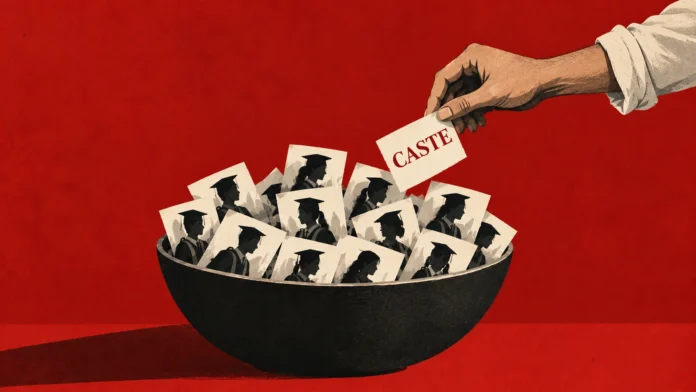
The question that replaced it was: what was his caste?
By that night, students had gathered at the institute’s main gate. Some chanted slogans invoking Rohith Vemula. By the next day, 19 September, Sahil’s father had gone to the police. His complaint alleged that Doolla had subjected his son to casteist abuse, threats and harassment for three months, and that the institute’s director, Shireesh Kedare, had directed it. Powai police registered an FIR under Section 108 of the Bharatiya Nyaya Sanhita, abetment of suicide, and under the SC/ST (Prevention of Atrocities) Act. The case was moved to the Mumbai Crime Branch.
A father’s complaint is not a finding, and it is not a crime until a court says so. It is an allegation, and it deserves a proper investigation. Doolla has told the Crime Branch that he followed the institute’s guidelines and has denied making any casteist remark. The institute says Sahil never complained of discrimination to its SC/ST cell or to the administration, and the director says students’ caste is hidden from faculty. The Crime Branch has recorded statements from more than forty people. None of this is settled. That is the point. The verdict arrived before any of it.
Within days the institute had done almost everything the crowd at the gate asked of it. Doolla was removed as Dean of Administrative Affairs and then sent on leave. The director signed an 18-point charter of student demands, which included action against the professor; he was reported to have told protesters he would resign, a report the institute later denied. On 21 September IIT Bombay apologised for its own first statement, the one that had said Sahil was caught with a phone. It was, the institute now said, “inappropriate to have set out or characterised details relating to the events preceding his demise.” On 24 September it deleted the apology from X, and then, after a backlash, posted it again.
Consider what that apology means. The institute did not say its account was wrong. It said it had been wrong to give one. The facts of what happened in its own exam hall had become an embarrassment, because they pointed somewhere the story did not want to go.
Consider, too, the whose name is on the FIR. Suryanarayana Doolla took his BTech at Nagarjuna University, his MTech at IIT Bombay and his PhD at IIT Delhi. He won IIT Bombay’s Young Faculty Award in 2009 and its teaching awards in 2017 and 2021. In 2022 he was organising chairman of JEE (Advanced), the examination that decides who gets into the IITs. The IIT Bombay Faculty Forum has said he was “merely discharging his academic duties.” Not everyone agrees: The Wire has published allegations that he was harsh and humiliating towards students. Whether he is a good teacher or a bad one is not the question here, and neither is it a matter for a crowd. What happened in the three months before 18 September is for the Crime Branch to establish. What is plain already is that the label came first. He was the invigilator, the student was Dalit, and for the purpose of the argument that was all anyone needed to know.
SAHIL WAS NOT THE FIRST student to die at IIT Bombay this year. On 4 February, a 21-year-old second-year civil engineering student was found dead in his hostel. In late July, a 20-year-old second-year student from Rajasthan died in his hostel room. Their families lost sons too. Neither became a national argument. Neither produced an FIR naming a professor, or a charter of demands signed by the director.
This is not to say those deaths mattered less to anyone. It is to say that they did not fit. A death with no caste in it has no villain with a surname, and a death with no villain does not fill a gate. So the questions those deaths raise — three students on one campus in seven months; what exam pressure does to a nineteen-year-old who has spent his adolescence in a coaching room in Kota; whether a counselling session amounts to anything more than a form filled in — go unasked, because they cannot be shouted.
The institute has since set up a committee, with equal numbers of faculty and students, to review its academic malpractice rules. It is drafting a “student-friendly” procedure for how invigilators respond to suspected cheating, and proposes that a student be allowed to consult a mentor before any disciplinary step. Some of that may help. But notice where the institute has chosen to look. Not at the months before 18 September, and not at February or July. It has looked at the ten minutes in the exam hall: the moment the story needed to be about.
THE REFLEX HAS A FOUNDING CASE. In January 2016, Rohith Vemula, a PhD scholar at the University of Hyderabad, took his own life. The country was told that a Dalit student had been killed by the system. Two Union ministers, a state legislator, the vice-chancellor and student leaders were blamed. For eight years, his name was the shorthand for caste on campus, and it was still being chanted at the gate in Powai last month.
In May 2024, the Telangana Police filed a closure report. It concluded that Vemula was not a Scheduled Caste; that the caste certificates issued to him, his mother and his brother were not genuine; that he knew this and feared it would come out; and that none of the accused had driven him to his death. An earlier judicial commission, headed by a former Allahabad High Court judge, A.K. Roopanwal, had reached a similar view of his caste. The family called the report absurd. The same day, the state’s Director General of Police announced a further inquiry, citing doubts raised by Vemula’s mother, and the family has been allowed to contest the report in court.
The courts will decide what is true. But look at what the eight years were spent on. The argument about Rohith Vemula was never about why a young scholar in despair could find no one to stop him. It was about his caste — and on the police’s account, the caste at the centre of the argument may not even have been his.
In May 2019, Payal Tadvi, a resident doctor at Mumbai’s Nair Hospital, from the Tadvi Bhil community, a Scheduled Tribe, took her own life. Three senior doctors were accused of taunting her over her caste. They were arrested, and later released on bail. The trial is still not over. Seven years on, no court has found anyone guilty of anything.
That has not stopped either case from doing a great deal of work.
IN 2019, THE MOTHERS OF Rohith Vemula and Payal Tadvi went to the Supreme Court, asking for the UGC’s 2012 anti-discrimination rules to be enforced. In that case, Abeda Salim Tadvi v Union of India, the Court directed the UGC to frame new regulations. The UGC (Promotion of Equity in Higher Education Institutions) Regulations were notified on 13 January 2026.
The interesting part was a definition. Clause 3(c) defined caste-based discrimination as discrimination against members of the Scheduled Castes, Scheduled Tribes and Other Backward Classes, and only them. A general-category student or teacher who suffered discrimination on the basis of caste had no place in that clause. Petitioners also pointed out that the regulations had no mechanism to penalise a false complaint. The rule had decided, before anything had happened on any campus, who could be a victim and who could only ever be the accused.
On 29 January, sixteen days after the regulations were notified, a bench of Chief Justice Surya Kant and Justice Joymalya Bagchi stayed them, calling them prima facie vague and open to misuse, and restored the 2012 rules in the meantime. On 20 August the Solicitor General told the Court that the regulations were “under reconsideration.”
So a national rule for every college in India was built on two cases: one in which the police record says the student was not a Scheduled Caste at all, and one in which, seven years later, there is still no verdict. The narrative did not wait for the courts. It went straight to the gazette.
THE REGULATIONS WERE STAYED; the reflex was not. Less than eight months after the Supreme Court put them in abeyance, Powai followed them anyway. A student died. Within a day the victim and the accused had been named, not by an inquiry but by category. The professor was removed from his post before he had been questioned. The institute apologised for describing its own exam hall. And the only reform on the table concerns how the next invigilator should behave when he catches the next student cheating.
There is a cost to this, and it is not paid by the activists at the gate or by the commentators who will cite the case for years. It is paid first by the accused, who may wait years for a clean chit that will never make the front page. It is paid by teachers, who learn that the safest thing to do when a student cheats is to look away. And above all it is paid by the next student at risk — the one in some hostel room right now with a bad thermodynamics paper and the conviction that he has ruined everything. Nobody is building a movement around him, because whatever is wrong with him has no caste. He needs counsellors who are actually available at three in the afternoon, a system that tells a frightened twenty-two-year-old the truth about how much a mistake costs, and friends who know what to do with a phone call like the one Sahil made. None of that will be reached by asking what his caste is.
When a student dies, the first question should be how the next death can be stopped. In India it has become what the dead student’s caste was. Where that question came from — and how a theory written in Harvard and Paris decided, years before Powai, what the answer to every campus death would be — is the subject of the second part of this series.
If you or someone you know is struggling, call Tele-MANAS on 14416 or 1-800-891-4416 (free, 24×7).