

ON 12 OCTOBER the Delhi Police told the Cockroach Janta Party (CJP) that Jantar Mantar was no longer a protest site, and named three other venues. A normal protest group would have said thank you and gone to one of the three. The CJP’s founder, Abhijeet Dipke, went to X instead and announced that “you cannot denotify the resistance”. Very true. But you can detain it at the airport. Two days earlier, Dipke and his co-convenors Saurav Das and Ashutosh Ranka had been picked up at Delhi airport before they reached the baggage belt. The next day they were released on ₹50,000 bonds, promising one full year of good behaviour. Revolution, with terms and conditions. The terms lasted two days. On 13 October volunteers jumped the barricades at Jantar Mantar, about 20 were detained, and Das and Ranka spent the next week in judicial custody for breaching their bonds.
All this over the Election Commission. The CJP wants Chief Election Commissioner Gyanesh Kumar to resign over the revision of voter rolls. In five months it has gathered 20 million Instagram followers, filled Delhi’s streets twice and seen a Union minister resign. It started by fighting for students who were cheated out of an exam, and has ended up fighting the body that runs the biggest exam in India, the general election. There is one thing it will not do: sit that exam itself.
ASK WHY, and the CJP has answers. “In India, I don’t think that forming a political party is a solution right now,” Dipke told Reuters in August. He wanted to consult Gen Z first, and would form a party if “a majority of the people” wanted one; Reuters reported that he also feared the government would discredit a new party by investigating its leaders. Das said simply that a party “would not be beneficial” at this time. Then, on 25 September, Dipke went further. “Yes, elections are being rigged,” he wrote on X, and urged opposition parties to stop contesting them, because taking part only keeps up “the illusion that they are free and fair”.
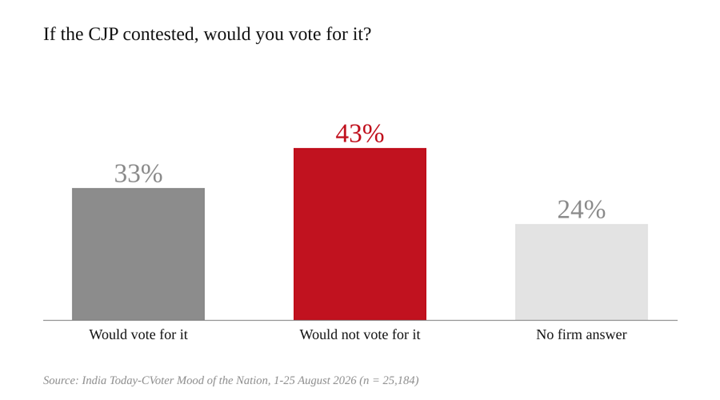
Some of this is fair. The CJP is five months old, with no party organisation and no candidates. And it might simply lose. The India Today-CVoter Mood of the Nation survey, conducted in August, found more people would not vote for it (43%) than would (33%). Among Gen Z respondents, 39% wanted it to stay a pressure group; only 26% wanted it to contest. A pressure group is never on the ballot, so it is never rejected. It is like a student who never writes the paper and then tells everyone he has never failed.
The rigging post is harder to take seriously. A movement that demands the referee’s resignation, says the match is fixed and tells every other team to walk off the field has given itself a permanent excuse never to play. No major opposition party has taken Dipke’s advice. The one organisation that follows it is the CJP.
Nobody outside the CJP can know which of its reasons weighs most. What can be shown is who gains from its absence, and how it behaves. Both point the same way.
THE GAIN starts with who is behind it, and that part is no secret. Dipke volunteered on AAP’s social media team from 2020 to 2023; Ranka worked as an associate fellow with the AAP-led Delhi government. Arvind Kejriwal came to the protest site in July. On 14 October Delhi Chief Minister Rekha Gupta asked why the CJP acts “like the B-Team of AAP”. On 20 October, when a Ramlila committee in Pitampura burnt a cockroach effigy alongside Ravan’s, AAP’s Delhi president, Saurabh Bharadwaj, sought an FIR against the organisers. The BJP’s RP Singh said it was now clear the CJP was “in some way, the youth wing” of AAP; the Congress’s Udit Raj called it “a proxy”. When the BJP and the Congress say the same thing about you, it is not a conspiracy any more. It is a consensus.
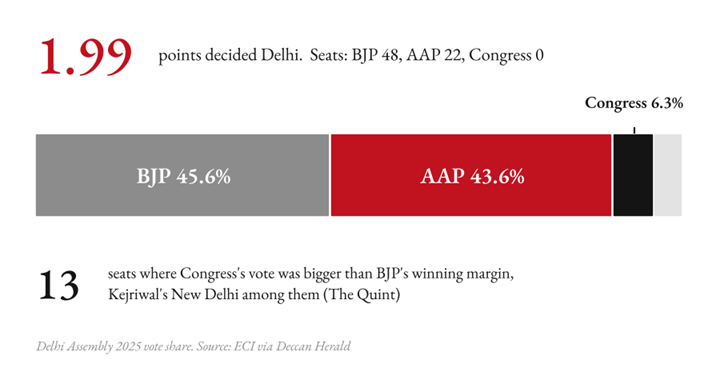
The link matters because of whom the CJP would hurt. Its supporters are young, urban, angry and anti-BJP. That is exactly the voter AAP lives on, and the voter the Left is trying to win back. In Delhi in 2025 the BJP polled 45.56% and AAP 43.57%. Less than two points, and AAP went from 62 seats to 22. The Congress took 6.34% and won nothing, but, as The Quint reported, in 13 seats its vote was larger than the BJP’s winning margin. Kejriwal’s own New Delhi seat was one of them. A party that lost its capital by two points does not need a second spoiler wearing its own jersey.
Treat what follows as an illustration, not a forecast. Assume a CJP’s votes would come 60% from AAP and 20% each from the Congress and the BJP. On that assumption, a CJP taking just 5% would have doubled the BJP’s lead from two points to four. At 8%, the lead becomes 5.2 points. The split is a guess, and the next Delhi election is years away. But the direction is not in doubt: a cockroach on the ballot eats from its friends’ plate.
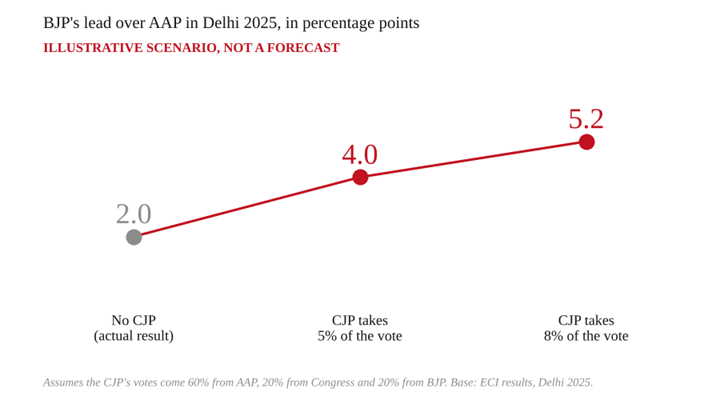
Illustrative scenario on stated assumptions, not a forecast
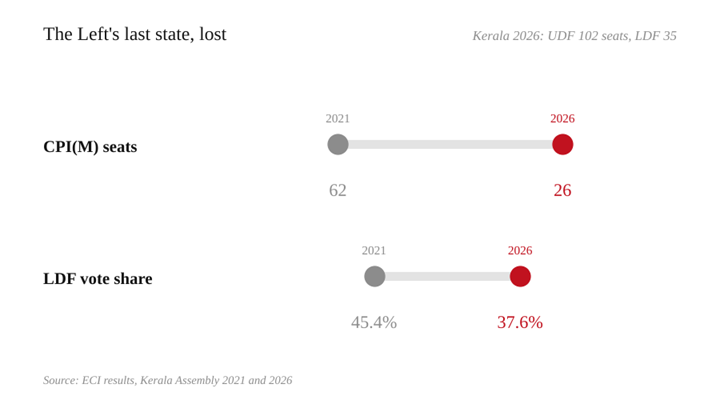
THE LEFT has the same problem: same pond, fewer fish. In Kerala this year the CPI(M) fell from 62 seats to 26 and the LDF’s vote share by about eight points. The Left lost its last state. CPI(M) general secretary MA Baby and Brinda Karat turned up at a CJP protest in June. Students, jobless youth and campus anger are the Left’s last real pool. A CJP that contested would fish in exactly that pond. A CJP that only protests can be borrowed, flattered and invited on stage.
THE BEHAVIOUR is where the CJP gives itself away. On 3 September a former volunteer, Manish Brahmbhatt, launched a rival called CJP-Democratic. He said the movement had become a “hand-picked team” for Kejriwal’s party, that eight of the 12 members of its national team had AAP links, and, most tellingly, that the CJP had agreed not to campaign aggressively in states the BJP does not rule. These are a rebel’s claims, and no one has tested them. Dipke denies the CJP is aligned with any party; it is, he says, “the students’ A-team”. But the claims did not come from the BJP. They came from inside the CJP’s own kitchen.
Look at Punjab. AAP rules it with 92 of 117 seats, won on 42% of the vote in 2022. The CJP has been there. In September a team led by Das audited three government schools in Ludhiana, praised the showpiece School of Eminence and handed its report to the state’s education minister, who promised action. Kejriwal thanked Das for “pointing out our deficiencies”. In BJP-ruled Rajasthan, Ranka had been challenging the education minister to show him ten of the best schools built on his watch. The Congress’s Sachin Pilot asked the CJP to audit Punjab “with the same eyes, the same questions and the same courage” it brought elsewhere. Then, on 13 October, an anti-drug activist, Parvinder Singh, was shot dead in a market in Mansa, and Gupta dared the CJP to protest in Punjab. So far as the public record shows, it has not. A movement that marches on Parliament over exam leaks and on the Election Commission over voter rolls goes to the one big state its friends govern with a clipboard.
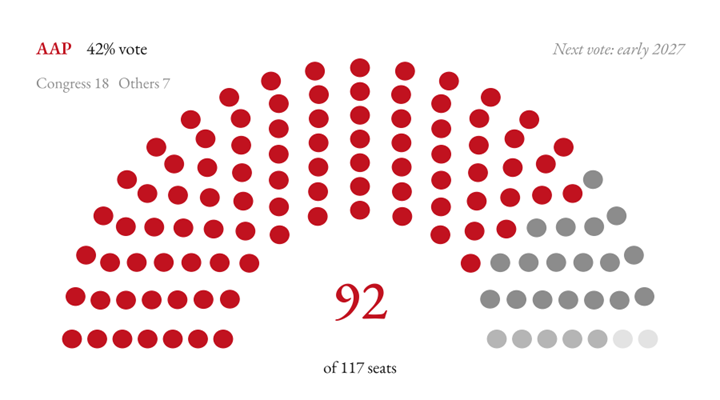
HERE IS the joke the CJP cannot tell. The only party that clearly gains if the cockroach contests is the BJP, the very party it protests against. Every vote it took would come from its friends. Whatever its reasons for staying a pressure group, its friends could not have asked for a better arrangement. Punjab votes early in 2027. If the cockroach goes to Punjab only with a clipboard, never on the street and never on the ballot, it will have answered the question itself.
Young Indians had a real grievance about exams. They deserved a movement that would stand for election, show its accounts and answer for its friends. Instead they got a meme with a manifesto, a youth wing without a membership card, and a pressure cooker with no rice inside. It whistles every evening. Nobody has eaten yet.