

There are some places where silence is not an absence of sound but itself a form of worship. Places where one does not go merely to see a monument, attend an event, or collect an experience for social media but to stand before something believed to be older, deeper and greater than oneself. Badrinath is one such place. And perhaps that is why the images coming out of Badrinath in September 2026 are disturbing for a reason that goes far beyond one cultural programme.
They raise a much larger question about what happens when a civilisation that once knew how to distinguish between a temple, a festival ground and an entertainment venue begins treating all three as interchangeable.
At an altitude of around 10,279 feet in Chamoli district, Badrinath Dham is one of the most revered Hindu pilgrimage centres and one of the Char Dhams. The shrine is associated with Lord Vishnu in the form of Badrinarayan, and its religious atmosphere has historically been marked by restraint, ritual and devotion. This is not a place whose importance comes merely from its architecture or scenic location. For millions of devotees, the journey to Badrinath is itself an act of pilgrimage, a movement away from ordinary life and towards prayer, austerity and contemplation. The surrounding Himalayas only deepen that feeling of withdrawal from the noise of ordinary life.
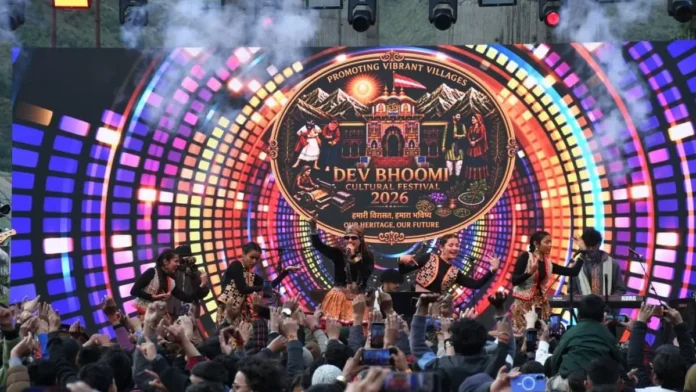
And then came September 19 and 20. A two-day Devbhoomi Cultural Festival 2026, organised as an Indian Army initiative under Operation Sadbhawna in collaboration with the Chamoli district administration and Uttarakhand Tourism, was held at the Tourist Arrival Plaza adjoining the Badrinath shrine. The stated theme was “Our Heritage, Our Future”, and the programme was presented as a celebration of Uttarakhand’s living culture, including folk music, dance, handicrafts, local products and community participation. There is nothing wrong with celebrating Uttarakhand’s folk traditions. The problem is that a cultural programme does not become appropriate simply because it is given the label of heritage. The form in which something is presented and, more importantly, the place where it is presented matter just as much.
Videos from the event circulated on social media showing amplified music, stage performances and people dancing near the venue. The performance by Uttarakhandi singer Priyanka Meher became one of the focal points of the controversy, with critics describing the atmosphere as resembling a concert or DJ-style programme rather than a restrained cultural presentation. Chief Minister Pushkar Singh Dhami attended the concluding ceremony on September 20 after offering prayers at the shrine.
And this is where the question becomes very simple. Uttarakhand has every right to celebrate its singers, folk traditions and local culture. But does every form of cultural expression belong everywhere? Does a sacred pilgrimage centre have to accommodate the same kind of music, dancing, lighting and crowd energy that one would expect at an ordinary public event?
We seem increasingly unwilling to ask such basic questions because everything can now be defended by calling it cultural promotion.
Former Union minister and senior BJP leader Dr Murli Manohar Joshi objected to the event, arguing that permitting a music or DJ concert at Badrinath violated the cultural decorum of the dham and directly affected its sanctity. He invoked the tradition associated with Adi Shankaracharya and the idea of Badrinath as a place intended for peaceful devotion in the Himalayan environment. He also pointed to the fact that even the blowing of conch shells is traditionally restricted there, questioning why that restraint should coexist with loud music and large-scale dancing. Joshi further raised concerns about the environmental and health implications of holding such an event at high altitude and appealed to religious leaders as well as the central and state governments to prevent what he described as the erosion of the cultural character of Devbhoomi.
His intervention is significant not because every argument he makes must automatically settle the question, but because it articulates the same underlying concern from another direction: that cultural promotion cannot be separated from the character of the place in which it takes place.
A temple is not simply a geographical coordinate. A tirtha is not simply a tourist destination with religious architecture attached to it. The significance of Badrinath does not suddenly disappear at the temple gate and reappear when someone walks into the plaza. Sacred geography has its own boundaries, its own inherited etiquette and its own memory. What may be perfectly normal at a city auditorium can feel completely out of place a few metres away from a living shrine. This is not about being against modernity. It is about understanding context.
And this is where our obsession with spectacle becomes troubling. We have developed an odd habit of believing that something becomes more valuable when it becomes louder, brighter and more visually exciting. A quiet bhajan is not enough unless it is amplified. A folk performance is not enough unless there are lights and a stage. A cultural event must look energetic. A pilgrimage must become an “experience”. A sacred place must become visually engaging.
At some point we stop asking what the tradition actually means and start asking how attractive it looks on a screen.
This is how vulgarisation often happens. It does not necessarily arrive by openly mocking a tradition. Sometimes it arrives pretending to celebrate it. A traditional song remains a traditional song in name, but the setting, presentation and atmosphere around it completely change its character. A bhajan becomes a “jam”. Folk culture becomes a stage product. A sacred gathering becomes content for social media. A pilgrimage becomes another tourism experience. The form survives, but the sense of restraint surrounding it slowly disappears.
And eventually we stop asking what a place requires from us and start asking what we can do there. That is the real cultural shift.
We are strangely comfortable preserving costumes, songs and dances while discarding the behavioural codes that once gave those things their meaning. We want the visible parts of tradition without the discipline that came with them. We want the music but not the restraint, the festival but not the boundaries, the spectacle but not the sacredness. Yet civilization is not preserved merely by performing its music. It is preserved by knowing where that music belongs, how it should be performed and when silence itself is sacred.
The Himalayas already possess something that modern cities spend enormous amounts of money trying to manufacture: silence, distance, darkness, vastness and the feeling of being small before something immeasurable. Badrinath does not need speakers to become impressive. It does not need flashing lights to become vibrant. It does not need concert-style dancing to prove that Uttarakhand has a living culture. The place already has meaning. The danger is that by constantly surrounding sacred landscapes with noise, activity and spectacle, we are only slowly destroying the very atmosphere.
The same tendency can be seen across other pilgrimage centres as well, where sacred places are increasingly being presented through the language of tourism, entertainment and social-media experiences. A similar concern had already surfaced earlier in 2026. As The Dossier reported in March 2026, the Raulane festival showed how easily a traditional Himalayan practice came under the pressure of tourism, social media and spectacle.
There is nothing inherently wrong with tourism or with cultural promotion. The problem begins when every sacred space is expected to behave like a tourist venue and every cultural tradition is expected to compete for attention. Once that happens, the question of whether something is appropriate to the place becomes secondary to whether it will attract people, create excitement or generate content.
That is how boundaries disappear. Today, it is loud music and dancing near Badrinath. Tomorrow another pilgrimage site can host something similar. Then another religious fair can slowly acquire the atmosphere of an entertainment festival. Nothing dramatic happens in one moment. The boundary simply moves a little further each time until something that would once have seemed completely inappropriate becomes normal.
This is why the issue should not be reduced to “DJ versus bhajan” or “traditionalists versus modern people”. The deeper issue is whether we still understand that different places demand different behaviour. Hindu civilization has never been against music, dance, colour or celebration. Its temples and festivals are full of them. But celebration was never synonymous with sensory excess. There were distinctions between temple ritual, devotional gatherings, village festivals, folk performances, royal spectacle and ordinary entertainment. Those distinctions mattered because context mattered and we seem to have forgotten that. And perhaps this is the most uncomfortable part of all.
In trying to make our heritage modern, we sometimes make it vulgar.
We mistake amplification for grandeur, crowds for participation, spectacle for culture and visibility for preservation. We take something subtle and make it loud, something contemplative and make it performative, something sacred and make it consumable.
Some places are meant for celebration. Some are meant for music and dance. Some are meant for crowds and spectacle. But there are also places where the appropriate response is to lower your voice, put away the urge to perform and remember that you are standing somewhere people have come to worship and Badrinath is one of those places.