

On 30 August 2026, The Hindu, referred to by millions of UPSC aspirants, published an editorial titled ‘State of exception: On India, the UN Committee on the Elimination of Racial Discrimination (CERD) report’. The report is the committee’s first review since 2007. Based on the report, the editorial argues that India has a “culture of discrimination” and specifically links the NRC, SIR, FCRA, UAPA, AFSPA, PMLA and the Forest (Conservation) Amendment Act to concerns raised by the UN CERD. In this piece, I’ll be showing you, through data, whether any such culture exists in India. However, firstly, it seems the UN CERD hasn’t read anything on India since 2007, actually, since India’s Constitution came into effect.
First. Untouchability was abolished by the Constitution itself. Article 17 declares its practice in any form forbidden, and its enforcement a punishable offence, which is a guarantee no comparable federal democracy enshrined at the moment of its founding. Parliament backed this with the Scheduled Castes and the Scheduled Tribes (Prevention of Atrocities) Act, 1989, which creates special offences, mandates victim compensation, and establishes dedicated Special Courts for speedy trial.
The 2024 enforcement data show a state machinery actively engaged, not indifferent. 55,685 cases concerning Scheduled Castes and 9,961 concerning Scheduled Tribes were registered under the PoA Act and the conviction rates stood at 33.9% (SC) and 33.2% (ST), which is a rise from 32.4% and 24.6% respectively in 2023. Not just this, but Rs 495.29 crore in Central assistance reached 99,965 atrocity victims in 2024-25 alone. And here we have the UN’s CERD saying that ‘India has normalised a culture of Discrimination’.
No provision of Indian law authorises caste-based treatment and every instrument of the State exists to punish it.
Second. Characterisation of caste by the Committee on the Elimination of Racial Discrimination (CERD) as a form of discrimination ‘based on descent’ under Article 1 of the International Convention on the Elimination of All Forms of Racial Discrimination (ICERD) is a contested reading of the treaty text, which enumerates ‘race, colour, descent, or national or ethnic origin’, not caste. India’s Permanent Mission to the U.N. has consistently argued that the Convention’s travaux préparatoires (the treaty’s drafting records such as negotiation notes, delegate speeches, early drafts), and when a term’s meaning is disputed in international law, it allows checking these to find original intent. And in this case, as I have quoted before, India’s Permanent Mission to the UN has consistently argued that ICERD’s travaux préparatoires do not support extending “descent” to caste.
Thinking that our interpretation can make a country bend, as we believe, is nothing but overconfidence.
Third. The continuing deaths of sanitation workers are a matter the Government treats with urgency, not denial. Hazardous manual cleaning of sewers and septic tanks has been statutorily prohibited since the Prohibition of Employment as Manual Scavengers and their Rehabilitation Act, 2013. Where the prohibition is violated, the law provides for prosecution. As a result, FIRs were registered in the preceding five years.
Then, under the National Action for Mechanised Sanitation Ecosystem (NAMASTE) scheme, 89,915 sewer and septic-tank workers had been formally validated for rehabilitation, mechanised equipment and social-security coverage by August 2026.
A practice that continues despite a two-decade-old and reinforced legal prohibition is a governance and implementation challenge demanding continued mechanisation and municipal accountability and very clearly it is not, in law, a State sanction.
Fourth. The editorial expresses ‘concern’ on the mass refoulement (forced return of refugees to a country where they face serious danger) of Rohingya Muslims to their home state. It is nothing but laughable because India is not a signatory to the 1951 Refugee Convention or its 1967 Protocol. Hence, it is under no treaty obligation to apply a non-refoulement standard it never accepted. India has built its own framework of judicial safeguards. For instance, in 2021, while declining to bar possible deportation of detained Rohingya in Jammu, the Supreme Court held that deportation could not proceed except through prescribed legal procedure. And so, I observe such concern as foolish.
Moreover, concerns on the mass deprivation of citizenship via the NRC are one step ahead, as it does nothing but misstate the exercise’s very scope. The NRC has taken place only in Assam, conducted under the Assam Accord (1985) and Supreme Court supervision, addressing the state’s distinct history of post-Partition and Bangladesh-border migration. Within Assam, the final NRC included 3,11,21,004 persons and excluded 19,06,657, all of whom retain a statutory right of appeal before Foreigners Tribunals.
There I say: treating a localised, judicially supervised, appeal-backed process as evidence of nationwide mass denationalisation is not analysis but a category error the record does not support.
The same is with the Special Intensive Revision (SIR). Large-scale deletions did occur, but they were carried out through a supervised process with stated reasons. In Bihar’s 2025 SIR, around 65 lakh names were removed for death, migration, duplication or failure to submit forms. Fresh enrolments later increased the final electorate to 7.42 crore. You must note that the UN CERD didn’t: the Supreme Court noted that no voter came forward to challenge a deletion, despite legal assistance being made available. Similarly, in West Bengal, nearly 91 lakh names were removed, including deletions following judicial scrutiny. In Uttar Pradesh, 12.55 crore of 15.44 crore registered voters were retained in the draft roll after the SIR exercise concluded.
On exclusion. In May 2026, ruling on the Special Intensive Revision of electoral rolls, the Supreme Court explicitly held that deletion from the electoral roll “does not amount to a declaration” of non-citizenship, and that citizenship questions must go to the competent authority under citizenship law. The Court simultaneously upheld the legal validity of the SIR exercise itself.
That individual grievances about wrongful deletion or inadequate notice are legitimate and should be pursued through the correction mechanisms the exercise itself provides but the constitutional distinction between an electoral roll and a citizenship register is not a “technicality”; it is actually the law, as declared by India’s apex court!
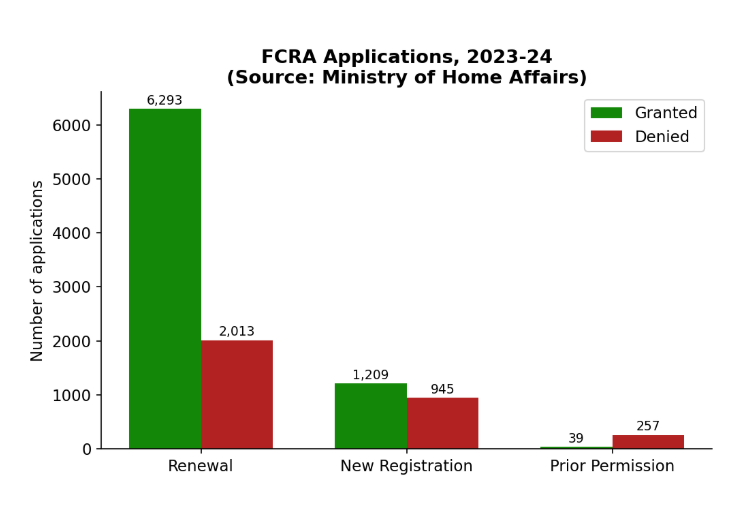
It is so funny that in a line, so many concerns are raised without giving an iota of data. The editorial doesn’t stop at the SIR. It also expresses concerns over “the government’s use of the FCRA, UAPA, AFSPA and PMLA instruments to hamper the work of civil society organisations.” The claim collapses under evidence. The Home Ministry’s 2023-24 data shows thousands of FCRA registrations and renewals actively granted, not blanket denial, an odd tool for ‘hampering civil society’ if most applicants keep operating. More on why the FCRA is inevitable, the context of bringing the 2026 amendment in the first place and what’s the hypocrisy of the US on the FCRA can be read here and here.
For the Unlawful Activities (Prevention) Act, 1967 and the Prevention of Money Laundering Act, 2002, these are neutral statutes targeting terrorism, secessionism and serious financial crime with the categories of conduct defined by acts, not by race, caste or religion. A claim of discriminatory application requires disaggregated, comparable data on arrests and prosecution and the editorial offers none.
What’s basic and not considered by such committees is this: constitutional courts, not the executive, control the outcome under UAPA and PMLA and that is the legal fact no rebuttal can dislodge.
In Syed Iftikhar Andrabi v. NIA (2026), the Supreme Court freed a UAPA accused after nearly six years in custody, holding Article 21 overrides Section 43D(5)’s bail bar once trial delay becomes indefinite. In V. Senthil Balaji (PMLA), Justices Oka and Masih held Section 45’s bar cannot be weaponised for indefinite detention, granting bail after 15 months. These are binding precedents and not policy promises. If The Hindu wants to highlight its fellow Comrade Umar Khalid, for whom it does reports on what is he reading in the jail. Then, too, it has to understand that the Supreme Court rejects Khalid’s plea because the accusations appear ‘prima facie true’ and also that seven of the fourteen adjournments in 2023–24 were requested by Khalid’s side.
Moreover, the Armed Forces (Special Powers) Act has been withdrawn entirely from Tripura and Meghalaya and substantially reduced across other Northeastern districts as the security situation has improved. A law whose geographical application is contracting, in direct response to improving peace and normalcy on the ground cannot be characterised as evidence of an entrenched or expanding ‘state of exception.’ In Nagaland, it now applies only in eight districts which is a shrinking footprint, not a blanket one. In Arunachal Pradesh, coverage has narrowed to Namsai district plus Tirap, Changlang and Longding.
This contraction tracks a real security shift, not political convenience: security-force casualties across the Northeast fell 90% and civilian casualties fell 97% between 1997 and 2000 and 2017–18, alongside signed accords resolving decades-old insurgencies such as the Bodo Accord (2020), Karbi-Anglong Agreement (2021), NLFT(SD) agreement (2019), and the Bru-Reang resettlement accord (2020).
A law being progressively rolled back, district by district, police station by police station, in direct proportion to declining violence is definitionally the opposite of an entrenched state of exception and not otherwise.
The editorial makes another sweeping claim that the Bharatiya Nyaya Sanhita 2023 does not expressly criminalise hate speech. But then, I wonder what Section 196 of it do? Because this section expressly criminalises promoting enmity between groups on grounds of religion, race, place of birth, residence, language, caste or community, including through electronic communication.
Therefore, another claim made gets busted – just like that.
Coming to another concern noted as, “the Forest (Conservation) Amendment Act exempting ‘national security’ projects from consultative decision-making.” The 2023 forest amendment created narrowly defined exemptions for specified strategic and security projects, which is a policy choice open to scrutiny because, simply, India is a democracy, but again, national security is not up for discussion. Period.
What’s there to know is that the Government of India has stated in Parliament, in February 2026, that these amendments do not abrogate the Forest Rights Act, 2006 or the statutory powers of Gram Sabhas, and that Rule 11(7) requires settlement of FRA rights before final forest-diversion orders are issued. So, what’s the issue, I wonder? Except for writing, because the Committee wanted to.
Lastly, concerns about appointments and pluralism at the National Human Rights Commission were raised and noted in The Hindu’s editorial. But as of August 2026, GANHRI has retained the NHRC’s ‘A’ status accreditation, after assessing autonomy, independence, pluralism and investigative powers. The Commission reported 41,344 ongoing cases as of 1 July 2026, with 6,106 disposed of in that single month and this is the profile of a functioning, internationally validated institution not a defunct one.
Accreditation is a thing for real, but I don’t think the UN CERD or The Hindu considered it at all.
I’m not saying that the Indian society is free of prejudice, or that every institution performs to exceptional standards every time. But the test for ‘State normalisation of discrimination’ cannot be met by cataloguing every hard law India uses to defend its sovereignty, security and borders and treating the aggregate as proof of animus. The correct test is narrower and clearer which says that does the law itself authorise discriminatory treatment and do victims have a remedy?
CERD is entitled to interrogate India’s record. Indian courts, legislatures, journalists and citizens should do so more rigorously still. But a phrase as sweeping as a ‘culture of discrimination’ cannot substitute for the evidentiary work required to establish State normalisation. A nation of 1.4 billion people governing through open courts and has a free press and a Parliament that publishes its own enforcement shortcomings for anyone to read, does not fit the description of a state that has ‘normalised’ discrimination. It fits the description of a democracy holding itself to its own constitutional promises imperfectly, but demonstrably and in the open. And seriously, CERD should interrogate, not just implicate.