

On 10 July 2026, the Catholic Bishops’ Conference of India (CBCI) walked into Home Minister Amit Shah’s office and asked him to withdraw the very bill this piece is about. Cardinal Anthony Poola and Archbishop Anil Couto handed the Home Minister a memorandum arguing the FCRA amendments would cripple charitable institutions built over decades.
However, Shah’s reported reply is worth sitting with before I make my own argument, because he made it for me. He told the delegation the amendments “should not be viewed as being directed against the Christian community,” and that donations to Christian organisations amount to only a fraction of what the law actually regulates.
I didn’t say that line. The Home Minister of our nation did, in a private meeting. It is the same claim I’m about to spend several thousand words defending.
“It may be dangerous to be America’s enemy, but to be America’s friend is fatal.”
The remark, widely attributed to Henry Kissinger, stayed with me long after I first encountered it. I had been reading about the making of the United States: how Native American societies were ethnically cleansed, displaced, converted and, ultimately, swallowed one treaty at a time, into an expanding republic that regarded its own civilisation as both inevitable and benevolent.
THIS PATTERN IS older than the modern nation-state that America is today. It flows from a deep theopolitical current (refers to the fusion of religious belief and political authority, where governance or social order is viewed as carrying out God’s mandate; e.g., territorial expansionism for divine purpose—a concept historically associated with both Christianity and Islam in different ways).
From the conversion of pagan Europe under Rome and Charlemagne’s brutal Saxon campaigns, where baptism or death was often the choice, to the Reconquista in Spain and the forced conversions in the New World, Christianity repeatedly demonstrated its capacity to function as both spiritual mission and imperial instrument. Churches and missionary orders frequently served as the soft edge of hard power, the theological justification and administrative infrastructure for colonialism.
Across Latin America, where the Cross arrived with the sword under Spanish and Portuguese rule, to Africa and Asia under British, French, Dutch and Belgian empires, missionary activity often marched in step with imperial expansion. In India, too, the arrival of Portuguese Jesuit missionaries in Goa was accompanied by the Inquisition (at the command of ‘Saint’ Francis Xavier), while later British-era missionaries benefited from the protective umbrella of colonial administration.
This theopolitical impulse did not disappear even after British and Portuguese colonial rule ended; the underlying ideological drive to reshape societies according to Abrahamic beliefs continued in new forms. Catholics and Protestants have different methods; the article here decodes the latter one because of American interests in India’s FCRA.
Thus, this pattern was reintroduced as what came to be called Protestant liberation theory — a worldview that views history as a linear march toward individual salvation and societal redemption. In this framework, societies are understood to be moving from darkness to light, from bondage to freedom, and from “backward” collective traditions toward enlightened individual personhood.
America’s moral vocabulary of liberation, universal rights, modernism and democratic mission, though often presented as secular liberalism, draws heavily from this distinctly Protestant understanding: that those outside the faith or the enlightened order ought eventually to be brought within it, and that such transformation constitutes an act of benevolence rather than domination.
The history of the American frontier illustrates the point.
Native American or Indian children were forcefully moved to boarding schools under the notorious slogan of “killing the Indian to save the man” during the late 1870s through much of the 20th Century.
The Dawes Act of 1887 broke communal tribal lands into individual holdings, reflecting a conception of property and personhood deeply rooted in Protestant assumptions about the individual soul and its relationship with God.
Finally, with the belief in Manifest Destiny, that God explicitly chose the United States to expand its territory across North America, by blending politics with religion, American leaders used holy language to frame aggressive land expansion not as a greedy political ambition, but as a divine mission. This mindset made the conquest of new territories seem like a moral duty, which the government used to justify the forced removal of Native Americans and wars with neighbouring nations. Thus, many missionaries, teachers and reformers acted with complete sincerity.
Their sincerity, however, did not prevent the destruction of cultures they believed they were liberating and improving.
INDIA’S CIRCUMSTANCES ARE obviously different now. Yet the underlying question is not entirely unfamiliar. Influence no longer arrives primarily through armies or colonial administrators. It often arrives through neo-colonial-liberal measures such as foundations, charities, advocacy organisations, development programmes and financial networks.
A foreign debit card issued in North Carolina can be as important as a diplomatic communiqué, and a missionary organisation may exercise greater long-term influence than a visiting ambassador.
That modern power is frequently dispersed through institutions that appear humanitarian before they appear political.
Relations between India and the United States have always contained this tension. Cold War mistrust has given way to strategic cooperation through the Quad and shared concern over China’s rise, yet closer alignment has not eliminated disagreement over the boundaries of external influence, tariffs, threats of sanctions, and the growing warmth between a Trump-led Washington and Pakistan in the aftermath of Operation Sindoor. Increasingly, that disagreement concerns finance, civil society, and the regulation of foreign-funded organisations rather than conventional diplomacy.
Whether or not Kissinger ever uttered those words matters less than the idea they express; the current India-US tensions show the exact cruelty of a friendship that wishes to reshape you until you no longer recognise yourself, all while insisting it is doing you a favour, that Kissinger mentioned.
This is the context in which India’s recent FCRA amendments must be understood, not merely as a regulatory dispute, but as a contest over sovereignty and the right to shape one’s own social, religious and demographic destiny.
INTRODUCED IN THE LOK SABHA on 25 March 2026 by Minister of State for Home Affairs Nityanand Rai, under Shah, the Foreign Contribution (Regulation) Amendment Bill creates a new Chapter IIIA establishing a “Designated Authority” empowered to take provisional control of an organisation’s foreign-funded assets the moment its FCRA registration is cancelled, surrendered, or lapses, even where funding was only partial, with proceeds from any disposal routed to the Consolidated Fund of India.
It bars any FCRA investigation from beginning without prior Central Government approval, sharpens the definition of “key functionary” to impose personal liability on directors and trustees, and reduces the maximum imprisonment for violations from 5 years to 1 year. The Bill was deferred amid opposition protest ahead of the 2026 Kerala Assembly elections and is expected to return in the Monsoon Session of Parliament.
However, the Supreme Court’s Noel Harper ruling, holding that foreign donations carry no vested constitutional right and that regulating them serves the legitimate aim of protecting sovereignty, gives the government precedent, though the 2026 Bill’s asset-vesting powers go further than anything that case considered, and a fresh constitutional challenge is near-certain.
INTERESTINGLY, the political reaction and criticism have been unusually bipartisan in Washington, despite the United States itself being a country where Christianity continues to occupy a visible place in public life.
For example, Senator James Risch called the proposals deeply concerning; Congressman Chris Smith urged the State Department to intervene on behalf of American-linked Christian ministries. Thus, Secretary of State Marco Rubio’s maiden trip to India began not in New Delhi but at the Mother House of the Missionaries of Charity in Kolkata on 23 May 2026. There, Rubio laid a wreath at Mother Teresa’s tomb and called her work “a living example of the Catholic faith in action”. A practising Catholic himself, this visit was widely read, in both Indian and Western press as a deliberate signal on the FCRA debate, as US Congressman Chris Smith explicitly urged Rubio to intervene and raise concerns over India’s FCRA laws.
This revived memories of the Missionaries of Charity’s own FCRA licence being denied renewal on Christmas Day 2021 before being restored a fortnight later under international pressure.
That such a visit opened a Secretary of State’s first India tour is not incidental diplomacy. It is a message.
Democratic voices echoed similar concerns, framing it as a threat to civil society and minority rights. US Democrats and Republicans found common ground here. It is not a coincidence of principle. It is a convergence of interest. Evangelical organisations with deep influence on Capitol Hill (where the US Congress sits) fund extensive missionary networks in India. Both parties thus have constituencies that benefit from those networks continuing to operate without Indian regulatory interference. The legend goes, when a group is said to have influence on Capitol Hill, it means they have power over the lawmakers who write the country’s laws.
Thus, the bipartisan concern is less a human rights position than a funding-protection racket dressed in the language of religious freedom.
Any law that enlarges executive discretion naturally raises questions about oversight and proportionality. Yet it is difficult to ignore the domestic political context in Washington, where evangelical organisations remain powerful supporters of overseas missionary work. The language may be one of religious liberty; the politics are rarely so uncomplicated.
In the context of hegemonic power, it is very important to note that Evangelical organisations fund extensive missionary infrastructure in India and carry weight across the American political spectrum; principle and constituency interest are not easily separated in Washington any more than in Delhi. Churches have been historically used as an extension of geopolitics by such ‘converted’ nations.
The resulting asymmetry is striking. The United States vigorously enforces the Foreign Agents Registration Act (FARA) and scrutinises foreign investment through CFIUS when it perceives threats to national security from Chinese, Qatari and Russian funding. Neither is seen in Washington as illegitimate. Yet when India seeks closer oversight of foreign funding directed at organisations operating within its own borders, the same principle is often portrayed as evidence of democratic decline. The inconsistency shows double-standards.
INDIA’S OWN RECORD is hardly free from political expediency. Successive governments have treated foreign funding with remarkable flexibility when party interests were involved. Amendments passed in 2016 and 2018 retrospectively altered the definition of “foreign source”, effectively shielding both the BJP and Congress from legal consequences arising from earlier donations. On that occasion, ideological rivalry gave way to bipartisan convenience.
The present dispute is notable because the bipartisan consensus has now broken down. The current amendments introduce tighter categorisation, compliance requirements, and restrictions on political activity funded from abroad. Opposition parties argue that these changes grant excessive discretionary power to the executive and risk constraining legitimate charitable, educational, and religious work.
Such objections should not be dismissed outright.
A democratic state must exercise regulatory authority with restraint, especially where freedoms of association and religion are concerned, as India’s diversity is both a strength and a weakness. Many of us are well aware that India has seen many separatist movements, especially from religious groups. Thus, the deeper question remains: should foreign funding intended to influence social or religious life be exempt from scrutiny simply because it passes through charitable institutions? Few sovereign states would grant such immunity.
HISTORICALLY, since its inception and conversion of Rome, Christian missionary activity has been driven by an explicit doctrinal mandate: the Great Commission. Unlike most Indian indigenous traditions, it contains a built-in imperative of expansion and identity alteration. While many missionary institutions have contributed meaningfully to education and healthcare, the theopolitical intention of long-term societal transformation has remained consistent across centuries, from the Crusades and colonial missions to present-day operations.
This pattern finds one of its clearest expressions in the historical role of American Baptist missionaries in India’s North-East. Recent enforcement actions illustrate the contemporary face of this broader evangelical and Protestant pattern.
Another such case is the Enforcement Directorate’s 2026 probe into the Timothy Initiative, which uncovered the alleged routing of Rs 92–95 crore through foreign debit cards linked to Truist Bank, with significant withdrawals in Left-Wing Extremism-affected Tribal districts of Chhattisgarh for church-planting activities, bypassing FCRA requirements. Thus, when viewed alongside cases such as Matthew VanDyke’s alleged activities in the North-East, these incidents reveal how theopolitical intentions, once advanced through crusades and colonialism, continue today through modern neo-colonial measures such as financial flows, NGOs, and hybrid networks.
Thus, the FCRA amendments represent an attempt to regulate this enduring dynamic in the name of sovereignty.
The Government currently notes that more than 22,000 FCRA registrations have lapsed or been cancelled since 2014, citing compliance failures, diversion of funds, and activities prejudicial to public order. Enforcement has affected organisations across the board, including Compassion International (which lost its licence in 2017 over concerns about child sponsorship and conversions), the Missionaries of Charity (which faced renewal delays), World Vision India, among others.
FCRA IS NOT BIASED. It has not cancelled registrations tied to Parsis or Bahais in India; it has also scrutinised some Hindu/Dharmic trusts as readily as Christian and Islamic ones. Yet the loudest resistance has come overwhelmingly from “proselytising” faiths, particularly those with organised, target-oriented conversion activities, such as Christian and Islamic-Dawah organisations, and that imbalance deserves an honest explanation, not a reflexive charge of persecution.
India is home to many foreign faiths such as Judaism, Zoroastrianism, Baha’i, etc.; my net inquiry was, why are they not protesting? What distinguishes them? The answer was that it is only because of the nature of the faiths that they are non-proselytising. The need to convert others before the day of judgment, or qayamat, is reserved for two proselytising faiths: Christianity and Islam, pure religious identities that are not bound by geography or tied to a particular land, other than established theopolitical centres.
Thus, the loudest opposition to tighter FCRA regulation has come from Islamic but mostly Christian organisations, both within India and abroad. This is sometimes presented as evidence that the legislation is directed against a particular faith. There is, however, another explanation.
CHRISTIANITY, particularly in its evangelical forms, possesses an explicit missionary imperative. The Great Commission in the Gospel of Matthew (28:19-20) instructs believers to “make disciples of all nations”.
For all denominations, evangelism is not an optional activity but a core religious obligation. The underlying psychology of conversion is often rooted in the conviction that one’s own faith is the only true path, that Jesus is the only God, that other religions represent darkness, and that conversion represents liberation and the securing of salvation. This theological framing has historically justified aggressive proselytisation tactics worldwide; from the forced conversions during the Crusades and the Spanish Inquisition in Europe and Latin America, to the colonial-era missions in Africa and Asia and farthest East, that frequently operated alongside imperial powers, presenting Christianity as the civilising force destined to replace “pagan” or “heathen” traditions. That is also the logic on which the British Empire was established in India. Read here the first-hand article published in 2021 by the Philadelphia Church of God, “Churchill and the God Family Empire: Devotion to a noble imperial cause inspires greatness in men and can transform the world”.
Educational institutions, medical missions, and humanitarian work often exist alongside, and sometimes as instruments of this objective, as documented over centuries. This observation should not be confused with an accusation that all charitable work is merely a disguise for proselytisation. Across India, missionary institutions have undeniably contributed to education, healthcare, and social welfare, often in remote areas where the state has struggled to provide services. Nor does every conversion occur through coercion or material inducement.
YET CONCERNS ABOUT inducement are longstanding and are based on historical facts and patterns. The term “rice Christian” originated in Western missionary circles. As early as 1697, English explorer and buccaneer William Dampier observed during his Indo-Pacific voyages that material aid, particularly gifts or aid or alms of rice, had converted far more people than preaching alone. In the region of Tonkin (present-day northern Vietnam, then under the Lê dynasty and Trịnh lords), where French Jesuits and other European missionaries operated amid complex local political and religious dynamics, Dampier noted these practices. Writing from a Protestant perspective, he adopted a dismissive tone toward what he saw as Catholic methods that relied on material incentives rather than genuine spiritual conviction.
This represents one of the earliest documented English-language references to the underlying concept of “rice Christians”, converts motivated primarily by material benefits rather than sincere faith, although the precise term itself evolved and later gained wider currency. It significantly predates the more widespread 19th-century usage of the phrase in China and India, particularly during periods of famine when relief aid was sometimes linked to conversion efforts. It also challenges modern narratives, such as those common in some Dalit Christian contexts, which attribute conversions largely to escape from untouchability or caste discrimination; the phenomenon of “materially motivated conversions” was already documented centuries earlier in diverse Asian settings.
Similar patterns were formalised by Dutch missionaries in 17th-century Ambon (in the Spice Islands), where rice distributions were used to encourage school attendance and Christian conversion. In India, the Niyogi Committee (officially the Christian Missionary Activities Enquiry Committee) of the 1950s, after investigating conditions in over 700 villages, documented cases in which missionary-run educational institutions, medical services, and other material benefits were employed to attract economically vulnerable communities toward conversion.
THE SCALE OF organised ambition is striking in this century too.
Jerome Anto, a practising Roman Catholic and anti-conversion activist who has filed petitions in the Supreme Court, has stated in interviews (including with On Record India) that missionary networks operate with a target of approximately 14,000 conversions daily in India. He describes it as a collective missionary duty, likening the systematic approach to the East India Company’s long-term planning. References to Pastor Mohan C. Lazarus of the Jesus Redeems Ministry have circulated, claiming even higher figures, sometimes 25,000 daily. While these numbers are disputed and official census data does not track daily conversions, they reflect publicly articulated ambitions within certain networks, making regulatory scrutiny not only defensible but necessary.
The resulting doctrinal and organisational asymmetry distinguishes Christianity from most of the world’s (erased/cleansed) and India’s indigenous and Dharmic traditions, which generally lack a comparable mandate for conversion. The question at the heart of the present controversy is therefore not whether missionary organisations perform charitable work; they plainly do, but whether foreign-funded religious activity, particularly when driven by organised proselytisation, can be regarded as entirely separate from broader questions of social and demographic change.
THE IMPACT OF missionary activity is visible only across decades, not news cycles. A single conversion is conscience. Thousands, sustained a century through funded schools, hospitals, and churches, became an organised force reshaping communities and political identities.
The strategy is documented, not inferred. The Joshua Project maps “unreached people groups” using caste and demographic data, placing India inside the “10/40 Window” as a named priority. What should unsettle any reader is where this data now comes from. Joshua Project’s own sources page lists “on-site workers, mission organisations, denominations… and crowd-sourcing”; census data is one input, not the primary one. India has held no census since 2011, yet its India profiles update continuously on a five-tier “Progress Scale.” The scaffolding predates this: AD2000, Joshua Project’s predecessor, drew on Dr K.S. Singh’s People of India Project, published by India’s own Anthropological Survey in 1985, and by the mid-2000s had layered on a “75,000 Pin Codes” ground-mapping effort via India’s postal system, run through the North India Harvest Network. Without a current census, the live demographic authority on India’s communities is not the Indian state; it is a missionary network already embedded in the villages.
THE NORTHEAST IS the clearest result.
American Baptists, such as Nathan Brown, Miles Bronson, and E.W. Clark, worked the Naga Hills from the 1830s; Welsh Presbyterians (Lorrain, Savidge) worked the Mizo Hills from the 1890s; William Pettigrew (1894) and Watkin Roberts (1908) planted the first Kuki Baptist churches in Manipur. Their heirs, such as the Kuki Baptist Convention and the Manipur Baptist Convention, dominate today. At Independence, Christianity was marginal there. By the 2011 Census, it stood at ~88% in Nagaland, ~87% in Mizoram, and overwhelming majorities across Manipur’s hills.
Nehru’s tribal policy, shaped by Verrier Elwin’s A Philosophy for NEFA, pursued isolation as preservation; whether that inadvertently advantaged embedded missions remains a real question, not a settled one. What is settled: missions delivered literacy and medicine the state often didn’t, while sacred groves, oral cosmologies, matrilinear societies changed to patriliny, and ritual life receded, reframed as demonic rather than merely different. The 1956 Niyogi Committee, after 700 villages, documented exactly this: material inducement toward conversion, and “crypto-Christians” retaining tribal status for benefit. Most recommendations were ignored.
Manipur is where this collides with the present. The Kuki-Zo and Naga areas are overwhelmingly (converted) Christian; the Meitei of Imphal remain predominantly Hindu. Violence since 2023 has killed 200+. Land rights, ST status, poppy cultivation, and Myanmar migration are the documented triggers, not religion directly, since Hindu, Christian, and Muslim Meitei fought Kukis alike, but the century-old demographic split is undeniably part of the terrain, especially as non-converted Meities seek ST status against those tribals converted to Christianity or Islam, which is contrary to the core historical cause for conversion; i.e., they despised the native identities so much that they believe conversion would only save the “pagans” or “heathens”, terms used by missionaries which are equivalent to what Islamic teachings of “kufr” is.
The implications extend beyond Manipur. Across the wider Zo homeland spanning India, Myanmar and Bangladesh, questions of shared identity increasingly carry political overtones. Sheikh Hasina warned in 2024 of what she described as a plot to carve out a Christian state spanning parts of Bangladesh and Myanmar. Separately, Mizoram’s Chief Minister Lalduhoma, addressing the Zo diaspora in Indianapolis in September 2024, spoke of the shared nationhood of a Zo people unjustly divided across three governments.
If Manipur demonstrates the visible crisis, Nagaland reveals the quieter tension. In Nagaland, the Naga Students’ Federation and church councils have protested the mandatory singing of Vande Mataram, rejecting a hymn to Mother India as incompatible with Baptist scripture. The double standard is stark. That the same evangelical tradition preaches Israel as a divinely promised fatherland, worthy of pilgrimage and reverence, such as Christian Zionism, celebrated openly. The identical instinct applied to the land a convert now lives on is forbidden.
Israel may be the fatherland, but India cannot be the motherland whatsoever.
This resistance has deep roots, but what predates it is the zeal of unconverted ancestors. In the 1930s, teenage Rongmei Naga Gaidinliu joined the Heraka movement, reviving indigenous worship against British rule and Christian missions alike. Gaidinliu was jailed for 14 years after leading it past her cousin’s execution. She was named “Rani” by Nehru himself in a Shillong cell in 1937. India has honoured her since with a Padma Bhushan, a stamp, a coin, and a Coast Guard ship bearing her name. Yet when the Sangh Parivar later aligned with Heraka in the 1970s, her decades-old resistance, which predated any RSS involvement, was recast as a Hindu-nationalist proxy rather than what it was: a Naga woman defending Naga religion. Birsa Munda and other leaders faced the same fate.
This is the pattern throughout: Joshua Project treats tribals as “unreached,” implicitly non-Hindu, until they resist conversion, at which point they become suspected Hindu nationalists instead. It seems, authenticity is granted only while a community is being converted; the moment it resists, that authenticity is revoked. The Sarna Dharma movement makes the same claim today: the right to remain what one already is, that is, continuing Gaidinliu’s fight under a different name.
SEEN FROM THIS PERSPECTIVE, debates over foreign-funded missionary activity acquire a different character. They cease to concern religion alone and become questions of cultural continuity.
That distinction also helps explain why successive Indian governments, of different political persuasions, have periodically expressed concern about the relationship between foreign funding and conversion. The Niyogi Committee, appointed in the 1950s by the Government of Madhya Pradesh, concluded, after extensive investigation, that educational institutions, medical services, and material assistance could, in certain circumstances, create conditions that encouraged religious conversion among economically vulnerable populations. Many of its recommendations were never implemented. Its central question, however, has never entirely disappeared: where does legitimate charity end and organised religious expansion begin?
Recent enforcement actions have dragged this question out of committee reports and into the raid footage.
THE 2026 ENFORCEMENT DIRECTORATE PROBE into The Timothy Initiative (TTI) shows exactly what unregulated foreign flows look like when they are finally caught rather than merely suspected.
TTI is a US evangelical church-planting organisation founded and directed by David Nelms, who simultaneously directs a second American missionary body, Gospelink Inc. Its model, built on 2 Timothy 2:2, trains “Pauls” to train “Timothys” into self-replicating house churches, and it has never been registered under India’s FCRA, which makes any foreign contribution it receives here illegal on its face, not merely non-compliant.
On 18–19 April 2026, the ED conducted raids at six locations under the Income-tax Act and the FEMA. Its findings, detailed in an FIR registered on 11 June 2026 at Kothanur Police Station, Bengaluru, invoking sections of the Bharatiya Nyaya Sanhita alongside Sections 13, 17 and 18 of UAPA, allege that TTI USA channelled more than Rs 95 crore into India between November 2025 and April 2026, not through any registered banking channel, but through foreign-issued debit cards linked to Truist Bank accounts, physically carried into the country and drained through ATM withdrawals across multiple states.
A courier identified as Micah Mark was intercepted at Kempegowda International Airport, Bengaluru, on 18 April, carrying 24 foreign debit cards, many of which were printed under a single cover name, “Santosh Kumar”, and internally coded by region: NE-1, NE-2, Southern Region-1. The FIR alleges that over 1,000 such cards were distributed across India and that, once enforcement began, TTI’s India-facing portal was disabled and operational data on US servers was remotely wiped, evidence destruction, in the ED’s own language. Named alongside TTI USA in the FIR: Jonathan S. Rajan, Micah Mark, Ajit Verghese Mathai, Varghese Chacko, Bablu Kurmi, and Supreme Joy.
The geography is what turns this from a compliance file into a security file. Roughly Rs 6.3–6.5 crore was traced to Bastar and Dhamtari (tribal areas), districts long affected by Left-Wing Extremism (red corridor), including a single cluster of Rs 3.2 crore withdrawn in 3,200 separate Rs 10,000 transactions from a single AU Small Finance Bank ATM in Dhamtari. The ED’s own statement did not soften this: the emergence of a cash-based parallel economy in Naxal-affected zones “poses a serious threat to security and financial integrity of India and can facilitate the movement of illicit funds for unlawful activities.”
When tens of crores move through channels built specifically to evade oversight, into districts where the Indian state is already fighting an armed insurgency, for the explicit purpose of planting churches, the line between charity and strategic expansion has not blurred. It has been crossed, and crossed deliberately.
TTI was not operating alone. Twelve foreign churches and networks have been publicly linked to its India operations, the Liberty Church Network, which funded 780 house churches across India in 2011–12; All Access International, which budgeted over $4.5 million for a 2026–27 South Asia campaign to train 1,050 “Pauls” and 19,000 “Timothys” toward 11,000 new house churches; Kensington Church, which described helping start over 3,000 house churches in a region it itself called “predominantly Hindu” on paper.
High-profile organisations working through formal channels have not been spared scrutiny either: Compassion International lost its licence in 2017 over child-sponsorship allegations affecting roughly 147,000 beneficiaries; the Missionaries of Charity faced renewal delays in 2021; World Vision India, the Evangelical Fellowship of India, and the Church Auxiliary for Social Action have all had licences cancelled.
These are allegations before the courts, and due process is owed to every named party. But the pattern, organised, well-funded, and specifically routed around the one law designed to make it visible, is not something a sovereign state can responsibly look away from.
IF TTI SHOWS what unregulated funding looks like, the March 2026 arrest of American Matthew VanDyke shows where the same current can end.
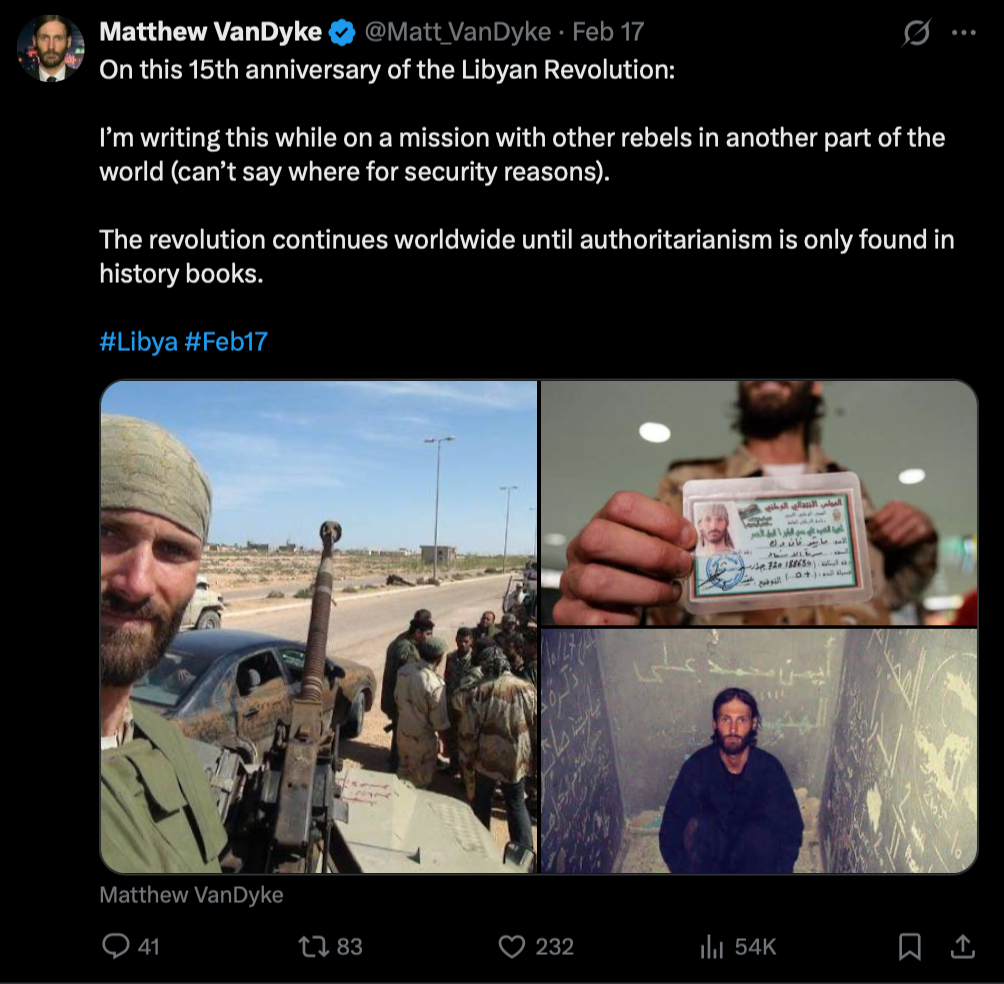
Matthew VanDyke, born in Baltimore and trained at Georgetown University, first gained prominence as a foreign fighter and prisoner of war during Libya’s 2011 civil war against Muammar Gaddafi. In 2014, following the murder of his friends, journalists James Foley and Steven Sotloff, by ISIS, he founded Sons of Liberty International (SOLI), a U.S.-based non-profit organisation that provides free military training to groups it considers defenceless against terrorism or authoritarian regimes.
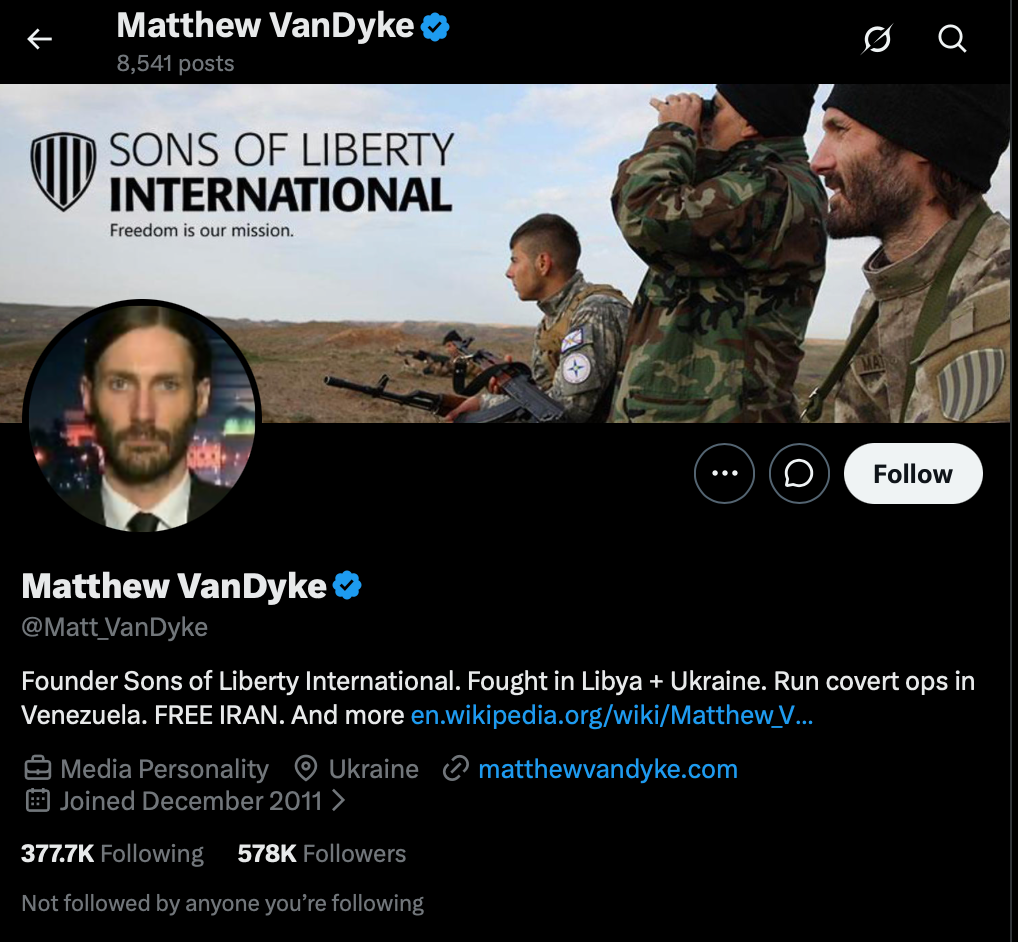
SOLI’s first and most defining client was the Nineveh Plain Protection Units (NPU), an explicitly Assyrian Christian militia formed in northern Iraq to combat ISIS. SOLI’s own materials have described the NPU as “a Christian army.” VanDyke personally trained the unit’s initial cohort in secret, later expanding it into a full battalion with the approval of the Kurdistan Regional Government.
Since then, SOLI has expanded its operations to the Philippines, Venezuela, and Ukraine, which he proudly flaunts on his X and LinkedIn accounts.
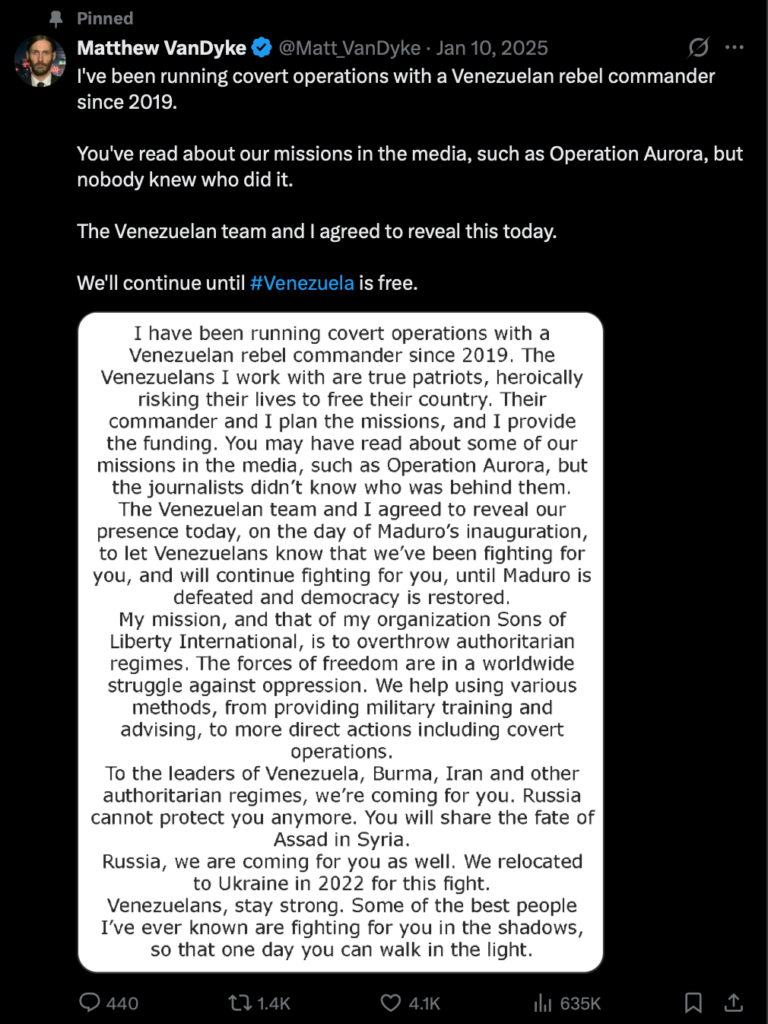
Frankly, I have never witnessed such an event outside Bollywood’s YRF Spyverse: Alpha.
However, given his extensive experience working predominantly with Christian communities and his public accusations of Christian persecution in India, VanDyke’s profile has often been likened to that of a ‘modern crusader’, a characterisation that also helps explain the organisation’s name, Sons of Liberty International.
On 13 March 2026, having been detained at Kolkata airport on 11 March, India’s National Investigation Agency arrested VanDyke along with six Ukrainian nationals, Petro Hurba, Taras Slyviak, Ivan Sukmanovskyi, Marian Stefankiv, Maksim Honcharuk, and Viktor Kaminskyi, under UAPA.
The NIA case in question alleges the group entered on tourist visas, moved into restricted areas of Mizoram without permission, crossed illegally into Myanmar, and trained ethnic armed organisations opposing the junta in drone assembly, jamming, and weapons handling. Later, VanDyke was moved to Tihar Jail in April and has reportedly been on hunger strike since May over medical access and consular contact.
The matter remains sub judice, and both VanDyke and the six Ukrainians are entitled to full due process; that principle does not bend for the seriousness of the charge, and a nation confident in its own institutions should not need it to.
It would be irresponsible to claim that missionary organisations naturally lead to militancy. The overwhelming majority clearly do not, and conflating peaceful religious work with armed activity dishonours both the aid workers building schools in Chhattisgarh and the ordinary faith of more than a billion Christians worldwide.
At the same time, it would be equally naïve to dismiss the pattern involving a man with a documented history of raising explicitly confessional militias, one who operates precisely in regions where a century of intensive missionary settlement has already created deep demographic and political fault lines, as mere coincidence. This is especially noteworthy given the visits by U.S. ambassadors to the Indian government following his arrests.
The Northeast-Myanmar border is precisely where foreign funding, organised religious identity, and unresolved insurgency have overlapped for decades. VanDyke sits at the outer, kinetic edge of a spectrum whose inner edge is a Joshua Project database, and whose financial edge is a Truist debit card used to withdraw cash in Dhamtari.
Different instruments; the same current running beneath them.
THAT IS THE BROADER FRAME in which India’s regulatory choices belong.
Dr A.P.J. Abdul Kalam’s dictum that “strength respects strength” was never about hardware alone; it meant the institutional confidence to decide according to India’s own interests rather than in anticipation of foreign approval. Earlier generations of Indian statecraft often hoped that goodwill would earn reciprocal restraint: support for the British war effort, Nehru’s faith in Panchsheel, decades spent assuming moral authority alone would shape great-power behaviour.
History offered a colder lesson: great powers adjust to competing interests of comparable weight, not to appeals of principle. Contemporary India increasingly proceeds from that colder, clearer premise: cooperating with Washington where interests align, buying Russian energy where they don’t, building Indo-Pacific partnerships that fit no inherited category. The FCRA fight, the TTI case, and the VanDyke prosecution are not three separate stories. They are one story about a post-colonial civilisational nation finally deciding that autonomy is not optional.
Critics are right that any law enlarging executive discretion over civil society deserves judicial review and transparency; a democracy that regulates without accountability to itself has simply traded one unaccountable authority for another. But the underlying claim of reform is not extreme: foreign capital and religious networks are not neutral merely because they carry a charitable label, and a nation’s sovereignty, if it means anything past the lines on a map, must include the standing to author its own demographic and cultural future.
The question India’s present controversy is actually asking is not whether missionaries do good work. It is who ultimately gets to author the future of a civilisation, its own citizens, through their own institutions, or networks whose funding, direction, and priorities originate somewhere else entirely.
Atithi Devo Bhava: the guest is as God. But even a god who enters as a guest is expected to respect the house (samsar’s samskar).