

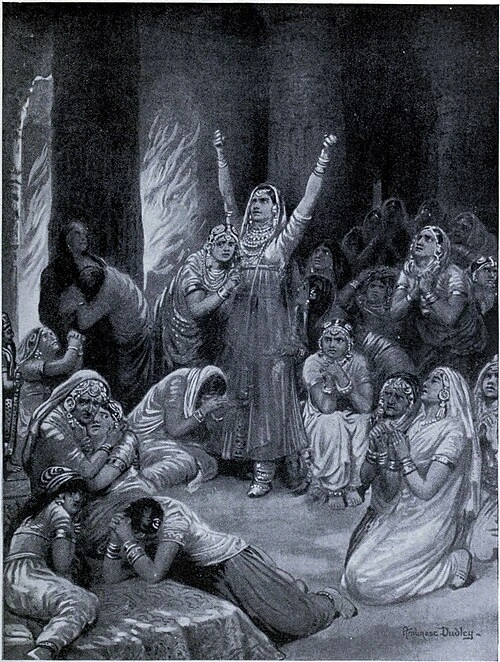
The evening after Jauhar (mass self-immolations), once the women had died, the Rajputs and the surviving men donned kesariya (saffron-colored robes), smeared turmeric on themselves, and rode out of the fort gates for a suicidal, fierce last stand against the enemy with no intent to return. Because surrender and subsequent slavery were unacceptable, with burning fury, they charged against the invading Islamic armies, knowing defeat was imminent. The Hindus called it the Saka.
Hindus knew that barbarians at the gate were used to raping even the corpses of women. Through the fire of Jauhar, the women denied the invaders the humiliation and conquest they sought. In choosing death over captivity, they claimed a moral victory even in the face of military defeat. Once the men had fallen, the enemy was left with just ashes surrounded by the empty walls of the fort.
The 2018 movie Padmaavat, based on the 14th– century siege of Chittor when the invaders outnumbered the defenders, depicts these scenes rather accurately. However, a public critic of the movie recently argued that the Jauhar scenes treat rape as the end of a woman’s life. Rape survivors watching the movie would be made to feel that she should have died rather than lived. It was implied that one should ‘choose life’ rather than commit suicide because it was cowardly. The scene of a pregnant woman participating in Jauhar was repulsive, as an unborn child should not be denied ‘life’ because of the threat of sexual violence.
This is not the first and definitely not the last time such comments have been made about the film and the brave acts of Jauhar and Saka. Unfortunately, those completely ignorant of history make such arguments, equating the past actions of women with today’s issues.
However, the need to force-feed ‘women’s empowerment’ by reducing the dignity of our female ancestors to cowardice is abhorrent. Hence, it becomes important to understand what ‘choosing life’ meant in the context on which the movie is based.
In A History of Civilizations by Fernand Braudel, Islamic rule in India is termed as a ‘colonial experiment’ which was ‘extremely violent’, and ‘the Muslims could not rule the country except by systematic terror’. Cruelty was the norm—burnings, summary executions, crucifixions or impalements, inventive tortures. Hindu temples were destroyed to make way for mosques. There were forced conversions. If ever there was an uprising, it was instantly and savagely repressed: houses were burned, the countryside was laid waste, men were slaughtered, and women were taken as slaves.
The modern Indian individual has little concept of what is meant by ‘men were slaughtered, and women were taken as slaves,’ because of the whitewashing of the cruelty perpetrated on Hindus by Muslim invaders (Mughals, Turks, etc.). This was done by the communists and Islamists who dominated the education and intelligentsia of India since independence and loved to show these barbarians as ‘great’.
When Hindus themselves speak of the mass rapes of Hindu women, sexual slavery, and the rampant killing of men, it is termed as false, exaggerated, or outright lies. Speaking the truth in this country is termed as trying to create unrest and trouble. Therefore, the atrocities on non-Hindu races and testimony of foreign authors are enumerated here. With this, it is easy to infer the brutality meted out to Hindus as well. What the Muslims did to women in Eurasia, they also did to Hindu women of undivided India.
Just 200 years ago, an uprising of Greeks against the Turks under the Ottoman Empire took place in Chios, the fifth-largest Greek island, located in the northern Aegean Sea just 8 km off the western coast of Turkey. As with the Hindu uprisings, if there were a Greek uprising, it too was instantly and savagely repressed: houses were burned, the countryside was laid waste, men were slaughtered, and women were taken as slaves.
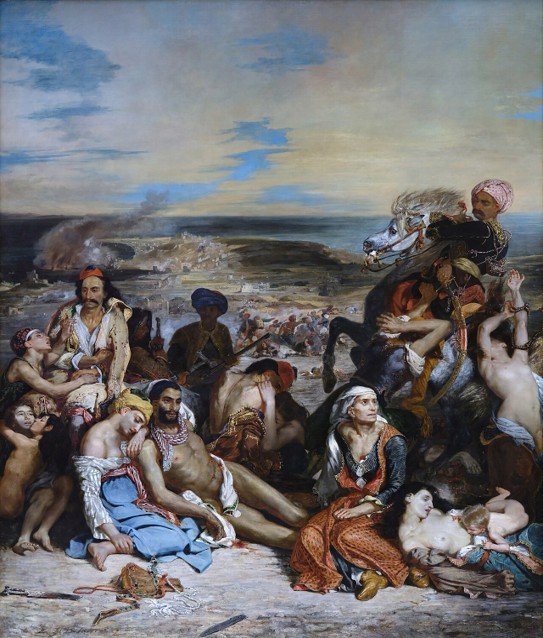
Author Homer Pavlos states, ‘On March 30, 1822, when the massacre in Chios began, the Muslim Turks had clear orders. The Sultan had commanded that all Greek Christians be slaughtered, except for boys aged 3 to 12 and women from 12 to 40. These would be captured and destined for the slave markets.
The frenzy of the Muslims was unprecedented. Many Turkish soldiers cut off the heads of Greek Christians and then licked their swords. With this act, they believed they would earn a place in paradise. Others were hanged from the island’s trees for deterrence.
Severed human limbs and corpses were scattered on the streets, while the sea had turned red from the blood. The smoke from the burning houses had covered all of Chios, while the flames made the night look like day.’
The gift bestowed upon the enslaved women by their Muslim master was humiliation and a degraded life. The unmitigated lust of the Islamic invaders, like the Turks and the Mughals, who enslaved Hindu women solely for the purpose of obtaining sexual pleasure—reduced a Hindu woman’s existence exclusively to carnality and breeding.
On the massacre of Chios, Pavlos further adds, ‘Young girls were raped publicly in the streets, and newlyweds in front of their husbands, who were then slaughtered. Others were raped in front of their parents, after which the men’s genitals were cut off.’
Women over 40 were set on fire and left to burn alive. Pregnant women had their bellies ripped open, and their fetuses pulled out, while small children were thrown forcefully against rocks.
Several women from Chios preferred death over dishonour and slavery. They committed suicide by jumping off cliffs. Some were killed while defending their children, siblings, and husbands. Even among those who were captured, some died on hunger strike. Destitute women and children from the island were crammed into ships and transported to the markets of Smyrna and Constantinople, where they were sold as slaves at humiliating prices.
By May 1, 1822, over 41.000 slave ownership documents, known as ‘teskerés’, had been issued in Chios. According to the French-language newspaper of Smyrna, Spectateur Oriental, by May 10, duties had been paid at the Smyrna customs for 40,000 slaves.’
The most famous slave market for females in Constantinople was the Aurat Bazaar (Avret Pazarları in Turkish). Hence, if a female did not die in the mass immolations of Jauhar, like the Kshatriya and other willing ladies, the Aurat Bazaar was her fate, likely after she had been raped multiple times. In case of an excess of female slaves like the ones from Chios, they were sold in fish markets and even on the streets.
The Christian Reverend Robert Welsh, who served as the priest to the British Embassy in Constantinople during the Greek Revolution, starts his book A Residence at Constantinople During a Period Including the Commencement, Progress, and Termination of the Greek and Turkish Revolutions with horrifying scenes of women and children taken as slaves by the invading armies of the Turks.
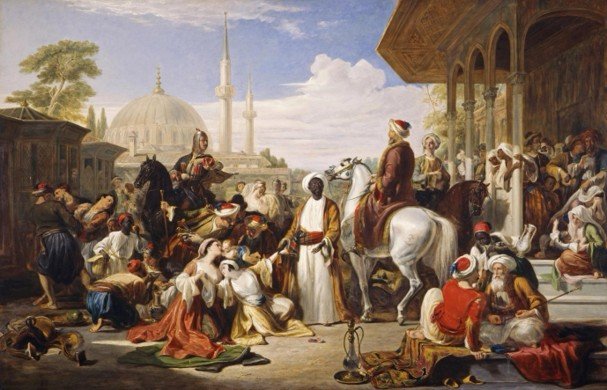
He states: ‘The manner of making slaves, and securing a property, is this—any fellows who join an expedition as volunteers for plunder would enter a house, and after setting fire to it, and killing the adult males, they carry off the property, with the females and boys.’
They then proceed to the next custom-house and, having paid twenty piasters or about ten shillings (60 rupees approx. of today), they take out a ticket, which certifies the slavery, and then the persons of the unfortunate family become the property of the captors forever, with all their posterity (offspring and descendants)!
But the oversupply of unfortunate women and children of Chios of Greece was such that they were exhibited for sale in any public place, even the streets. The most usual was the Baluk Bazaar or Fish-market. Here many poor girls, between twelve and fourteen, were sold like cattle at an English fair.
Several of them were without trousers, or the necessary articles of dress (implying they were naked with their genitals exposed for everyone to see). Terror and anxiety had so affected them that they exhibited the most deplorable picture of human suffering I ever beheld, and such as cannot be described.
Despite their suffering, they were treated by the Turks with contempt, without the courtesies of decorum (a sense of modesty) that a Turk shows to any other female.
They were taken and handled with the roughness of butchers examining young cattle (being groped and felt up) and sold at the rate of one hundred piastres or 3 pounds a head (380 rupees approx.).
You have heard it said that the volatile Greek women are not much affected by change of circumstances and are readily reconciled to the lot which casts them into the enjoyments of a Turkish harem. Never believe it.
The horror and repugnance felt by the free-born Greek women to slavery among the Turks, under any modification, is invincible, and they infinitely prefer death.’
Therefore, if the free-born Greek women preferred death, why would the free-born Hindu woman not prefer death in the Jauhar? Slave women were considered worse than cattle and treated with utter contempt while being sold in the Aurat Bazaars of the Islamic world. They suffered not only physical pain, but also public dishonour because the goal of the invader was to make them suffer intense humiliation.
The word ‘Aurut’ comes from the Arabic root word ʿawrah (ﻋﻮرة)’. In classical and religious Arabic, ʿawrah’ means ‘the private part of the body’.
Not only was a woman reduced to her vagina, but her value was 380 rupees, cheaper than a good-quality packet of dog food today. At this price, a Muslim Turk could buy her for her whole life and do with her as he pleased.
From these Aurat Bazaars comes the Persian/Indian term ‘Bazaaru Aurat’, which means ‘a woman of the market’. Nowadays, it is used as an insult to describe a woman as being of ‘bad character’, loose morals, or acting in a vulgar or promiscuous manner. In legal and traditional contexts, it is synonymous with terms like prostitute or harlot. The enslaved female was seen in the same context; after all, she and her private parts too were displayed vulgarly in the markets and, like a prostitute, she was sold to any buyer.
Men and women suffering from extreme poverty of historical knowledge, henceforth, should not disrespect the brave women who committed Jauhar. Self-respecting women had no desire to become ‘Bazaaru Aurat’ because this is what their future entailed if they ‘chose life’ instead of suicide.
It is utterly immature to compare the actions of women of the 14th century, during a period of Islamic invasions where rape was the legal reward for winning wars, with the aftermath of rape in today’s world, where there are laws to protect victims and punish the perpetrators.
The free-born European women chose death just like the free-born Hindu women. If the Christian women are not shamed for their choices, the Hindu women should not be shamed either. The modern-day Greeks have rightly chosen to honour the brave women and children who committed mass suicides by erecting grand monuments for them.
In the northwestern part of Greece lies one such grand monument, right atop a hill on the rocks from which the women and children of Souli committed suicide to avoid capture. Souli is a mountainous region in Greece where citizens wished to live freely, away from Ottoman subordination. However, the local Ottoman ruler, Ali Pasha, attacked and defeated the Souliote fighters after a long siege. Trapped on the steep cliffs of Mount Zolango, the brave women knew that surrender meant lifelong slavery, abuse, rape, and torture. In a final act of defiance, the women chose to sing and dance together at the edge of the cliff. One by one, the mothers threw their children down the rocks and then jumped off themselves. This tragic event is remembered in Greek history as the Dance of Zolango. It became a powerful symbol of freedom and self-respect.