

To evaluate the current strategic trajectory of the Indian National Congress (INC), one must first grasp the social architecture that sustained its mid-century hegemony. Historically, the Congress dominated the Hindi heartland through what political scientist Paul Brass termed the Coalition of Extremes, a Rainbow Coalition that anchored power by aligning Upper Castes (primarily Brahmins) with Dalits and Muslims. This structure effectively bypassed the burgeoning middle-tier castes, maintaining a stable but increasingly brittle status quo. The 1960s witnessed the first major fracture in this edifice with the rise of so called- Anti-Congressism. As the Other Backward Classes (OBCs) experienced a social and political awakening, the Congress leadership failed to integrate them into its hierarchy. This vacuum allowed socialist ideologues like Ram Manohar Lohia to channel OBC aspirations into a potent political force. Even when the Congress attempted to shake up its own internal order- appointing leaders like Jagannath Pahadia (a Dalit) as Chief Minister in Rajasthan or A.R. Antulay (a Muslim) in Maharashtra, failed to institutionalize these shifts at the grassroots in Uttar Pradesh and Bihar. Historical precedents of mass mobilization, such as the 1966 Cow Protection protests and the later JP Movement, further signaled that the Rainbow Coalition was under siege by forces combining religious identity with social grievance.
The transition from Congress’s long-standing dominance to the present political order can be understood through three pivotal democratic revolutions. The first came in 1967, when the Congress monolith was decisively challenged across the Hindi heartland through the formation of Samyukta Vidhayak Dal (SVD) governments. The second followed the Emergency, culminating in the 1977 Janata experiment, which brought together the socialist OBC constituency with the urban upper-caste base of the Bharatiya Jana Sangh. The third emerged around the Mandal–Mandir moment of 1989, when the Congress’s traditional social coalition fractured further, giving rise to identity-driven regional formations such as the SP, RJD and BSP, alongside the BJP’s expanding Hindutva politics. Having lost its traditional base to these regional and ideological forces, the Congress is now attempting a radical re-entry into the heartland by reclaiming the very OBC and Dalit constituencies it neglected for half a century.
The transition from a Big Tent centrist identity to a sharply defined Left-of-Center position is a high-stakes gamble. For decades, the INC functioned as a platform of consensus, but this ambiguity is being discarded in favor of an aggressive ideological posture. This shift is an essential prerequisite for its current demographic outreach, providing a clear ideological alternative to the incumbent’s “Vikas” (development) and “Hindutva” (cultural nationalism) narratives. The shift is most stark when compared to the United Progressive Alliance (UPA) era (2004–2014). That period was characterized by a productive tension between Sonia Gandhi’s socialist-leaning, rights-based welfare focus and Dr. Manmohan Singh’s free-market approach to capital flow and resource generation. Today, that duality has been replaced by a singular focus on social identity. The party’s rhetoric has shifted from Women’s Welfare to Smash the Patriarchy, utilizing academic and confrontational terminology. By critiquing the Manusmriti, framing it as a mindset that views women as mere extensions of male relatives, the party has abandoned soft political language for a theoretical critique of social structures. Gandhi’s rhetoric, specifically his Hindu vs. Hindutva distinction, has been characterized as an MA First Semester academic debate. While this reflects the influence of JNU-style academic training and advisors, it remains to be seen whether such nuanced distinctions resonate with a mass electorate or merely provide the BJP with a home turf advantage on issues of religious identity.
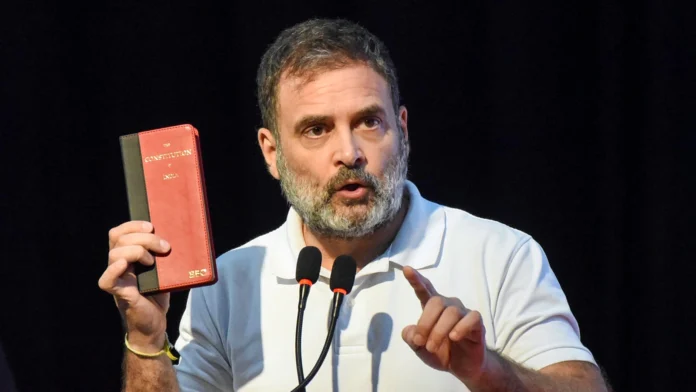
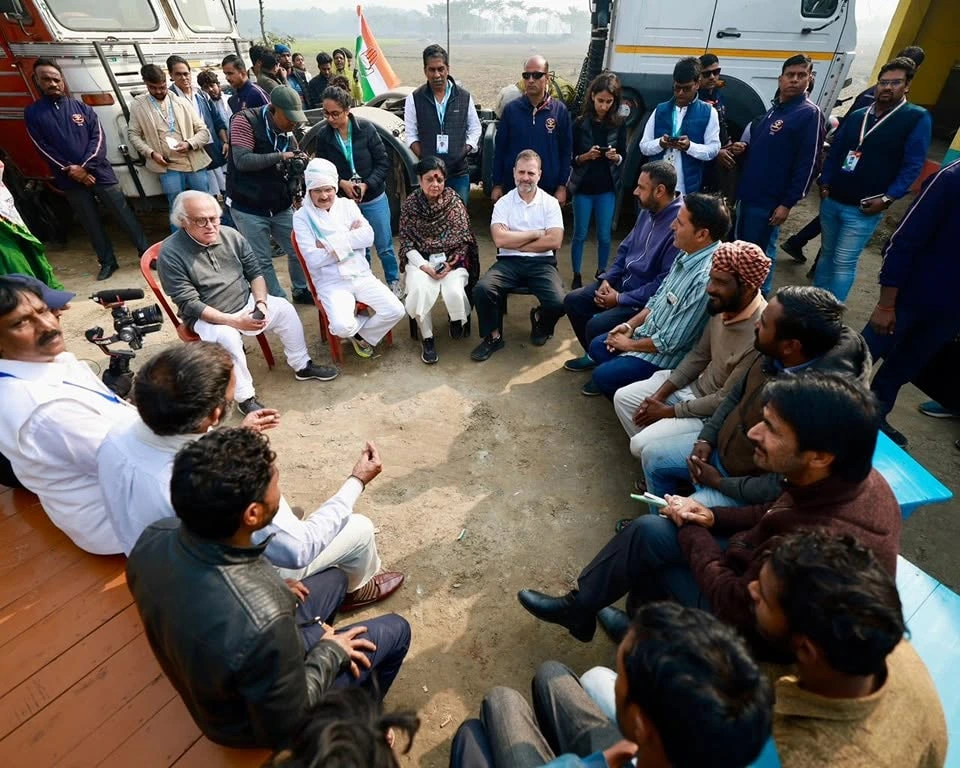
To bypass traditional block-voting patterns, the INC is executing a demographic pivot toward Gen Z and Gen Alpha. This strategy rests on the Act of Active Listening, a tactical tool designed to contrast with the formal, top-down oratory of the establishment. Rahul Gandhi has adopted an informal, YouTuber-style persona, engaging in unscripted interactions with truck drivers, mechanics, and students. This is not merely a stylistic change but a strategic attempt to align with the sensibilities of a younger generation that values authenticity and vlogging culture. The shift is visible not just in his words, but in the stagecraft around them. In Prayagraj and Pune, Rahul Gandhi stepped away from the familiar white kurta-pyjama and tucked-in T-shirt, opting instead for brighter, flowing colours. The wardrobe change may appear incidental, but it contributes to a deliberate visual departure from the conventional image of the Indian politician. The same instinct extends to the format of engagement. The traditional podium gives way to a microphone-in-hand, walk and talk style, while students are brought onto the stage to speak about their concerns themselves. It turns the political event from a speech to a spectacle of participation, less about addressing the audience from above, and more about creating the impression of a conversation from within it.
This outreach specifically targets young women by focusing on individual autonomy rather than traditional roles. While the government narrative centers on Vande Mataram and Motherhood, protecting women within a familial framework, the Congress is tapping into a social transformation where small-town women prioritize safety, education, and financial independence. By addressing the careless way the establishment speaks to women and asserting that no one else owns your choices, the party is attempting to weaponize the gap between traditional social mores and modern female aspirations.
A section of the party’s senior leadership appears increasingly uneasy with the influence of advisers perceived to be pushing Rahul Gandhi towards a more left-of-centre political vocabulary. Their concern is less about social justice itself than about the manner in which it is being pursued through a sharper emphasis on Dalit, OBC and tribal representation, alongside a more assertive critique of traditional social hierarchies. For leaders accustomed to the Congress’s accommodative, big-tent politics, this represents a marked departure from the party’s older language of social harmony, welfare and broad-based appeal. The older Congress instinct was to balance competing social constituencies; the emerging approach seeks to place social identity and representation much closer to the heart of its politics. Even its vocabulary reflects this shift, from universalist appeals to language drawn increasingly from contemporary academic and left-of-centre discourse. The result is a party that, while retaining the Congress name and organisational shell, is steadily acquiring a different political character. The larger question is whether this transformation can broaden its social base without unsettling the constituencies that sustained the party for decades.
Rahul Gandhi is now aggressively advocating for a caste census, a move that aligns him with the PDA (Pichhda, Dalit, Alpsankhyak) formula. This strategy is a direct echo of Kanshi Ram’s famous slogan: Jiski Jitni Sankhya Bhaari, Uski Utni Hissedari, a high-stakes gamble designed to fundamentally rewire North Indian politics. By attempting to reclaim the Muslim, Dalit, and non-Yadav OBC electorate, Congress is initiating a zero-sum game that threatens not just the BJP, but its own I.N.D.I.A. bloc allies. If this strategy succeeds, regional heavyweights like the Samajwadi Party and RJD risk being relegated to small change, isolated as strictly Yadav-only entities. While this eloquence forces the BJP into an uncomfortable defensive posture regarding its core voter base. Because the BJP largely excludes Muslims from its ticket distribution, it possesses a surplus of seats to generously accommodate Extremely Backward Classes (EBCs) without alienating its Upper Caste base. Congress, conversely, remains constrained by the need to balance Muslims and Upper Castes, leaving it critically little room to field EBC candidates.
Compounding this structural hurdle is a glaring organizational void. Congress has successfully generated social media traction and theoretical goodwill; it thoroughly lacks the relentless, booth-level machinery required to convert this sentiment into electoral dividends. Yet, a potent catalyst exists in the growing middle-class anxiety surrounding universal student grievances, such as the NEET and JEE controversies. Unlike agrarian protests, which the establishment easily contained as sectional issues, student angst strikes directly at the heart of the Hindu heartland. Historically speaking, as witnessed during the JP era, student movements have been the primary destabilizers of entrenched northern power. The BJP’s strategic delay in addressing the caste census has provided Congress a rare window of opportunity, but capitalizing on it requires a ground game the party currently does not possess.
Ultimately, this strategic reinvention exposes a deepening ideological fissure within the Congress itself.
Rahul Gandhi’s increasing reliance on academic, Left-leaning frameworks, characterized by semantic debates heavily influenced by university seminars, has triggered acute discomfort among the party’s old guard. By substituting the Congress’s historically centrist, catch-all identity with a sharper, theoretical progressivism, Gandhi is not merely altering a campaign strategy; he is attempting to build an entirely new party from the ashes of the old. The lingering question is whether this academic reimagining can survive the brutal, pragmatic arithmetic of the Indian heartland.