

In India, a Savarna can never be a victim of caste discrimination.
Not when university walls, such as those at JNU, are painted with slogans like “Brahmin Bania Bharat Chhodo” and “We are coming for you, there will be blood.” Not when public chants like “Tilak, Tarazu, aur Talwaar, inko maro jute chaar” are routinely normalized. Not when political mobilization is built on genocidal rallying cries like “Bhura baal saaf karo.” And certainly not when Savarna women’s bodies are treated as “sites of social justice conquest.”
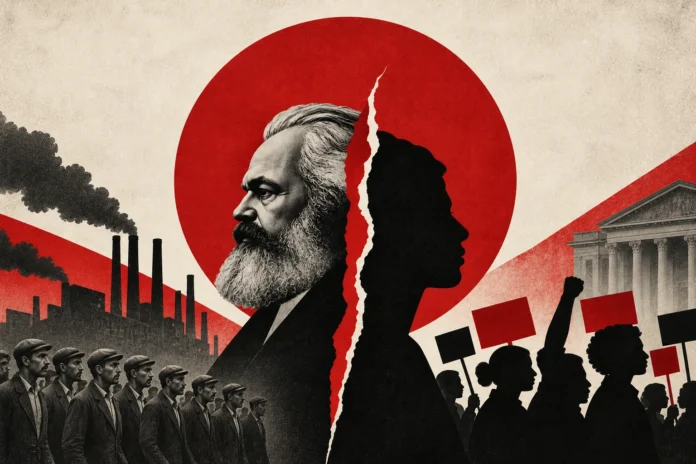
The system turns a blind eye to all of this because identity-driven legal and social paradigms pigeonhole these groups into a single, unyielding category: “the perpetual oppressor.” Within this worldview, any form of violence, intimidation, or hatred directed against them is rationalized not as a human rights violation, but as a righteous “revolution.” This systemic blind spot is no accident. It is the direct downstream product of the absolute conviction that human society is neatly divided into oppressors and the oppressed, tracing its ultimate genesis straight back to an 1848 pamphlet, i.e., The Communist Manifesto.
The first section of the Communist Manifesto opens by declaring that:
The history of all hitherto existing society is the history of class struggles. Freeman and slave, patrician and plebeian, lord and serf, guild-master and journeyman, in a word, oppressor and oppressed.
This framing not only divides society into two opposing factions but also presents them as mutually antagonistic. In this way, the Manifesto calls for workers’ unity by defining them as a shared oppressed class under the bourgeoisie:
Working Men of All Countries, Unite! The proletarians have nothing to lose but their chains.
This politics rests on the assumption that shared oppression would produce a shared political consciousness, since the proletariat shares a common relationship to the means of production that is one of alienation and exploitation, while bypassing other identities such as religion, nationality, and culture. Similarly, another assumption was that the internal contradictions of capitalism would drive the working class towards poverty, misery, and agony. Workers therefore would have no choice but to organise and revolt. However, this prophecy proved false. Rather than starving the proletariat, capitalism began to enrich the working class. Real wages rose in Western Europe, workers got better working conditions and shorter hours, and workers gained a stake in parliaments. This led to the embourgeoisement of the working class. Workers, unlike what Marx had predicted, were no longer interested in revolution, as they had more to lose besides their chains: they had pensions and homes to lose. They were no longer in the mood to risk it all for a utopian communist revolution. The final refutation of this workers’ unity came during the First World War. Before the war, the Second International, the global organisation of socialist and communist parties, declared that they would never fight in a “bourgeois imperialist war”. Yet when the war broke out, the German Social Democratic Party, the crown jewel of Marxist parties, voted almost unanimously to fund the Kaiser’s war efforts, and British and French Marxists did the same with their governments. Nationalism proved to be more powerful than class solidarity. The workers of the world did not unite; instead, they fought and slaughtered each other. This collapse shows that class solidarity did not override nationalism, even when Marx expected it to.
Lenin watched the collapse of the revolution with absolute disgust. To salvage Marxist theory from history’s falsification, he had to make several modifications. He needed to explain why the Western proletariat abandoned the revolution. He argued that capitalism had mutated and avoided immiserating its own workers by exporting the brutality of exploitation to the colonial periphery of Asia, Africa, and Latin America, and by bribing its own workers with surplus wealth to win their loyalty. He also argued that, unlike Marx, class consciousness would not develop naturally; it would need to be injected by the vanguard party, a centralised, highly disciplined cadre of professional, intellectual revolutionaries. This is the birth of the professional revolutionary: the theorist now knows the worker’s interests better than the worker does. This is how Lenin successfully relocated the revolutionary subject geographically to the periphery and sociologically to the unbribed. What this whole intervention of Lenin did, and what subsequent theorists used, was: whenever the designated revolutionary subject fails to perform, do not abandon the theory; instead, substitute the subject.
Antonio Gramsci, writing in Mussolini’s prisons between 1929 and 1935, attempted to answer the same problem: Why had the Bolshevik model not travelled west? He answered that, unlike Russia, where the state was everything, the state was only the outer ditch in the capitalist West; the capitalist class governed through a highly fortified network of institutions like the church, the press, the family, the schools, and civic associations. A frontal assault, a guerra manovrata, could not succeed against such depth. What was required was a guerra di posizione: a protracted struggle for position within civil society itself. Revolutionary consciousness was not developing because the ruling class used these institutions to manufacture consent by making its particular interests common sense. He called for organic intellectuals to produce a counter-hegemony and capture culture-producing institutions. The fact that one sees the capture of higher education and media by leftists today can be traced back to this very theory of Gramsci. What he did was to license, within Marxism, the treatment of culture as a primary rather than derivative site of struggle. It replaces the workers (proletariat) as the primary revolutionary force and the economy as the primary base; instead, it shifts to educated intellectuals of the same class as the force of revolution and culture as the base of struggle.
If there is one person, however, who can be credited with the rise of identity politics and identity Marxism, it is none other than Herbert Marcuse. In a multitude of his works, he argued that capitalism has absorbed and integrated its own opposition; even dissent is controlled and administered. According to him, consumerism keeps people satisfied, and media and popular culture absorb dissent; instead of challenging the system, people become comfortable with it, and proletarians are no longer the revolutionary force; instead, they have become the stabilising force for the capitalist system. Marcuse’s answer to this dilemma was to find a new revolutionary group. In the closing pages of One-Dimensional Man (1964), he writes:
However, underneath the conservative popular base is the substratum of the outcasts and outsiders, the exploited and persecuted of other races and other skin, the unemployed and the unemployable. They exist outside the democratic process; their life is the most immediate and the most real need for ending intolerable conditions and institutions. Thus their opposition is revolutionary even if their consciousness is not. Their opposition hits the system from without and is therefore not deflected by the system; it is an elementary force which violates the rules of the game and, in doing so, reveals it as a rigged game.
The new subject is defined not by its relation to production but by its exclusion from the integrated order. Hence, it became oppressed identities of the world, unite” instead of “workers of the world, unite”. Another feature of the modern world which can be traced back to the theories of Herbert Marcuse is the leftist policing of free speech and aggressive censorship of right-wing or conservative voices. In Repressive Tolerance (1965), Herbert Marcuse argued that neutral free speech is not truly fair in an unequal society. If both progressive and conservative ideas are given the same freedom, the powerful will always have the advantage, so equal tolerance ends up protecting the existing system. He proposed “liberating tolerance” instead: society should withdraw tolerance from right-wing movements while giving greater tolerance and support to left-wing and emancipatory movements. In simple terms, Marcuse argued that right-wing voices should be censored, marginalised, and denied the protection of neutral free speech, while left-wing voices should be amplified in the name of “liberation.” In my view, this asymmetric standard has become deeply influential across large sections of academia in India and the West, where ideological conformity with the Left is seen as a moral virtue rather than an exception. Marcuse, quite literally and unashamedly, justified unequal treatment of speech in the name of social justice.
C. Wright Mills, in his 1960 “Letter to the New Left,” rejected the old Marxist belief that the industrial working class was history’s inevitable agent of revolution. Instead, he argued that young intellectuals and the educated class had become the most promising force for radical social change. The externalisation of the revolutionary subject proceeded simultaneously; thinkers like Frantz Fanon relocated revolutionary agency to the colonised peasantry, something which Lenin had started half a century earlier. In works like Fanon’s Black Skin, White Masks and The Wretched of the Earth, he made an equally important shift: instead of describing oppression mainly through wages, property, or class, he described it through psychology and lived experience. The deepest wounds of control, according to him, were carried in the body and the mind in the form of internalised inferiority, humiliation, alienation, and the constant awareness of being seen through the eyes of the oppressor. Politics was no longer only about wages, jobs, and economic exploitation; it became about race, identity, dignity, as well as the lived experience of being oppressed. Stokely Carmichael and Charles Hamilton’s Black Power (1967) completed the shift from class politics to identity politics. They argued that racism was embedded not simply in individual prejudice but in the ordinary functioning of institutions such as schools, policing, housing, and the justice system. The central political question was no longer: who owns wealth? But which identity is systematically oppressed?
The final mutation from materialist economic Marxism to identity Marxism came from radical feminists, who kept Marxism’s revolutionary framework but replaced class with identity. The mutual antagonism continues, but the fundamental conflict is no longer bourgeois versus proletariat. It became man versus woman, with patriarchy replacing capitalism as the primary enemy. Carol Hanisch, with her popular slogan “The Personal Is Political”, similarly contributed to this sentiment. The Combahee River Collective Statement (1977) completed the transition by arguing that race, sex, and class operate as interlocking systems of oppression. The revolutionary subject was therefore no longer the industrial proletariat, nor even the student, but the individual located at the intersection of multiple oppressed identities. This was the decisive birth of identity-based Marxism. This was the final result of Herbert Marcuse’s formation; it employed the vocabulary of Marxism, like oppression, domination, liberation, and structural power, but its organising principle changed from economy to identity.
The most important political question was no longer: Who owns the means of production? It became: Whose identity occupies the highest position in the hierarchy of oppression? Thus, the oppression Olympics, which rules modern discourse, took its final form.
Marxist educator Paulo Freire argued that the marginalised are mathematically incapable of being true aggressors. Freire popularised the idea that all violence is inherently the fault of the dominant hegemony, that is, the oppressors. In Pedagogy of the Oppressed, Freire writes:
With the establishment of a relationship of oppression, violence has already begun. Never in history has violence been initiated by the oppressed… Violence is initiated by those who oppress, who exploit, who fail to recognise others as persons—not by those who are oppressed, exploited, and unrecognised.
By extension of this thinking, it is argued that a person from a marginalised community can never commit violence. Even if a crime is committed, it is merely an involuntary and reactive symptom of systemic oppression, thus effectively dismantling the concept of individual agency and personal responsibility, replacing it with collective racial, caste and class guilt. In India, this maps itself to the caste guilt seen quite frequently in some Savarna Hindus. So, through Marcuse, Freire and many more such thinkers, the academic Left successfully constructed a theoretical fortress where the “Oppressor” is inherently guilty simply by existing, and the “Oppressed” is inherently innocent, even when they commit brutal atrocities.
Kimberlé Crenshaw contributed to similar politics, based on oppressed identities, and popularised a hierarchy of oppression; it called for unity among oppressed identities and defined it as intersectionality. While it aims to unite oppressed identities, it also excludes some identities perceived as oppressors. This makes identity, rather than the strength of an argument, a source of political authority and continually fragments society into smaller, competing groups. This creates an asymmetry: even whose suffering is seen as genuine or worth listening to is determined by the hierarchy of oppression.
It has so far been established that identity Marxism neatly divides the whole world into mutually antagonistic groups of oppressors and oppressed based on identity, but it does not simply stop at condemning the oppressors; it needs to defang them; it needs to strip them of all their powers and defences. Defining the oppressor was only half the job; the next step was to pathologise the oppressors. They had to guilt-trip the oppressors into self-flagellation. Leftists managed it by inventing the concept of ‘Privilege’, which is an invisible, unwanted malice attached to the dominant racial, cultural, or caste group. Peggy McIntosh popularised it in her 1989 essay on “White Privilege.” By framing the natural advantage of living in a culture which respects meritocracy, values the institution of family, and values hard work as inherently oppressive, she converted normalcy into a moral crime. Thus, privilege theory guilt-tripped millions of people from the supposed oppressor community into believing that their success is not the result of their hard work or their community’s culture, but of a rigged, exploitative system.
This creates a system in which individuals belonging to the so-called oppressor community are constantly required to prove that they oppose the allegedly exploitative system. They must continuously demonstrate their allegiance to theories of privilege. They must prove that they are anti-racist, anti-casteist, and sufficiently “woke” at all times. In practice, this demands a form of perpetual self-flagellation where they are expected to view their own skin, caste, culture, religion, and heritage with disdain to establish that they are not part of the oppressors. Under such a framework, the fear of being labelled racist, Islamophobic, casteist, or reactionary becomes so overwhelming that moral judgment itself is distorted. Even when confronted with grave injustices, many choose silence rather than risk violating the ideological orthodoxy. The social cost of challenging the narrative outweighs the cost of ignoring the suffering of actual victims. In the left-wing moral framework that has emerged from these ideas, accusations of racism, Islamophobia, or casteism often carry greater social consequences than confronting serious crimes themselves. As a result, preserving ideological conformity takes precedence over protecting vulnerable people.
In the Indian context, one may draw parallels with anti-Savarna caste politics. Some upper-caste leftists, fearing the stigma of being branded casteist, adopt positions that they would otherwise reject, to prove their anti-caste credentials. In India, this asymmetry can be seen in instances when a Savarna is accused under the SC/ST Act for caste-based abuse against a Dalit; the act is treated as an expression of structural oppression. But when the same kind of caste-based abuse is directed at a Savarna, the language of oppression disappears; the perpetrator can instead be romanticised as a “revolutionary” resisting the social order. Two different reactions to the same crime, only based on identity. This binary manifests in policymaking, where caste-based discrimination against a Savarna is treated as an impossibility because the Savarna is presumed always to be an oppressor rather than a possible victim. The result is an asymmetrical framework in which one group is granted the status of the eternally oppressed. At the same time, the other is even denied the possibility of victimhood, just based on their identity. Under this rigid oppressor-oppressed binary, for an oppressor community to be systemically victimised by the oppressed group is not just unlikely, but an ontological impossibility.