

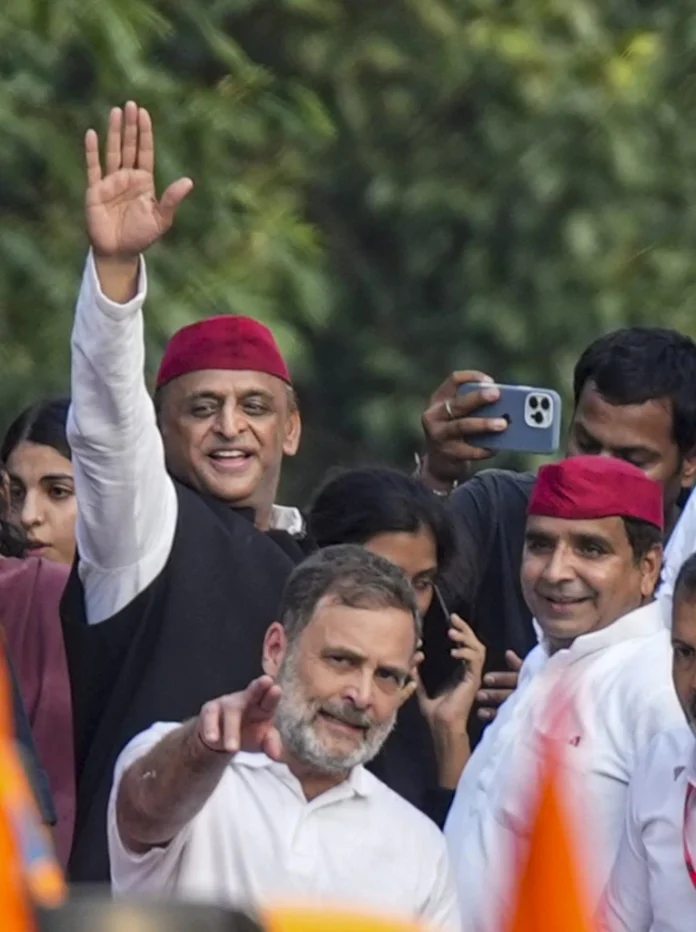
On 12 October 2026, the INDIA bloc marched on the Supreme Court. Delhi closed entry and exit at six metro stations for it. Rahul and Priyanka Gandhi walked with Neha Bora, the national president of the Left student group AISA. Congress president Mallikarjun Kharge and Rahul Gandhi had asked Chief Justice Surya Kant for time that afternoon to hand over a memorandum. It asked for four things: an end to “vote chori”, the resignation of Chief Election Commissioner Gyanesh Kumar, a halt to the Special Intensive Revision (SIR) of electoral rolls, and a return to paper ballots. The Chief Justice reportedly declined to meet them. Similar matters were already before his court and listed for hearing the next day, he noted; no orders could be passed on the administrative side; and the court stays open at any hour to any citizen whose fundamental rights are violated.
That reply is the whole story. The opposition went to the one institution already hearing its complaint and asked it to act outside the courtroom. The same day, Rahul Gandhi and ten other INDI alliance bloc leaders, among them Mallikarjun Kharge, Akhilesh Yadav, Tejashwi Yadav and Supriya Sule, filed a joint writ petition, the route the Chief Justice had pointed to. It asks for the Commission’s files, minutes and database access logs, and for an audit of deletions by a committee headed by a retired Supreme Court judge. That petition is the serious act. The march added nothing to it except the pictures. And the memorandum asked for something no court will give: the court itself rejected a return to paper ballots in April 2024.
The big number came first. For weeks the opposition has said the SIR struck 13 crore names off the rolls. The Election Commission says the 13.39 crore are electors it classed, almost all of them, as absent, shifted, dead or duplicate, out of 95.40 crore it scrutinised across three phases, and that anyone eligible who was left out can still apply to be added. By its count, about 6.3 crore had permanently shifted, about 3 crore were absent or untraceable, about 2.8 crore had died and about 1 crore were registered in more than one place; the rest fall in other categories. It also says about 2.73 crore voters aged 18 to 28 have been added since the revision began. Those are the Commission’s own figures, and they can be audited. But they turn “vote chori” from a finding into a disputed number.
What is left is much narrower. The petitions before the Supreme Court allege that Kumar took decisions on his own, without the other two commissioners, among them changes to Form 6, the form a citizen fills in to join the electoral roll. On 5 October a bench led by the Chief Justice issued notice to the Centre, the Election Commission, Kumar and the other two commissioners. It said it had never approved a modified Form 6, called for the records showing who authorised the change, and said it would examine whether decisions were taken unanimously, by majority or by Kumar alone. It refused to suspend him in the meantime, and said it could not pass orders on newspaper reports alone. The Commission says all SIR orders were issued with the unanimous approval of all three commissioners, though the other two, Sukhbir Singh Sandhu and Vivek Joshi, reportedly recorded objections to several decisions, the Form 6 change among them. That is a procedural question with an answer on paper, and the court has asked for the paper.
A party confident of its case would let the court do the work. The bloc has kept marching. In April, the Lok Sabha Speaker and the Rajya Sabha Chairman refused to admit its notice to remove Kumar. On 6 October its MPs marched from Parliament towards the Election Commission; Rahul Gandhi climbed a police barricade waving the Tricolour and posted, “Gyanesh, it’s done, bro. Time to resign.” On 9 October a delegation took the matter to President Droupadi Murmu. On 12 October it was the Chief Justice’s turn. Each stop asks a different authority to hand down, outside a courtroom, the verdict the court has not yet given.
The street has its own faces. Neha Bora, the 29-year-old national president of AISA, the student wing of CPI(ML) Liberation, and a PhD scholar at JNU, was detained at protests near Jantar Mantar demanding Kumar’s resignation on 2 and 4 October. In June and July she sat on a 23-day hunger strike demanding the resignation of the then education minister, Dharmendra Pradhan. Pradhan has since resigned. On 11 October she and other AISA protesters ran from police from RK Ashram Marg to Connaught Place, and were detained at the end of it. “I am not a professional runner,” she told The Telegraph, “but chasing (chief election commissioner) Gyanesh Kumar’s resignation has made me one.” On 12 October she walked beside the Gandhis, which suits both sides: Congress borrows her energy, and AISA borrows Congress’s respectability. That day she wrote on X that the CJI “cannot look away and call it politics”. He did not look away. He pointed to his courtroom. Her persistence is real. So is the method: name a minister, demand the resignation, and stay on the street until something gives. Applied to the Election Commission, that method turns a question of law into a contest of stamina.
The opposition’s problem is that the street drowns out the one argument it has left. Accurate rolls matter, and the SIR deserves scrutiny: cleaning the rolls of a vast, mobile country is hard to do without striking off real voters, and the Commission should have to show its work. But “vote chori” rests on a number the Commission has explained. And the paper-ballot demand tells voters the bloc distrusts not one commissioner but the machine itself, the same machine on which Congress won Karnataka and Telangana in 2023.
If the bench finds that Kumar rewrote Form 6 on his own, the opposition will have something no march can win it: a judgment. Until then, every barricade climbed tells the court, and the voters watching, that the bloc would rather have the picture than wait for the verdict. The cameras will move on. The case will still be heard, and it will be decided on the records.