

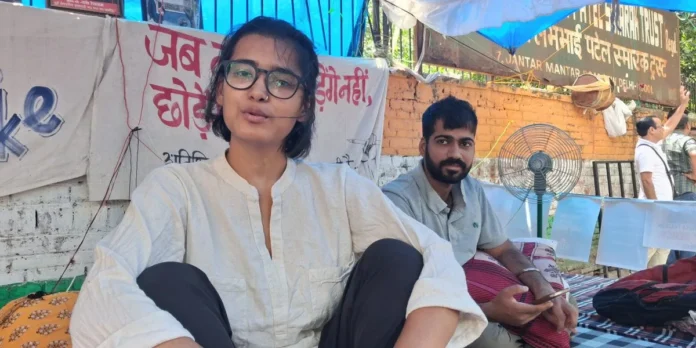
Neha Bora spent 23 days on hunger strike in central Delhi. The protest she helped lead ended with the resignation of India’s education minister.
The trigger was a real scandal: the papers for the national medical-entrance exam leaked, and the exam had to be cancelled. But Bora, a doctoral student who heads the All India Students’ Association, the student wing of a Marxist–Leninist party, has bigger game in view. “We want a complete rollback of the NEP,” she told The Caravan on 1 August, meaning the National Education Policy of 2020. That policy, she says, has “broken the backbone” of public education, cut funds and seats, locked future generations out of university and turned learning into a commodity.
It is a thunderous indictment. It is also one that can be checked against the document it condemns.
So let us do something unfashionable and read the thing before we burn it.
Nobody serious pretends that NEP has been implemented well everywhere. Some states cannot afford it, some universities have bungled it, and not every digital system it has spawned is harmless. But a bungled reform is a reason to mend it.
A slogan of total rollback is not an education policy.
Start with what the policy is for. India’s deepest educational failing is that vast numbers of children pass through school without learning to read properly or do simple sums. NEP makes fixing that a national mission. It wants less rote learning, more teaching in a child’s own language in the early years, more freedom to choose subjects, and universities that are multidisciplinary, more autonomous and willing to let a student pause a degree and resume it. It sets two targets that amount to a bill presented to the Treasury: half of young Indians in higher education by 2035, and public spending on education of 6 per cent of GDP as soon as possible. This is not the manifesto of a state trying to get out of the education business.
The charge that it is dismantling public education is the largest of Bora’s claims and the thinnest. The policy treats state schools as the foundation of the system. It asks for scholarships, free boarding where needed, and a fund for the inclusion of girls and transgender students. Its flagship scheme, PM SHRI, is upgrading existing government schools into model institutions: by July, 13,092 of more than 14,500 planned had been chosen. A third round of funding for state universities in poorer regions has an approved outlay of Rs 129 billion. None of this proves that every government school is thriving. It does show that a policy which builds and funds public schools cannot honestly be described as a plan to abolish them.
Then the money. In the interview there is no budget series, no institution-by-institution comparison, no distinction between what a ministry is promised and what it spends. The government’s figures point the other way: the education ministry’s budget for 2026-27 is Rs 1.39 trillion, 8 per cent more than the year before, with higher education alone getting 11 per cent more. Budgets are promises, not payments, and these are nominal figures at that. Inflation bites, posts sit vacant, cash arrives late, and India is nowhere near the 6 per cent of GDP that the policy itself demands. Those are fair complaints. But they lead to “fund the policy properly”, not “tear it up”. If the Left thinks public spending is too low, why is its answer to demolish the one policy that formally demands more?
The charge that university doors are closing fares no better. India’s latest survey of higher education, published in July, counts 45 million students in 2023-24. That is up from 41 million in 2020-21, the year the policy appeared, and from 34 million a decade ago. The gross enrolment ratio has risen from 23.7 to 30. Women have outnumbered men for seven years running. Since 2014-15, enrolment of Scheduled Castes (Dalits) is up 51 per cent, of Scheduled Tribes (Adivasis) 76 per cent, and of Other Backward Classes 60 per cent.
Much of that growth began before 2020 and cannot be chalked up to the policy, and national totals can hide a shrinking department or a starved campus. Those cases need institution-level evidence and correction. But Bora’s claim is national: that the next few generations may never see the inside of a university. It is hard to sustain against a system that added some 3.6 million students in three years.
If the doors are being sealed, someone must explain why so many more people are walking through them.
She is right about one thing. India’s inequalities walk into the classroom with the children, and the poor, Dalits, Adivasis, linguistic minorities, girls and the disabled meet different barriers there. But that is a fact about India, not a verdict on NEP — and it’s a fact that cuts wider than her list too: plenty of general-category students, especially the poor among them, face their own version of the same struggle. The policy names “socio-economically disadvantaged groups” and promises scholarships, free boarding, transport, bridge courses, mentoring, Special Education Zones and a standard Indian Sign Language. These pledges must be audited: the money has to reach students, and campuses should publish outcomes by social group. But rollback would erase the very commitments that activists ought to be using to hold governments to account.
“Commodification” does heroic work in the Left’s vocabulary. It can be pinned on almost any contact between a classroom and an employer, a technology or a private college. But a slogan needs a mechanism. Which provision of NEP sells education to the highest bidder? The policy calls education a public service and access to it a basic right. It demands transparent fee-setting, backs scholarships, and opposes arbitrary fee rises and commercialisation. Its enthusiasm for vocational courses and internships answers a long-standing grievance, that too many graduates leave with a degree and no practical skill.
To treat employability as contamination is a luxury. A first-generation student does not become less educated because her course also helps her find a job.
The risks are real: weak regulators let profiteers thrive, loans are no substitute for grants, online courses are no substitute for teachers and laboratories. The answer is strict fee rules and proper accreditation, not the abolition of apprenticeships and flexible credits.
The same goes for flexibility. Critics fear that multiple exit points will normalise dropping out among poor students. The fear deserves a hearing: no university should hand a certificate to a student who left because her scholarship failed, and then congratulate itself on its flexibility. But was the old system humane? A student who completed two years and then left, through illness, migration or a family crisis, walked away with nothing. Under the new Academic Bank of Credits, completed learning is stored and can be counted later. By July, 2,899 institutions had registered and roughly 48 million student IDs had been linked to the scheme. The remedy for poverty-driven dropout is better scholarships and easy re-entry. Scrapping credit recognition would leave the poverty in place and merely ensure that it erases academic progress.
Nor does the policy impose a language on anyone. It keeps the three-language formula, says in terms that no language will be imposed on any state, and recommends that young children be taught in their home or regional language until at least Grade 5, and preferably beyond. That is hard to deliver in multilingual classrooms, and parents must keep real choices while English teaching stays strong. But teaching a child arithmetic in a language she understands is not cultural regression. It is pedagogy. By July the national curriculum body had translated textbooks for Grades 1, 2, 3 and 6 into all 22 scheduled languages.
The last refuge of the rollback case is that the reform has already failed. It is far too early to say. NEP is a long-term framework that depends on the Centre, the states, regulators, universities, teachers and school boards, and much of it is still arriving. There are early signals worth studying. ASER, the annual household survey of learning in rural India, found in 2024 that the share of Grade 3 children in government schools able to read a Grade 2 text had risen from 16.3 per cent in 2022 to 23.4 per cent, above its pre-pandemic level. The share able to do basic subtraction rose from 20.2 per cent to 27.6 per cent. No one can say that NEP alone did this; post-Covid recovery and the efforts of individual states lie behind the numbers too. But it is a reason to measure the national mission for foundational literacy and numeracy, refine it and carry on, not to cancel it.
Bora’s case is, in the end, a method rather than a finding.
It begins with a conclusion, then treats every ailment of Indian education as proof of it. Paper leaks become NEP. A university’s budget row becomes NEP. Social inequality becomes NEP. Private profiteering becomes NEP. Even reforms designed to cure these ills are folded into the charge sheet. Yet India’s education system was not equitable, well funded or free of rote learning in July 2020. NEP did not invent teacher vacancies, the coaching-class industry, uneven state capacity or the foundational-learning crisis. The policy was written because those failures were already entrenched.
The remedy is accountability, not demolition.
A confident government would not treat criticism of the policy as sacrilege; it would publish an annual scorecard. How many children can read by Grade 3? How many teacher posts are empty? What does the state really spend per pupil? Are credits genuinely transferable? Why do students leave? Are mother-tongue materials reaching classrooms? These are questions of governance, not loyalty. And ministers should fix what is plainly broken: a credible fiscal path to 6 per cent, consent and safeguards for the digital identity systems, vacancies filled faster, regulators unleashed on profiteers, loans that supplement grants rather than replace them, and four-year degrees that prove their worth rather than merely adding a year’s expense.
The nationalist case is simple. India needs an education system rooted in its own civilisation and open to modern science; at ease in Indian languages and globally competitive; technologically capable and open to the poorest child. NEP tries to hold all of that together. That is precisely why it unsettles those who remain comfortable with the old vocabulary and the old gatekeepers.
So give the policy time. Fund it, audit it, correct it, punish the profiteers, protect students, publish the results. But do not roll back a national reform merely because the Left has found a slogan shorter than the policy document.
India’s children do not need a return ticket to the old system. They need the new one to work.