

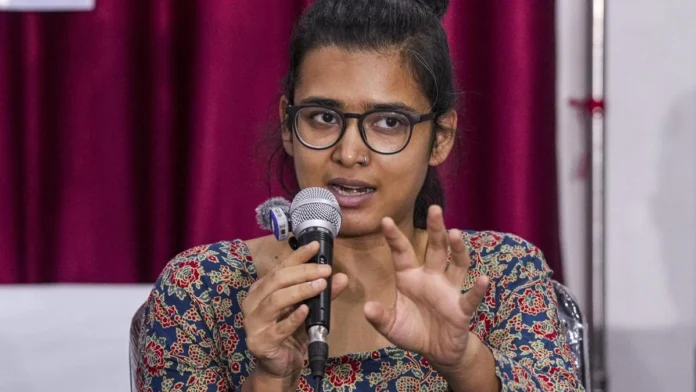
Last week, Neha Bora said her movement is inspired by Bangladesh. She said it plainly, as the face of this October’s protests. Sit with that for a second, because it says everything about where this trending reel generation’s politics is headed.
I watched the same script unfold at Jadavpur University, where factions aligned with her politics cheered Sheikh Hasina’s ouster, a democratically elected woman, as a triumph of the street over the ballot box. Bora took the same line in Delhi: in July 2024 she stood at Jantar Mantar behind placards demanding the defeat of the “autocratic, anti-people force in Bangladesh.” What came after never drew the same crowd. When Bangladesh finally voted in February, the Awami League, the party of 1971, was barred from the ballot. Jamaat-e-Islami, a party that stood with Pakistan in 1971 and was banned by Hasina’s government in August 2024, returned with its best showing in history. Its alliance took 77 seats, more than four times its previous best, and became the main opposition.
The BNP won the government, and Jamaat does not rule Dhaka. But a movement that called itself anti-authoritarian removed an elected woman, saw her party shut out, and handed the party that opposed Bangladesh’s birth the biggest platform it has ever had. That is the politics of East Pakistan coming back, in practice if not in name. It started with a wave of attacks on Hindus and other religious minorities.
Follow these uprisings anywhere, and you get the same script: the grievance never gets solved, and the protest just migrates to its next host country. That is how a franchise works: the model is drafted abroad, and the local branch supplies the anger. So ask the question Dhaka never did: whose interest did the model serve? People asked it in 1928, and no one has answered it yet.
Dear Neha Bora,
Subhas Chandra Bose asked first. In May 1928, presiding over the Maharashtra Provincial Conference in Poona, he answered the communists who attacked nationalism. Their attack, he said, “unconsciously serves the interests of our alien rulers.” India should “first secure the right to shape our own destiny”; to talk “openly of class war” before then was “a crime against nationalism.” He even mocked the comrades who “openly advocate the use of British or foreign cloth on the plea of internationalism.”
Seven years later, in The Indian Struggle, published in London in 1935 and promptly banned in India, he gave “several reasons why Communism will not be adopted in India.” They still read like a forecast. Communism “today has no sympathy with Nationalism in any form,” he wrote. Its hostility to religion came out of Russia’s church, which India never had. And its materialist reading of history would “not find unqualified acceptance in India.” Hold on to those three, because your tradition has spent a century proving each one.
His rule was simple: secure the nation’s destiny first, then argue about everything else.
Note which nation he meant. India is not just a political arrangement drafted in 1950. It is the longest-living, thriving civilisation, and its freedom fighters and writers, Bankim among them, knew it. Tilak, Aurobindo, Savarkar, Bose: cultural nationalists, every one, and proud of it. Bhagat Singh went to the gallows for a motherland, not a framework. Bose believed in the kind of socialism that would benefit India, but he kept the communists at arm’s length.
So when the reel generation announces that patriotism is lovely and nationalism sinister, it repeats, with great confidence and no reading, a distinction no freedom fighter ever drew. It was imported, like the rest of the line.
You lead AISA, the student wing of CPI(ML) Liberation, a “students’ body” whose founding texts end in the dictatorship of the proletariat. This October you marched at the head of young Indians who say, straight-faced, that they are protecting democracy. You sat through a twenty-three-day hunger strike over real exam leaks. Nobody doubts your courage. The question is Bose’s: when India’s interest and the international line collide, which do you choose? And why should the Gen Z of a civilisational nation choose you as their leader? What are you offering? Your tradition has answered for a hundred years, and there are a number of hardcore reasons why you and your doctrine must not be voted into power.
On 17 October 1920, the CPI was founded in Tashkent, on Soviet soil, under the Communist International. Bose and Savarkar both found the Soviet counterweight tactically useful against a common empire, and both said India would never adopt the ideology wholesale. Tactics for them. Theology for you.
It ran like a franchise from the start: doctrine from abroad, branch at home, local anger as raw material. Moscow set the line until the 1960s, Beijing after. The supplier changed, the business model didn’t. Read your “international solidarity” as an address.
| Organisation | Status | Youth wing |
| CPI | Registered | AISF, AIYF |
| CPI(M) | Registered | SFI, DYFI |
| CPI(ML) Liberation | Registered, holds seats | AISA, RYA |
| SUCI(C) | Registered | AIDSO |
| CPI(Maoist) | Banned under UAPA since 2009 | Fronts, by its own documents |
They differ on method. They agree the Indian state is a class enemy’s machine, whoever runs it. In 1942 the enemy was the British state. In 1948 it was the Congress state in Delhi and the Nizam’s in Hyderabad. In 1967 it was every state the republic had built. Today it’s a BJP state. Tomorrow it would be a Congress one the moment Congress governed without your backing, and the day after, whatever coalition you helped install.
The ruling party is incidental. A few years back, Congress was a bourgeois landlord party. Today the BJP is an upper-caste Hindutva party.
The theory needs an enemy at all times, because a revolution without a permanent crisis is just a protest that can’t explain why it’s still protesting.
You haven’t been fighting this government. You’ve been fighting the idea of government since Tashkent. And no youth wing here is simply “students.”
Your marches carry Bhagat Singh on red cloth, Azad beside him. Singh read Marx but never joined the Communist Party or took a line from Moscow. Arya Samaj Sikh family, DAV school in Lahore, heir to Khudiram Bose, who hanged in 1908 with Vande Mataram on his lips. Azad shot himself at Alfred Park rather than be taken. Udham Singh took the name Ram Mohammad Singh Azad and shot O’Dwyer for Jallianwala Bagh.
You won’t print Udham Singh on a T-shirt. You’ll print Che, and never what he did: La Cabaña, 1959, tribunals and the firing squad; Cuba’s UMAP camps, which held gay men and believers. Even Castro later called that persecution “a great injustice.” An Indian who shot O’Dwyer for Jallianwala Bagh is too local for the banner. An Argentine who ran Havana’s firing squads is universal.
Your tradition never honoured them. Leninist doctrine held armed individual action a substitute for revolution, and filed Anushilan and Jugantar in the same bracket. A Delhi University textbook co-written by Bipan Chandra calls Singh a “revolutionary terrorist”; when his family protested in 2016, DU withdrew only the Hindi edition. Tilak, who used Hindu festivals to pull the masses into politics, and Aurobindo, who gave nationalism a spiritual vocabulary, were filed as communal and reactionary. Savarkar and Bose got the same. Whoever mobilises Indians through something Indian is suspect. Whoever does it through a Russian or Chinese template is progressive.
Song was the sharpest test. Bankim’s Vande Mataram carried the Swadeshi years. The left dismissed it as communal and Anandamath as the same sin, while the Internationale, sung in translation, was universal. A Russian hymn to world revolution was progress. A Bengali hymn to the motherland was Sanskritised and suspect. The difference was never the poetry. It was where the party took its orders. You borrow their faces and leave their beliefs at the door.
In June 1941, Hitler invaded the USSR, and the CPI decided the war was a “People’s War,” because Moscow needed it to be. When Gandhi launched Quit India, and the leaders went to jail, the communists backed the British war effort. The Adhikari thesis applied national self-determination to India as though it were a prison house of nations, handing the Muslim League’s demand for Pakistan a Marxist alibi. And Bose, who struck a hard bargain with Imperial Japan to free his own country, became in the party press a fascist puppet and Tojo’s running dog. Defending the Soviet Union came first. Defending India didn’t make the list.
Your comrades love noting that the RSS and Hindu Mahasabha stayed out of Quit India. Staying out is one thing. Working against it is another, and only your party did that. As Congress president in 1938, Bose barred members of both the Mahasabha and the League. Your tradition fights communalism on one flank and calls that secularism.
In 1948, the Calcutta Thesis called for insurrection: Yeh azadi jhooti hai, this freedom is false. Telangana fought the republic until 1951. In 1962, Chinese troops crossed the border, and the government detained the pro-Beijing faction that became the CPI(M). In 1967, People’s Daily hailed Naxalbari as “Spring Thunder over India.”
CHARU MAJUMDAR CALLED parliament a trap and preached “annihilation of class enemies.” Landlords, policemen and villagers branded informers died alike. In 1970, in my own Kolkata, his followers beheaded the statue of Vidyasagar, who taught Bengal to read. This was not a peasant war fought for peasants. Majumdar borrowed his line wholesale from Mao, to please Beijing as much as to feed anyone.
The villages were the stage. Beijing was the audience.
Kanu Sanyal, who stood beside him at Naxalbari, later rejected the killing. Kobad Ghandy was expelled for writing honestly about Maoist brutality. Your party contests elections now, credit where due, but the programme still speaks of a “people’s democratic revolution.” Which part of Majumdar’s allegiance have you left behind?
In 1979, Jyoti Basu’s Left Front blockaded Namasudra Dalit refugees, who had fled East Pakistan for their faith, on Marichjhapi island. Boats sunk, food and water cut, the dead uncounted. In 1982, sixteen Ananda Marga monks and a nun were burnt alive at Bijon Setu, with no conviction to this day. In 2007, police firing at Nandigram killed fourteen. Marichjhapi’s refugees are exactly the people the CAA now protects.
Your tradition starved them in 1979 and marched against their citizenship in 2019.
The Maoists, the armed heirs of Naxalbari, merged into CPI(Maoist), whom Manmohan Singh called “the single biggest internal security challenge”, kept a ledger: seventeen policemen at Laheri in 2009, seventy-six security personnel at Chintalnar in 2010, nearly 150 dead in the Gyaneshwari Express derailment, almost the entire Congress leadership of Chhattisgarh at Jhiram Ghati in 2013. The Adivasis of Bastar, Dantewada and Gadchiroli paid most: shot as informers, schools bombed, roads never built, children recruited before they could read. A villager in August 2026, on the men who brought this war to the forest: “Even if I forgive them, our villagers won’t.” Armchair revolution is cheap. Its bills are paid in Bastar.
Your party line says the tribal took up arms freely against an exploiting state. There is truth in the exploitation. But “freely chosen” doesn’t hold up against how the movement enforces itself. Refusing to join, feed, or shelter has carried a documented cost: death dressed as punishing an informer. Whether commanders enriched themselves while the base stayed poor needs investigation, not rumour, and I won’t print an unverified charge.
A second weapon is the unverified atrocity claim. Rape and custodial abuse allegations against security forces in Bastar and Kashmir have gone public before any FIR or inquiry. Some were confirmed. Others collapsed, and the retraction never travelled as far as the accusation. Where abuse happens, prosecute it. But you can’t weaponise doubt about the army on Tuesday and expect it to guard the villages you claim on Wednesday. Your own father wears that uniform, by your own account. Why did you turn on it?
The Maoists wrote down how they meant to win the cities. Their 2004 Urban Perspective names students, teachers and intellectuals as the front line. “Urban Naxal” comes from their own plan, not an insult. Those in Bhima Koregaon remain accused, not convicted, and due process must run. But notice how fast the language of human rights gathers around an insurgency that never respected one. Similarly, after Chintalnar, the BJP, then in opposition, declined to demand the Home Minister’s head because the Maoists would have called it a win. That’s what a patriotic-nationalist opposition looks like.
FOR FIFTY YEARS, your movement has owned Bastar’s cause without answering for its condition: no all-weather roads, no school past primary, no health centre in walking distance, in districts guarded as liberated zones against a state trying to build in them. Roads don’t get built in a live insurgency, because roads are how the state walks in. A pregnant woman is carried on a cot between bamboo poles to a district hospital ten kilometres off, a sight so common it has become wallpaper.
Purulia is fresh proof. Its water crisis lasted decades in a belt within the Maoist corridor on the Bengal-Jharkhand border. The JICA-funded pipeline was inaugurated in August 2026. Whatever share of the delay is apathy and whatever is the difficulty of building through contested ground, the villagers hauling water weren’t asked to adjudicate.
You call the RSS fascist and saffron terrorists. You can, but look at your own halls of red terror, in India and globally. Stalin hangs beside Marx, Engels and Lenin at CPI(M) congresses. Mao’s portrait has hung for decades in student union rooms from Kolkata to Kannur, the Mao whose Great Leap Forward killed an estimated fifteen to forty-five million. The Black Book of Communism put the century’s toll near 100 million. Historians argue over figures, but even cautious estimates run to tens of millions. No Indian communist party has taken down a portrait or apologised. Whoever garlands those faces and won’t condemn what was done under them is an apologist for the red terror, whatever the T-shirt says.
You march for freedom and democracy. Try it in the countries your doctrine built. Every one-party state that ruled in communism’s name ran on the same machinery: a party above the law, a controlled press, captive courts, prisons for marchers. China shut the square in 1989 and kept it shut, and by Amnesty’s long-running estimate, executes more people each year than the rest of the world combined, while treating the figure as a state secret. Cuba, Vietnam and North Korea sit near the bottom of every press freedom index. The hunger strike, the barricades, the slogans that reached foreign papers in a day: none of it is legal in the systems you admire. You use a freedom your ideology has never granted anyone.
You call religion the opium of the people and sneer at a goat sacrificed before a deity. What were your own idols doing? A portrait garlanded yearly, criticism treated as heresy, doctrine recited like scripture, failures excused as a devotee excuses a flawed avatar. That isn’t atheism. It is a political religion, with a death toll in tens of millions rather than one goat at a time. Call it a mass delusion, if you like. Bengal makes the contradiction plainer: party offices that denounce religion as false consciousness still put up a pandal every autumn. Cadres who call Hindu identity communal in February measure cloth for Durga’s idol by September, because Puja was relabelled a Bengali cultural festival. You can’t be Marx on Monday and Mahishasuramardini on Mahalaya and call other Hindus communal for doing openly what you do by another name. Bose’s second doubt is settled every autumn, in your own pandals.
Then comrades start teaching Hindus what Hindus believe. They repeat that Hindus can never accept the tiranga because three is inauspicious. The line isn’t theirs. It comes from an Organiser editorial of 14 August 1947, which Congress has waved at its rivals ever since. A bad editorial in one weekly, not Hindu doctrine. Three is the Trimurti, the Tridevi, the Triveni at Prayag, Shiva’s trishul. When a communist instructs Hindus on what their faith finds auspicious, it is a red flag, and you carry one.
EVERY DAY, YOUR MOVEMENT lectures India on patriarchy and caste. Look who runs the pantheon: Che, Mao, Stalin, Lenin. Marx fathered a son with Helene Demuth, his family’s unpaid housekeeper. The Soviet Politburo admitted two full women members in seven decades: Yekaterina Furtseva, whom it pushed out, and Galina Semyonova, in its final year. Mao said women “hold up half the sky,” yet the CCP has never put one on its Standing Committee. No woman has led the CPI, CPI(M) or CPI(ML) as general secretary. The CPI(M) admitted its first woman to the Politburo only in 2005, Brinda Karat, wife of the new general secretary Prakash Karat, after eighty-five years of communism in India lecturing the country on gender. In Kerala in 1987, the party campaigned on K.R. Gouri Amma’s name and gave a man the chief minister’s chair. In 2021 it dropped K.K. Shailaja, its most popular minister.
And Bora, the journalist Ruchi Tiwari says you called for her to be stripped in public at Delhi University in February. AISA called her account of the attack lies. Answer it anyway before you lecture anyone on women’s safety.
Caste is worse. The template arrived with Moscow’s categories, class not caste, and a doctrine built to read Petrograd’s factories could not see an Indian village. The CPI(M) took fifty-eight years to seat a Dalit on its Politburo. Ambedkar saw it coming: in Buddha or Karl Marx he rejected the communist path because it rested on violence and a dictatorship he warned would never wither away. Nor did a communist government free India’s queer citizens. The Supreme Court did, in Navtej Singh Johar on 6 September 2018, with the Union government declining to oppose it. The doctrine whose saints you print on banners never allowed any of it. It allowed only the party.
India gave the Dalai Lama refuge in 1959. China still holds Aksai Chin, claims Arunachal as “South Tibet,” holds the Shaksgam Valley Pakistan handed over in 1963, and runs its corridor through Gilgit-Baltistan. Twenty Indian soldiers died at Galwan in 2020.
You march for Gaza, Havana, Caracas, Vietnam. You do not see PoJK, Aksai Chin, or the Hindu, Sikh and Buddhist minorities in the lands carved from India, where temples vanish and populations shrink by the decade. A solidarity that reaches Havana but stops at India’s amputated borders isn’t internationalism. It is a careful silence.
The pattern is older than any hashtag. In 1998, Vinod Mishra, then general secretary of your own party, wrote that the Pokhran blasts posed “a threat to democracy” and warned of “ultra-nationalist frenzy.” He named the P-5 and the BJP. He did not name China, which had held the bomb for thirty-four years and was helping Pakistan build one. When Beijing struck in 1962, a wing of your tradition could not call it aggression, and the party split.
In 2008 the Left pulled support from the UPA over the nuclear deal while Beijing was blocking India’s waiver at the Nuclear Suppliers Group, and that same year Congress, your partner today, signed an MoU with the Chinese Communist Party. Scroll the Left’s timelines now, and the admiration is open: the poverty miracle, the infrastructure model, the party that knows best. Nobody asks how a country that cannot be criticised on its own internet got to the top, or why Tibetans and Uyghurs never appear in the thread.
Whenever India defends itself, a comrade explains why it shouldn’t. Whenever China moves, the same comrade finds context.
In December 2019, your movement needed a crisis, so it borrowed one. It told Indian Muslims the CAA would strip their citizenship and the NRC would march them to camps. Seven years on, no Indian Muslim has lost citizenship under the CAA, and no national NRC was announced, but the fear did its job. Shaheen Bagh blocked a road for three months. Northeast Delhi burned in February 2020, fifty-three dead. In January 2026, the Supreme Court denied bail to Umar Khalid and Sharjeel Imam over their alleged central role in the conspiracy.
Let the trial decide. But your marches have already branded the Chief Election Commissioner a “vote chor” without any finding.
You stand with Arundhati Roy, with Prashant Bhushan, who called for a Kashmir plebiscite in 2011, with Yogendra Yadav. Your allies have a plan for power too: on 1 October, Gaurav Gogoi promised that the day after Rahul Gandhi becomes PM, a case will be filed against Himanta Biswa Sarma and he will go to jail. Prosecutions decided by election results.
A protest over exam leaks became a demand to remove the CEC, then a demand that the SIR be “completely halted,” though the Supreme Court upheld it in May, and your Kerala allies had fought their April election on those very rolls. The only vote theft the Court actually found this season was in AAP-ruled Punjab: fifty ward elections set aside after a court-appointed inquiry found candidates assaulted, threatened and kept from filing their nominations. Your movement said nothing. A movement demanding dignity from one side of the barricade only isn’t asking for dignity. It’s asking for immunity. And when a crisis has to be manufactured, ask whose interest it serves. It was never Northeast Delhi’s.
A fair indictment admits the other side. The British jailed communists at Meerut. Land reform in Kerala and Operation Barga gave millions land rights. The Maoists killed hundreds of CPI(M) cadres in Jangalmahal. Most young people under a red flag are lawful citizens exercising lawful rights. The charge isn’t against each of them. It is against a doctrine that, whenever India’s interest and the international line collided, chose the line.
Nehru, who borrowed Soviet planning but never Soviet politics, held that communism’s reliance on violence and coercion ran counter to democracy and India’s progress. Buddhadeb Bhattacharjee tried an industrialising communism modelled on post-Mao China and met severe friction from his own party. You can go only as far as the ideology allows.
Bose saw it coming long back. Loyalty, faith, history: all three of his doubts have been tested since, and all three held. The Left governed Bengal for thirty-four years and never took root in the Indian mind. Look at it now: a rump in Parliament, its Bengal cadres at the pandal. Netaji’s prophecy holds in 2026.
This isn’t abstract to my family. My maternal uncle was a Leftist who worked for the party in Bengal. In the years of political violence, CPI(M) cadres reportedly picked him up, mistaking him for another uncle they meant to target. They let him go when they realised he too belonged to their party. They spared a man not because his humanity mattered, but because his party card did.
When your own comrades can become your targets, what exactly are you liberating? Kolkata’s canals know the answer.
Solzhenitsyn, who survived the Gulag, left one instruction: personal non-participation in lies. Bose left another: secure the nation’s destiny; argue the rest after. He brought every faith and caste into one army under one greeting, Jai Hind, and gave women their own regiment decades before your party gave one a Politburo seat.
Fight the exam leaks. Demand clean rolls. Go to Bastar and listen before you speak for it. Go to Purulia and ask why the tap took so long. But don’t let a franchise that backed the Raj in 1942, called freedom false in 1948, looked to Beijing in 1967, beheaded Vidyasagar in 1970, starved refugees in 1979, and still hangs a mass murderer’s portrait in the halls that raised you, sell you Bhagat Singh’s hat.
Say it plainly, comrade. 1942 was betrayal. 1947 was real freedom. Singh was a revolutionary, not a terrorist; Bose a patriot, not anyone’s dog. The tens of millions who died under Mao and Stalin were murdered, not mislaid, and their portraits belong in no classroom. Tibet was occupied; Arunachal is India. Marichjhapi deserved citizenship, not starvation. Bastar and Purulia deserved roads and water, not a war fought in their name by people who never had to live in it.
Say that when India and the line collide, you choose India. Every time.
Bose asked first, Neha. India is still waiting.