

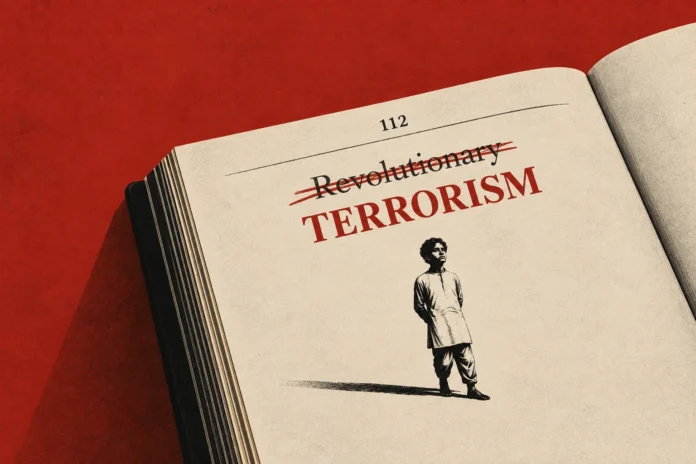
IN 2014, A CLASS VIII CHILD IN MIDNAPORE opened a state history book and found the district’s most famous son under a heading that read, in Bengali, biplobi santrasbad. Revolutionary terrorism. The English twin of the same reader, Our Past, Our Heritage, put the compound on page 112. Under it sat Khudiram Bose, Prafulla Chaki and Jatindranath Mukherjee, Bagha Jatin, filed as “extremism and terrorism.”
A translated line from the chapter is worse than a slur, because it pretends to be method: “Towards the latter half of the freedom struggle, especially around 1908, revolutionary terrorism became a dominant phenomenon. Many opted for isolated personal attacks on British officers instead of an organised freedom movement.”
Khudiram was hanged at eighteen in Muzaffarpur jail on 11 August 1908. The bomb had hit the wrong carriage. Mrs Kennedy and her daughter, family of the barrister Pringle Kennedy, were in it. Miss Kennedy died within an hour; her mother died of her injuries on 2 May. Kingsford, the target, walked away. Bratya Basu, the education minister whose government had the book in print, called the row “necessary and welcome” and said the pre-Independence meaning of “terrorist” was “not relevant now.” The chapter stayed.
Mind you, A 2020 Class VI reader, same state board series, ran a parallel sketch: Bhagwan Ram as nomadic-invader, Ravan as native victor-written-villain, resting on a nineteenth-century aryan race theory that neither the epic nor modern science supports. Same habit, same board, one book younger. Currently, this matters again because of a television series. Nikkhil Advani’s The Revolutionaries, which premiered on Prime Video on 11 September 2026, draws on author Sanjeev Sanyal’s 2023 book and treats the cells from Calcutta to Tokyo as one war, not a string of separate martyrdoms. A streaming drama is now doing the work a schoolbook refused. Before we ask Bengal’s directors to tell this story, we have to fix the page.
THE STREET DID COME OUT. It did not last. In August 2014, teachers and students of Midnapore Collegiate School, led by their headmaster Dilip Das, walked to the Board’s district office and called the heading an insult. The BJP stood outside the Board headquarters in Kolkata. SUCI’s student and youth fronts held smaller protests. Chandra Kumar Bose asked whether it was ignorance or design. Board historians still called the word factual.
Five years later, the fight came back as a file, not a procession. In July 2019, CPI(M) MLA Pradip Saha stood in the Assembly, handed Speaker Biman Banerjee the book and pointed to page 112. Education minister Partha Chatterjee called it a mistake. A review panel under Jiban Mukhopadhyay, a retired college history teacher and Trinamool MLA, recommended dropping “terrorism” and keeping “armed revolutionary,” because the word sent the wrong message to children.
That is the whole rally record: one district march, one gate, one book handed across the Speaker’s desk. For five years after the school marched, children were still reading santrasbad. From 1918, when a colonial committee minted the compound, to 2014, when a Bengali child had to swallow it, is ninety-six years. To today, one hundred and eight.
NO BYLINE SAT ON THAT PAGE. The Statesman looked for the author’s name and found none. That is not an accident. The noun did not crawl out of a village press. It came down a ladder: university phrase, Board committee, unnamed school page.
The book that trained the teachers was Bipan Chandra’s India’s Struggle for Independence (1987 to 88), written with Mridula Mukherjee, Aditya Mukherjee, K. N. Panikkar and Sucheta Mahajan, and later standard reading at Delhi University. Chapter 11 is “The Split in the Congress and the Rise of Revolutionary Terrorism.” Chapter 20 is “Bhagat Singh, Surya Sen and the Revolutionary Terrorists.” Chittagong is a “terrorist act”; the killing of Saunders an “act of terrorism.” The authors defended the phrase as technical, used “without any pejorative meaning, for want of a different term.”
In 2016, the Deputy Chairman of the Rajya Sabha, P. J. Kurien, asked the Union government how that heading was still in a DU book. Chandra had said in 2007 that he would not choose the word again. The reprints had already done the work. When Board historians were pressed in 2014, they did not deny the word; they defended it as the reality of that time. Irfan Habib’s dry line on the controversy was that we have a habit of carrying forward the British tradition. He was describing the habit, not blessing it.
BHAGAT SINGH ANSWERED THE HEADING while he was still alive. In February 1931, weeks before the rope, he wrote: “Apparently I have acted like a terrorist. But I am not a terrorist,” except perhaps at the start of his revolutionary career. Sachindra Nath Sanyal’s HRA manifesto of 1925 had said it first: Indian revolutionaries “are neither terrorists nor anarchists.” The men under the heading rejected the noun. The books kept it.
WHOSE NOUN IS IT? It is older than Trinamool, older than the Left Front, older than independent India. British police already said “anarchist” and “terrorist.” The compound that reached a Bengali child comes from the Sedition Committee Report of 1918, Justice Sidney Rowlatt sitting in Calcutta, and then the Rowlatt Act of 1919. Biplobi santrasbad is that English charge sheet, translated. No Congress working committee minted it. No CPI resolution minted it. A colonial committee did.
Gandhi did not need the police word. He had his own ranking: the bomb was the wrong method, the underground a brief interruption of satyagraha. That ranking was not invented for Bhagat Singh. In Hind Swaraj (1909), writing on Madan Lal Dhingra’s shooting of Sir Curzon Wyllie, Gandhi called Dhingra “a patriot, but his love was blind,” a man who “gave his body in a wrong way,” and in Indian Opinion called the act itself a “heinous sin.” Twenty-two years later, after Bhagat Singh’s hanging, he wrote in Young India that the courage was genuine and the method still wrong, warning against turning the execution into a “cult of the bomb.” Dhingra in 1909 and Bhagat Singh in 1931 get the identical ranking: wrong method, not criminal. That was his standing register for the whole armed line, including Rash Behari’s Japan years, Bagha Jatin and Azad’s last stand in Alfred Park. He disagreed with the pistol. He never once reached for Rowlatt’s compound to say so.
After Chauri Chaura, he stopped the movement, and the Gandhi-Irwin Pact did not save Bhagat Singh. After 1947, Congress needed a plot in which the party, not Jugantar, delivered the transfer of power. The ashram became the compulsory chapter; the armed stream became a “phase.” Congress rarely gazetted “terrorist.” It sorted the dead into a quieter drawer.
The Communists used the word while the men were still alive. On 13 November 1930, as Bhagat Singh and his comrades waited on the Lahore Conspiracy verdict, the party’s weekly, Workers’ Weekly, ran an editorial titled “Lahore: The Cynosure of the Petty Bourgeoisie”. Following a Comintern line to unmask non-communist revolutionaries, it dismissed the HSRA’s armed resistance as a “psychology of revenge” and “petty-bourgeois extremism.”
A decade later, the party set its calendar in Moscow again. When Germany invaded the Soviet Union in June 1941, the war became a “People’s War” overnight. Legally, again under the government that had the Congress leadership in jail, the party opposed Quit India. Its paper, People’s War, called Subhas Chandra Bose and the INA “traitors,” “arch-traitor,” “henchman,” “rapine loot and murderer,” “Tojo’s master,” the “advance guard of Tojo” and “Hitler,” and turned the same ink on Gandhi and Nehru for launching Quit India. Decades later, Jyoti Basu and others called the wartime verdict on Netaji a “wrong assessment.” By then the insult had done its work, and the same current had staffed the departments that trained the teachers.
Chandra’s headings are that dialect: praise underneath, Rowlatt’s noun on top. The British gave the noun. Congress gave the moral hierarchy. The Left gave the title. Trinamool printed page 112. The child got it all at once.
TWO VOCABULARIES, ONE TARGET. The Raj gave us the word terrorist. It did not give us jingoism or hypernationalism. Jingoism is a nineteenth-century British music-hall and parliamentary jibe, aimed at Britons. Hypernationalism is a twentieth-century academic term for how European patriotism curdled into fascism. No district magistrate in Bengal used either word on a boy with a bomb. Indian institutions imported them a generation after the empire left, borrowed from a European argument about a European catastrophe, and pointed them inward at Anushilan, at Bankim, at Bagha Jatin’s river. At the love itself. The charge sheet was written for the armed underground. The second vocabulary targeted the feeling that made the underground possible.
The reuse is not hypothetical, and it did not stop at the 1940s. In December 2019, the historian Ramachandra Guha told a Bengaluru audience that Hindutva nationalism “is jingoism,” borrowed from a nineteenth-century European model rather than the pluralism the republic was built on, in the same breath accusing the communist Left of its own failure, calling it “anti-patriotic” for “worshipping another country.” Kancha Ilaiah Shepherd, writing in The Hindu in 2017 under the headline “Are we turning into a nation of hyper-nationalists?”, named the post-2014 mood hyper-nationalism, a climate in which criticism of the ruling party becomes anti-national, and Pakistan, Muslims, Dalits and universities supply the props. Both are serious academics, not pamphleteers, and both reached for a word minted for a Westminster drinking song and a Weimar collapse to describe an Indian electorate’s pride in its own country. The seminar did not borrow the vocabulary once, by accident. It kept borrowing it, from one decade’s communal file to the next one’s political file, and the target each time was the same: an Indian loving India too audibly for the room.
Tagore was drafted into this older borrowing first, and the licensing still runs on half of him. The licensed Tagore, the one syllabi reached for, is the 1917 lecturer of Nationalism and the author of Ghare-Baire: the Nation as a Western machine, Swadeshi as a fever that could exclude the Muslim peasant. That Tagore is real. It is half of him. The same man wrote Hindu Musalman and the Kalantar pieces, and after the 1931 riots wrote to the press that both communities must stop recrimination, that separate electorates and official nomination had sown the split, that poverty and social distance did the empire’s work. He turned Rakhi into a public Hindu-Muslim bond against the 1905 Partition and wrote Banglar Mati Banglar Jol for the same street. He hammered Hindu custom without fear and stepped more softly on Islamic practice, fearing a public scolding would feed extremism. That caution is documented. It is no licence to quote him only against Devi-ma. He was made a lock on one door while the other door, his critique of political separatism, was left open and called secularism.
He was also a poet, not a conspirator, born into the most privileged household in Bengal, and I say that without contempt. He could write freely without worry because someone was watching the gate of his mahal, or his brothers and father were handling business and social matters. Thus, a pen moved a nation before any soldier did. But it is not the same instrument as a pistol on a riverbank near Balasore, and a state that quotes his caution against the Nation but never his caution against separatism has not honoured him. It has used him.
The same asymmetry runs straight through to Guha and Ilaiah: a critic who borrows a European catastrophe-word to warn against this country’s fever is doing serious work, and a critic who borrows the same word and never once turns it on the fever that produced Charu Majumdar’s portrait is doing something narrower than scholarship. One standard, or none.
A MOTHER IS NOT A COMMUNITY. The hymn was halved the same way. In 1937, on Tagore’s advice, the Congress Working Committee adopted only the first two stanzas of Vande Mataram as the national song, since the later verses invoke Durga. Subhas Bose wanted the fuller song. Nehru, Gandhi and Maulana Azad sat on the committee that accepted the cut. In 2026, we are still arguing over whether the full song may be sung.
A mother is a relation, not a census form. The first two stanzas ask a subject people to bow to the land that bore them. Calling that communal is a later operation: point at Durga in the later stanzas and at harsh lines in Anandamath, and teach children that love of soil is a Hindu plot.
The record is more mixed than the Muslim League’s later doctrine admits. Police notes of April 1920 record a Sholapur Idgah meeting under Shaukat Ali where Bande Mataram was sung before the address, and Gandhi wrote that Shaukat wanted three common cries: Allahu Akbar, Bande Mataram and Hindu-Musalman ki jai. It was not unanimous: Muhammad Ali Jauhar walked out when the song began at the 1923 Kakinada Congress, and from 1937 Jinnah, who had sat through Congress sessions where it was sung, called it idolatrous. That is politicisation, not a verse that changed its religion.
Others stayed with the song. Dr M. A. Ansari presided over the 1927 Madras Congress, where it opened the house. Abdul Rasul presided over the 1906 Barisal conference, where police beat delegates for singing it. The writer Rezaul Karim said it gave a speech to the mute. Hasrat Mohani, Saifuddin Kitchlew, Khan Abdul Ghaffar Khan and Rafi Ahmed Kidwai belong on the same list. None of them became less Muslim.
And the communal file does not survive the scaffold. Ashfaqullah Khan of the Kakori case was hanged at Faizabad on 19 December 1927, a practising Muslim who went to the rope with the kalima on his lips. His comrades Ram Prasad Bismil and Roshan Singh were hanged the same week at Gorakhpur and Allahabad. The HRA did not ask Ashfaqullah to become a Hindu. It asked him to end an empire. Put him inside Bankim’s hymn, and the trick of calling the song one community’s property fails.
THE SPINE THEY FILED AS A PHASE. The underground was one network across half a century, with nodes in Britain, France, Germany, the United States, Japan and Singapore. Anushilan and Jugantar trained the body before they produced the bomb. Barindra Kumar Ghosh, Aurobindo’s brother, and Bhupendranath Dutt, Vivekananda’s brother, launched the weekly Jugantar in 1906.
Khudiram and Prafulla Chaki hit the wrong carriage on 30 April 1908. Jatin escaped that net and rebuilt Bengal’s command for 1915: a rising timed to a German arms shipment and to the Ghadar movement’s Punjabi returnees, men such as Kartar Singh Sarabha. The plan leaked, and the February 1915 risings in the north collapsed before they began. Jatin, waiting on the Odisha coast for rifles that never landed, was cornered on the Burhabalang near Balasore on 9 September 1915. Five men with pistols held a cordon for over an hour. He died of his wounds the next day. On a map it looks like an Odia footnote to a Bengali story. It was one Bengal command dying at the far end of its supply line.
Rash Behari Bose, hunted for the 1912 attempt on Hardinge and for 1915, fled to Japan and spent three decades building the Indian Independence League, the scaffolding of the first INA. On 4 July 1943 in Singapore, he handed the League and the army to Subhas Bose. He died of tuberculosis in Tokyo on 21 January 1945. Japan remembers him mostly for the curry he helped create at Nakamuraya.
Sachindra Nath Sanyal, the author’s great-uncle and the subject of the book the series draws on, was sent twice to the Cellular Jail and wrote from there that this history was already being erased from official memory. After Kakori, Bismil, Ashfaqullah and Roshan Singh were hanged. Surya Sen turned Chittagong into a town at war for four days in April 1930. Bhagat Singh, raised in a household where his uncle Ajit Singh ran a Bharat Mata Society, read Marx and Lenin in jail, never held a Communist Party card, and was hanged on 23 March 1931 at twenty-three, days after the Gandhi-Irwin Pact had passed over his sentence and four months after Workers’ Weekly had called his method petty-bourgeois.
The women were the network, not its auxiliary. Pritilata Waddedar led the Pahartali raid and took cyanide rather than surrender. Bina Das fired at the Governor at a convocation. Santi Ghose and Suniti Choudhury, teenagers, shot the magistrate of Comilla in December 1931. Bhikaji Cama raised a flag at Stuttgart in 1907. Lakshmi Sahgal commanded a regiment of women through Burma. The hills fought the same war: Tilka Manjhi around Bhagalpur in the 1780s, Sidhu and Kanhu Murmu in the Santal Hul of 1855, Birsa Munda’s ulgulan. Their fight fit neither Congress’s plot nor the Left’s class plot, so it fit no compulsory chapter.
WHO KEPT THE HEADING? The Left Front ran Bengal’s school boards from 1977 to 2011. It did not need an order to strike the underground; the heading was already the house style. Trinamool’s own 2012 review said history had been made to look as if it began with the Bolsheviks, cut back Marx and Engels, and left Santrasbad where it was.
The proportion tells you who was writing. Charu Majumdar, who modelled CPI(ML) on Mao and preached the annihilation of class enemies inside the Indian republic, survives on campus walls as tragic idealism; his portrait can still hang in a Jadavpur union room. Khudiram’s bomb, aimed at an occupying empire, was santrasbad in a schoolbook. That is not proportion. That is a priesthood.
The Left never bothered to build an intellectual tradition from the Bengali mind; it imported the class theory of the soviets instead. We still read Indian history and sociology through that lens. The syllabus it shaped rarely mentions that the party stood against Quit India.
In Bengal, the accountable names are not a signature on page 112, because there is none. They are the ministers and panels who cleared it.
| YEARS | SEAT | WHAT HAPPENED |
| 1977 to 2011 | Left Front boards, unions, WBBSE | Thirty-four years. Bolshevik dose, communal-forces chapter, Mookerjee blank |
| 2011 onward | TMC expert committee | Marx and Engels cut back (2012). Some Bankim dropped from higher-secondary Bengal as difficult. Santrasbad not removed |
| 2014 | Education department under Bratya Basu | Book in circulation. Row called “welcome.” Chapter not pulled. Basu moved to Tourism that year, over a different controversy |
| 2014 | Four-member historian panel | Said the word was not used on Khudiram’s name. Heading stayed |
| 2014 to 2021 | Partha Chatterjee, Education | Pulled a Class XII book over a fallen party singer. In July 2019 called the Khudiram heading a mistake and set the Mukhopadhyay review going. No sackings followed |
| 2017 | Same machine | Singur chapter: Mamata starts the movement, TMC names in, others out |
| Late 2019 | Mukhopadhyay panel | Recommends “armed revolutionary,” five years after the march |
| May 2026 onward | New government, same 2017 Act | Mookerjee in, Singur out, new college presidents |
That is the tell. When a Class XII book offended the party over a singer, it was pulled. A colonial police noun on Khudiram got a committee. No minister resigned over page 112. No Board president was sacked. No author was named, because the byline was already missing.
WHAT THE HEADING COST. NCERT’s flagship Class 12 chapter is built around Gandhi, from Champaran to 1948, with the underground woven around that plot. ICSE’s Class 10 paper makes the INA the single compulsory armed chapter, because Bose cannot be cut without gutting the paper. Jugantar, Ghadar, Balasore and the women of Chittagong remain optional boxes, and in 2026 people learn this history from YouTubers and streaming series. A newer NCERT Class 8 reader reduces Rash Behari, Sanyal, Sarabha, Jatin and the INA to bullet points. That is genuine repair. A list of names restores the fact of a war. It does not yet restore its command, its women, its rivers and its losses on equal footing with the ashram.
POUR THE WATER BACK. None of this asks for new, uncritical saints. Keep Mrs Kennedy and her daughter beside the scaffold. Keep Anandamath‘s harsher lines in the record. What must end is the asymmetry: one armed tradition, aimed at an occupying empire, filed as crime; another, aimed at the republic on a foreign manual, kept as an idea. Tagore quoted only against the hymn. A department that will pull a book over a singer but sacks no one for teaching children that Khudiram belongs beside a word the news now uses for men who fly planes into buildings.
Put Jatin’s river in the same week as the Salt March. Put Ashfaqullah inside the hymn Bankim wrote. Put Birsa’s forest beside Surya Sen’s armoury. Put Bhagat Singh’s own sentence, “I am not a terrorist,” above any chapter title a professor chose for want of a better term.
They were erased first by the invader who wrote the charge sheet, then by a movement that took its cues from a foreign capital, and then, more quietly and for far longer, by countrymen who inherited both insults and found them useful. The names were never missing from the archive, the riverbank, the regiment roll or the hill. What was missing was the willingness to open the right drawer.
And if a production house in Bengal is reading this, the river is still waiting for its own writers’ room.