
Every few years a protest arrives that we are told is spontaneous. Nobody organised it, we are informed; it simply erupted. The people had a grievance, the grievance grew too heavy to carry, and they poured into the streets on their own. This is the story attached to almost every mass agitation. It is almost always false.
Spontaneous crowds disperse by evening. They do not hold a perimeter for weeks. They do not arrive with a press cell, a legal-aid desk, a supply line of food and water, and a list of maximalist demands drafted before the first placard was printed. Genuine anger is real, but anger is only fuel. Fuel does not drive anywhere by itself. Somebody has to build the engine, point it, and keep the throttle open. The interesting question about any large protest is never whether the grievance is real. The grievance is usually real. The question is who built the engine.
Look at the record and one pattern repeats with almost mechanical regularity. In 58 BCE, Rome had a genuine crisis of grain prices and urban hunger. Publius Clodius Pulcher distributed free grain, organised the street collegia into standing gangs, blocked voting in the Senate, drove Cicero into exile, and advanced the Populares faction. The hunger was real. The outcome was a seizure of political ground. In 1789, the bread shortage among the market women of Paris was real; it was the Jacobin and Cordelier clubs that directed the crowd to march the twenty-one kilometres to Versailles and bring the royal family back as prisoners. In 1917, the bread queues of Petrograd were real; it was the Bolsheviks who compressed all of it into three words, “Peace, Land, Bread,” and rode that slogan to the total collapse of the state.
The grievance changes. The method does not.
In May 1968, the trigger at Nanterre was overcrowded classrooms and strict dormitory rules. Real complaints, and small ones. Trotskyist and Maoist groups expanded a hostel dispute into an anti-capitalist assault, ten million workers walked out in a general strike, and the French state was pushed to the edge of collapse over dormitory visiting hours. We do not have to leave India for the template. In 1974, the spark of the Gujarat Navnirman agitation was a twenty per cent increase in the hostel mess bill at L.D. Engineering College. Opposition networks elevated a mess bill into a statewide movement that forced the dissolution of an elected legislative assembly.
In 2019, Chile’s Estallido began with a thirty-peso rise in the Santiago metro fare — four American cents. Student unions and left coalitions launched the “¡Evade!” fare-evasion campaign, and months of rioting ended with the country rewriting its constitution. In Nepal, between 2006 and 2025, feudal grievance and then a social-media ban were each turned into street sieges of the parliament and the executive; the result has been thirteen governments in eighteen years, capital flight, and a generation of young people leaving the country.
A mess bill dissolves a government. Four cents rewrites a constitution. This is not what an organic response to hardship looks like. It is what a technique looks like.
Because the constant across every one of these episodes is not the size of the grievance. It is the presence of an organiser who selected that grievance precisely because it was small, relatable, and attached to a group with high emotional energy and little to lose. The grievance is chosen the way a demolition engineer chooses where to place the charge — not because that spot is the most damaged, but because that spot brings the building down.
The theory behind this was written down, and it is worth reading it in its own words rather than through its slogans. Gene Sharp took nonviolent action away from the moral and religious ground where Gandhi had placed it — satyagraha as a discipline of the soul — and rebuilt it as a pragmatic, operational system for dismantling political power. His central claim is that power is not a solid thing a ruler owns. Power is relational. A ruler commands only so long as subjects obey, officials cooperate, and enforcers enforce.
Withdraw obedience in a coordinated way and the ruler’s power dissolves, because it was never his to begin with; it was on loan from the governed. Sharp broke this into six pillars a state stands on: its authority or claimed legitimacy, its human resources, its skilled specialists and bureaucrats, the intangible habits of obedience in the culture, its material and financial control, and its sanctions — the police and the army. Knock out enough pillars and the structure falls.
To the pillars he attached a toolkit: 198 methods, sorted into protest and persuasion, then noncooperation, then direct intervention like occupations and sit-ins. And to the toolkit he attached a trap he called political jiu-jitsu. Keep the movement rigidly nonviolent, and any force the state uses recoils onto the state — the crowd looks innocent, the police look brutal, the security forces begin to hesitate, and international pressure arrives on cue. The genius of the design is that it weaponises the state’s own response. The state is made to choose between looking weak and looking cruel, and there is no third door.
This did not stay on a shelf, and it did not stay independent. In Belgrade in 2004, after the youth movement Otpor! helped bring down Slobodan Milošević, Srđa Popović and Slobodan Đinović founded CANVAS and turned Sharp’s theory into a training curriculum — standardised, exportable, taught in modules to activists across dozens of countries. CANVAS added its own refinements: dilemma actions, where you paint a slogan on a stray animal or a cluster of balloons so that arresting it looks ridiculous and ignoring it looks weak; movement branding, a single clean symbol like Otpor!’s clenched fist, lifted straight from corporate marketing; and “laughtivism,” the use of satire and street theatre to break a population’s fear.
And it was funded. Sharp’s Albert Einstein Institution and CANVAS took money from United States government-linked bodies — the National Endowment for Democracy, the International Republican Institute, the National Democratic Institute, and USAID. In 2012, WikiLeaks released internal emails from the private American intelligence firm Stratfor showing Popović in close and continuing contact with the firm, trading movement briefs and activist contacts across Egypt, Venezuela, Iran, and Russia. And the framework’s own logic gives away its purpose: Sharp’s playbook targets only the political layer — remove this leader, this government — while leaving the underlying economic alignment and outside interests untouched. It changes who sits in the chair, not whose interests the chair serves.
Which brings us to why students, and not workers, are today’s chosen group. Classical Marxism placed its bet on the industrial proletariat as the engine of revolution. That bet failed in the West, because the post-war working class did not sharpen into revolt; it rose into the middle class and bought houses. The New Left, drawing on the Frankfurt School and Herbert Marcuse, made the pivot that matters here: it abandoned the contented worker and moved to students, youth, and identity groups. The reasoning was cold and practical. Students carry high emotional passion. They are concentrated in one place, the campus, where a crowd can be assembled in an hour. And they carry little immediate economic risk — a worker who strikes loses wages that day, a student who marches loses a lecture. That is the whole appeal. It is a supply of intense, gatherable, low-cost bodies. After the template worked in Paris in 1968, it stopped being a theory and became a procedure.
So there is nothing new in the protests now being sponsored around the alleged grievances of students. The grievance is dressed as the point. The people organising the crowd, supplying the ideological framing, and shaping the narrative to the press are, in the main, of the Left. And the operational bridge into India is not hidden. In 2016, in Goa, Yogendra Yadav held a formal public dialogue with the CANVAS co-founder Srđa Popović, published on the LSE South Asia Blog, examining how Gandhi’s “dilemma actions” like the Salt March translate into a modern civil-resistance playbook. Since then Yadav has left the front line of electoral politics for the more useful role of civil-society convener: on the seven-member apex committee of the Samyukt Kisan Morcha that ran the highway blockades of 2020–21; rallying more than a hundred non-party groups under Bharat Jodo Abhiyaan in 2022–23; and running technical campaigns questioning voter-roll revisions and the integrity of the electoral process itself.
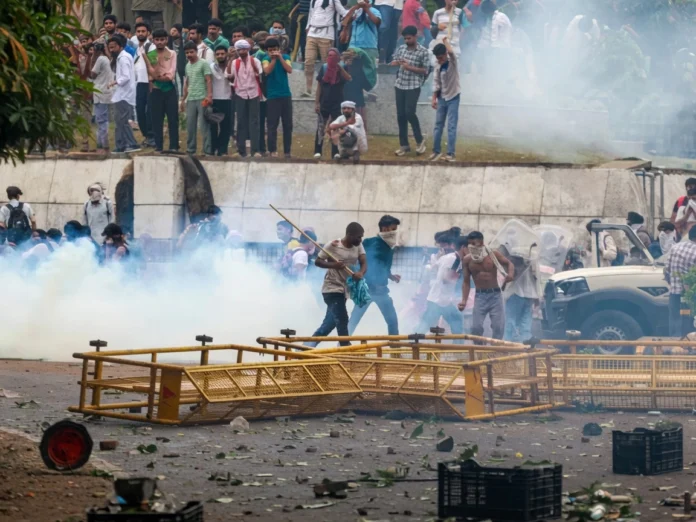
That last item is the tell. The recent student agitations over examination paper leaks, pushed by outfits like CJP, have featured opposition leaders staging sit-ins near the Prime Minister’s residence. Watch the structure of that move, because it is the Sharp trap built to scale. A sit-in at the executive perimeter hands the state two doors and only two. Clear the site by force, and the footage becomes “state brutality against peaceful students,” which grants the movement moral high ground and mobilises the next, larger crowd. Leave the standoff in place, and the government “looks weak and paralysed” while a genuine security risk sits outside the head of government’s home. Every hour the standoff holds, one of those two narratives is being manufactured. That is not a protest that wants its demand met. A protest that wanted its demand met would take the departmental inquiry, the policy fix, the announced reform — and the demands here are kept deliberately nebulous precisely so that nothing the government does can ever satisfy them. An unmeetable demand is not a failure of the protest. It is the design.
It is genuinely astonishing that supposedly politically aware people fall for this — that they read “the students’ concerns are not being addressed” as the story, when the operative objective is to dent the political standing of the BJP. And it fits neatly into the line the Congress and the Left have run for some years now: that because the electoral process is supposedly compromised, power may legitimately be taken in the street instead — by assembling crowds and pushing the government into a corner until it either cracks or is made to look illegitimate.
It does not matter whether Dharmendra Pradhan is competent or not. That is a real question, and it belongs where such questions are settled — at the ballot and on the floor of Parliament. It does not belong in the street. In a democracy no minister can be made to resign by mob violence, and the reason is not tenderness towards the minister. It is that the instant a crowd can extract a resignation, the crowd — and whoever assembles it — has found a lever to dismantle any elected government minister by minister, without ever winning a single vote. A resignation surrendered to a siege is not the end of one man’s career; it is a precedent that hangs over every government that comes after. He cannot be made a sacrificial lamb at the altar of a mob strategy imported from Belgrade.
And notice what has already quietly happened. The examination was held. The NEET paper was conducted and allowed to stand, through the proper channels of the state and the courts — which means the stated grievance has, in fact, been addressed. That is exactly why the demands will not settle, and keep sliding upward towards a resignation and towards the government itself: the cause was never the exam. When the grievance is met and the agitation only grows louder, the grievance was never the object. This is the clearest possible proof that what we are looking at is not a student protest. The students in Paris did not understand what they were rioting for; I do not expect the students here to understand either. That is not an insult to them. It is the whole point of the method — the foot soldier is not meant to understand the operation he is inside.
And there is a warning owed to those foot soldiers specifically, because history is unusually consistent on this. In 1793, Jacques Mallet du Pan observed that the revolution devours its own children, and it has done so every time since. The moderate Girondins were guillotined by the Jacobins. Danton, who built the Terror, was guillotined by Robespierre, who was himself guillotined three months later. Trotsky, co-architect of 1917, was driven into exile and killed with an ice-axe in 1940; nearly every original member of Lenin’s Politburo — Bukharin, Kamenev, Zinoviev — was shot in Stalin’s show trials. And the Kronstadt sailors, the very vanguard who made the October Revolution, rose in 1921 asking only for bread and free speech, and were crushed with military force by the government they had installed. The people who man the barricades are never the people who inherit the state. They are expended first.
So let us be exact about what is in front of us. This is not a grievance that grew into a movement. It is a movement that went looking for a grievance and found one in an exam hall. It is a technique with a written theory, a funded international apparatus, and a named domestic bridge, applied to a chosen group selected for its passion and its low cost. The national interest and basic political stability weigh far more than the complaints of a few lakh people who have let themselves be made into cannon fodder. At this moment it is a political operation, not a student cause — and it must be given no goodwill by anyone who is not already of the Left.