

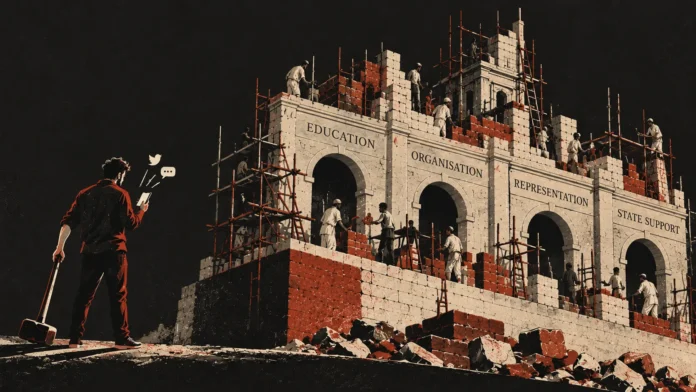
In January 2026 a general-category activist posted an open letter on X to the Dean of IIT Delhi, expressing serious concern about a conference marking twenty-five years since Durban. A second echoed him. A third dispensed with the Dean altogether and tagged Delhi Police, demanding to know why a woman speaker had not been arrested for, as he put it, calling for a genocide of Brahmins. None of this changed anything at IIT Delhi. It added a few posts to three X timelines. The conference they objected to took a quarter-century of advocacy to build. The objections took an afternoon.
The mismatch is worth dwelling on, because it is the whole story in miniature.
A man buys a plot of land, has the plans drawn, digs the foundation and puts on a roof. Twenty years later his son adds two floors; his grandson buys the plot next door. A century and a half passes and there is a neighbourhood standing where the field used to be. Then another man arrives. He posts four tweets, hosts two Twitter Spaces and announces that the whole thing is coming down next month. He says it with such conviction that for a moment the neighbourhood itself begins to wonder whether it has any business still standing.
My objection is not that he wants it down. Several of his complaints are perfectly reasonable. My objection is narrower: he understands neither the engineering of construction nor that of demolition. He has certainly brought a hammer. He has not yet established where the wall is. For the moment he is ringing the doorbell and informing the building that its days are numbered.
This is broadly the condition of the men who have appointed themselves warriors of the General Category. ‘Warrior’ is a rank they conferred on themselves, which is presumably why bureaucratic trifles such as an appointment letter, training, reconnaissance and a map of the battlefield were deemed unnecessary.
Their grievances are not imaginary, and it is worth conceding that at the outset rather than at the end. There are real questions about how reservation is structured, about certain provisions of the SC/ST Act and the way they are enforced, about caste-based policy in universities, about representation and about who gets what from the state. None of these becomes illegitimate merely because the man asking belongs to the General Category. In several areas there ought to be an honest argument about serious reform.
But one elementary question comes before all of that: do you understand how the machinery you have set out to dismantle was actually built? Because the other side did not arrive here on four tweets and a hashtag. It was doing politics before Twitter Blue. It was doing politics when the only blue tick most Indians could see was in the sky.
What we now call, in its various forms, non-Brahmin, Dalit, backward, OBC or Bahujan politics rests on roughly 150 years of intellectual, organisational, legal and political investment. You are looking at the crop. The seeds went in during the nineteenth century.
Begin in Maharashtra. Jyotirao Phule founded the Satyashodhak Samaj in 1873 – and the Satyashodhak Samaj was not a WhatsApp group started on a Sunday afternoon to which 412 people were added on Day One, 287 of whom walked out on Day Three over a disagreement with the admin and founded a rival group.
Before organisation came thought. An alternative way of reading Indian history was constructed. A political vocabulary was built around categories such as Shudra and Ati-Shudra. Books were written, pamphlets printed, a framework assembled for understanding caste and social authority. Nobody was told at the outset to go and change the government at the next election. They were told first who they were, what their history was, where their interests lay and through which lens the existing order should be viewed. That entire process is now considered complete once somebody has written a thread. Append ‘this is the truth nobody will tell you’ and History politely steps aside.
None of it happened in a vacuum. Nineteenth-century colonial India was a churn of missionary polemic, Orientalist classification, Western education, print networks and indigenous social conflict. Phule did not simply absorb what came out of those worlds, but his intellectual universe did not sit outside them either. This is the first stage of any serious movement: it builds an explanatory universe. What words will people use to describe their own condition? Inside which historical story will they place themselves? What collective self will they imagine? These things are settled long before anyone votes. A movement draws a map inside the head first. The procession comes afterwards. Our warriors have begun with the procession and intend to ask someone for the map on the way.
Then came organisation, and after organisation, patronage. Shahu Maharaj of Kolhapur matters here because non-Brahmin education, representation and government employment acquired state backing under him. And there is a thread running out of Kolhapur that deserves, at minimum, curiosity. A British officer involved in Shahu Maharaj’s administrative training was Sir Stuart Mitford Fraser. Fraser went on to become tutor and guardian to the young Maharaja of Mysore, Nalwadi Krishnaraja Wadiyar IV, from 1896 to 1902; the UK National Archives catalogue identifies him first as tutor at Kolhapur and later as tutor and guardian at Mysore. In time both states became significant centres of non-Brahmin representation.
The colonial establishment, in other words, was not an innocent spectator standing outside the theatre and returning after the interval with a packet of peanuts. British officers were educating princes. The bureaucracy was classifying communities. The census was sorting people into categories. Representation in government service was becoming a measurable quantity. The state was deciding the boxes through which society would be seen. First it regarded a man as a subject, then as a number, and eventually it found him a column. If he did not fit the column, another could be created. It was an empire. Stationery was not in short supply.
In Mysore the process began to take institutional shape. Non-Brahmin groups pressed the question of representation in public services, and in 1918 the Maharaja appointed a committee under Sir Leslie Miller; the Government of India’s own historical account of the backward classes describes its purpose as recommending measures for adequate representation of non-Brahmin communities, and notes that a section of the Mysore court was sympathetic to those grievances.
Here the deeper effect of colonial policy enters. British rule did not invent Indian diversity. Castes, languages, sects, local hierarchies and regional identities were all there before the Company. Pre-colonial India was not populated by people wandering about embracing one another in civilisational harmony; we have reserved that convenience for later imagination. What the colonial state did was count, classify, rank and compare those differences systematically. The census asked who you were and how many of you there were. The bureaucracy asked how many of your community held government posts. Representative institutions asked what share of political representation your group should get. An identity that had once been of largely local social consequence was now attached to jobs, education, representation and state resources.
Christophe Jaffrelot has examined a related process through the idea of the ‘ethnicisation’ of caste. His argument is not that caste literally became ethnicity, but that caste identities in modern politics increasingly took the form of larger, more bounded and more politically self-conscious collectivities – shaped, he suggests, by ideologies of autochthony, by electoral politics and by public policies such as positive discrimination.
This is where affirmative action and ethnicisation meet. Take ten castes with separate local histories, rivalries and status claims. So long as the state deals with each separately, there is little advantage in building a common umbrella. The moment the state attaches tangible benefits in jobs, education or representation to membership of a larger recognised category, the arithmetic changes. The old quarrels do not vanish. They are simply left at the door with the footwear before the meeting starts. The category is no longer merely an identity; it is a resource-bearing identity. Numbers become political capital, and the incentive to get inside the category grows.
So the state does not only recognise identities. Under the right conditions its policies can also create the incentive for identities to consolidate. A consolidated group then forms associations, submits memoranda, appears before commissions, writes its history, builds its literature and converts its numbers into an argument. Concession strengthens identity; strengthened identity demands further concession; the next concession makes the category more durable still. In administrative language this is called the continuing process of social justice. In electoral language: the accounts have not been settled.
The vocabulary evolved too. Consider what ‘non-Brahmin’ actually is as an identity. You are defining yourself by what someone else is – or more precisely by what you are not – and gathering people of different castes, occupations, regions and social positions into one residual box. Gail Omvedt’s Cultural Revolt in a Colonial Society opens by working through interpretations of ‘Non-Brahman’ and ‘Bahujan Samaj’. Tilak’s polemic becomes interesting precisely here. The conceptual weakness is obvious enough: subtract Brahmins and practically everybody qualifies. In the Kesari episode usually cited, Tilak is said to have pushed this to the point of joking that trees, plants, animals and birds were non-Brahmins as well. I do not have the original issue in front of me and would not offer that as a verbatim archival quotation.
What matters is what came next: a more affirmative vocabulary, above all ‘Bahujan Samaj’. ‘Non-Brahmin’ tells you what you are not. ‘Bahujan’ tells you what you claim to be – the majority. Change the pronouns carefully enough and governments eventually change with them.
This is not word-swapping. Political vocabulary is an instrument of organisation. A successful movement decides what the grievance will be called, what the collective will be called, how the adversary will be described and in what language the remedy will be demanded. Once your vocabulary is part of how people understand themselves, half the organising is already done. The other half needs workers. Follower counts are now offered in their place. Both can be counted, and working out the difference requires effort nobody is keen to spend.
Which brings us to the first thing our warriors need to grasp: the modern state does not run on emotion. It runs on formalities. Constitutions, statutes, notifications, rules, commissions, categories, statistics, petitions and written definitions are not decorative. The state can see a problem once it has a formal name. It can negotiate with a group once that group is a recognised category. It can consider a demand once the demand has travelled from slogan to proposal to evidence to legal language. A grievance without documentation is treated less as a grievance than as a vibration in the atmosphere. Governments maintain seismological departments to measure vibrations. They do not yet maintain Twitter Space departments.
To mistake formality for cowardice is therefore a serious error. Every durable structure exists because somebody gave a thought words, gave the words definitions, turned definitions into categories, categories into organisations, and then had the patience to turn organisations into laws.
Leave the Constitution aside for a moment. Those who consider themselves defenders of Hindutva, of Indian civilisation, of the nation, might look at their own inheritance. Why were sutras composed? Why were commentaries written, traditions systematised, purvapaksha and uttarapaksha constructed around every philosophical proposition? Because traditions do not survive on intuition. They require words, sequence, interpretation and recognised method. The rishis did not proceed on the assumption that the truth was in their hearts and everyone else could check their timelines.
And if the Constitution and the paperwork of the modern state still feel unbearably Western, consult Bhartrihari. Put simply, his philosophy of language and the doctrine of sphota hold that meaning does not arise from the mechanical clatter of isolated letters; the word or sentence is grasped as a meaningful whole in consciousness. One should not inflate this into the claim that objects cease to exist unless named. The careful point is that in human understanding and social practice, the presence of a thing, an idea or a category depends heavily on language. What has no name is hard to identify. What has no definition has blurred edges. What has no legal vocabulary is very nearly invisible when it stands in front of the modern state.
The irony is that the self-declared heirs to India’s intellectual traditions are the people most contemptuous of words, definitions, method and form. They appear to believe that the stronger the feeling, the faster the institution will rise. Their own inheritance teaches the opposite. If you want an idea to last, formulate it, define it, write commentary on it, answer the objections to it and leave it behind in an organised form.
Anger cannot be bequeathed. At best you can forward the recording.
Look at what was actually built. In the Madras Presidency the questions turned practical – who held government jobs, who had access to education, who was represented in the bureaucracy, what share each group should get in the new representative institutions. The Justice Party came out of that argument. Then the Self-Respect Movement and Periyar; then Dravidian identity acquired ideological and cultural shape; then the Dravidar Kazhagam; then the DMK. From organised non-Brahmin politics in 1916 to a DMK government in 1967 took half a century. Nobody woke up, posted ten tweets and held Madras by dinner. Newspapers had to be run, associations built, cadres trained, elections fought, defeats absorbed, alliances stitched together. People did not lose an election, announce that the country was no longer worth living in, and move on to the next trending subject.
The north went differently. ‘Non-Brahmin’ never became as durable an umbrella there. Caste associations came first, then backward-class organisations, then the constitutional categories, then OBC politics, with socialist politics supplying a fresh layer of ideological energy. Ram Manohar Lohia and the currents after him gave ‘forward’ and ‘backward’ a central place in mass vocabulary. Karpoori Thakur turned quotas and representation into governance. Mandal then converted the accumulated work into a national explosion. We remember the explosion of 1990. The powder, the fuse and the warehouse had been prepared long before. History has this irritating habit of starting work before breaking news notices.
If a general-category warrior genuinely wants to learn how movements are built, the man to study is Kanshi Ram – not for his ideology but for his method. He did not begin with the BSP. He began with a network of educated employees: BAMCEF linked people who had education, regular incomes, a working knowledge of bureaucracy and organisational capacity. DS4 widened it into mass mobilisation. Only then did the BSP appear as an electoral vehicle. The human infrastructure came before the vehicle. In the current model the vehicle is bought first, the driver is looked for later, and the government is tagged on social media about the petrol.
There is something else in that story worth separating from ideology: dedication. Someone who knew him told me he lived for years on little more than onions and roti. I would not offer that as an independently verified biographical fact; it belongs to the broader picture of his life – personal austerity, distance from marriage and family, decades given to a single mission. Whether the project was right or wrong is a separate question. The narrower one is this: how many of today’s rage merchants show anything like that commitment? Forget onions and roti. Some movements are suspended for the day because the studio cab was late.
Who is prepared to leave a comfortable life and spend twenty years building an archive? Who will spend ten years compiling judgments, or fund researchers whose names nobody will ever learn, or build an institution whose beneficiary will be the next generation rather than its founder? This is the sharpest difference between old movement-building and contemporary activism. The older activist gave his life to a movement. The newer one puts ‘activist’ in the bio first and then checks which movement is convenient.
And there is a social irony underneath it. A society that spent decades reducing education to two ticket counters – engineering and medicine – is now discovering, somewhat late in the afternoon, that history, sociology, law, political science, philosophy, linguistics, archives and public policy also produce power. For years children were asked what on earth they would do with history, whether becoming a lawyer just meant a lifetime of fighting cases, whether the humanities were not really for those who could not manage science. The same society now asks who will argue its case in universities, courts, commissions, publishing houses and international forums. The children who were meant to go there are sitting in a coaching centre, preparing for a third attempt at JEE.
So the warriors do not merely need to learn things. They need to unlearn several: that economic success confers intellectual capacity, that popularity is evidence of organisation, that being angry about a law you have not read constitutes legal strategy, that a society which mocks the humanities can nonetheless keep permanent ownership of the interpretation of history. A man who sets out to alter the Indian state without understanding how it works is a man walking into an operating theatre with a sword, telling the surgeon to move aside because he too knows how to cut things.
Consider, meanwhile, what already exists. The Government of India’s own Dr Ambedkar Foundation currently lists chairs at 25 universities and institutions, with MoUs signed with three more in 2025 – at least 28 institutions in the formal chair network. These are not ornaments for one lecture on Ambedkar Jayanti; the Foundation’s scheme explicitly supports research output and academic work. Nor is the ecosystem confined to India. The Government of India established the Dr B.R. Ambedkar Chair in Indian Constitutional Law at Columbia Law School, which has since developed a broader programme in global constitutionalism, runs Ambedkar Law Lectures and carries a full-time faculty position in the field. The first meeting of our warriors’ academic infrastructure, by contrast, took place on a Twitter Space. The second was postponed because the co-host’s account had been suspended.
Connect this with what polemicists like to call ‘atrocity literature’. Academia does not publish under that heading; the titles run to caste discrimination, untouchability, caste violence, social exclusion, structural inequality, discrimination based on work and descent, affirmative action, marginalisation. A distinction matters here. There is serious evidence-based scholarship in that corpus documenting real discrimination and real violence, and to dismiss the field wholesale as fabrication is as lazy as swallowing every activist claim without scrutiny. Calling every book a conspiracy does not shorten the bibliography. It only shortens your reading list.
But study the method. A claim that stays transient after a hundred reposts becomes durable once it has a doctoral thesis, a peer-reviewed paper, a research grant, a university centre, a named chair, a conference, a place on a syllabus and a citation chain behind it. The next generation no longer starts the argument at zero; it inherits a bibliography. Journalism comes out of that bibliography. NGOs build reports from it. Lawyers draft submissions from it. Policymakers borrow its frameworks. Once an idea becomes an institution it no longer requires motivation in the morning. It is on the payroll.
Then there is internationalisation. The 2001 Durban conference was important enough to Dalit advocacy that NCDHR’s own documentation calls it a watershed; after Durban, caste discrimination was increasingly placed inside international human-rights frameworks through formulations such as ‘discrimination based on work and descent’. Later NCDHR annual reports describe international advocacy through the Asia Dalit Rights Forum, the International Dalit Solidarity Network and multi-country parliamentarian networks. Recent IDSN reporting records activity at the UN Human Rights Council and the Forum on Minority Issues, OECD engagement, European Union advocacy and work on business-and-human-rights frameworks and global supply chains; its 2024 reporting covers UN submissions, meetings with EU officials and advocacy around caste-related language in European corporate sustainability rules, and its 2025–26 reporting extends to activist missions in Brussels, the UN CEDAW process and proposals for an EU strategy on caste.
None of which means that academics, NGOs, churches, universities and UN officials are all taking instructions from a single room. That claim runs far ahead of the evidence, and the chief attraction of conspiracy theories is that they cut research costs dramatically: evidence you find is proof, and evidence you fail to find is secrecy. But denying the organisational achievement is equally absurd. What began as domestic caste movements now commands international vocabulary, professional advocacy, access to UN mechanisms, engagement with the EU, academic scholarship and policy expertise.
The sequence, roughly, ran: an interpretation of history, then a vocabulary, then organisations, then patronage, then representation inside the state, then quotas and legal architecture, then parties, then academia and NGOs, and finally a presence in international human-rights forums. That is how a movement stops depending on one leader or one election. It reproduces itself through institutions. The leader retires; the grant cycle does not. The party loses; the syllabus returns next semester.
Set contemporary rage-bait against that. Often enough the direction of travel is reversed: instead of relevance emerging from a cause, the cause becomes a way of acquiring relevance. A man nobody had heard of takes up activism. Television debates invite him. Photographs with politicians appear. Party functionaries return his calls. Followers accumulate. Visibility starts to feel like achievement. It would be unfair to say every activist is in it for the fame; it would be naive to ignore the incentive. India has never suffered a shortage of people willing to sacrifice everything for a cause, provided the camera is at the right angle. If a careful argument gets seven hundred likes and a furious one gets seventy thousand, the algorithm teaches you what the market is buying. It does not instruct you like a guru. It shows you the sales figures like a shopkeeper.
A photograph is not an organisation, a television appearance is not a cadre, and followers are not an institution.
At most a photograph proves that two people were in the same room at the same time. Real movements are built by an anonymous researcher spending five years on a dataset, a lawyer annotating a hundred judgments, a donor quietly paying for scholarships, an editor publishing the book people will still be citing in a decade. Such people are unsuited to prime time. They have the inconvenient habit of thinking before they answer.
And this is where the real damage is done – not to an image, but to the grievance itself. Suppose a law genuinely does contain a serious flaw. Suppose you have a constitutional argument, the data and a workable reform proposal. But the public face of the campaign is an account that abuses a community every third tweet and announces the apocalypse every second day. The neutral observer will not read your eighty-page paper. He will see your ten worst screenshots. Your opponent no longer has to answer the argument; he simply displays the screenshots and says, this is their movement.
You did the research. Your publicity department conducted the funeral. Then comes the complaint that nobody takes you seriously – usually during a livestream with animated flames in the background.
The most important work in a real movement is boring. Somebody has to read the 300-page report, examine the High Court and Supreme Court judgments, collect district-level data, build longitudinal datasets on who actually receives the benefit of reservation. You cannot settle the question of the SC/ST Act from one screenshot of a conviction rate: acquittals, pendency, quality of investigation, hostile witnesses, procedural failure and allegations of misuse all need separate study. If you object to a UGC regulation you must read the whole text, compare it with earlier drafts, understand the constitutional position and then draft alternative language.
The statute book contains no section headed ‘Enough is enough.’
Young lawyers must be trained, researchers funded, journals founded, archives built, scholarships offered, think tanks established. None of it draws applause in a Twitter Space, and no producer will call. But twenty years on, that tedious PDF may be an annexure to a Supreme Court petition; that dataset may be quoted before a parliamentary committee; that student may be a professor with an ecosystem around her. In a movement, the PDF occupies roughly the position manure occupies in farming. The smell is not glamorous. The crop depends on it.
Look at the difference in scale. On one side: submissions to UN bodies in Geneva, meetings with EU officials in Brussels, an endowed chair at Columbia, Ambedkar Chairs across Indian universities, doctoral scholarship, a share in the drafting of global human-rights vocabulary. On the other: you, tagging a minister and announcing that this time he will be taught a lesson. The minister has turned off notifications.
There is also the matter of being played. In the film Dus, the villain explains that the tabla may be playing in one country, the harmonium in another, the flute in a third and the singer somewhere else entirely, until the finished piece is the orchestra called a bomb blast. Social media is rarely that cinematic, but the analogy holds. A narrative on your timeline may be produced by several incentives at once – genuine anger, ideological campaigning, party politics, personal ambition, media amplification, algorithmic reward. Different people play different instruments and the listener hears one coherent melody and mistakes it for spontaneous public mood. By then there is no time to ask who assembled the orchestra. The ticket has been bought.
Manipulation does not require a secret room where every tweet is written. It can be entirely decentralised. The rage account knows outrage sells; television knows conflict holds attention; political machinery knows an emotional voter is easier to move than one reading a policy document; the algorithm knows outrage generates engagement. No conductor is needed. Every musician plays his own instrument, convinced he has the main melody, and the orchestra assembles itself.
Which is why the politics of teaching the government a lesson needs more care than it gets. If your central concern is caste-based policy, the reservation framework or the SC/ST Act, then anger at the incumbent is not by itself sufficient information; the documented positions of the alternatives have to be read. The Congress manifesto of 2024, for instance, committed the party to a nationwide socio-economic caste census and to a constitutional amendment removing the 50 per cent ceiling on reservations for SCs, STs and OBCs. Anyone whose own preference is to restrict or reform the existing architecture therefore has a basic informational duty: compare the stated programmes of all the parties. This is not advice about how to vote. But ‘I want to teach X a lesson’ and ‘which programme moves policy towards what I actually want?’ are different questions. The first can be answered by feeling. The second requires manifestos, legislation and governance records – documents with no background music, in which the phrase ‘shocking revelation’ never appears.
That may be manipulation in its most effective form. Nobody introduces himself by announcing that he is here to manipulate you. You are simply made to feel that an immediate reaction is a moral duty, and emotional urgency quietly replaces comparison. You believe the decision is entirely your own, though the field of attention was narrowed some time ago. Before treating electoral revenge as strategy, it is worth checking whether the instrument of punishment moves policy in the direction you prefer. Otherwise you may, in the excitement of slapping somebody, break your own spectacles and go home declaring a historic victory.
The algorithm wants a fresh outrage daily; a movement may need ten years on one issue. The algorithm rewards maximalism; policy work rewards precision. The algorithm wants every event to be an existential crisis; the researcher wants to know which words in Section 18 need changing. ‘Everything is finished’ may earn a million impressions. ‘The evidence is still incomplete’ will be considerably more useful in changing a law, though its thumbnail possibilities are admittedly limited.
There is no shame in learning movement-building from a tradition you profoundly disagree with. Learn the importance of literature from Phule. Learn institutional patronage from Shahu and Mysore. Learn the incentives of category-building from colonial classification and from Jaffrelot. Learn organisation and patience from the southern non-Brahmin parties, decades-long networking from the northern socialists, cadre-building and personal austerity from Kanshi Ram, and from the international Dalit networks how a local grievance is translated into a language that travels. You need accept none of their conclusions. It is harder to deny that they did the homework. The student who disagrees with them is at present submitting a blank answer sheet and objecting to the examiner’s ideology.
Our own model works the other way round. The inauguration date is fixed first. Then the chief guest’s poster is printed and the founder’s name engraved on the plaque. Only afterwards does someone ask, quietly, where the plot of land is – at which point he is accused of negativity, since to discuss real estate during something as sacred as a revolution betrays a very small mind.
The deepest weakness of general-category activism is that it wants to begin at the last stage. The state must listen to us. Parties must fear us. The law must change. Our strength must show at the polls. Very well. But where is the definitive intellectual statement of the grievance? Where are the serious books, the research centres, the law journals, the data archives, the legal-defence networks, the scholarships, the pipeline of young academics and lawyers, the twenty-year plan? The usual answer is that work is going on. This is one of the most versatile sentences in Indian public life, equally applicable to bridges, drains, political parties, social movements and national renaissance; to ask where the work is going on, who is doing it and when it might finish is generally treated as an attempt to obstruct the work.
A movement does not need one famous face. It needs a thousand people nobody will ever hear of: a researcher, a lawyer, a statistician, an editor, an organiser, a donor, a professor, an archivist. Power comes later. Skip the first ten stages and perform the eleventh and you will acquire visibility, but not a movement. The horse arrives, the brass band arrives, the drone camera arrives. Only the groom and the reason for the wedding are still to be finalised.
If the grievance is real, the first people it needs protecting from are its own champions. The worst outcome of a fight against injustice is not that your opponent refuses your argument. It is that you have the right argument and your self-appointed defenders present it so badly that the right argument starts to look ridiculous. They guard the cause with the zeal of the village watchman who, determined to catch the thief, begins by beating up the family that owns the house.
The tree standing in front of you has roots going down a century and a half: literature, vocabulary, colonial classification, affirmative-action incentives, caste associations, princely patrons, parties, socialists, lawyers, universities, endowed chairs, NGOs, advocacy networks, UN submissions, EU engagement and generations of organisational labour. You may reject the ideology, challenge the history, dispute the policy outcomes and disagree with the scholarship. You will still have to understand how deep the roots go before you take anything on. Abusing a tree has very little effect on its botanical structure.
The other side has been working this land for 150 years. It chose the seed, prepared the field, watered it, manured it, taught the next generation to farm and built an agricultural system. What you are looking at is the crop. You have not yet picked up a handful of soil, but the sickle is already on your shoulder and you are asking what date we should fix for the harvest.
Sow something first. And before you sow, one small precaution: check that the ground under your feet is a field, and not merely your timeline.