

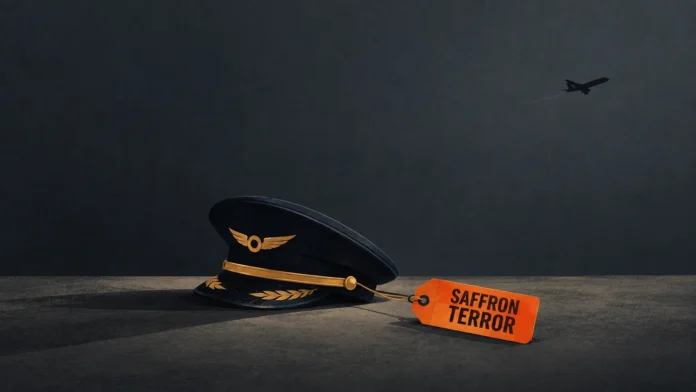
An Omani co-pilot attacked an Indian captain at 30,000 feet. Wounded, the captain still opened the door. Israel and India praised him, and so did ordinary people across the border, who prayed for his recovery.
Rana Ayyub and Arfa Khanam Sherwani, stars of the liberal commentariat, had different opinions. On 1 October, as India celebrated the captain, Rana Ayyub wrote that ‘the Indian right wing’s love affair with Israel and Netanyahu is ultimately rooted in one thing: its visceral hatred of Muslims’. Arfa Khanum Sherwani wrote that the ‘world-famous’ Israeli propaganda machine was ‘on fire’ and that Indian audiences were consuming it ‘no questions asked.’
Guess why?’ Neither defended the co-pilot. Neither mentioned the stabbing, the plunge, the door or the captain’s name.
The story had moved from the man who tried to crash a plane to the Indians who thanked the man who stopped him. That was the reflex with the captain alive, thanked by Israel and by his own country. It is not hard to guess what it would have reached for over a dead one. It was the move they had made after Pahalgam, where gunmen asked their victims’ religion before firing, and the commentary that followed warned of “anti-Muslim hate” without naming the kalma test.
The killers made religion the filter. The commentators made naming it the offence.
On the morning of 30 September 2026, flydubai FZ1073 left Dubai for Tel Aviv with more than 170 people on board, most of them Israeli. About two hours out, near the Jordanian border, the Boeing 737 MAX 8 began to fall: around 14,000 feet in under thirty seconds by Reuters’ count, more than 16,000 by the New York Times’. The transponder showed 7700, a general emergency. Then 7500.
Everybody knows what 7500 means: hijack.
Inside, the Omani first officer had attacked the captain. Passengers initially described a knife; Israeli officials spoke of an axe. Every airliner of this size carries a crash axe on the flight deck, so the weapon never passed a scanner. On 3 October, the UAE attorney general settled it: the cockpit’s own crash axe.
The Indian captain was Smit Machchhar: Gujarati by roots, Hindu by faith, Mumbai by home, eleven years at SpiceJet, flydubai since 2022, close to 10,000 hours. Bleeding, he opened the cockpit door. On 2 October, from hospital, he told Prime Minister Modi he was on the floor when he did it: ‘I couldn’t let all of them die.’
His own account, given in calls with Modi and with Netanyahu, is plain. The co-pilot asked to pray, and Machchhar faced forward out of respect. Four or five minutes later came ‘a powerful blow to the back of my head’. He first thought the aircraft had suffered catastrophic damage. Half-blind on the floor, he felt the plunge and heard the passengers. He opened the door once; the co-pilot shut it. With one last push, he opened it again.
Israeli passengers Tzvika Manes, Yaniv Hayun and Asaf Rajuan put the co-pilot in a chokehold and tied him with headphone cables. Two off-duty flydubai pilots landed the jet at Tabuk, Saudi Arabia. They later found most of the rudder missing. Nobody died.
Israeli officials called it an averted 9/11. For Israel, that is the right comparison. For India, it would have been something else: a 26/11 for Hindus, the night a Hindu name was meant to be pinned on a massacre, played out again at 30,000 feet.
His plan is now on record, second-hand. Details from the interrogation in the UAE, reported by Israeli media, say he meant to crash the jet into Ben Gurion Airport, with a US military base in Jordan as his fallback if he could not reach Israel. Reuters and CBS have since carried the plan, citing Israeli officials and a source briefed on the UAE probe. He had studied the airport on a June duty visit and called off a July attempt because he was friends with a crew member. ‘I planned it even before I was accepted,’ Channel 13 quotes him, and two Israeli officials have said the same. He chose flydubai because it flew to Tel Aviv, as revenge for Gaza, NDTV notes.
That is not a dispute. It is a plan with a route. Had he succeeded, the wreckage would have held an Omani co-pilot and a Hindu captain, and no one alive to say which of them flew the plane into the ground.
The UAE foreign ministry spoke of an ‘altercation’ in the flight deck that prompted crew on board to ‘intervene and secure the aircraft’. No name, weapon, plunge or 7500. Flydubai called it an ‘altercation’ and urged no ‘premature speculation’. Early Western headlines used the airline’s word.
Flydubai is not a private budget carrier. The Government of Dubai owns it through the Investment Corporation of Dubai. CNN, Al Arabiya, the Wall Street Journal and Saudi state media named the co-pilot Hamam al-Hammami. The Journal reported that Oman had banned him from flying because of his radical views, and flydubai hired him anyway. Compare Germanwings. In 2015, a French prosecutor named co-pilot Andreas Lubitz within 48 hours. After FZ1073, the name came from leaks and Saudi media. Only on 3 October did the UAE attorney general call it an ‘attempted terrorist act’.
The silence did not stay empty for long, even with the captain alive. The Times of Israel, citing the Combat Antisemitism Movement, counted 2,963 posts on X in twelve hours blaming Israel, Mossad, Netanyahu, Zionists or Jews. A deepfake ‘BBC’ clip went round blaming an invented Indian passenger; the BBC confirmed it was fake. Another fake account tried to tie Machchhar to Rahul Gandhi. An invented Indian on board is the smear already attempted, in real time. It failed only because the real Indian on board was alive to contradict it.
India has seen what fills that kind of silence before. On 12 June 2025, Air India AI171 came down seconds after leaving Ahmedabad; 241 of 242 on board died. The AAIB’s preliminary report found both fuel switches moved to CUTOFF and blamed no one. Within days, the Wall Street Journal, citing people familiar with American officials’ assessment, reported that Captain Sumeet Sabharwal had moved them. The suicide theory went round the world. His 91-year-old father went to the Supreme Court, which told him no one in India believes the pilot was the cause.
The cause is unsettled, and I will not do to others what was done to Sabharwal. My point is the order. With an Indian as suspect, anonymous sources sufficed. With an Indian as victim, the attacker’s name had to leak.
A dead captain gets no headline in his own words. He gets a cockpit, a co-pilot and a question.
And had the captain died, one more word was waiting to fill the silence. It had been waiting for more than twenty years. The journalist Praveen Swami is credited with coining ‘saffron terror’ in 2002, after the Gujarat riots. It took the bombings of 2006 to 2008 to give it a case file.
Start with Malegaon 2006, because it is the case that should trouble everyone. On 8 September 2006, bombs in Malegaon killed 31 people. The Maharashtra ATS arrested nine Muslim men. They spent about five years in jail before a special court discharged them in April 2016, after the NIA, which had taken over the case in 2011, told the court it had no evidence against them. The NIA then accused four Hindu men instead, partly on the strength of a statement by Swami Aseemanand that he later retracted. On 22 April 2026, the Bombay High Court quashed the charges against those four too. Twenty years on, nobody has been held responsible for 31 deaths, and an appeal against the Muslim men’s discharge has sat unheard since 2019.
Then the Samjhauta Express. On 18 February 2007, bombs on the train to Pakistan killed 68 people. On 20 March 2019, a special NIA court in Panchkula acquitted all four accused, Aseemanand among them. Judge Jagdeep Singh found no concrete oral, documentary or scientific evidence linking them to the crime, and wrote that ‘suspicion, however grave, cannot take the place of proof’. The US and the UN 1267 committee had separately designated Pakistan’s Arif Qasmani for helping finance the attack with Lashkar. A victim’s daughter has appealed the acquittal in the Punjab and Haryana High Court.
Islamabad was ready on the day of the verdict. On 20 March 2019, it summoned India’s High Commissioner, called the acquittal “a travesty of justice”, and said it reflected “the Indian state’s policy of promoting and protecting Hindu terrorists.” A phrase coined in Delhi had become a foreign ministry’s position.
At the Mecca Masjid in Hyderabad, a pipe bomb on 18 May 2007 killed nine people. Muslim youths were arrested first; the Andhra Pradesh government later paid them compensation for wrongful arrest, which the High Court set aside in 2013. The NIA’s case against five men, Aseemanand again among them, ended on 16 April 2018, when Special Judge Ravinder Reddy acquitted all five. He resigned hours later, citing personal reasons.
Ajmer went the other way. A bomb at the Khwaja Moinuddin Chishti dargah on 11 October 2007 killed three pilgrims. On 8 March 2017, a special NIA court in Jaipur convicted Devendra Gupta and Bhavesh Patel, and Sunil Joshi, who had been shot dead in December 2007. Gupta and Patel got life; Aseemanand and six others were acquitted. Patel was granted bail by the Rajasthan High Court in 2018. Individuals committed crimes, and courts punished them. That is justice, not a theology of terror.
The last was Malegaon again. On 29 September 2008, a bomb on a motorbike near a mosque killed six people. The ATS under Hemant Karkare charged Pragya Thakur, Lt Col Prasad Purohit and others in January 2009, two months after Karkare was killed on 26/11. The NIA took over in 2011 and dropped the charges against Thakur in 2016. On 31 July 2025, Special Judge A.K. Lahoti acquitted all seven. The prosecution could not prove the motorbike was Thakur’s, and the samples from Purohit’s home were contaminated. The victims’ families have appealed, and the Bombay High Court issued notice in September 2025.
Purohit was a serving Army intelligence officer. For seventeen years, “saffron terror” meant an Indian officer in the dock. In 2026, the Army cleared him for brigadier rank. The label was never aimed only at the BJP and the RSS. It was about whether India’s uniforms could be believed.
Lay the five side by side. One unsolved, with wrongly arrested Muslim men at its start. Three acquittals. One case of convictions, of individuals, for a crime they committed. Behind every one of them, families who still have no justice.
The strangest test of the label had come in between. On 26 November 2008, Ajmal Kasab came ashore in Mumbai with a saffron kalava on his wrist and an identity card as Samir Dinesh Chaudhari of Bengaluru. Rakesh Maria, who led the investigation, wrote in his memoir Let Me Say It Now (2020) that had Kasab died, it would have been called Hindu terror. A ‘Deccan Mujahideen’ email also claimed the attack, and a former IB Special Director, Ashok Prasad, has said Pakistan planned to blame disgruntled Indian Muslims. Lashkar laid more than one false trail. One was a Hindu name on a corpse.
It broke at Girgaum Chowpatty, where ASI Tukaram Omble, armed with a lathi, gripped Kasab’s AK-47, took around 23 bullets and held on. Kasab was taken alive, and Faridkot in Pakistani Punjab entered the record.
With Kasab alive, the Hindu-terror line should have died. It grew inside the government. In December 2008, A.R. Antulay tied Karkare’s death to the Malegaon probe; US cables called Congress’s handling religious politics. In July 2009, Rahul Gandhi told US Ambassador Timothy Roemer, according to the ambassador’s cable, that while there was some support for Lashkar among Indian Muslims, ‘the bigger threat may be the growth of radicalised Hindu groups’. That was eight months after Lashkar killed 166 in Mumbai. WikiLeaks made the cable public in December 2010.
On 25 August 2010, Home Minister P. Chidambaram told a conference of police chiefs that a ‘recently uncovered phenomenon of saffron terrorism’ had been implicated in bomb blasts. He said it in a speech that also covered Kashmir, Maoists and terror attacks. The phrase now had a minister behind it.
On 6 December 2010, the Babri anniversary, with Kasab already convicted, Digvijaya Singh launched Aziz Burney’s 26/11: RSS Ki Saazish? Burney apologised in 2011. In January 2013, at the Congress convention in Jaipur, Home Minister Sushilkumar Shinde said investigations had found the RSS and BJP running terror training camps, and named Samjhauta, Mecca Masjid and Malegaon. He regretted the remark a month later. Years afterwards, in his memoir Five Decades in Politics, he wrote that he had chosen ‘saffron terror’ deliberately over ‘Hindu terror’. By 2018, Congress was claiming it had never used the term.
One version went further, and it has never died. In 2009, a former Maharashtra Inspector General, S.M. Mushrif, published Who Killed Karkare?, arguing that the ATS chief was killed not by Kasab’s men but by right-wing extremists. A petition built on the book sat in the Bombay High Court from 2010 until 2018, when the court refused to order a probe. In May 2024, Congress’s Vijay Wadettiwar, Leader of the Opposition in Maharashtra, repeated it: Karkare, he said, was killed by the firearm of an “RSS-linked” police officer, not by Kasab. Sixteen years after 26/11, with Kasab hanged, the Hindu name was still being reached for.
Each of these men spoke while the cases were still open. None waited for a verdict. The same haste ran the other way when the accused were Muslim. Digvijaya Singh called the 2008 Batla House encounter fake. Sonia Gandhi, Khurshid says, ‘cried bitterly’. In 2021, a Delhi court convicted Indian Mujahideen’s Ariz Khan of killing Inspector Mohan Chand Sharma there.
When the verdicts came, every case Shinde named in Jaipur had ended without a conviction. The brand outgrew every conviction it produced. That makes it a political product.
The courts took the cases apart. They could not take back the words. In 2021, Salman Khurshid’s book Sunrise Over Ayodhya set a “robust” Hindutva beside ISIS and Boko Haram; his own party colleague Ghulam Nabi Azad called the comparison “factually wrong” and an “exaggeration”. In July 2024, Rahul Gandhi told the Lok Sabha that those who call themselves Hindus talk of violence and hatred. He later said he meant only the BJP and the RSS. The line travelled; the footnote didn’t.
Next, a young, curious reader searching today finds Wikipedia’s ‘Hindu terrorism’ entry, which lists ‘saffron terror’ as another name for it, opening on a definition tied to Hindutva, with the collapsed court cases further down. Beside it sit an Islamabad think tank’s explainer and another on ‘militant Hindutva’ whose star witness is an Indian Home Minister. On 25 September 2026, five days before FZ1073, Shehbaz Sharif blamed an ‘RSS-driven Hindutva ideology’ for rising Islamophobia at the UN General Assembly.
A remark in Delhi becomes an encyclopedia line, then an Islamabad brief, then a UN speech. I do not claim the speech and the stabbing are linked. The brief was written. Only an occasion was missing.
On FZ1073, the occasion never came. On 3 October, the UAE attorney general, Dr Hamad Al Shamsi, said the co-pilot had attacked the captain ‘using a crash axe and attempted to take control of the aircraft’, an ‘attempted terrorist act’. No charge sheet has been published, and a court must still find a terrorist purpose.
India remembers those who held on: Omble with Kasab’s rifle; Karkare, Kamte and Salaskar; Sandra Samuel on the stairs of Nariman House with a Jewish child; Neerja at the exit in Karachi. Machchhar joins them. No crash site, no disputed black box, no headline asking about the Hindu captain’s ‘role’.
‘Hindu terror’ was always loudest before the evidence. This time the evidence came first. It came out of the cockpit, bleeding, and opened the door.