

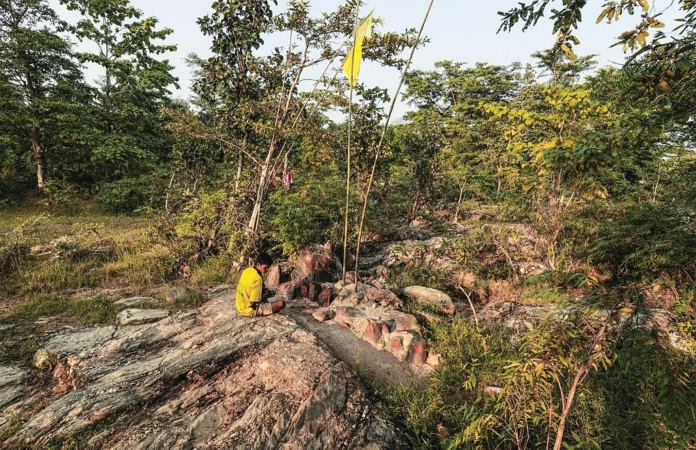
In Jharkhand, we don’t build a house first. We build a Jaher.
When a new village takes root on the Chotanagpur plateau, the first collective act is to leave a patch of virgin Sal forest completely untouched. In that grove — known as Jaherthan to Santals, Sarna to Mundas, Kurukh Kuti to Oraons, Desauli to Hos, and Jankor to the Kharias — three stones are nestled under the canopy of a Sal tree. That is our sanctuary.
To an outsider’s eye, it looks like simple nature worship. In colonial ethnography like E.T. Dalton’s Descriptive Ethnology of Bengal (1872), it gets squeezed into easy, patronising boxes: primitive animism, an isolated forest cult.
But if you have grown up looking at a Pahan among the Mundas and Oraons, a Naeke among the Santals or a Kalo among the Kharias offering a white fowl to the supreme consciousness before a single seed hits the soil, you know those labels are just lazy.
The gods of Jharkhand are not random spirits wandering the woods. They form a complete, rigorous theology of land, ecosystem, and memory.
This pantheon is built on a profound structural order. Take Marang Buru, the Great Mountain. He is not merely a literal peak to be worshipped; he represents the supreme father figure in Santal creation lore who taught the first humans how to survive. White is his colour, which is why during Baha, the spring flower festival of the Santhals, every initial offering — from a fowl to rice beer — is chosen for its pure whiteness. If Marang Buru provides overarching protection, Jaher Ayo, the Lady of the Grove, acts as the mother. Her domain is the tangible: childbirth, children, and the immediate health of the standing crop. She is the living reason the community vows never to touch an axe to the sacred grove.
Then there is the cosmic scale of Singbonga — the ultimate creator revered by the Munda and Ho communities (Santal traditions more commonly name Thakur Jiu as creator) — and of Dharmes, the supreme god of the Oraon. In Munda cosmology, when the world was nothing but a primeval abyss of water, Singbonga guided the slow gathering of clay from the depths to manifest trees, animals, and humanity. This absolute cosmic authority mirrors how the Kharia community leans on Ponomosor, whom Sarat Chandra Roy and Ramesh Chandra Roy note in The Kharias (1937) as the Supreme Spirit and creator. He demands moral uprightness and anchors their entire spiritual existence. Alongside these creators stand the immediate village protectors: Moreko-Turuiko, the Santal guardian bongas, who ward off negative elements; Chala Paccho, the Earth Mother of the Oraons; and Desauli — both the Ho name for the sacred grove itself and the name of its guardian spirit — who keeps watch over village boundaries.
The popular shorthand for Sarna Dharma is jal, jangal, jameen (water, forest, land). The triad is true, but merely reducing a faith to land rights misses the deeper cosmology behind it. Let’s look closer.
First, this tradition possesses a highly sophisticated cosmology. The image of a creator bringing order out of a watery chaos is a philosophical milestone shared by ancient civilisations globally. The Munda recitation Sosobonga, which carries both the creation story and the Asur story, describes how Singbonga, the Supreme God, establishes ethical order after conquering the Asurs, the iron-smelting beings of the legend. This isn’t “worshipping rocks”; it is a complex philosophy explaining why the cosmos exists and how its internal balance must be defended.
Second, the sacred grove is far from a localised, isolated Jharkhand phenomenon. It is an ancient, pan-Indian institution. What is called Sarna or Jankor here is called Kavu in Kerala, Devarakadu in Karnataka, and Devarai in Maharashtra. The core philosophy — that a community’s spiritual marrow resides in a patch of untouched, wild forest — is a deep civilisational thread running across the subcontinent. Calling the Adivasi tradition “isolated” ignores this shared, ancestral respect for nature.
Finally, this continuity is naturally inclusive. There is a frequent academic trap, inherited from that colonial ethnography, that tries to push these ancient traditions into an absolute silo, isolating them from the rest of the historical landscape. The ground reality is far more fluid.
Look at the Deori Mandir near Tamar, a temple of the sixteen-armed Devi Durga whose original stone structure dates to around the 10th or 11th century. According to the Jharkhand government, it is the only temple in the state where pujas are performed by Pahans, the tribal priests, alongside Brahmins.
In Adivasi thought, the spiritual world is vast and accommodating. It doesn’t build heavy walls; it respects different paths as part of the same horizon.
When we reduce this worldview to a primitive forest cult, we diminish our collective intelligence. We diminish the philosophy of the Jaher. A community that protects a sacred grove by custom before building its own houses is practising an advanced form of ecological mindfulness. It acknowledges that the forest holds the primary lease, and humans are merely its guests.
The gods of Jharkhand do not need to be forced into rigid, foreign categories to earn respect. They deserve to be read on their own terms — as a timeless theology where a Sal tree acts as a sanctuary, and three stones beneath it encompass the entire cosmos.