

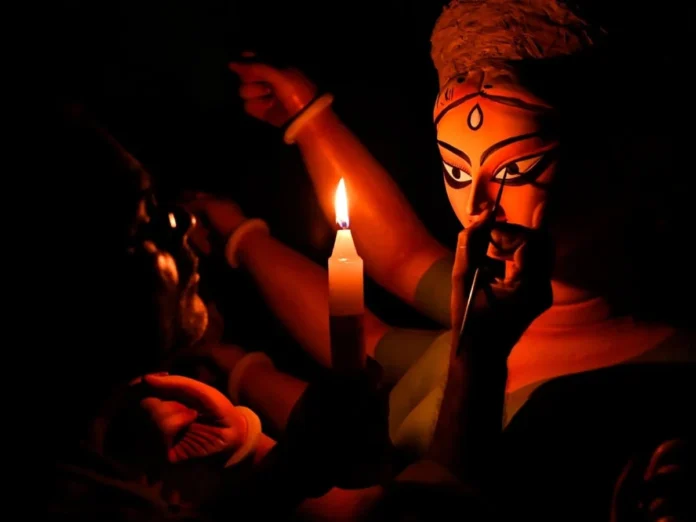
AT BRAHMAMUHURTA, before the city has decided whether it is still night or already morning, Bengal wakes the Goddess. A man who has not entered a temple in forty years switches on the radio. He does not announce it. He does not explain it to the child who asks why the lights are on. Perhaps he will explain later. For now, Birendra Krishna Bhadra’s voice comes through the dark, carrying the old declaration of war: Mahishasuramardini, she who slays the buffalo demon.
Somewhere across a border, a Bengali in a rented room does exactly the same. Somewhere across an ocean, another hears those first words and stops whatever he is doing. For ninety minutes, the party line, the creed, the commute, the argument and the calendar move quietly into the back seat.
The zamindar, the Company, the party stall and the corporate pandal explain why Durga Puja became so large. They do not explain the alarm. Each of them has tried to own this festival, and none has quite managed it. The reason lies in the story Bengal tells about why the Goddess comes in autumn at all.
Mahalaya is the new moon that closes Pitru Paksha, the fortnight of offerings to the dead, and opens the fortnight of the Mother. At the ghats of the Hooghly, people enter the water with black sesame and kusha grass. In Kumartuli, the potters perform chokkhu daan, painting the clay eyes, and the image becomes a presence awaiting worship. This year Mahalaya falls on Saturday, 10 October, and Bodhan, the formal awakening, on Shashthi, 16 October.
The sound of the morning has a date. In 1931 Bani Kumar wrote the programme, Pankaj Mullick set it to music, and Bhadra recited it live, at four in the morning, with an orchestra. Some orthodox Brahmins objected. In 1976, All India Radio replaced him with Uttam Kumar and a new score, and Bengal rejected the experiment. Changing the narrator proved harder than changing governments.
The verses come from the Devi Mahatmya, the Chandi, composed somewhere between 400 and 600 CE. Mahishasura drives the gods from heaven, and their combined power gathers into a blaze that takes a woman’s form. Each god gives her a weapon. When Raktabija spawns a demon from every drop of blood, Kali drinks the blood before it falls. The same text holds the first Durga Puja: King Suratha has lost his kingdom, the merchant Samadhi has been cast out by his family, and on a riverbank they fashion a clay image and worship her for three years. Bengali memory places that worship in spring, and it survives as Basanti Puja, kept in Chaitra alongside Chaitra Navratri: the older of Bengal’s two Durga Pujas.
IN SHAKTA RECKONING, the Goddess is awake in spring and asleep in autumn. Worshipping her in Ashwin is akala, out of season. The explanation comes from Krittibas Ojha’s fifteenth-century Bengali Ramayan (the poet is dated to c. 1381–1461). Lanka will not fall. Brahma counsels Ram to wake the sleeping Goddess and undertake the rite. Ram vows to offer 108 blue lotuses. One is missing. Remembering that he is called Kamalanayana, the lotus-eyed, he raises an arrow to offer his own eye in place of the absent flower. The Goddess stops his hand and grants him victory. The 108 survive in Sandhi Puja, the charged junction between Ashtami and Navami.
This is Akalbodhon, the untimely awakening: we knock because Raghav knocked. Akala is more than a scheduling error. It is a crisis that forces someone to knock on a closed door. The permanent Mother was already there, in the seats where Sati’s body fell: Kamakhya, Kalighat, Tara Tarini, Vimala. The autumn Durga is the visiting daughter. Bengal welcomes her as Uma, the married daughter who comes without Shiva, with Ganesh, Kartik, Lakshmi and Saraswati beneath one frame, in its agamani songs. She is woken at a shut door and comes home anyway. Bengal’s festival has been shaped ever since by people standing outside doors, and by people trying to keep them shut.
DURGA PUJA’S POLITICS have always been written into its courtyards and gates. One tradition credits Kangshanarayan of Taherpur with the first recorded autumn puja; another names Bhabananda Majumdar of Nadia around 1606. The Sabarna Roy Choudhury family has kept its Barisha puja since 1610. The claimants vary, but the pattern is clear: a landholder who could not be a sovereign could display a sovereign Goddess on his land while another sovereign collected the revenue.
After Plassey in 1757, tradition says Robert Clive wanted a thanksgiving ceremony, and Nabakrishna Deb, the Company’s Persian translator and intermediary, offered Durga Puja at his Shobhabazar home. Clive said he was a Christian, and Deb said he would handle it; Kartik is said to have worn an English jacket and boots. Historians treat the story cautiously, but it has endured because it captures a real accommodation: British victory could echo Durga’s victory over Mahishasura, and Nabakrishna could advertise his closeness to the new rulers. Calcutta’s grand Durga became both a goddess and a political host.
The gate began to give way from below. Rani Rashmoni, born in 1793 into a fishing family that orthodoxy ranked as Shudra, leased ten kilometres of the Hooghly for Rs 10,000, and the Company abolished the fishing tax. She later built the Kali temple at Dakshineswar, though priests at first refused to consecrate a temple founded by a Shudra woman. The gate opened anyway.
At Guptapara, the gate broke differently. Young men refused entry to a grand household puja, pooled their money and organised their own. The date is disputed, 1761 or 1790, but the name endured: barowari, from the twelve friends, baro yaar. A landlord’s private ritual became a subscription-based public one, and Calcutta followed, with Bhowanipore’s 1910 puja often cited as a milestone.
THEN THE GODDESS entered nationalism, and the subscription list became an advantage. A pamphlet could be banned, a meeting disrupted, an association declared illegal. It was harder to stop a neighbourhood that had already collected its money and hired the dhak. In 1905, as Bengal was partitioned, Abanindranath Tagore painted a saffron-clad woman, first called Banga Mata, later renamed Bharat Mata. One account has Bipin Chandra Pal organising a Swadeshi Puja urging a boycott. In 1926, Anushilan men founded the Simla Byayam Samiti, and Subhas Chandra Bose inaugurated its puja. The idol wore khadi. Bose served on its committee and Baghbazar’s, and swadeshi exhibitions and puppet shows carried messages against British rule. The authorities banned the Samiti’s puja in 1932, 1933 and 1935 and, by one account, declared the Samiti illegal in January 1932.
Maharashtra had shown in the 1890s how Ganapati could carry cultural nationalism. Bengal had a different advantage: a Goddess with a household, a seasonal return and a story of victory. Once the Company’s hostess, she became an awkward gathering for the Empire, intimate, local and already paid for by the neighbourhood. Even the missionaries’ printers helped. Krittibas’s Ramayan was first printed in five volumes at the Serampore Mission Press in 1802-3, and cheap, uniform copies carried the image of a door forced open in an emergency into ordinary homes.
AFTER INDEPENDENCE, the politics changed hands again. The CPI(M), which ruled West Bengal for thirty-four years, generally did not inaugurate pandals. Instead, it set up bookstalls at their gates. The first Park Circus stall is dated to 1954 by one account and 1952 by another; by 2025 the party counted more than 2,000. The argument has since moved from whether Marxists could take part to what the festival should be called. Suvendu Adhikari, then Leader of the Opposition, objected to the word Sharodotsav, and CPI(M)’s Satarup Ghosh pointed to Vivekananda, whose brother Bhupendranath Dutta had introduced Bengalis to Marx. The argument was over a word on a signboard. The Goddess’s ancient text was on neither side. Meanwhile, UNESCO inscribed Durga Puja in Kolkata in December 2021. The festival that once needed a landlord’s courtyard, and then a subscription list, now carries an international heritage designation.
The zamindar, meanwhile, has not disappeared. He has changed clothes. Chetla Agrani is associated with Trinamool leader Firhad Hakim and Sreebhumi with Sujit Bose; Santosh Mitra Square‘s spokesperson has been a BJP leader. Mamata Banerjee reportedly received 12,000 puja invitations in 2019 and later set a target of inaugurating 3,000; the BJP brought Amit Shah to open an Operation Sindoor-themed pandal. The patron now cuts the ribbon where the Company once ate. Yet the older hospitality survives. Bhukailash Rajbari distributes bhog on Nabami, Bonedi courtyards open at set times, and Shobhabazar now admits visitors free, though the thakurdalan can stay restricted.
The newest patrons have also tried to set the menu. In 2026, Dhirendra Krishna Shastri, the preacher of Bageshwar Dham in Chhatarpur, Madhya Pradesh, told Bengal to keep non-vegetarian food away from pandals and was reported to have called those who ate it pakhandi, or hypocrites. Chief Minister Suvendu Adhikari, who had welcomed him alongside ministers, later said the preacher had imposed nothing on anyone, and himself ate fish bhog at Kalighat. The BJP’s state president, Samik Bhattacharya, also rejected the idea that a religious figure could dictate what Bengalis eat.
No single Bengali Durga Puja plate exists. Durga Puja falls in the same bright fortnight as Navratri; Bengal keeps the spring Navaratri too, and one Howrah house sacrifices a lemon in autumn and a watermelon in spring. Shakta traditions themselves accommodate rajasic and tamasic food, sacrifice and blood offerings. Even at Puri, where Jagannath’s kitchen is strictly vegetarian, his food is incomplete until it is also offered to Vimala, and fish is cooked at midnight in a temporary kitchen and carried to her before Jagannath wakes. Kashmiri Pandits offer meat and fish to Bhairava at Shivaratri, and at Vaishno Devi the legend sends a meat-demanding tantric to a separate shrine. Not one plate, not one kitchen, not one rule.
The pandal has become a battleground of its own, and so has the clay. Durga stands traditionally in one frame, Lakshmi and Saraswati on one side, Ganesh and Kartik on the other. One account credits Barisha’s 1610 puja with bringing the family into a single chalchitra. From the mid-1980s, artists such as Aloke Sen carried social themes into the idol, and Bhabatosh Sutar placed Durga outside the pandal as a daily-wage labourer. The backlash had its slogan: We do not do theme puja, we do Durga puja.
If the clay is theology, the pandal has become an open-air newspaper. In 2021, pandals took up the farmers’ agitation, the NRC and Partition. In 2022, a puja organised by the Akhil Bharat Hindu Mahasabha depicted Mahishasura with a face resembling Gandhi’s, and police asked for it to be changed. In 2024, as Kolkata protested the rape and murder of a doctor at RG Kar Medical College, one committee made its pandal a protest, another showed the Goddess covering her face before a woman’s body, and a Kankurgachi installation veiled Durga and her lion. A year later, a prominent committee recreated battlefield scenes for Operation Sindoor, and another theme invoked the Ram Mandir in Ayodhya. Within two years, the festival had shown the Goddess as a face of protest and of military nationalism. Yet a critic who visited 150 pandals in 2024 found only five that engaged directly with RG Kar. Protest is a possibility the festival allows, not an obligation it imposes.
YET PEOPLE STILL stand outside the gate. In the old Kumartuli tradition, the clay for the Goddess is not simply river mud. A handful of earth is collected from outside a sex worker’s door and mixed with Ganga mud, cow dung and cow urine. Sonagachi, close to the potters’ quarter, became associated with the practice. Bengal’s oral explanations differ. One says a man leaves all his goodness at her doorstep before entering, so the soil outside is pure. Another says worship is incomplete if the woman society excludes is herself excluded from the making of the Goddess. Neither is a Purana chapter. The Tantric Navakanya lists include dancers, courtesans and washerwomen alongside Brahmin women and milkmaids, and Kumari Puja seats a girl as the living Goddess.
Now that woman is refusing the arrangement. In 2018, Sonagachi sex workers were reported to have stopped providing the soil because they contributed to puja donations but were barred from entering the pandals. In August 2024, many refused amid the RG Kar protests. A civilisation that wakes a warrior Mother still asks a socially excluded woman for the earth on which that Mother stands. The woman has noticed that the Goddess’s house does not make room for her.
Others are forcing the door from inside. In 2010, Gokul Chandra Das, known as the Dhaki Samrat, began teaching women the dhak; one researcher now counts around 150 women’s dhaki groups. In 2021, at 66 Pally in south Kolkata, Nandini Bhowmik, Ruma Roy, Semanti Banerjee and Paulomi Chakraborty conducted the worship, a path opened by the Sanskrit professor Gauri Dharmapal. In 2022, New Town’s first community puja had four women priests and twelve women dhakis. This is more a return than an invention. Traditional lists of Rigvedic seers name 27 women hymn authors, though historicity varies, and the Devi Sukta, which proclaims the Goddess sovereign, is attributed to the woman seer Vak.
Which brings us back to the radio. Bengal spent a generation under a political culture that often described the Goddess as a social festival rather than an expression of faith. Communist bookstalls stood outside pandals selling books that had little to do with the worship inside. Yet in homes where fathers had read Marx, uncles ran local committees, and sceptics stopped entering temples, the radio still came on at four. The ritual was not always a declaration of belief. Sometimes it was simply the morning one had inherited.
The man switches on the radio. Perhaps he believes in the Goddess. Perhaps he does not. The child asks why the lights are on, and the answer can wait. For ninety minutes, the argument moves into the back seat.
The gods have lost. Their power gathers. A woman appears, and she takes the field.
Akalbodhon means the war would not wait for a convenient hour.
Agamani means she comes home regardless.
Bengal rises before light because both sentences are true at once.