

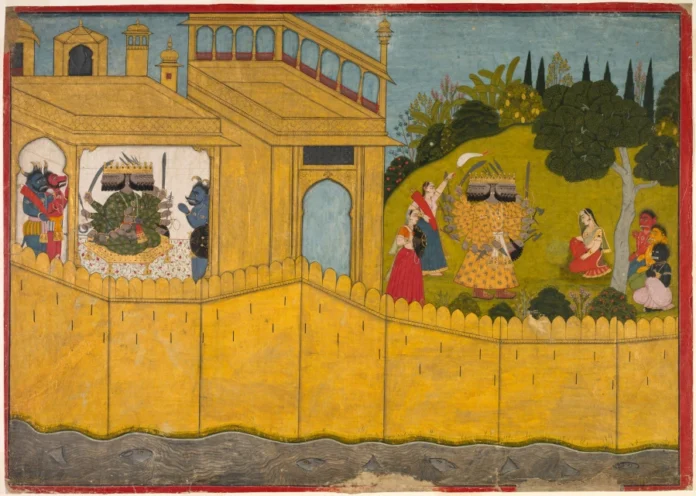
Immersed in grief, her face constantly wet with tears, Devi Sita sighs repeatedly and trembles like a lone doe surrounded by a pack of wild dogs in the jungle. Many months pass, but Ravan continues to pine for her. Steeped in lust, full of vanity, intoxicated with wine, and with wide, red eyes that are slanted, he desires to see her and obtain her.
On a full moon night, he approaches her again in Ashok Vatika. Now she trembles like a small banana tree shaken by strong winds. As he nears the wide-eyed, fair-complexioned Devi Sita, she pulls her thighs closer, covering her stomach and with her arms covering her breasts, sits down crying.
Ravan, however, has no mercy for her and mocks her instead.
मां दृष्ट्वा नागनासोरु गूहमाना स्तनोदरम् ।
अदर्शनमिवात्मानं भयान्नेतुं त्वमिच्छसि ॥५-२०-२॥
“Seeing me, O woman with thighs like an elephant’s trunk (meaning shapely), you hide your breasts and belly, as though, out of fear, you wished to make yourself unseen to me.”
He does not look away. Unashamedly, he repeats his desire for her by admiring her body. Ravan does not hide his misdeeds; rather, he brags to Devi Sita. He makes it clear that abducting women by force has religious sanction amongst the rakshasas, implying that he, the emperor, is even more entitled to do so.
स्वधर्मो रक्षसां भीरु सर्वथैव न संशयः।
गमनं वा परस्त्रीणां हरणं सम्प्रमथ्य वा ॥५-२०-५॥
“O timid lady! Obtaining women belonging to other men or abducting them by force is the righteous deed (dharma or religiously sanctified act) for rakshasas in every way. There is no doubt about this.”
The abducted women could be the wives, daughters, or sisters of another male. In moral cultures, permission is sought from family beforehand for marriage, but not for immoral rakshasas.
In the current era, thousands of years later, at Nitesh Tiwari’s film Ramayana premiere in Los Angeles on 27 October 2026, a reporter asked the lead actress Sai Pallavi, playing the role of Devi Sita: “People who have grown up with this, billions of them, what do you hope they see differently here (Ramayana)?”
Pallavi said that it could act as a starting point for those who are curious about Indian epics and added: “As a scripture, if you are a believer, you would try to introspect and see what is good and bad exists in you, and you learn to correct yourself over time, because Ravana is not all bad. And it is important that we spot the Ravana in us and make changes over time.”
However, the real Devi Sita of the Ramayan does not see him that way. And Sai Pallavi invokes the scriptures without knowing what they actually say about rakshas-raj Ravan. This comment therefore comes across as not only ill-informed but also troubling, as she speaks up for her abductor, a notorious rakshas ruler known for violence and rapes.
In Sanskrit, ‘rakshas’ is defined as ‘something to be guarded against or warded off, malignant and nocturnal man-eating giant or demon’. In other words, they hunt and prey on humans and need to be warded off and protected against. The sovereign of rakshasas, Ravan, is the personification of these grisly characteristics.
In Sarga 47 of Aranya Kanda of Valmiki Ramayan, while living in the forest, Devi Sita expresses hatred towards Ravan by using spiteful adjectives and pungent words after he asks her to elope and marry him despite knowing she is already married to Bhagwan Ram.
Devi Sita calls him a turbid rivulet or worse, a drop of saliva (स्यन्दनिका) in front of Bhagwan Ram, who is like the great ocean (समुद्र). To Devi Sita, her husband Ram was incomparable to Ravan—just as gold (कांचन) cannot be compared to iron (लोह), nor sandalwood water (चन्दन वारि) to sewage (पंक). Devi Sita regards Ravan with disgust and disdain. She openly tells him she is as indigestible to him as a diamond swallowed by a fly. If this is not bad enough, then what is?
Despite her refusal, Ravan, a vile and evil man, abducts Devi Sita from the Dandaka Aranya and brings her to Lanka. He then tries his best to impress her, so she yields to his lustful desires. In comparison to a banished Prince Ram, who cannot provide any luxuries, Ravan can place at Devi Sita’s feet any riches she fancies. He shows her his beautiful gem-studded palace, brags about the number of subjects under him and offers her the chance to become the supreme queen of his mighty kingdom. Ravan is conclusively sure that Devi Sita will be impressed by what he is showing and offering her. Unquestionably and willingly, she will walk into his arms.
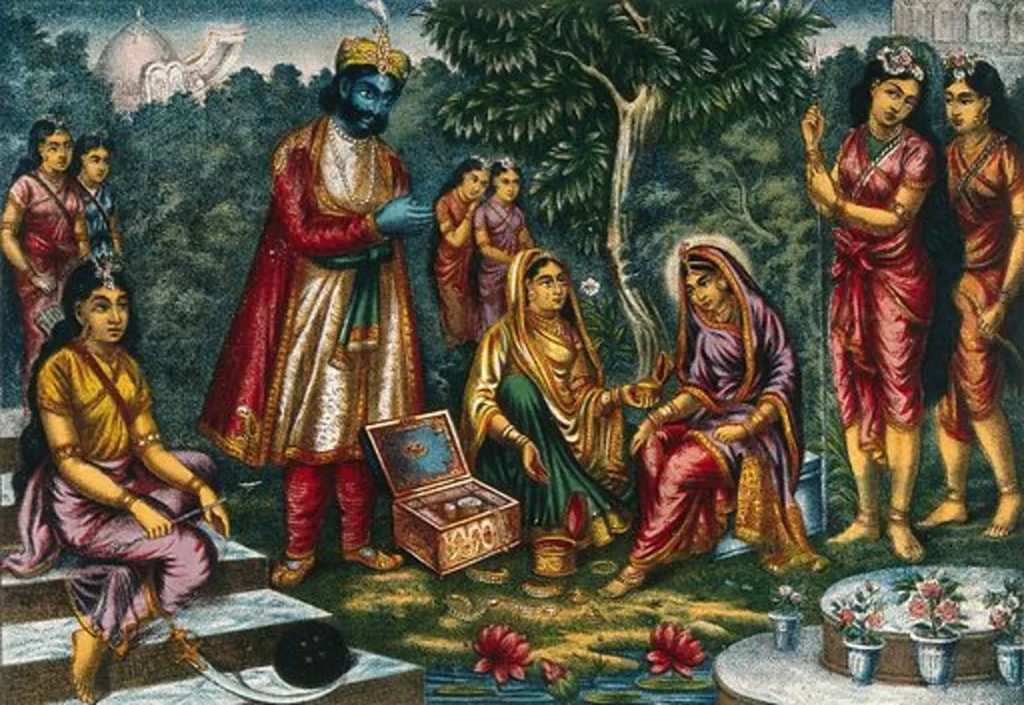
Instead, Devi Sita castigates him. The righteous lady tells Ravan that he could trample her body and life (implying kill her), but she is intolerant of any disrepute to her name by consenting to his desires because she is already wedded to Bhagwan Ram.
Even though Ravan desires her, he cannot force himself on her because he bears a curse. If Ravan ever attempts to engage in sexual intercourse with a lady without her consent, his head will blow into a hundred pieces, killing him instantly. Frustrated by her harsh words and her refusal to cave in to his demands, he gives her an ultimatum.
He tells her that if she willingly does not come to his bed, in twelve months, he will have her cut up into pieces by his cooks and eat her for his breakfast. An enraged Ravan, then, instructs his flesh-eating, blood-drinking, and fearful rakshasis to break her pride.
Prior to this rejection, he had asked the loathsome rakshasis to make sure all her needs and demands were catered to. But upon rejection, the fickle and mercurial Ravan punishes the grieving Devi Sita and instructs that she be kept secretly in Ashok Vatika, forcing her to live in the open, exposed to harsh elements of nature. Thereafter, Devi Sita sits, lives, and lies on the bare ground under a tree, like a broken branch purposefully torn off.
Devi Sita is to be ruthlessly tamed by the rakshasis either via force, cajoling, or through any means that could bend her will. By torturing her mentally and physically, her life is to be made worse than hell, so that, out of desperation, Devi Sita would break down and succumb to Ravan’s lust.
But she does not break. Despite being pushed and repeatedly threatened with dire consequences, she remains steadfast in loyalty to Bhagwan Ram. When he mocked her for covering herself and wishing to be invisible to his lustful gaze, she answered him.
She tells him he is a coward to abduct her when her husband and brother-in-law were absent from their home in the jungle. She equates him to a dog that cannot smell a tiger. Likewise, he cannot catch the scent of Bhagwan Ram and Lakshman, for he cannot stand in front of them.
इमे ते नयने क्रूरे विरूपे कृष्णपिङ्गले ।
क्षितौ न पतिते कस्मान्मामनार्य निरीक्षितः ॥५-२२-१८॥
“O ignoble one! These eyes of yours—cruel, ugly, black and reddish brown—why don’t they fall to the ground when you gaze upon me so?”
तस्य धर्मात्मनः पत्नीं स्नुषां दशरथस्य च ।
कथं व्याहरतो मां ते न जिह्वा व्यवशीर्यते ॥५-२२-१९॥
“How is it that your tongue does not split and fall away as you speak to me—wife of that righteous man (Ram), and daughter-in-law of Dasharath?”
These are not words of someone who appreciates her abductor or sees any good in him. These are words of a woman who abhorred him for abducting her, and for making her life harder to endure each time she refused his advances.
Some argue that Ravan deserves praise for his intelligence. But intelligence does not make a person virtuous; it just amplifies their basic character traits. In Ravan’s case, it became a means of harming others rather than helping them.
Ravan had no redeeming qualities that could outshine his despicable behaviour. Calling an evil man like him “not all bad” is morally and ethically corrupt. Neither is every man or woman an abductor, rapist, or a cannibal like Ravan who needs fixing. This is why, for aeons, the story of the Ramayan is celebrated as the victory of good over evil, and not as a lesson in self-discovery and self-amendment.