

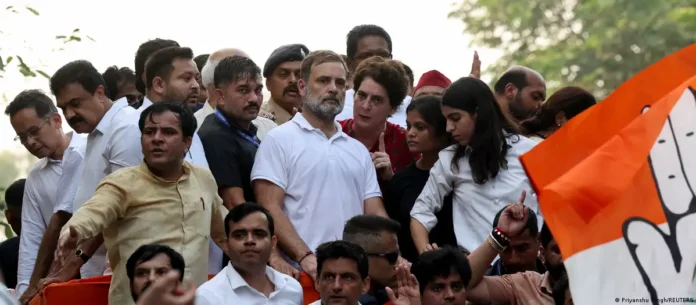
ON 12 OCTOBER, Rahul Gandhi rode a truck towards the Supreme Court with his sister Priyanka beside him and dozens of opposition MPs behind. He carried a memorandum for the Chief Justice of India. It demanded that the Chief Election Commissioner, Gyanesh Kumar, resign; that the Special Intensive Revision (SIR) of electoral rolls be halted; and that India return to paper ballots. Gandhi said the CEC should be tried for treason. “We will not spare you,” he said. The day before, the CJI had reportedly declined to meet him, observing that similar matters were already before the court, and told him to file a petition like any other litigant. The truck turned around; the petition was submitted, though not in person.
Resign or cancel: a two-button remote control for the republic. Two days earlier, the Cockroach Janta Party (CJP) had tried to take over the capital’s streets with its own demand that the CEC resign. The police made sure it could not: thousands were detained, Metro services were restricted and the internet was cut in parts of the capital. The CJP’s list went further than Gandhi’s: freeze the SIR and restore the January 2025 rolls, pause the upcoming elections, and bring criminal proceedings against the CEC. Nor was resignation the end of it. “Even if Gyanesh Kumar resigns, we will not bow down,” its co-convener Saurav Das told The Week on the eve of the protest.
And we are asked to accept that those protesting for all this are protesting for democracy.
The right to protest is integral to democracy. But democracy is not endangered merely because a government’s opponents are angry, nor is it made safer when that anger acquires a stage, a soundtrack and a relentless supply of resignation demands. The presumption that every protest is democratic in purpose, informed in substance and proportionate in method does not survive contact with this one.
The protest rests on a single claim: that India’s institutions are finished, so the street must do their work. The record of the past fortnight says otherwise. And once that is clear, two questions follow. Who gains from declaring the institutions dead? And who is being asked to believe it?
THE SUPREME COURT has been anything but idle. In May, a bench led by Chief Justice Surya Kant upheld the validity of the SIR, while laying down safeguards: notices, individual inquiries, reasoned orders and a right of appeal for anyone struck off. On 5 October, hearing petitions against the CEC, the same court refused to suspend him without hearing him, said it could not pass orders on newspaper reports alone, and issued notice to the Union, the Commission, the CEC and both Election Commissioners. In the same hearing, it said it had never approved the modified Form 6 the Commission had cited, a point against the Commission, not for it.
On 11 October, a Sunday, the court held a special sitting on the police response to the CJP protest. It said peaceful protesters must not be detained illegally, that Metro and internet services should keep running unless public order required otherwise, and that lawyers must be allowed to work. It issued contempt notices to the Union Home Secretary and the Delhi Police Commissioner. The crackdown was real and heavy-handed. The court checked it within a day. On 15 October, it took up 46 petitions on the protests and the SIR, and also issued notice to the Congress and Gandhi on a plea against the march to the court. “We are not sitting in ivory towers,” the CJI said. “We know what statements they are making outside and what they are saying in court.”
That is what a working institution looks like. It hears the grievance, rules against the government where the government is wrong, protects the protesters from the police, and refuses to be stampeded. None of these matters has reached a verdict. The time that takes is the natural pace of adjudication. To deny the institutions that time is not a demand for justice. It is political opportunism draped in moral vocabulary.
The language has stopped being proportionate to the problem. Senior Advocate Vikas Singh, appearing for one petitioner, told the bench it “has to pass some interim orders, otherwise the country will burn.” Courts are not usually persuaded by arson forecasts, and this one was not.
NOW TEST the evidence in the public domain. The Indian Express reported that Election Commissioners Sukhbir Singh Sandhu and Vivek Joshi recorded at least 14 objections between October 2025 and August 2026 on decisions including forms, software, appeals and the allocation of work. The Commission said differing views are part of decision-making and that the decisions were unanimous; the newspaper said that did not answer its questions. These are grounds for demanding an explanation. They are not, in themselves, proof of a coordinated national operation to steal votes.
An objection can justify an inquiry, an inquiry can establish wrongdoing, and wrongdoing can justify a proportionate remedy. The political shortcut skips every rung: from an objection a conspiracy is assumed, the conspiracy is always aimed at the opposition, and it is always grave enough to demand a resignation and nothing less.
Then there is the number. About 13.3 crore names have been left off the draft rolls across the SIR’s phases. “Where 2 per cent is deciding the election, you are deleting 13 crore votes. What is this if not a setting,” Dipke asked on 15 October. The number has travelled. US Congresswoman Pramila Jayapal said she was “deeply concerned about the actions of the Indian government to purge 130 million people from the voting rolls”; Newsweek likened the figure to the population of Mexico. Read without its breakdown, it sounds like the end of the franchise. Read with it, it looks like administration: about 2.8 crore were dead and about 1.01 crore were duplicates. The rest were marked absent, shifted or “other”, and those voters can apply to return to the final rolls through Form 6. None of this means every deletion is correct. Critics say the removals have fallen hardest on minorities and the poor, and wrongful deletion of eligible citizens is a legitimate question that must be investigated. Nor does the pattern fit a theft aimed at the opposition. In Uttar Pradesh, ThePrint found that 15 of the 16 assembly seats that lost more than a lakh voters were held by the BJP. Chief Minister Yogi Adityanath had reportedly warned months earlier that of about four crore eligible voters unaccounted for, “85 to 90 per cent” were “ours”. But a contested deletion is not a stolen vote, and the place to contest it is the claims-and-objections process and, failing that, the court that is already hearing the case.
When the CJP first appeared, a columnist in The Tribune called the comparison with Anna Hazare’s 2011 movement “inevitable”. It flatters the CJP. The 2011 movement followed the CAG’s report on the 2G spectrum allocation, tabled in Parliament in 2010, which estimated a presumptive loss of ₹1.76 lakh crore, and came amid the Commonwealth Games scandal. The Supreme Court later cancelled 122 licences. Whatever one thought of its methods, the movement had a documented scandal behind it and a concrete demand in front of it: a Lokpal. Anna had a ledger. This movement has a hashtag.
If the courts are hearing the case, why do the loudest voices insist that only the street can deliver? Look at who is saying it.
ABHIJEET DIPKE, the CJP’s founder, told AFP this month that there is “no point in making it a political party when the elections are fixed and the results are already pre-decided.” Fixed, before any court or inquiry has found anything of the kind. Yogendra Yadav, cheering the CJP’s march on Parliament in July, said “the future of democracy in this country will not be determined by the Parliament”; “it will be decided from the streets.” Neither man explains why the street should outrank the institutions that are, at this moment, hearing their case. A movement cannot declare institutional exhaustion because the institutions have not instantly delivered its preferred result.
On 13 October, after a high tea hosted by Gandhi, AISA president Neha Bora told reporters: “When we say ‘We, the People versus the BJP’, we are talking about one fight… one common enemy; one enemy of the people of this country.” The name of that enemy, she said, “is the BJP.” The BJP is a party citizens may oppose, investigate, criticise and defeat. It is not an enemy of the Indian people, and the millions who vote for it do not stop being “We the People” because a protest leader has divided the country into the awakened and the condemned. There is nothing improper about an anti-BJP campaign. The impropriety begins when a partisan coalition presents itself as the nation, disagreement as hostility to the nation, and a lawful mandate as an obstacle to it.
The speaker matters, because a cause is judged partly by its champions. AISA is the student wing of the CPI(ML) Liberation, which descends from a Naxalite stream that once treated boycotting elections as a legitimate form of struggle. The older Left’s record is no better: the CPI’s 1948 line was “Yeh azadi jhooti hai”, and the CPI(M)’s programme still describes the Indian state as an instrument of bourgeois-landlord rule, with Parliament one arena of struggle among others. These parties have since contested elections, and none is barred from the ballot. A convert is welcome. A convert who declares everyone else a heretic is not.
This is not a charge of treason. It is a question of credibility. When a tradition that spent decades calling this republic a bourgeois device now appoints itself its sole defender, it is fair to ask whether the reverence is principle or tactic. Making it the referee of Indian democracy is like asking a committee that considers chess a bourgeois plot to referee the world championship: enthusiastic about the board, unsure about the rules, and certain the other side is cheating.
The movement’s own handling of facts does not inspire trust either. On 10 October, while Dipke was in detention, his grandmother died in Hingoli. His mother said the police had lied and that he had not been told. Delhi Police then released footage of officers telling him, offering him water and offering help to travel home. It is a grief nobody should trivialise, and the footage settles his mother’s claim. Dipke’s own complaint was narrower: that he was then denied his phone and his lawyer. The video does not show that, and it deserves an answer. It will get one, because the detention petitions are before the Supreme Court. Which is rather the point.
IN THE 2024 general election, the ruling party fell to 240 seats and lost the majority it had held for a decade. The system supposedly rigged against the opposition has been remarkably incompetent at it. Yet we are told votes are being stolen and the cure is to stop counting them. Try reading the demand as a cricket match: the umpire must go, the match must stop, last year’s scorecard must be restored, and the series continues until our side wins. That is not a fixture. It is a tantrum with a travel budget.
The pattern is now settled. A defeat proves manipulation. A victory proves sophisticated manipulation. An unexpected victory proves manipulation so advanced nobody saw it coming. This is not a method for finding out whether elections are fair; it is a mechanism for ensuring they can never restore confidence. Without the possibility of proof, politics becomes faith, and one no longer asks what happened, only which camp supplied the explanation.
Democracy includes the possibility that a party you dislike will win and carry out policies you oppose, within constitutional limits. Accepting that is not submission to the powerful. It is the basic discipline that makes peaceful competition possible. A serious opposition exposes wrongdoing, offers alternatives, organises voters and competes for power. It does not make the legitimacy of institutions conditional on its own victory.
Nor does a loud crowd speak for a silent country. The farm laws were repealed in 2021 after a year of protest. Yet the report of the Supreme Court-appointed committee, made public in March 2022 by its member Anil Ghanwat, found that most of the farmer organisations that made submissions supported the laws. The most visible protest is not the same as everyone affected. It may be loud. It is not necessarily representative, and it is certainly not automatically right.
Which leaves the third question: who is being asked to believe all this?
THE DAMAGE will outlast the hashtag. A citizen taught that the Election Commission is a thief, the investigating agencies compromised, the courts complicit and Parliament a stage set, all because one party is disliked, becomes a citizen who will accept no result he does not like. That distrust does not stay with the incumbent; it attaches to machinery that every future government, of any colour, must also use. A defeated party can win the next election. A discredited institution cannot easily be un-discredited. Trust in the umpire is the asset a democracy lives on.
History is blunt about what follows when it is spent. Weimar Germany was told for years that its parliament was a sham; when the republic fell, it fell to men who promised to end the chaos. In Egypt, mass protests against an elected president in 2013 ended with the army removing him and installing a general. Neha Bora has offered a “red salute” to Bangladesh’s young protesters, calling theirs a movement “for democratic and voter rights”, as she says India’s now is. Bangladesh is still counting the cost of that uprising. In Nepal, a Gen Z uprising toppled a government at the cost of at least 77 lives, and it took a general election on 5 March 2026 to restore legitimacy. Even the revolution queued at the ballot box.
The young are the target audience of this campaign, and they deserve better than to be its raw material. An algorithm shows you what agrees with you, then more of it, until the echo chamber looks like a consensus. A reel can introduce an issue; it cannot replace understanding its source, scope and uncertainty. A swelling soundtrack can make a Saturday in Delhi feel like 1942. It cannot tell you whether a particular voter was wrongly struck off.
So study before you share. Is the claim an allegation, a procedural objection, an administrative error, an unlawful exclusion or a proven conspiracy? Read the original report and the official reply, and note what the reply answers and what it evades. Ask your favourite activist the questions you would ask a minister. Replacing loyalty to a party with loyalty to a personality who denounces parties is not independence. Young citizens strengthen democracy when they become hard to manipulate, not merely easy to mobilise.
THE REMEDIES are demanding but real. Document electoral-roll grievances. Use the claims, objections and appeals the SIR provides. Seek records under the Right to Information Act. Press MPs to ask questions in Parliament. Challenge unlawful action in court, as is already happening. If misconduct is proved, pursue the CEC’s removal under Article 324(5), which requires the same process as removing a Supreme Court judge. The Commission, for its part, must answer its dissenting commissioners, explain Form 6, and publish whom it has removed and why.
Protest belongs to those who are refused a hearing. It is the last resort, not the first reflex. These protesters have been heard, and are being heard, in the highest court in the land. Protect the protest. Examine the claim. Require the evidence. Defend the remedy. Democracy needs two refusals: of official impunity, and of self-appointed sovereignty.