

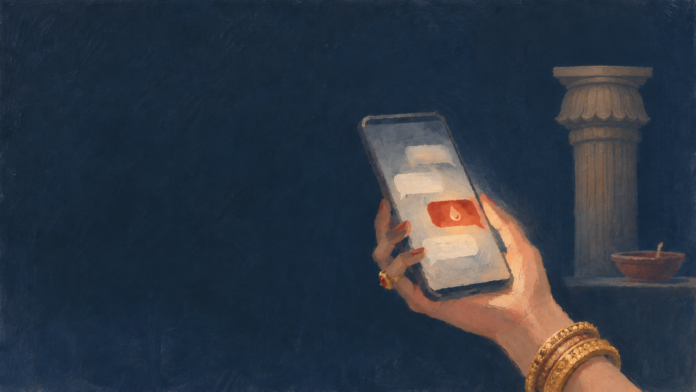
Imagine yourself as a powerful minister in the Mauryan Empire. One day, a parivrajika (wandering female ascetic) comes to you and reveals that the lithe and soft-spoken empress has fallen for you. The empress wants to meet you in secret at the palace guesthouse, where she entertains only her guests. The time is set for midnight, once everyone is asleep.
Your mind races to imagine the soft embrace of the beautiful chief queen. With her love comes power—just as Devi Sita’s stri dhan (a woman’s exclusive wealth) included a large, divine chaturanga sena (the four-limbed armed forces), a wedding gift from her father. With her love come the best creature comforts, the stunning palace, and your happily ever after—just as Vibhishan inherited Lanka with its palace and other luxuries after Ravan’s death. You have everything under your command. You remind yourself that you are smarter than the emperor in numerous fields. Heady with the stories of ancient queens and imagining the world at your feet, you walk into the dimly lit private chamber.
Instead of walking straight into her arms, you walk into the arms of the royal soldier. From behind, five others poke the pointy tips of their spears into your back. The empress is blissfully unaware of what has conspired in her name, but Acharya Chanakya has trapped you. Congratulations, you have failed the ‘Lust Test’.
Men like to believe that if they can avoid lust, they will be safe. They think their street smarts or morals may save them because they can spot such traps from a mile away. They also assume that intelligence, discipline, status, wealth, and high security clearance act as a shield against manipulation.
But they could not be more wrong. Over 2,300 years ago, Acharya Chanakya mapped out the exact blueprint to break men—and it is still claiming victims today. Acharya Chanakya knew that no human being is beyond seduction, and November 2026 is a testament to the oldest trick in espionage.
In November 2026, Jensen Huang, the visionary billionaire who built Nvidia into an AI superpower, resigned as its chief executive at the end of two weeks of damaging reports. US officials believed that Alice Huang, a former executive of the Singapore-based Megaspeed who had grown close to him, was a Chinese intelligence asset; and reports said he had had two extramarital affairs, one with her and another with a vice-president who reported directly to him. Nvidia gave no reason for his departure, and its board said it had no reason to believe that company secrets or national security had been compromised.
On Indian social media, memes cast Huang as a Bollywood hero who walks into ruin with his eyes open. In one, the woman warns him, “Mere itne kareeb mat aao, main tumhe barbaad kar dungi” (Don’t come so close, I will destroy you). He replies, “Main barbaad hona chahta hoon!” (I want to be destroyed!)
Around the same time, details emerged from a Delhi Police chargesheet against an Indian Air Force wing commander, arrested on 30 May under the Official Secrets Act. The police allege that between January and April 2026, he shared a page from a classified war plan, drone capabilities and fighter aircraft movements with a suspected Pakistani operative over WhatsApp, in exchange for explicit photographs. According to the chargesheet, the contact began with a message asking for therapy advice during a separation, a personal situation the officer was also going through.
One man commanded a global tech empire; the other guarded the sovereign skies. Neither was naive, but both were targeted, and both have paid for it: one has lost his job, the other faces trial. Power does not protect you from desire, ego, or loneliness—it just makes you a higher-value target.
In the Arthashastra, Acharya Chanakya laid out one of the earliest systematic accounts of women as intelligence agents, because he understood that seduction is not always about lust. It is also about access, validation, and emotional timing or vulnerability. Every human being, no matter how disciplined, aware, or inaccessible, has blind spots where logic shuts off, and emotions take the driving seat.
To find that blind spot, Acharya Chanakya did not rely on merely one type of seductress. There was an invisible network of female operatives designed to disarm every kind of mind and provide exactly what the man wants. His spies (male and female) are listed in Book 1, Chapter 12, The Creation of Wandering Spies, and Book 2, Chapter 27, The Superintendent of Ganikas (in R. Shamasastry’s translation). Three of them are described here, because their kind still operates.
THE PARIVRAJIKA (परिव्राजिका, wandering female ascetic): Acharya Chanakya recruited poor, widowed but sharp-witted Brahmin women and disguised them as wandering nuns who subsisted on alms. They commanded immediate religious reverence and walked unchallenged into any home and private chambers of women, from ordinary housewives of the empire to rival queens. They became confidantes of men and women and were beyond suspicion or the popular trap of lust, as they displayed piety.
A modern-day example allegedly operated in our neighbouring country, Pakistan. In November 2025, The Economist reported, citing anonymous sources, that intelligence officers passed information to Imran Khan’s wife, Bushra Bibi, which she relayed to him as “divine inspiration”. Earlier reports in Pakistan had named the former ISI chief Faiz Hameed as her source. Khan’s party called The Economist’s report defamatory. While she was not a widowed Brahmin, she clearly established herself as a faith healer and mystic.
THE GANIKA (गणिका, courtesan): In the Mauryan state, the courtesan was a government employee. The Arthashastra places her under the Ganikadhyaksha (superintendent of courtesans), who appointed a ganika at the king’s court on a salary of 1,000 panas a year, with a rival ganika on half that. The state paid teachers to train them in singing, music, dancing, acting, painting and even reading the thoughts of others. For the state, ganikas were sources of pleasure, income and information. The Kamasutra makes mastery of the chausath kalaein (sixty-four arts) the mark of a true ganika.
We know this today because Acharya Chanakya wrote about it; however, the high-flying minister or businessman of the Mauryan era would have been caught unawares. He would have simply assumed she was wealthy because she had numerous moneyed benefactors. In today’s era, think of her as the corporate courtesan who seduces CEOs and other powerful men, aiming at nothing but the top.
THE RASADA AND THE VISHKANYA (रसद, poison giver, and विषकन्या, poison maiden): Literally, a rasada is a giver of fluids or mixtures. In the Arthashastra, the rasada is a poisoner planted inside a house or palace as a cook, a sauce-maker, a bath attendant, a shampooer or a barber.
The female version is the vishkanya: a woman said to be raised on poison, so that intimacy with her is enough to kill. The Arthashastra does not mention her. However, later Sanskrit literature does, and its most famous story features Acharya Chanakya himself. In Vishakhadatta’s play Mudrarakshasa, the Nanda minister Rakshasa sends a poison maiden to kill Chandragupta; Acharya Chanakya diverts her to Parvataka, Chandragupta’s ally, who dies instead.
The WhatsApp Vishkanya does the same job, except that she seduces you through a phone screen, extracts information, and destroys you in the process. No man is too high or low for the seductress who uses emotional trappings of loneliness to capture her prey.
The trap only needs one night or one moment of weakness. You do not have to be Jensen Huang or an IAF officer to be worth targeting. You may only hold a password, a bank account, a corporate login, access to an office, or a secret that someone else wants. Just as Acharya Chanakya’s spies never needed to break down palace gates, modern-day spies wait patiently till a vain, proud, tired, or lonely individual leaves a small window open.