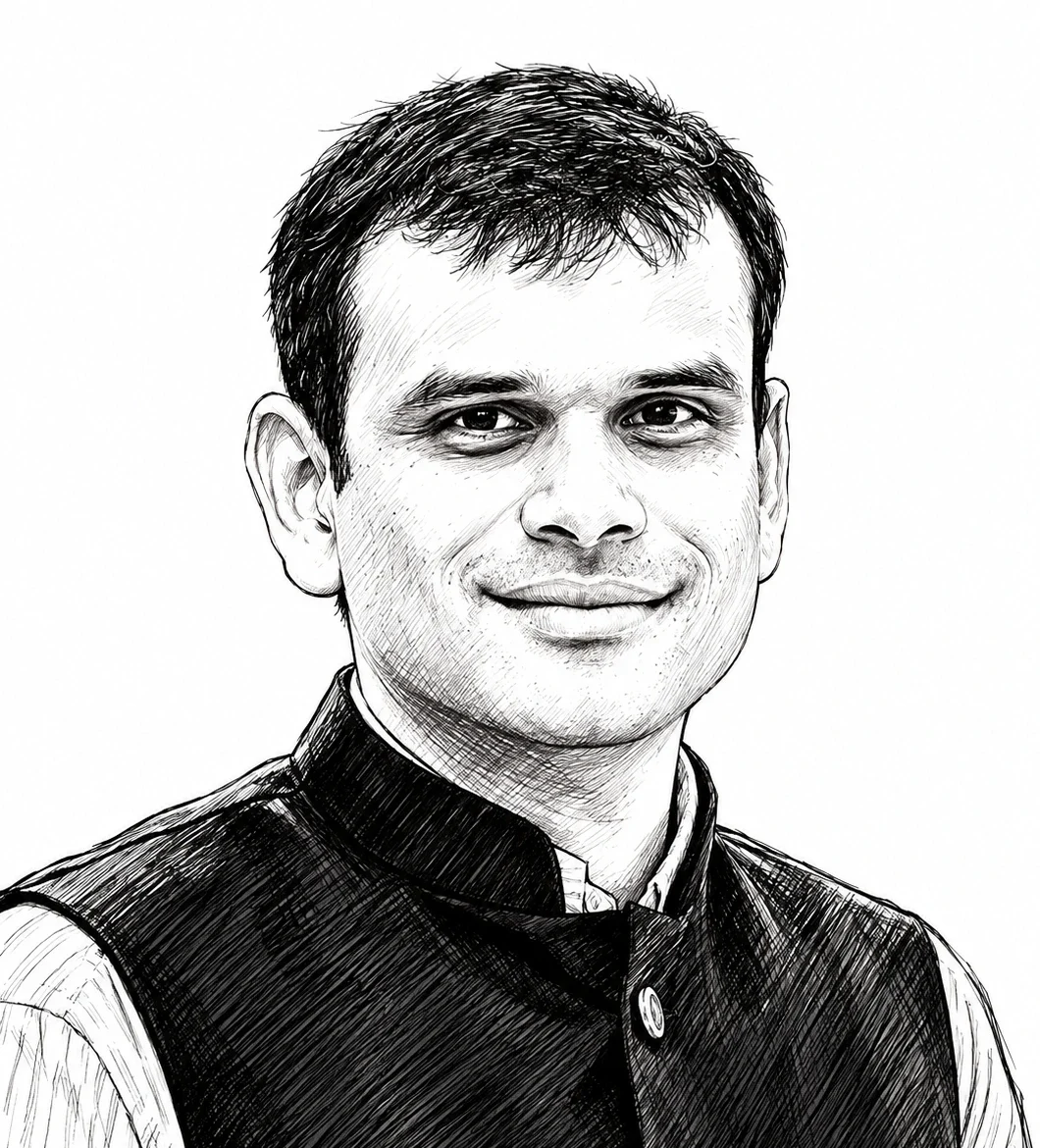

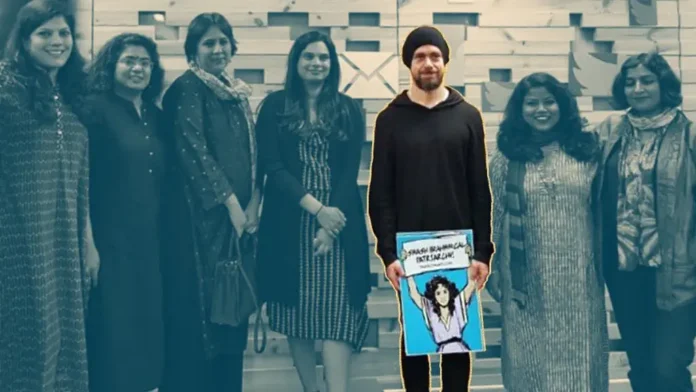
Congress leader Rahul Gandhi’s recent invocation of the Manusmriti in a recent program in Pune to characterize the Indian social order and to point to its embedded patriarchal instincts has once again brought to surface the political term “Brahmanical Patriarchy”. An unnecessary invocation of Manu Smriti in a congregation where Mr. Gandhi was speaking and the associated general discussion of the term Brahmanical Patriarchy, tells us about the pervasive nature of a term which actually needs a lot of analytical caution. This of course is not a novelty. In 2018, a photograph of Twitter CEO Jack Dorsey holding a poster reading “smash Brahmanical patriarchy,” with Indian activists and journalists, provoked a similar controversy, forcing the company into an apology.
Campus posters at institutions such as Jawaharlal Nehru University have attributed everything from sexual violence to administrative fee hikes to a “Brahmanical” hand at work. The recurrence of such episodes across a decade, spanning student politics, government decisions, corporate practices and now also the frontline national politics, suggests the term is not merely being cited but actively kept alive as a piece of political vocabulary. That durability is worth examining on its own terms, because a term this loaded in public discourse must rest reasonably on correspondingly solid scholarship. Unsurprisingly, it does not.
The term Brahmanical Patriarchy was first academically coined by Uma Chakravarati in her 1993 essay “Conceptualizing Brahmanical Patriarchy in Early India”. Chakravarti in that essay gave the term a political turn with an academic credence which has since then been used effectively by academicians and polemics alike of the left. But long before the 1993 essay gave the phrase its current currency, “Brahmanism” or “Brahmanical” had a place in the public discourse, sans its ideological insinuation. Popularized by European scholars in India, the term had a considerably more modest life in the nineteenth- and early twentieth-century. It seemed to have been used primarily as a descriptive marker distinguishing the Vedic ritual and textual tradition from the other Indic traditions like Buddhism, Jainism, and various shramana movements. The term did occasionally invoke some recall to orthodoxy, especially within the reformist movements within India, but the term was not an ideological vector common today. For instance, a scholar could write of “Brahmanical cosmology” or “Brahmanical law” in a purely descriptive way used for any other classical textual corpus without associating any accusation. At the same time, reformers like Justice Ranade would at times use it to refer to certain orthodox practices to separate it from the traditions of Bhakti to make a point for reforming within the traditions. The accusatory or ideological value to the term was associated over a due course of time, which however is not the point of this essay.
Chakravarti’s essay however effected a quiet but consequential shift to the concept of Brahmanical Patriarchy. Her stated project was to explain how Dharmashastra prescriptions around female sexuality served to preserve caste purity. But the argument’s rhetorical architecture did something, the older Indological usage never did- it collapsed the distinction between a textual tradition and a social order and then further collapsed the social order into a hereditary group. “Brahmanical” stopped being a body of prescriptive literature and began to be identified as an ideology actively imposed by “ideologues” who “mapped out” the patriarchal caste-class structure of an entire civilization. The move from this text prescribes X to this community engineered X as a structure of rule is a substantial inferential leap, and it is one Chakravarti’s essay asserts rather than demonstrates. Arguably, this effectively solidified a flimsy logic that occurrence of a passage meaning something was seen as precisely how the society was.
Indeed, no evidence is offered to explain how prescriptive norms in Dharmashastra literature translated into enforced practice across the enormous regional and caste diversity of the subcontinent, over two millennia. The essay was popularized not because this evidentiary gap was closed by subsequent scholarship, but because a growing activist and NGO-adjacent academic milieu in the 1990s and 2000s found in it a ready-made, single-phrase synthesis of caste and gender oppression. A slogan disguised as a historiographical finding suited to placards, hashtags, and campus polemic was born and since then has been used with a veneer of academic authenticity. The popularity substituted for the argument’s actual evidentiary load-bearing capacity.
It is this political convenience, more than any accumulating scholarly consensus, that explains the term’s afterlife in left activist discourse. “Brahmanical Patriarchy” offers something politically efficient that a more accurate, disaggregated account of Indian patriarchy cannot: a single named villain. Rather than the harder, slower work of showing how inheritance law, marriage practice, dowry and women’s labor-force exclusion actually vary by region, religion and specific caste-cluster – work that would implicate patriarchal practice among many communities across the religious spectrum, the phrase allows a single hereditary group to be named as the origin and continuing agent of a nationwide structure of oppression. Rahul Gandhi’s use of the Manusmriti fits this pattern precisely: an approximately two-thousand-year-old normative text, with no evidence of it ever been uniformly applied is cited as though it describes the present, with “Brahmanical” doing the work of transferring blame from a diffuse, multi-caused social phenomenon onto an identifiable, hereditary community.
There is a further pattern worth naming directly primarily because it clarifies what the term is actually doing. “Brahmanical Patriarchy” operates through a two-step reduction and over-simplification. The first step collapses the entire diverse corpus of Hindu religious and normative literature, shastra, smriti, epic, and purana, composed across a millennium and a half by authors of varying caste background and often in contention with one another, into a single category loosely labelled “Brahmanical.”
The second step is to then ascribe to this flattened, simplified category every socially problematic practice discoverable anywhere in Indian history regardless of whether the practice is textually mandated or even entirely absent from the textual record. Once “Hindu religious tradition” has been narrowed to “Brahmanical text” and “Brahmanical text” has been made to answer for every social ill under discussion, a critique of an entire civilizational tradition can be delivered under the cover of a narrower, caste-specific accusation. This smartly removes any obligation to demonstrate with proof of any such causal link. Tellingly, this discourse is rarely followed through with sustained empirical attention to the actual material condition of Hindu women, literacy, property outcomes, workforce participation compared against women of other faiths and other countries; the sustained energy goes almost entirely into relitigating ancient textual authorship. That imbalance is itself evidence of what is actually being contested.
This is where the term’s use crosses from flawed historiography into something that deserves to be named plainly as bigotry. To hold a community morally and politically responsible today for the content of a two-millennium-old text is a textbook instance of collective, hereditary guilt – the same reasoning structure, applied to any other inherited identity category, religious, ethnic or racial, would be immediately and correctly recognized as prejudice rather than analysis. The double standard by which this reasoning is treated as acceptable, even progressive and unacceptable when applied to any other community is not a minor inconsistency; it is the clearest evidence that the term now functions as an instrument of political mobilization rather than as a neutral tool of social analysis.
The cost of this is not merely rhetorical. It actively obscures the empirical study of patriarchy that Indian society genuinely needs. Patriarchal control of women’s sexuality, mobility, inheritance and labor is a near-universal feature of different societies across different time frames. Treating or attributing it as the distinctive invention or possession of one religious / cultural community forecloses any comparative, cross-cultural, materialist analysis that would actually explain why patriarchal control recurs wherever property, inheritance and lineage purity intersect, regardless of which religious or caste tradition happens to be locally dominant. A social phenomenon this consequential, and this variable across region, religion, and community, deserves study through rigorous, disaggregated, genuinely academic, falsifiable and comparative categories and not through a single ideologically charged label that pre-assigns blame before the evidence is even examined.
The concern on display is not necessarily the wellbeing of women; it is the delegitimization of Hindu tradition as such with the vocabulary of feminism serving as a morally necessary and therefore respectable front for an argument about religion and civilization that could not command the same authority if made in its own terms. This is a familiar left technique more broadly, targeting a tradition under the cover of a more defensible-sounding cause, and it deserves to be called what it is rather than accepted at face value because it borrows the language of social justice.
The debate reignited by Rahul Gandhi’s remarks is not a debate about the Manusmriti, a text which actual relevance and consequence in daily lives of Hindus can be debated, even in the history. It is a debate about whether Indian public discourse will keep treating the unevenly followed prescriptions of certain ancient texts as a live indictment of a community today. It should not. The study of patriarchy in India is too consequential and too genuinely damaging to too many women across every caste and religion to be surrendered to a vocabulary whose function is accusation rather than explanation. What the subject demands is depoliticization: a deliberate return to disaggregated, falsifiable, comparative categories tracked against actual data on inheritance, marriage, education, and labor, in place of a slogan that lets any speaker skip the evidence and proceed directly to the verdict.
The Indian left has kept “Brahmanical Patriarchy” in circulation for exactly this reason: it is rhetorically costless, endlessly renewable, politically and strategically convenient and requires no engagement with the historical record it purports to summarize. Political actors such as Rahul Gandhi now reach for it not as scholars weighing evidence but as opportunists borrowing a ready-made accusation for immediate political effect, fully aware of its capacity to generate outrage without the burden of demonstrating anything. A society genuinely serious about the welfare of its women and honest about the internal diversity of its own past, would retire the term rather than continue to weaponize it.