

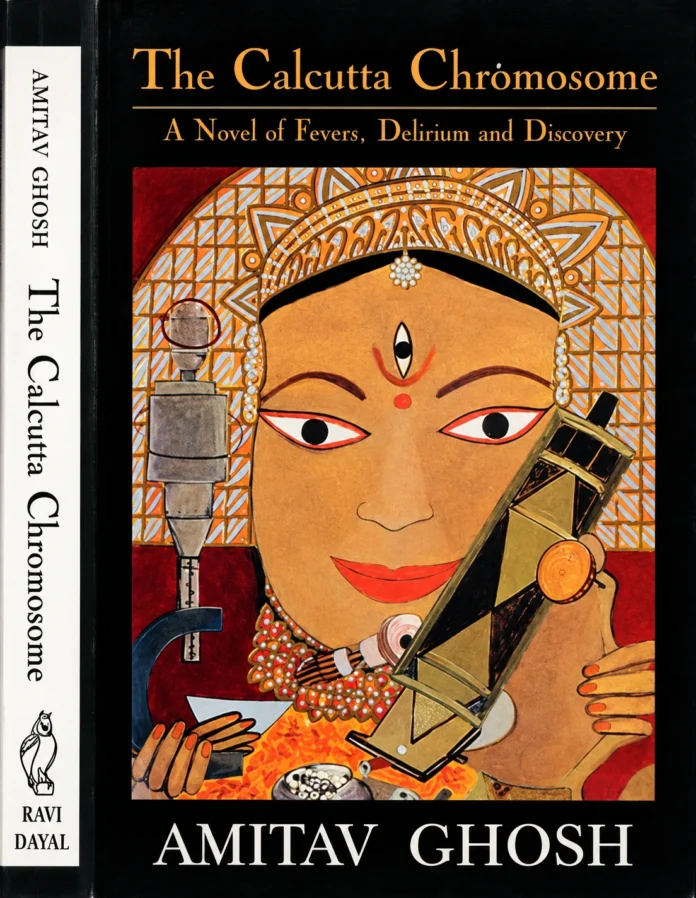
In Amitav Ghosh’s The Calcutta Chromosome, Elijah Farley visits D. D. Cunningham’s laboratory in Calcutta. When Lutchman takes unusually long to return with a slide, Farley notices that the handle of an adjoining room is polished despite the dust around it. Inside, he finds Mangala among a group of patients, preparing a slide with pigeon blood. Under the microscope, the slide shows Laveran’s rods. Farley comes away convinced that she knows far more about malaria than Cunningham could ever have taught her. Cunningham sees none of it. To him she is just the sweeper-woman, a fixture of the place, not worth a second thought.
It would be easy to call this a story about a woman denied credit for a scientific discovery. Ghosh suggests something harder. Mangala may not have been shut out of the history of science so much as working beyond the terms on which that history grants recognition. If so, the urge to rescue her, to identify the true discoverer and correct the record, risks repeating the wrong it means to undo. That urge runs through a good deal of postcolonial scholarship, which reads every silence in the archive as a theft. To recover Mangala, we would have to turn an uncertain life into a definitive story. She would become visible, only to be made legible on our terms.
Ghosh places the fictional Mangala beside Ronald Ross, the real British doctor whose research established the role of mosquitoes in transmitting malaria. The contrast is not simply between a celebrated scientist and an overlooked Indian woman. It is between two kinds of historical existence. Ross belongs to the documented past: his work can be traced through institutions, publications and prizes. Mangala emerges through fragments, observations and suspicions. One arrives with a record; the other arrives as a question about how that record was made.
Much of what we know about her comes through L. Murugan, a researcher convinced that the accepted history of malaria conceals another history beneath it. He suspects Ross’s breakthrough depended on people whose knowledge was never acknowledged, and Mangala becomes central to his reconstruction because she keeps appearing at the edges of events others claim to understand. His theory is compelling, but it remains a theory. To treat it as settled fact would be to resolve a mystery Ghosh deliberately leaves open.
Cunningham’s dismissal of Mangala shows how knowledge is filtered before it is ever tested. Her position settles in advance what he thinks she can know: where Farley sees a woman who understands malaria, Cunningham sees a sweeper. His failure is not that he withholds credit after a discovery. It is that he cannot imagine her as a source of knowledge at all.
Scientific institutions exist to make knowledge credible. Observations are recorded, findings circulated, credit assigned, and that discipline lets people test claims and build on one another’s work. But the same authority decides which claims get a hearing in the first place. Someone without the accepted credentials, language or social standing must clear an extra hurdle before their knowledge is even considered possible.
Ghosh does not offer a neat alternative in which everything outside Western science is wiser or truer. He unsettles a narrower assumption: that knowledge becomes legitimate only when an authorised institution can name, classify and preserve it. A person can know something without the credentials that would make others listen. The absence of an official account does not, by itself, establish the absence of knowledge.
Murugan has a name for what lies beyond the laboratory: a “counter-science”. “The first principle of a functioning counter-science would have to be secrecy,” he says. “The way I see it, it wouldn’t just have to be secretive about what it did… It would have to use secrecy as a technique or procedure”. In his account, secrecy is not only a shield for Mangala’s circle but its method.
Yet the novel also makes it hard to romanticise what remains hidden. Secrecy is not the same as freedom, and exclusion is not the same as choosing to stay outside. Mangala’s apparent authority over those around her blurs any easy line between the powerless and the powerful.
Suppose Murugan is right, and Mangala has been directing events from outside the recognised world of science. Murugan can explain how her circle works; he cannot tell us what she wanted. We still cannot say whether she chose secrecy because she feared appropriation, rejected colonial authority or preferred anonymity. Each explanation is plausible; none is hers.
To declare her silence an act of resistance would still be to speak on her behalf.
An archive is not history. It is what remains for history to be written from, shaped by what was recorded, preserved and thought worth keeping. Sometimes an absence exposes an injustice. Sometimes the evidence is simply insufficient. Often, as in Ghosh’s novel, we cannot tell which we are facing.
By the end, the question is no longer whether Ross received credit that belonged to someone else. It is whether credit measures what happened in that laboratory at all. When Farley looks through Cunningham’s microscope, he sees Laveran’s rods, and he sees that the woman who prepared the slide knows more than the laboratory can explain. What he cannot see is where that knowledge came from, or what she meant to do with it. Finding the missing name is necessary. It does not give us the right to decide what the person behind it must have wanted.