

Senior Advocates are not, as a rule, given to emojis. So I studied Sanjoy Ghose’s recent post with some care. It has a photograph of Nepal’s Supreme Court on fire, and a story from a Nepali judge who told him that judges “had no place to work”. It ends: “I am glad Nepal has moved on. The Court must never lose its connect with the people ☺.”
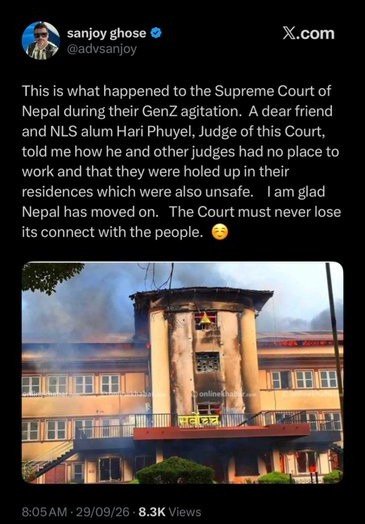
I read it three times, hoping it meant something else. It doesn’t. The Indian judiciary has been shown a burning building and told to cheer up.
The occasion was the cockroaches. In May the Chief Justice, Surya Kant, compared certain unemployed young people who attack institutions online to the insect; the next day he said he had been misquoted. Within days the cockroaches had a party, millions of followers and noticeably better jokes than their critics. Their grievance was a real one: a leaked medical entrance exam, two million students made to sit it again, an education minister they wanted gone. They sat in at Jantar Mantar and marched on Parliament, and almost nobody set anything on fire. In July the minister resigned, and the cockroaches went home. Which makes it odd that it is the grown-ups who keep bringing up Nepal.
Not only the grown-ups, admittedly. Walking through North Campus recently, I heard a few young men announce, with some satisfaction, that “India is going to be the next Nepal!” They said it the way one might predict a good monsoon.
It is worth asking what Nepal actually was. The spark was a ban on social media. The fuel was youth unemployment of about 20 percent and an economy living on remittances, which make up about a quarter of GDP. On 8 September 2025, police fired on protesters and killed at least 19, among them a schoolboy in uniform. The next day was not a protest. Parliament, the Prime Minister’s office, politicians’ homes and the Supreme Court were stormed and burned. By the end, 77 people were dead.
The court is the part nobody photographs twice. Of the files for some 24,000 pending cases, about 20,000 went up in smoke, along with nearly 197,000 archived ones. Last fiscal year it disposed of 29.46 percent of its caseload, down from 42 percent the year before. Somewhere in that backlog is a litigant waiting on a verdict and an undertrial waiting on bail. Nobody asked them about the fire.
A protest says “hear us”. What happened on 9 September said “we will burn the place where you hear anyone.”
Nor did the young get much for it. In Nepal, as in Bangladesh and Madagascar, the government fell, and the young say they were iced out of what came next. In Madagascar an army colonel took power; in Nepal the army chief brokered the talks that chose the interim government. They paid with their lives and their livelihoods, and the keys went to someone else.
India, happily, already has the doors that Nepal’s young had to kick in. Some of them were built by protest. In 1996, village labourers in Rajasthan sat in at Beawar for 40 days demanding, of all things, information. Nine years later, the country had the Right to Information Act. They had no weapons and no mob, only patience. After the Delhi gang rape of 2012, overwhelmingly peaceful crowds got a committee under Justice J.S. Verma within a week and a new criminal law within months. Nobody burned a courtroom. They needed the state to listen, and it did.
Article 19(1)(b) gives every citizen the right to assemble, peaceably and without arms. Those last four words are not a technicality. They are the bargain that makes the first part possible.
Which brings me back to the grown-ups. Ghose may say he was only passing on a friend’s story, and perhaps he was. But a burning Supreme Court, posted in the middle of a quarrel with the Indian one, will be read as a message, whatever he meant by it. And the lesson is wrong anyway.
Nepal’s court did not burn because it lost touch with the people. It burned because people set it alight. There is a difference.
Then there is Prashant Bhushan, who told in a podcast that to save the country’s civilisation people must take to the streets, and be ready to pay for it in lathis, bullets and jail. Taking the lathi without striking back is an old and honourable Indian idea; Gandhi’s satyagrahis made a discipline of it. But Mr Bhushan’s version stops halfway. It tells a crowd to expect gunfire and never tells it what to do when the gunfire comes. In Nepal, the police fired on the 8th. On the 9th, the city burned.
Neither man has called for violence, and that is not the complaint. The complaint is what both leave out. Neither tells a 19-year-old that the Constitution gives him the right to protest peaceably, that the state owes him a proportionate response, and that keeping the peace is his half of the deal. Those with the microphone should remember who is listening: a 19-year-old with an impressionable mind and a grievance in his heart.
He is also the one who pays. It is the unemployed young man who stands at the front, because he has the time and the anger and little else to lose. It is his FIR that follows him into every police verification, and his bail bond he can’t afford. The speaker goes home, and the speaker’s family goes on with its life. Revolutions have always been fought with other people’s children.
For a preview, look at Lovely Professional University. Last month, a viral claim that a woman student had been raped on campus brought students out. The university calls it a rumour, though three students who appeared in its video denying the incident later said they had been told what to say. Police have registered an FIR and an SIT is investigating, and that is where the merits belong. What followed was not a protest. NH-44 was blocked for over 15 hours. Windows were smashed and vehicles set on fire, and people climbed onto the fighter jet and the tank the university keeps on display in honour of the armed forces. Shops in the campus mall were looted, and the looters filmed it. In one video, a voice can be heard celebrating the “free shopping”.
Nine people, seven of them students, have been arrested. Whatever their ID cards say, a person who loots a shopkeeper, films it and posts it as a trophy has not earned the word. It was theft with an audience. LPU had nothing to do with Nepal, or with any tweet. But it showed, on one campus, how quickly a crowd’s anger can outrun an investigation. The next Nepal would look like that, across a country.
Every generation inherits a country, and a choice about how to change it. Ours is being offered a shortcut, wrapped in the language of courage and passed around with a smile. There is nothing brave about a fire. Anyone can light one, and it asks nothing of the person who does. The harder courage stays standing, visible and unarmed, and puts a question to the republic that it has to answer.
A protest knocks on the door of power. A mob burns the door, and with it the only way an answer could ever have come. India built its doors patiently, through sit-ins, fasts and petitions, and they are still open. I am not willing to watch anyone burn them down to prove a point, and I am certainly not willing to smile while they do.
Protest, yes. Nepal, never. Not here.