
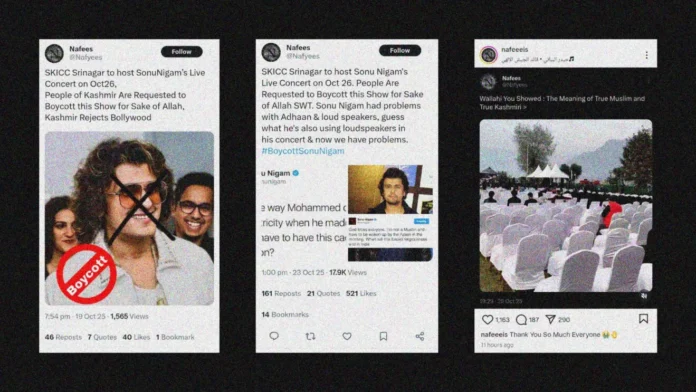
Padma Shri awardee and one of the most versatile singers of Bollywood, Sonu Nigam, performed at the NDTV Good Times Concert, held at the Sher-i-Kashmir International Conference Centre (SKICC), Dal Lake, on 26 October 2025. However, the concert didn’t attract much audience. The reason lies in a boycott campaign started by a Kashmiri Muslim and supported by many others from the community.
On 19 October 2025, a tweet on X showed up. It was by an account named Nafees, who describes his location as Kashmir, India, in his bio. The tweet featured an image of Nigam, with a black cross drawn over his face and a red stamp on the bottom-left, which had “boycott” written within it.
In the tweet, Nafees requested people “to boycott this show for the sake of Allah SWT.” “SWT” refers to “Subhanahu wa ta’ala” in Arabic, meaning “Glory to Him, the Exalted,” and often appears in the Quran.
Nafees said, “Sonu Nigam had problems with Adhaan & loudspeakers, guess what he’s also using loudspeakers in his concert & now we have problems.” Many Kashmiri Muslims echoed Nafees’s request.
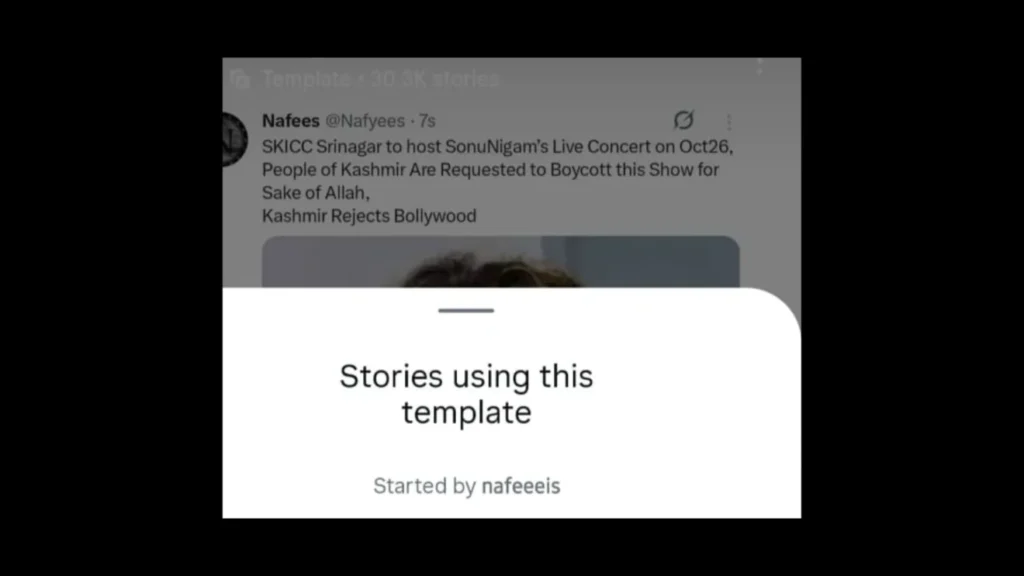
The #BoycottSonuNigam campaign started by Nafees to boycott Nigam received more than 50,000 views on both X and Instagram. Over 30,000 people on Instagram shared the template, created by Nafees, calling for Nigam’s boycott on their stories, which had “Kashmir Rejects Bollywood” mentioned on it.
However, this rejection appears to be irrational.
Bollywood has long been an important contributor to Kashmir’s economy. According to The Kashmir Observer, film productions contribute directly to the local economy by employing local talent, utilising local services, and paying location fees. The outlet also noted that movies filmed in particular areas often draw tourists eager to visit the locations featured in the movie.
Since the 1960s, Kashmir has benefited immensely from Bollywood in terms of employment opportunities and getting popular as a tourist destination. The films shot in Kashmir include Junglee (1961), Kashmir Ki Kali (1964), Rockstar (2011), Jab Tak Hai Jaan (2012), and Dunky (2023), to name some.
The tourism in the Union Territory (UT) accounts for nearly 7–8% of Jammu & Kashmir’s GDP. In the Valley, this percentage seems even larger.
Around 2 lakh Kashmiris are directly dependent on tourism—and many more benefit from it indirectly: from artisans and transporters to farmers and shopkeepers, reported The Statesman in April 2025.
Moreover, many Kashmiris were seen worried for their businesses in the aftermath of the April 2025 Pahalgam attack—which claimed 25 Hindu lives; they were killed because they were Hindus—asserting the importance of tourism for the UT.
A Salafi Muslim, with over 2,50,000 followers on Instagram and over 12,000 members on his Instagram channel, in a video, said, “I have been receiving a lot of DMs related to a Bollywood singer, Sonu Nigam, whatever his name is, that his show is about to happen in Kashmir’s Srinagar.”
Muslim added, “Nigam once said that Azaan should be banned on the loudspeaker. Anyone who goes to his show will be those who call themselves Muslims, however, don’t have iman (faith) in their hearts. I would request my Kashmiri brothers, my Muslim brothers, to boycott this fitnah (test).”
A Salafi is a follower of the Salaf (ancestors), who believes that the spiritual practices of the earliest generations of Muslims and Prophet Muhammad’s companions provide a detailed model for how people should live and govern in today’s world.
The year was 2017, 8 years back, Nigam wrote a series of tweets expressing how Azaan from a mosque near his home disturbed his sleep. Many people found rationale in Nigam’s tweets.
Azaan is the Islamic call to prayer, which is made 5 times a day, just a few minutes before the prayer. It includes phrases like Allahu Akbar (Allah is the Greatest) — 4 times and Ashhadu alla ilaha illallah (I bear witness that there is none worthy of worship except Allah) — 2 times.
In one of the tweets from the series, Nigam wrote, “God bless everyone. I’m not a Muslim and I have to be woken up by the Azaan in the morning. When will this forced religiousness end in India.”
Back then, the tweets written by Nigam received a mixed response from Bollywood, with many supporting him while a few called to accept the noise as a routine affair.
Article 19 (1) (a) of the Indian Constitution guarantees every citizen the right to freedom of speech and expression. However, some Kashmiri Muslims involved in these boycott calls don’t seem to respect the Constitution and only turn toward it when they have to make a case for their rights.
This is not the first instance where some Kashmiri Muslims have expressed discomfort with the Indian state and its Hindu majority. Over the past several years, their tendency toward exclusionary attitudes rather than a unified perspective has become evident.
11 years ago, in March 2014, while watching the one-day India–Pakistan cricket match, which was being played as part of the 2014 Asia Cup, a hall full of Kashmiri students at Swami Vivekanand Bharti University in Meerut, Uttar Pradesh, chanted: “Pakistan, Pakistan, meri jaan, meri jaan!”, “Pakistan se rishta kya? La ilaha illallah!”, and “Jeetega bhyi, jeetega — Pakistan jeetega!”
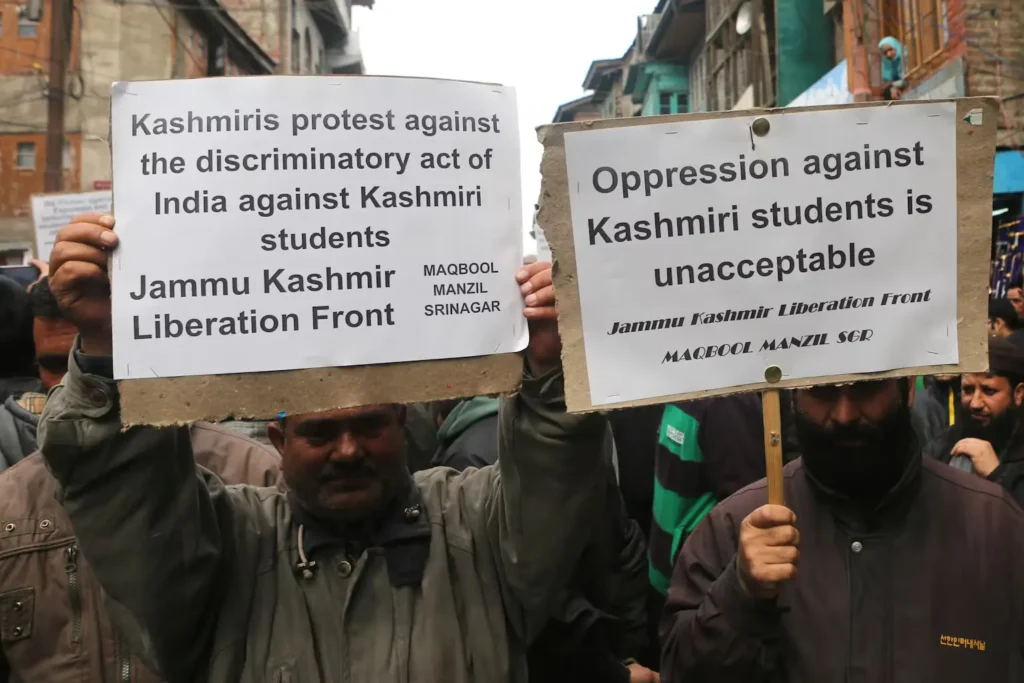
In response, initially, the police were called and around 60 Kashmiri students were suspended. Some of them were charged with sedition, as well as other offenses. However, the charges were dropped later.
Last year, in September 2024, in a video report by The Rajdharma, Mushtaq, a Kashmiri Muslim man speaking to the anchor Archana Tiwari, said, “Building a Hindu temple on our land isn’t right. We will burn it down.” Mushtaq added, “We are Muslims; if the temple is built on our land, we will burn it.”
Mushtaq’s reply came in response to a question from Tiwari: “What if someone builds a temple in your village?”
Further, in the wake of the Pahalgam attack, Medha Yadav, an anchor and producer with Jist, went to Kashmir to report on the situation on the ground. In the video report, on stating that she travelled across Kashmir, and the people told her that they want tourism, employment, and peace, a black-bearded Kashmiri man wearing a black blazer, a white shirt, and a black tie, said, “Kashmiris don’t want tourism, don’t want development. You’ll attack Azaan, Namaaz, and Hijaab and you’ll talk about tourism?”
However, the black bearded Kashmiri man failed to note even one instance of attack to prove his claims.
He added, “This country isn’t being run by the government; it’s running only by God’s mercy — there’s no government anywhere.”
Last month, in September 2025, a Muslim mob vandalised the Indian national emblem at Hazratbal Shrine, located in Srinagar. The reasons cited for the vandalism by the Kashmiri Muslim politicians included the usual ones: hurting the religious sentiments of people and forbidden idol worship in Islam.
In the first week of September 2025, the shrine was formally inaugurated by the Waqf board with its grandly decorated and renovated interior and crores of rupees were spent on its construction.
Nafees’s campaign received the support of fellow Kashmiri Muslims.
Wajahat Nabi, 25, who hails from Anantnag, Jammu & Kashmir, as per his X bio, quoting Nafees’s tweet, wrote, “Even if he doesn’t have any problem with Azaan, being a muslim state it’s our moral responsibility to boycott the concert.”
Syed, another Kashmiri Muslim who describes his location as the “Land of Martyrs,” in his X bio, wrote, “A person who disrespects Azaan … cannot be accepted in our land. This is not chaos. This is a peaceful resistance. A call for respect. The concert must be boycotted… peacefully, firmly, and with awareness.”
What’s fascinating about some Kashmiri Muslims is that while they are very much in favour of their fundamental rights. They deny respecting others’ fundamental rights. In addition, when some Kashmiri Muslims use phrases like “being a Muslim state” and “cannot be accepted in our land,” it reminds me of the Hindu history of Kashmir and raises the question: what if Hindus started saying the same to Kashmiri Muslims?
In July 2014, the Massachusetts Institute of Technology (MIT) published research titled “Networks, Careers, and the Jihadi Radicalisation of Muslim Clerics.” In the research, Richard A Nielsen collected and analysed 27,124 fatwas, articles and books by 101 contemporary Sunni Muslim clerics to know why some Sunni Muslim clerics preach militant Jihad while most do not.
On page 4, Nielsen wrote, “Jihadists believe that violent Jihad purifies the soul and advances the cause of justice” (Brachman, 2009).
This Islamic indoctrination is not limited to the Sunni Muslim Clerics.
In 1989, following the publication of a novel titled Satanic Verses in 1988, then-Iranian leader Ayatollah Ruhollah Khomeini, who was also an Islamic Shia cleric, issued a fatwa calling for its author and a Booker Prize awardee, Salman Rushdie’s death. The fatwa led to attacks on Rushdie and those associated with him.
33 years later, in August 2022, Rushdie was stabbed multiple times by Hadi Matar, a 27-year-old Shia Muslim, following the decades-old fatwa, which allegedly insulted Islam. The attack happened during a lecture in New York, which left Rushdie with life-altering injuries, including blindness in one eye, a damaged liver and a paralysed hand.
As a parallel, Nigam too faced a fatwa after making comments on Azaan. It was Syed Sha Atef Ali Al Quaderi of the West Bengal Minority Council who issued a fatwa against Nigam and said that he would give Rs 10 lakh to anyone who shaves Nigam’s head and makes him travel across the country with a garland of old shoes.
However, he himself shaved his head in response and said, “… Keep your 10 lakh ready, maulavi.” Nigam never received the amount.