

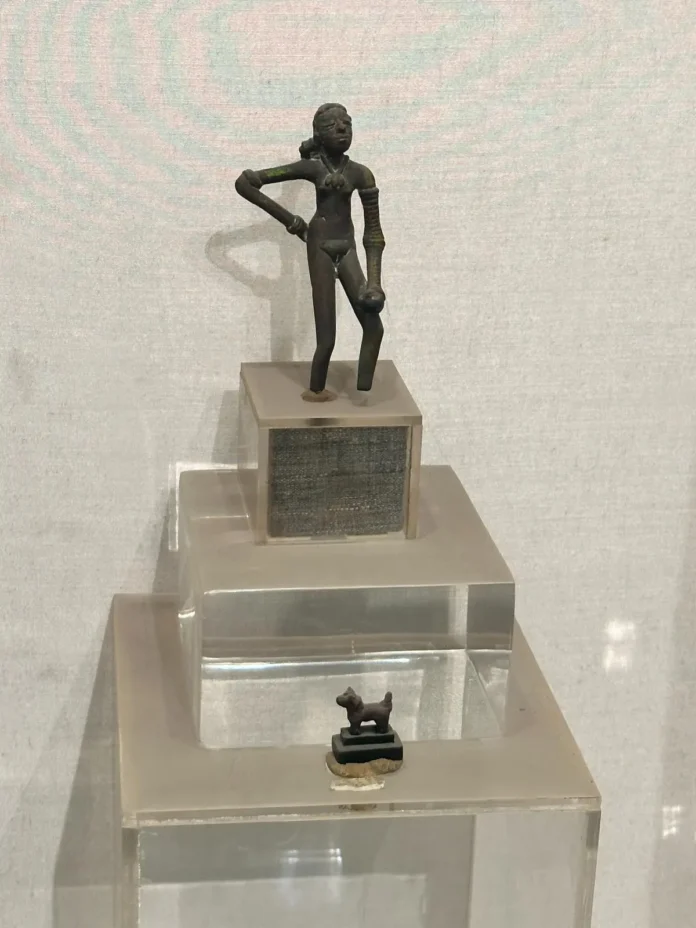
If you happen to visit the National Museum in Delhi someday. Try to locate one glass case in the Harappan gallery. If you’ll get successful, what you’ll see would be this: a ‘Dancing Girl’ figurine measuring 10.5 centimetres tall, bronze, bare-torso, arm stacked with bangles to the shoulder, one hand on her hip, chin up. She has been standing like that for roughly 4,500 years. Until around April 2026, none had any issues. However, in June 2026, a controversy erupted that revealed the NCERT, an autonomous organisation under the Ministry of Education, Government of India, thought that it did.
Expressing its thought, the autonomous organisation, in its Class 9 Arts Education textbook titled Madhurima, introduced a digitally altered version of the ‘Dancing Girl’ of Mohenjo-daro — shading applied across her torso to suggest clothing that has never existed in the original figurine. The justification provided was ‘age-appropriateness.’ Being what the justification was – utterly disgusting – the NCERT received backlash from historians and archaeologists. As a result, it announced a reversal. However, the fact that it happened at all. That someone in an official capacity sat down, opened an image editor, and decided to put shades on a Bronze Age artifact is worth examining with clear eyes.
The image of the figurine appears in two NCERT textbooks. One is of Class 6 and the other is of Class 9. The altered image did not appear in a Class 6 textbook meant for 11-year-olds. It appeared in a Class 9 Arts textbook intended for older students studying the history of Indian art. At the same time, the Class 6 textbook continued to carry the original image of the figurine. In other words, the same institution that found the original statuette acceptable for younger children decided that older students required a digitally modified version.
That there is a particular kind of intellectual arrogance involved in looking at an artifact made four and a half millennia ago and deciding it needs to be corrected for modern sensibilities. Such mentality reveals that the person involved treats the past as a rough draft of the present — something that got some things wrong, and which we are now helpfully revising.
We must know that this figurine was not created in a context of shame. She was made by craftsmen who understood the human form with extraordinary sophistication, who cast her in bronze using a technique that much of the earliest ancient world had not yet mastered, and who gave her a posture — hand on hip, head slightly tilted — that communicated confidence, not vulnerability. For them, the figurine was not a passive object. It was a statement. And to drape that statement in digital fabric is to misread it entirely. This is what historians call presentism: the imposition of contemporary values onto historical evidence. It is, in a quieter way, not unlike what Victorian-era archaeologists did when they catalogued Indian sculpture with barely concealed discomfort, dismissing erotic temple carvings as ‘primitive’ or ‘decadent.’ We spent decades arguing against that colonial framing. It is worth asking what it means when we now do it to ourselves.
Here is the real test of any principle: apply it consistently and see if it still holds. If the Dancing Girl’s bare torso is inappropriate for Class 9 students, what about the Khajuraho temples? What about the Konark Sun Temple, whose exterior panels depict sexual congress in considerable anatomical detail? What about the sculptures at Belur and Halebidu, whose bracket figures — the madanika and shalabanjikas — are studies in sensuality, carved in stone for eternity on the outer walls of functioning religious sites? What about the erotic panels of Aihole, or the mithunas on the Lingaraja temple in Bhubaneswar? That these are not obscure artifacts in storage rooms. They are on government tourism posters. They are taught in architecture courses and art history programmes across the country.
If, according to the NCERT, the standard is that the human body — in its natural, unclothed form — is too disturbing for some Indian students to encounter in a textbook, then a significant portion of India’s artistic and architectural heritage will have to be either reclassified or hidden from children. Would that be great? Absolutely not. It would be an absurd conclusion.
After all, the Indian temple sculpture did not treat the body as something to be ashamed of. The Shilpa Shastras — the canonical texts governing temple architecture and iconography — are explicit about the placement of erotic imagery on temple exteriors. That this imagery was not an accident or excess. It was theology. According to them, the body was not opposed to the sacred; it was a vehicle for it. The civilisation that produced the Dancing Girl doesn’t need our approval to be what it was. And a country that invokes that civilisation to establish its antiquity and greatness cannot simultaneously treat its most iconic artifacts as too disturbing to show students whole. It would be hypocrisy.
The defence offered — vaguely, is that the alteration was made in the interest of age-appropriateness. This deserves to be taken apart. By the time students reach Class 9, they have already been introduced to human anatomy and the reproductive system in school. These concepts are taught in Class 8 and expanded upon extensively in Class 10. And in today’s time, they encounter far more graphic imagery on any social media platform than a small, stylized, non-erotic bronze figurine from the Indus Valley. The Dancing Girl is not erotica. She is not provocative in any meaningful contemporary sense. If you want to decide it on your own, refer to the featured image of this article.
She is a Bronze Age artifact, 10.5 centimetres tall, whose significance lies in her form, her posture, and the extraordinary technical skill that made her possible. Shielding 15-year-olds from her is not protection. It is condescension. And it teaches something very specific: that certain parts of our past need to be managed before being handed to young people. That history is something adults process and curate, not something students encounter directly.
I believe: this is not education, this is gatekeeping dressed as pedagogy.
The body, in India’s ancient sculptural, visual and philosophical traditions, was never the problem. The problem is a more recent import — the discomfort that arrived with ‘Victorian morality,’ calcified over a century, and has now been interiorised so thoroughly that we apply it to our own heritage without recognising its origin.
When we alter the Dancing Girl, we do not protect students in any way, but expose our inability to be sensible. We expose our senseless anxiety. I would categorise it as an uncomfortable confidence for some people to sit with. But education is precisely the place where you sit with uncomfortable things and learn to understand them.
Of course, NCERT’s reversal is welcome. But the question behind the decision — who thought this was a good idea, on what grounds, and how it passed through whatever review process exists — has not been answered. And that question matters. Because the same logic that clothed the Dancing Girl, applied consistently, would require us to drape a significant portion of India’s ancient and medieval sculptural heritage.
A civilisation is not something you can selectively celebrate. You cannot claim the grandeur of 4,500 years and then flinch at what those years actually looked like. The Dancing Girl does not need to be made acceptable for India’s students. They need to be trusted with her — whole, unaltered, and exactly as she is. India’s students are sensible enough to understand the figurine, unlike the person who felt compelled to cover her torso.