

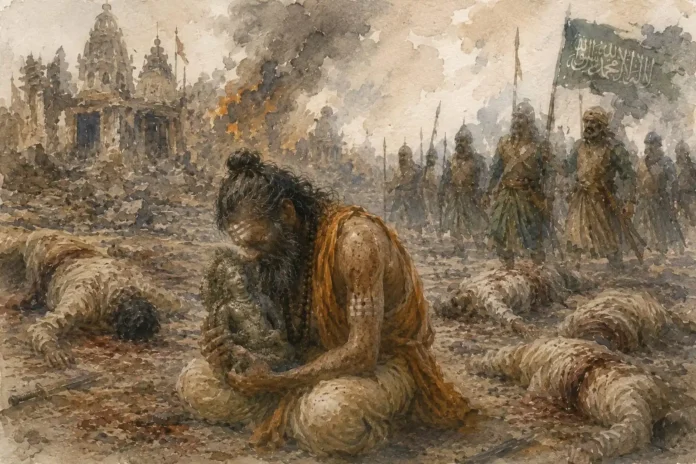
In his celebrated historical work Kitab al-Yamini, Abu Nasr Muhammad ibn Muhammad al Jabbarul-Utbi, who served as the secretary to Mahmud of Ghazni, provides a vivid and detailed account of the conquest of Thaneshwar (present-day Thanesar in Haryana). Al-Utbi writes:
The blood of the infidels flowed so copiously that the stream was discoloured, not withstanding its purity, and people were unable to drink it… The victory was gained by God’s grace, who has established Islam for ever as the best of religions, notwithstanding that idolaters revolt against it… Praise be to God, the protector of the world, for the honour he bestows upon Islām and Musulmans.
What does this quote do? At least, for me, it celebrates the killing of the infidels and a religion, its God and Muslims for the victory. History is not merely a collection of dates, dynasties, and battles. It is the collective memory of a civilization—its triumphs, its wounds, its moments of glory, and its deepest traumas. Some chapters inspire pride; others demand solemn reflection. Among the most painful and transformative periods in the history of Bharat is the long era of Islamic invasions.
Spanning over a millennium, this era commenced with the Arab conquest of Sindh under Muhammad bin Qasim and extended through the relentless raids of the Ghaznavid dynasty under Mahmud of Ghazni, the decisive campaigns of the Ghurid forces led by Muhammad of Ghor, the establishment and relentless expansion of the Delhi Sultanate with its five successive dynasties—the Mamluk (Slave) Dynasty, the Khalji Dynasty, the Tughlaq Dynasty, the Sayyid Dynasty, and the Lodi Dynasty and ultimately culminated in the founding of the Mughal Empire by Babur which endured in various forms until its eventual decline.
Babur was not an exception, but the norm. And here we have writers like Parvati Sharma, trying to repaint Babur, as sensitive poet-gardener who also wished to transform Hindustan and his one of the deepest contribution to Hindustan was flowers, melons, and charbaghs — as if aesthetic taste somehow washes away conquest and bloodshed. Babur himself never hid who he was. After capturing Chanderi in 1528, he wrote:
I attacked Chanderī and, by the grace of Allah, captured it in a few hours… We got the infidels slaughtered and the place which had been a dāru’l-harb for years, was made into a dāru’l-Islām.
These are not ‘modern interpretations’ or products of some imaginary ‘mob.’ They are Baburnama’s own words. Yet much contemporary commentary prefers to dwell on Babur the garden-builder rather than Babur the conqueror, as though refinement in taste mitigates religious triumphalism and slaughter. The danger of such romanticism lies not merely in selective reading, but in severing medieval invasions from their civilizational consequences.
At Narwar in Madhya Pradesh (Shivpuri District), within the Narwar fort, once stood a shrine associated with Shah Madar. An inscription from this site, later removed and now preserved in the Archaeological Museum at Gwalior, was engraved in a blend of Arabic and Persian. The inscription reads:
‘Dilawar Khan, the chief among the king’s viceroys, caused this mosque to be built which is like a place of shelter for the favourites. Infidelity has been subdued, and Islām has triumphed because of him. The idols have bowed (to him) and the temples have been laid waste on account of him. The temples have been razed to the ground along with their foundations, and mosques and worship houses are flowing with riches.’
It must be clear to us that the temples that had stood for centuries as centres of learning, devotion, and economic vitality. They housed not only deities but also vast treasuries, educational institutions, and community hubs. And as already described above, they were targeted not merely for material gain but as embodiments of ‘idolatry’ (shirk and kufr) that had to be uprooted to establish the supremacy of Islam.
Contemporary Persian and Arabic chronicles, penned by Muslim historians, court chroniclers, eyewitnesses and official secretaries, document these events with striking candour, often with overt pride, religious exaltation, and explicit framing as pious duties in service of the (one who can’t be named) and the expansion of the Dar al-Islam (abode of peace/Islam) at the expense of Dar al-Harb (abode of war/infidelity).
For example, in Miftah-ul-Futuh, the historical work composed by the renowned court poet of Allauddin Khilji, Amir Khusrau, which records the campaigns of Jalal-ud-din Khalji, the following description appears regarding the invasion of Jhain:
‘Three days after this, the king entered Jhain at midday and occupied the private apartment of the rai…. He then visited the temples, which were ornamented with elaborate work in gold and silver. Next day he went again to the temples, and ordered their destruction, as well as of the fort, and set fire to the palace, and ‘thus made hell of paradise…’ while the soldiers sought every opportunity of plundering, the Shah was engaged in burning the temples and destroying the idols. There were two bronze idols of Brahma, each of which weighed more than a thousand men. These were broken into pieces and the fragments distributed amongst the officers, with orders to throw them down at the gates of the Masjid on their return.’
Same old playbook, repeated across centuries. If it were just about loot, Jalal-ud-din Khalji would’ve stayed back, counting gold and silver while his soldiers did the dirty work. But no — the Shah personally entered the temples, ordered their destruction, and supervised the burning himself. And publicly scattered the fragments so that whenever Muslims entered the temples (converted into mosques), they would be reminded that the gods of the infidels lay shattered beneath their feet.
In Tarikh-i-Wassaf, authored by Abdullah ibn Fazlullah Sharafuddin Shirazi, a graphic account is given of Sultan ‘Alauddin Khalji’s campaign against Somnath in Gujarat: ‘The Muhammadan soldiers plundered all these jewels and rapidly set themselves to demolish the idol. The surviving infidels were deeply affected with grief, and they engaged ‘to pay a thousand pieces of gold’ as ransom for the idol, but they were indignantly rejected, and the idol was destroyed, and ‘its limbs, which were anointed with ambergris and perfumed, were cut off. The fragments were conveyed to Delhi, and the entrance of the Jami’ Masjid was paved with them, that people might remember and talk of this brilliant victory.’ Praise be to God, the Lord of the worlds. Amen!’
Alauddin Khalji was both the nephew and son-in-law of Sultan Jalal-ud-din Khalji. To understand the ideological foundation of his rejection, which eventually led to destruction. Let us have a look at a significant conversation he reportedly had with a Qazi (Islamic jurist) of his realm. This dialogue has been recorded by the contemporary historian Ziauddin Barani in his work Tarikh-i-Firoz Shahi. According to Barani, Alauddin Khalji invited the Qazi to his palace for a detailed discussion. The Sultan began by asking a pointed question about the legal status of Hindus under Islamic law:
How are the Hindus designated in the law — as payers of tribute (kharaj-guzar) or as givers of tribute (kharaj-dih)?
The Qazi replied:
They are called payers of tribute (kharaj-guzar). When the revenue officer demands silver from them, they should, without question and with complete humility and respect, tender gold. If the officer throws dirt into their mouths, they must, without reluctance, open their mouths wide to receive it. By doing so, they demonstrate their respect for the officer. The due subordination of the Zimmi (protected non-Muslim) is exhibited in this humble payment and in the acceptance of such humiliation.
‘The glorification of Islam is a duty, and showing contempt for the religion is futile. God Himself holds them in contempt, as he has said:
Keep them under subjugation.
To keep the Hindus in abasement is especially a religious duty, because they are the most inveterate enemies of the Prophet. The Prophet has commanded us to slay them, plunder them, and make them captive, saying:
Convert them to Islam or kill them, enslave them, and spoil their wealth and property.
No doctor (jurist) except the great Imam Abu Hanifa — to whose school we belong — has assented to the imposition of jizya on Hindus. Doctors of other schools allow no alternative but “Death or Islam.’
After listening to the Qazi’s detailed exposition based on Islamic jurisprudence, Khalji responded:
What you have said in accordance with the books, I have discovered all that by my own endeavours, and I have treated the Hindus accordingly.
This was not a random acceptance. But Khalji’s own brutal policies of temple destruction, heavy taxation, and systematic humiliation of Hindus. To place it simply: a deliberate, conscious implementation of orthodox Islamic doctrine, not mere political expediency.
In another instance, Ahmad Yadgar, an old servant of the Sur sultans, writes in Tarikh-i-Shahi, about the conquests of Sultan Sikandar Lodi, particularly at Nagarkot (Kangra) in Himachal Pradesh:
Sultan Sikandar led a very pious life… Islām was regarded very highly in his reign. The infidels could not muster the courage to worship idols or bathe in the (sacred) streams. During his holy reign, idols were hidden underground. The stone (idol) of Nagarkot, which had misled the (whole) world, was brought and handed over to butchers so that they might weigh meat with it.
Lodi did not stop at this. Similar accounts of temple demolitions and conquests by Sikandar Lodi, including at Dholpur, Gwalior, Narwar, and Kurukshetra, appear in other Islamic chronicles such as Tarikh-i-Daudi.
Enter Audrey Truschke, an American academic specializing in South Asian history. Truschke, in her book Aurangzeb: The Life and Legacy of India’s Most Controversial King (and related writings), has portrayed Aurangzeb as a complex, pragmatic Indian ruler. When in reality, he was an Islamic zealot.
Maasir-i-Alamgiri, which was completed in AD 1710 by Saqi Must’ad Khan at the behest of Inayatullah Khan Kashmiri (Aurangzeb’s last secretary and a close disciple in matters of state policy and religiosity), and drawing heavily from state archives, the following account appears regarding the policies of Muhiyu’d-Din Muhammad Aurangzeb Alamgir:
‘…Praised be the august God of the faith of Islam, that in the auspicious reign of this destroyer of infidelity and turbulence, such a wonderful and seemingly impossible work was successfully accomplished. On seeing this instance of the strength of the Emperor’s faith and the grandeur of his devotion to God, the proud Rajas were stifled and in amazement they stood like images facing the wall. The idols, large and small, set with costly jewels which had been set up in the temple [of Mathura] were brought to Agra, and buried under the steps of the mosque of the Begam Sahib, in order to be continually trodden upon. The name of Mathura was changed to Islamabad.
Yet, for Truschke, who was Aurangzeb? Yes, a pragmatic Indian ruler.
This was no isolated act. During Aurangzeb’s military campaign against Mewar, his forces systematically demolished 239 Hindu temples in just two months across the Udaipur and Chittorgarh regions: one in the Rana’s palace, three on the banks of Lake Udaysagar, 172 around Udaipur, and 63 in Chittorgarh. The same Maasir-i-Alamgiri also notes that Aurangzeb personally commanded the demolition of the revered Vishwanath temple at Kashi (Varanasi).
Virtually every major Islamic historical source repeatedly mentions the demolition of temples, the plunder of sacred wealth, and the systematic subjugation of native religious practices by successive Islamic dynasties. These invaders and rulers did not perceive themselves merely as political or military conquerors, but as agents of divine will, divinely tasked with subduing infidelity (kufr) and expanding the realm of Islam across the prosperous land of Bharat.
Take a moment and really think about those fallen temple ruins—the shattered stones lying on the ground, fragments repurposed into the walls of mosques that still stand today. Look at the broken sculptures and idols now placed behind glass in museums, stripped of their sanctity and reduced to relics.
Ask yourself—have you ever truly been told this side of history? Try to feel, even for a second, what our ancestors must have endured, watching their sacred spaces being torn down before their eyes, their faith desecrated, their world collapsing piece by piece. That pain still echoes in ruins, in those reused stones, in the broken idols that refuse to be forgotten.
History isn’t only what is written—it’s also what is left scattered in ruins, waiting to be acknowledged.
Editor’s note: This article is based on Hindu Temples: What Happened to Them (Volume 2) by historian Sita Ram Goel. The Dossier extends its sincere gratitude to all the contributors of this book, namely Arun Shourie, Ram Swarup, Jay Dubashi and Harsh Narain.