

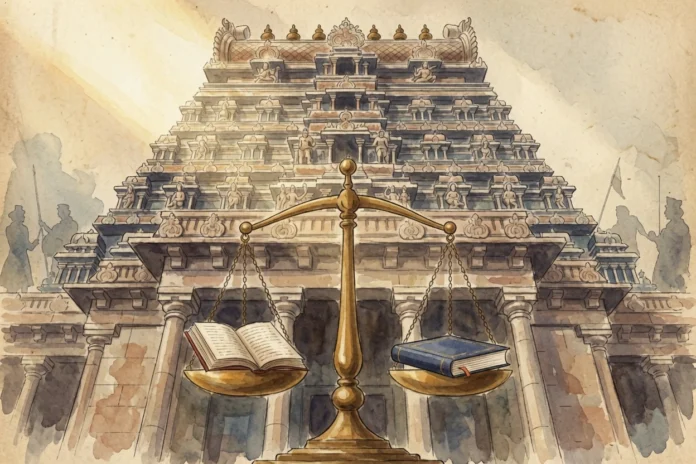
On a cool September evening in 2018, outside the Sabarimala hill shrine in Kerala, a line of policemen stood between two crowds that would not look at each other. On one side stood devotees who had long held that the temple’s strict exclusion of women of menstruating age was essential to honouring Bhagwan Ayyappa’s unbroken vow of celibacy—a vow they believed defined the deity and the very character of the pilgrimage. On the other side were women who wanted the exclusion to end and to climb the 18 golden steps. Both sides felt sure they were right. What neither side had settled was a much older question that the Supreme Court had first taken up back in 1954: who gets to decide what is truly essential to a religion, and what happens to everyone else once the court decides for them.
That question has a name in law — the Essential Religious Practices doctrine, or ERP — and it did not arrive all at once. It was built up slowly, case by case, over almost seventy years, by judges who were, in effect, teaching themselves how to read scripture, weigh custom, and decide what a faith could not survive without. That method was built, through three judgments that, on the surface, look nothing like each other — a dispute over a mutt’s debts, a fight over whether a Gujarati saint’s followers counted as Hindus, and a challenge brought by a Christian priest. Yet, together, they laid down the ground rules that every later case, including Sabarimala and Ayodhya, would have to work within.
THE DOCTRINE BEGAN, almost by accident, with a dispute over money. In 1954, a seven-judge bench of the Supreme Court heard the Case of the Commissioner, Hindu Religious Endowments, Madras, against the head of a mutt — a religious institution — at Shirur, in present-day Karnataka. The mutt had run into serious debt, and the state government, acting under the Madras Hindu Religious and Charitable Endowments Act of 1951, had stepped in to appoint an executive officer to take over its administration. The head of the mutt, the Mathadhipati, challenged the law itself, arguing that it let the state reach far too deeply into matters that were his and his religious institution’s alone to decide.
The Court had to work out, for the first time, exactly where the line between “religion” and “regulation” should fall. Its answer, delivered by Justice B.K. Mukherjea, became the founding statement of the entire doctrine: the state could freely regulate the economic, financial, administrative, and political sides of running a religious institution, but it could not touch practices that were genuinely essential and integral to the religion itself. Deciding what counted as essential, the Court said, was not for judges to guess at from the outside — a religious denomination had, in principle, complete freedom to determine which of its own practices were essential to it. On that basis, the Court struck down parts of the Madras Act that let the government take over temple funds too freely, while upholding the broader scheme of state supervision.
It reads, at first, like a clean and generous rule — believers themselves get to say what their religion requires. But buried in that same judgment was the seed of a much harder problem. If a practice’s “essential” character could be tested and questioned in court, then someone still had to do the testing, and the Court had already said that this was ultimately a legal question, not simply whatever a community claimed about itself. Once that door was open, it stayed open. Every dispute that followed — over priests, over temple entry, over rituals — would ask the same buried question the Shirur Mutt case never fully answered: essential according to whom?
THAT QUESTION CAME BACK with unusual force twelve years later, in a case that did not look like a temple dispute at all. It was a fight over whether an entire community of worshippers counted as Hindu in the first place.
The followers of the nineteenth-century Gujarati saint Swaminarayan, known as Satsangis, went to court in Sastri Yagnapurushadji vs Muldas Bhudardas Vaishya to stop Dalits — referred to in the judgment, as was then common, as Harijans — from entering their temples in Ahmedabad. Their case rested on a bold claim: the Bombay Hindu Places of Public Worship (Entry Authorisation) Act, 1956, which opened “Hindu” temples to worshippers of every caste, simply did not apply to them, because the Swaminarayan sect was not really part of the Hindu religion at all. They argued it was a separate faith, with its own founder, its own scripture, and its own idea of salvation — and that treating their temples as ordinary Hindu temples violated their right under Article 26 to manage their own religious affairs.
The matter had already travelled a long road by the time it reached the Supreme Court. It began in a trial court in Ahmedabad in 1948, moved through amendments to the law and to the pleadings as India’s Constitution came into force in 1950, went to the Bombay High Court on appeal, was remanded back down for fresh evidence on whether the temples were genuinely Hindu institutions, and returned to the High Court a second time before the Satsangis finally appealed to the Supreme Court itself.
The bench, led by Chief Justice P.B. Gajendragadkar, did not simply ask whether the Satsangis called themselves Hindu. It went much further, tracing the very meaning of the word “Hindu” back through its origins near the Sindhu river, discussing the philosophy of the Upanishads, drawing on the writings of Sarvepalli Radhakrishnan and the Orientalist scholar Monier Williams, and setting out, in unusual detail, the life story and teachings of Swaminarayan himself — his rejection of what he saw as corrupt practices among Vallabhacharya’s followers, his own ascetic life, and the four scriptures that record his teachings. From all of this, the Court concluded that Hinduism was never one fixed set of doctrines, but a broad and absorbing tradition that had made room, again and again, for reformers such as the Buddha, Mahavira, Guru Nanak, and Chaitanya — and that Swaminarayan belonged in that same lineage. The Satsangis, the Court ruled, were Hindus, and their temples fell within the Act. It was a verdict that campaigners against untouchability, working in the spirit of Bhimrao Ambedkar’s constitutional vision, welcomed as vindication.
But look past the result, and the judgment reveals the method the doctrine would lean on for the next sixty years: judges reading scripture and history like scholars, and then using that reading to decide, from the outside, what a faith’s true and essential character was. It is exactly the kind of reasoning that would return, almost unchanged, in the Sabarimala and Ayodhya judgments decades later.
If the Swaminarayan case asked who counts as a believer, the next major case asked a narrower but equally sharp question: what exactly does the right to “propagate” a religion protect?
In 1977, the Supreme Court heard a challenge brought by a Christian priest, Reverend Stanislaus, who had been prosecuted under Sections 3, 4 and 5(2) of the Madhya Pradesh Dharma Swatantraya Adhiniyam, 1968 — a state law that made it an offence to convert a person to another religion through force, allurement, or fraud. A near-identical Orissa law, the Orissa Freedom of Religion Act, 1967, had been challenged at the same time. The Orissa High Court had struck its own state’s law down, holding that the right to propagate religion under Article 25 naturally included the right to try to convert others, and that state legislatures had no power to make laws on the subject at all. The Madhya Pradesh High Court had gone the other way, upholding its state’s law as a valid exercise of the state’s power to protect public order. With two High Courts in direct conflict, the matter went up to the Supreme Court.
The petitioners argued that the right to propagate religion, guaranteed by Article 25, was meaningless if it did not include the right to invite someone to convert; that regulating conversion was really a matter for Parliament, not the states, since it fell under Entry 97 of the Union List rather than the states’ power over public order; and that the Acts were an unconstitutional intrusion into personal faith. The states argued the opposite: that propagation meant explaining and spreading one’s own beliefs, not converting others by force or inducement, and that these laws were squarely about preventing the communal tension that forced conversions tend to produce — a matter the states were entitled to legislate on as part of maintaining public order.
The Supreme Court sided fully with the states. Chief Justice A.N. Ray, writing for the bench, held that Article 25 protects the right to transmit or spread one’s religious beliefs, but does not extend to a right to convert another person, particularly not through coercion, fraud, or material inducement, because doing so violates the “freedom of conscience” of the very person being converted. The Court also rejected the argument that only Parliament could legislate on the subject, holding that preventing forced conversions fell within the state’s power to maintain public order under Entry 1 of the State List. Both laws were upheld.
The ruling has remained, ever since, the foundation on which a number of Indian states have built and strengthened their own anti-conversion laws. It also did something quieter but just as lasting: it showed that the essential-practices method was not only about deciding what a religion required internally — it could also be used to draw the outer boundary of what “freedom of religion” meant as a right, deciding not just what believers could keep, but what they could and could not do to each other in the name of faith.
Taken together, these three judgments — Shirur Mutt, the Swaminarayan case, and Rev. Stanislaus — gave the Court a working toolkit. From Shirur Mutt came the basic test: essential religious practice versus secular regulation. From the Swaminarayan case came the method: judges reading scripture and history to decide, from outside a faith, what belonged at its core. From Rev. Stanislaus came the boundary: freedom of religion protects belief and its peaceful spread, but not everything a believer might wish to do in its name.
Every major case that followed, be it Sabarimala or Ayodhya, the Supreme Court returned in one way or another to this same toolkit. The questions only got louder and the stakes got higher, but the underlying method, worked out quietly across these three judgments, never really changed.
THE SABARIMALA TEMPLE, home to Bhagwan Ayyappa, sits deep in the Periyar Tiger Reserve in Kerala’s Western Ghats. For generations, women between the ages of ten and fifty — broadly, women who might be menstruating — were kept out of the temple on the belief that Bhagwan Ayyappa is a celibate deity whose lifelong vow of austerity required the exclusion of women of reproductive age. The custom was first tested in court in 1991, when the Kerala High Court, in S. Mahendran vs The Secretary, Travancore Devaswom Board, upheld it as a long-standing and constitutional practice.
In 2006, the Indian Young Lawyers Association filed a petition in the Supreme Court, arguing that the custom violated the right to equality under Article 14 and was degrading to women’s dignity. The Travancore Devaswom Board, which runs the temple, argued that Ayyappa’s devotees formed a distinct religious denomination under Article 26, entitled to manage their own religious affairs, and that the exclusion — aimed only at one age band, not at women as a category — was itself essential to the temple’s unique character as the shrine of a celibate deity.
The dispute also turned on a more technical question: Rule 3(b) of the Kerala Hindu Places of Public Worship (Authorisation of Entry) Rules, 1965, allowed places of worship to exclude women “at such time” as custom did not permit their entry — but Section 4 of the parent Act, the very law the rule was made under, banned any regulation that discriminated against Hindus on the basis of the section or class they belonged to. Petitioners argued the rule could not survive against its own parent law.
The case moved unusually slowly. Notices went out in 2006; the matter was referred to a three-judge bench in 2008; it was heard again only in 2016; and in October 2017, a three-judge bench referred it onward to a five-judge Constitution Bench. That bench — Chief Justice Dipak Misra, and Justices Rohinton Nariman, A.M. Khanwilkar, D.Y. Chandrachud, and Indu Malhotra — heard arguments across seven days in July and August 2018 on five separate questions: whether the ban violated equality and the right against untouchability; whether Ayyappa’s devotees were a distinct religious denomination; whether the exclusion was an essential religious practice; whether the Public Worship Rules even permitted such a ban; and whether those Rules conflicted with the Act that created them.
On 28 September 2018, the bench ruled 4:1 that the ban was unconstitutional. Chief Justice Misra, writing for himself and Justice Khanwilkar, along with separate concurring opinions from Justices Nariman and Chandrachud, held that Ayyappa’s devotees did not form a separate religious denomination, that the exclusion of women was not essential to the religion, and that it amounted to unconstitutional discrimination. Justice Chandrachud went further than his colleagues, reading the constitutional guarantee against untouchability broadly enough to cover any social exclusion built on ideas of ritual purity — extending a protection historically aimed at caste discrimination to cover the treatment of women’s bodies as well.
Justice Indu Malhotra, the only woman on the bench, dissented. Matters of religious belief, she wrote, should not be tested only by the yardstick of rationality, and it was not for courts to decide which of the many practices that make up a living faith deserved to be struck down, except where a practice was plainly harmful, in the way a custom like Sati unquestionably was.
The judgment did not settle the matter. More than fifty review petitions followed, filed by groups including the National Ayyappa Devotees Association and the Nair Service Society. On 14 November 2019, a differently constituted bench, now led by Chief Justice Ranjan Gogoi, delivered a narrow 3:2 ruling that kept the review petitions technically pending, while referring a broader set of questions about women’s access to religious spaces across faiths to a nine-judge bench — reasoning that the logic of the Sabarimala verdict might have implications well beyond this one temple.
Justices Nariman and Chandrachud dissented, arguing that this went far beyond what a review petition was meant to do. The Court did make clear that the original 2018 judgment would remain the law of the land until the larger bench ruled otherwise.
That larger bench has yet to decide the matter.
WHERE SABARIMALA TURNED on “gender and ritual purity,” the country’s most politically significant essential-practices case turned on “land and memory.” The Ayodhya title dispute , a case decided on maps and excavation reports rather than scripture, could not quite escape the doctrine’s shadow.
Somewhere in that courtroom sat Bhagwan Ram himself, not as a metaphor but as a party with a name on the cause list — a very old idea in Hindu law, one Shirur Mutt had already leaned on decades earlier, that a deity can hold a claim the way a person does. And yet, unlike at Sabarimala, no one asked the harder question the doctrine was built to answer: whether the belief driving the entire dispute was essential to the faith itself. The Court let that belief stand quietly in the background, treated it as fact rather than as something to be tested, and settled the matter instead on whose evidence for the land was stronger. So Ayodhya borrowed the doctrine’s oldest instinct without ever calling on its sharpest tool.
The complete legal timeline of the Ayodhya Dispute can be read here.
SOME 2,100 KM AWAY FROM AYODHYA, in the city of Thiruvananthapuram, another case came up. The fight here involved deciding whether one of India’s last reigning royal families should keep control over a temple. The Sree Padmanabhaswamy Temple in Thiruvananthapuram, one of the 108 holy Vaishnavite shrines and reputed to be among the wealthiest religious institutions on earth after hoards of gold, jewels, and antiquities were found in its sealed underground vaults in 2011, had for more than two and a half centuries been managed by the former royal family of Travancore, acting as shebaits — ritual custodians — of the deity Padmanabhaswamy.
That arrangement traced back to a 1949 covenant, later given legal form through the Travancore-Cochin Hindu Religious Institutions Act, 1950, which recognised the “Ruler of Travancore” as the temple’s administrator.
In January 2011, the Kerala High Court ruled that this authority had lapsed with the death, in 1991, of the last formally recognised maharajah, Sree Chithira Thirunal Balarama Varma, and ordered the state to take over the temple’s management. The royal family and the temple’s executive officer appealed to the Supreme Court.
On 13 July 2020, a two-judge bench of Justices Uday Umesh Lalit and Indu Malhotra delivered a judgment running to roughly 200 pages, reversing the High Court entirely. The Court held that the death of the last ruler who had signed the original covenant did not, by itself, end the family’s shebaitship, because the 1950 Act used the title “Ruler of Travancore” to refer to the office and its natural line of succession, not to one individual for life.
Drawing on its own ruling in Bala Shankar Bhattjee vs Charity Commissioner, Gujarat State (1994), the Court also confirmed that the temple was a public institution rather than private royal property, and found that the 26th Constitutional Amendment, which abolished the privy purses and official recognition of India’s former princely rulers, had no bearing on the family’s religious role as shebaits, since that role rested on custom and covenant rather than on any political title. The Court restored the family’s role in temple administration, while directing that a court-appointed administrative committee oversee its day-to-day running.
The judgment barely used the language of “essential religious practice” at all — but it rested on the same underlying idea the doctrine has carried since 1954: that certain roles in religious life belong to particular people or families by virtue of tradition and custom, and that courts, when asked to referee such disputes, must still decide, in the end, what that tradition actually requires.
Read side by side, these three modern judgments — Sabarimala, Ayodhya, and Padmanabhaswamy — show a doctrine still working, seventy years on, exactly the way Shirur Mutt first set it up: weighing scripture against custom, denominational identity against constitutional equality, private tradition against public accountability.
Similarly, Sabarimala saw the doctrine turned against old authority in the name of “equality”; Ayodhya saw an essential-practices finding from one case quietly decide the outcome of an entirely different one, a quarter century later; and Padmanabhaswamy showed that even when a judgment barely mentions the words “essential practice,” the doctrine’s oldest instinct — protecting tradition and custom as something courts must interpret, not just record — is never far beneath the surface.
None of this has been settled once and for all. The nine-judge bench that the Sabarimala review left pending has still not spoken. Temples across the country continue to test where the line between ritual and regulation, custom and constitutional right, actually sits.
For the millions of people whose daily faith runs through these institutions — the pilgrims at Sabarimala, the worshippers at Ayodhya, the devotees at Padmanabhaswamy — the doctrine is not an abstract legal test. It is the reason a temple gate opens or stays shut, the reason a family keeps or loses a role its ancestors held for centuries, the reason a dispute over a small patch of land takes seventy years and three generations to resolve. The Supreme Court built the tools to answer these questions back in 1954. It is still using them today.
Editor’s note: This piece draws on publicly reported case records, judicial opinions and legal commentary concerning the essential religious practices doctrine as it has developed in Indian Supreme Court jurisprudence.