

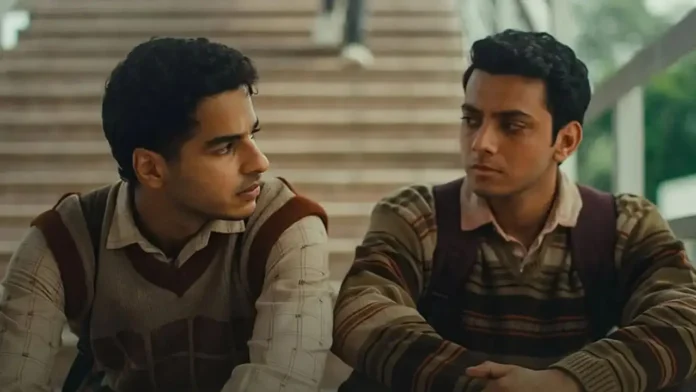
Neeraj Ghaywan’s film Homebound starts with a conversation between two friends: Mohammed Shoaib Ali (Ishaan Khatter) and Chandan Kumar Valmiki (Vishal Jehtwa). Ali says, “We can’t keep running away, Chandan. When you wear that uniform, your faith and caste no longer matter. Once we become cops, nobody will dare humiliate us.”
Rather than building up the argument to prove the point, at the start of the film itself, Ghaywan suggests that both Muslims and Dalits are humiliated because of their religion and caste and that they need a layer of protection—a police uniform, in this case—to create the same.
Inspired by the Kashmiri journalist Basharat Peer’s 2020 opinion piece Taking Amrit Home (now retitled A Friendship, a Pandemic and a Death Beside the Highway), Ghaywan’s film takes significant creative liberty to portray Ali and Valmiki as the victims of the system. The film is based on a real story of two friends, namely, Mohammad Saiyub and Amrit Kumar, who went to Surat for work as migrants, but only one returned, as the other died from fever before he could reach home.
The film vilifies the upper castes. In one scene, Arjun Mishra (Yogendra Vikram Singh), a Brahmin, asks Ali—working as an office boy—not to refill his water bottle; in another, after they finish watching the India–Pakistan cricket match, Mishra taunts him, saying, if it were in Ali’s hands, he would have entered the ground and taken eight wickets for Pakistan. Further, he calls out the halwa brought by Ali from home, made by his mother, as “authentically Lahori,” highlighting the casual prejudice of an upper-caste toward a Muslim.
Conversations between Valmiki and his friend Sudha Bharti—whom he meets on the railway platform and falls in love with later—attempt to highlight tales of oppression. “But what will really change, Chandan? These people aren’t afraid of the uniform,” says Bharti. In Bharti’s dialogue, “these people” refer to the “upper castes.”
A 2022 government report found that around 15% of cases under the SC/ST (Prevention of Atrocities) Act were closed due to false claims or insufficient evidence—14.78% for SC cases and 14.71% for ST cases. Charge sheets were filed in just over 60% of cases, with 60.38% for SCs and 63.32% for STs. The conviction rate fell to 32.4% in 2022, down from 39.2% in 2020.
The film’s intent seems to extend the discourse of oppression—introducing that Brahmins not only subjugate lower castes but also target Muslims. Yet, this narrative is built more on fiction rather than inspired by real-life incidents.
Produced by Dharma Productions, Homebound received a nine-minute-long standing ovation at the 2025 Cannes Film Festival, where the movie was screened in the Un Certain Regard category. I went through the reviews across mainstream publications, but didn’t notice any being critical of it, let alone how it portrays the upper castes.
This reflects a broader trend in Indian media, which rarely examines or challenges the depiction of upper-caste characters, allowing stereotypes and biases to pass unchallenged.
Lower-caste Muslims are considered untouchables by the upper-caste Muslims. There exist 4 types of castes in the South Asian version of Islam: Ashrafs (nobles), Azlafs (low-born) and Arzals (vulgar). Ashrafs rank the highest in the hierarchy, then come the Azlafs and lastly come Arzals.
Between October 2014 and April 2015, a significant study was conducted across 7000 Dalit Muslim households in 14 districts of Uttar Pradesh—the largest state of India, as per population. The study revealed that at least 1/3 of them are not allowed to bury their dead in an “upper-caste Muslim” burial ground, around 13% of them reported having received food/water in different utensils in “upper-caste Muslim” houses and around 8% of “Dalit Muslims described that their children are seated in separate rows in classes and also during school lunches, reported BBC.
Ghaywan comes from a Dalit family and has taken the themes of the film personally, as reported by The Hindu. Homebound features a neo-Buddhist wedding—a ceremony where the couple and priest chant before images of the Buddha and Dr BR Ambedkar. The same was earlier seen in his series Made in Heaven Season 2.
Ghaywan has said, “I am the only acknowledged person from the community who is there behind and in front of the camera in all of Hindi cinema history.” But in emphasising his identity, he seems to let personal conviction overtake balance—using art less as a medium of presentation and more of assertion.
The concept of Neo-Buddhist marriage comes from Neo-Buddhism, also called Ambedkarite Buddhism — a religious movement started by Ambedkar. The movement proposes a radical re-interpretation of nirvana, emphasising its attainment through societal peace and justice rather than individual enlightenment.
In October 1935, Ambedkar declared that he would renounce Hinduism; however, he formally did so 21 years later, in October 1956, during a conversion ceremony to Buddhism, where he took 22 vows. Critics argue these vows are anti-Hindu and promote hostility toward Hinduism as a religion.
The Dalit filmmaker has played smartly with the location. As per Peer’s piece, two of Saiyub’s brothers leave for Mumbai to find work.
Yet, in the film, Ali’s father, Hussain Ali (Pankaj Dubey), wants him to move to Dubai—a city with a majority Muslim population—as he believes Muslims are being insulted in India every day, reinforcing the film’s narrative of systemic hostility and victimhood towards the Muslims.
The disclaimer of Homebound says that “the filmmaker believes in the constitutional values and Indian tradition of religious coexistence.” But the film itself does not reflect that.
It also claims to “recognise the contribution of the central and state governments, their various agencies and all the Corona Warriors,” but this appears only in a short, one-minute news clip. Overall, the film gives a one-sided outlook and ignores the efforts it claims to stand for, turning what could have been a story equipped with sense.
On 24 March 2020, the central government announced a nationwide lockdown to prevent COVID-19, after India had reported around 600 cases. Peer, in his piece, described this as one of the many “dramatic policy decisions” of Prime Minister Narendra Modi.
Although Dr Henk Bekedam, the WHO Representative to India, commended the nation’s handling of the pandemic, calling it “timely, comprehensive and robust.” Furthermore, a day before the announcement, Mike Ryan, Director of WHO’s Emergencies Programme, said, “The future of this pandemic will be determined by what happens to densely-populated countries.”
In reality, a local politician helped Saiyub, arranged an ambulance, and his friend Kumar was taken first to a small hospital and later shifted to a better-equipped facility, where he died in the ICU.
The film, on the other hand, shows Valmiki dying in his friend, Ali’s lap, alone on a deserted highway, with no one coming to his aid—neither authorities nor any other person.
Homebound is one of the many movies in which facts have been manipulated, yet it received recognition and acclaim.
Jai Bhim, released in November 2021, swapped the character of the sub-inspector—one of the villains in the film—with a person belonging to the Vanniyar community. In reality, the sub-inspector was Anthony Sami and was not from the aforementioned community.
Similarly, Mir Ranjan Negi’s character was changed to Kabir Khan, framing the movie around the premise of Islamophobia, in Shah Rukh Khan’s Chak De India.
Ghaywan’s approach shows carelessness and a lack of attention to detail in his filmmaking. In another scene of the first half, Valmiki is shown being questioned by an upper-caste government official about his caste. In the scene, Valmiki says, “I am a Kayastha,” but a subtitling error shows it as “I am a Brahmin.”
Further, the official says, “Ye aarakshan waale sabhi seat bator lete hain” (all these people with reservations grab all the seats). On-screen, but the subtitle reads, “these ‘quota rats’ grab all the seats.”
The first technical film was made in the year 1896. The first full-length feature film was released 10 years later, in 1906, titled The Story of the Kelly Gang. Earlier, title cards were used between silent film sequences and were very important for storytelling.
Later, sound was introduced in the films, which the audience loved, but it led to redundancy as well. Therefore, subtitles were introduced to fill the gap between intertitles and audible speech.
In subtitling and captioning, “accuracy” forms the core of ethical responsibility, as inaccuracies are bound to create misunderstandings and can even change the perceived meaning of a scene. Many professional subtitling service provider companies even provide “context” while dealing with topics like religion, politics, and social issues, as it is crucial to be respectful to all citizens.
But Ghaywan seems to avoid the principles and spread his own propaganda.
“Nobody bothered me,” Saiyub told Peer. “I did my job. I got paid.” These lines are from Peer’s piece. A question that these lines put forward is, when the person himself denies facing any discrimination, is it right to build a narrative of victimhood, based on manipulated facts?