
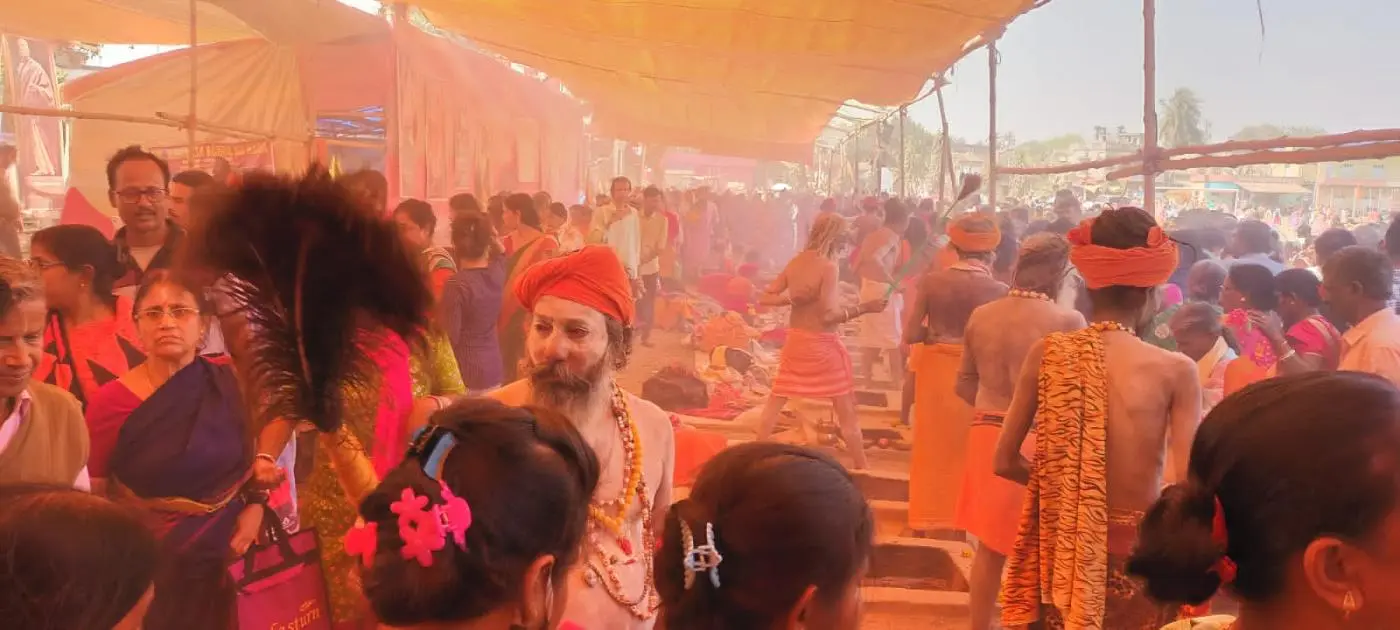
I’m sure you’ve heard of the grand Maha Kumbh Mela in Prayagraj. I’m fairly certain you’ve heard of the one in Haridwar. I might even bet you’ve caught wind of the gatherings in Ujjain or Nasik. But I am absolutely sure you haven’t heard of the Kumbh in Bengal – or more specifically, the annual ‘Bongoyio Tribeni Kumbh Mela’.
According to a prevailing story, while Garuda was fleeing with the urn of nectar during the churning of the ocean, four drops of nectar fell on the earth from the urn. These places became the four fields of Kumbh Mela. For centuries, the world believed there were only these four places where the sacred nectar fell. But history is a layered thing. In the heart of Bengal, a fifth Kumbh once thrived, only to be silenced by the weight of Islamic invasions.
Khan Ghazi attacked Tribeni, carrying out a massacre and destroying a Pala-era Vishnu temple. Though Maharaja Bhudev Rai briefly liberated the area and restarted the festival in 1305 AD, it was later banned entirely by Sultan Alauddin Hussain Shah, who renamed the region ‘Husenabad’ and barred ‘Kafir’ Hindus from gathering. After a staggering 703-year hiatus, this ‘crest jewel of pilgrimages’ has started breathing again.
It was during the stillness of the COVID-19 lockdowns that Kanchan Banerjee, a Pravasi Bharatiya and Historian, was immersed in research for his book Manus of Civilization. While scouring old scriptures, travelogues, and folk histories, he stumbled upon a startling revelation: Tribeni was once a major site for Magh and Kumbh Sankranti baths, a tradition that had been suppressed for hundreds of years. The ‘Aha!’ moment came in 2021 during a trip from Kolkata to Katwa. As he was driving with his friend, his GPS flashed a simple notification: ‘You are crossing Tribeni’. He stopped the car, walked to the water’s edge, and touched the holy Ganges. In that moment of spiritual clarity, he declared: ‘We will perform Kumbh here’. It was a promise made to the river and to history—a vow to restore the ‘Dakshin Prayag’ (Prayag of the South) to its former glory.
And for over seven centuries, a silence that hung over the banks of the Hooghly in Saptagram, the chants that had faded, the sacred fires which were extinguished, and the memory of a grand tradition – all were revived in 2022. Next year, Prime Minister Narendra Modi lauded these efforts in his Mann Ki Baat programme, noting that over 1 million devotees had gathered to protect India’s cultural heritage.
The Tribeni Kumbh is centered at the confluence of three ‘nadis’ or rivers: the Bhagwati Ganga (Ida), the Yamuna (Pingala), and the Saraswati (Sushumna). In spiritual terms, bathing here is believed to awaken latent powers and provide otherworldly peace.
If we speak of the Kumbha Mela of India, which received recognition on the world stage a few years ago. Then, Kumbh is identified as the world’s largest peaceful religious gathering. For the attainment of virtue, the Hindus consider Kumbh Snan as obligatory. In 2017, UNESCO declared the Kumbh Mela as India’s unique cultural heritage.
At 25, I view the Kumbh as not merely a ritualistic dip in the water; I see it as an ‘act of decolonisation’. By reviving this tradition, we, the Hindu community is not just reclaiming a festival – we are reclaiming our identity. Like the organisers suggest: with this Kumbh, we are not just reviving a fair; we are reviving the soul of the community. The Yamuna river has disappeared due to loss of flow, the Saraswati river has disappeared due to loss of its own flow, and only the Ganges is flowing. But the holy bath and Kumbh Mela of Tribeni are still present with pride. Many may see the Kumbh Mela as just a religious gathering. But it has evolved into a festival of oneness, where millions of Hindus gather to celebrate what they firmly believe in.
This resurgence of Hindutva is a guide to making Bharat Mata once again supremely glorious and from tomorrow, the Kumbh is starting again. An estimated 1.5 million Hindu devotees are expected to participate. From February 11th to 14th, the festival will feature the Amrit Snan (holy bath), Rudrayagya, and a grand Dharma Sabha. For the first time, the Kumbh will include a Shakti Peeth Parikrama, bringing water and soil from 51 Shakti Peeths across the subcontinent. And from the last Saturday, the Saptrishi Ghat has started echoing with daily evening Aratis performed by local Hindu women, and Sanskrit language classes have also been initiated for the youth. We can say this isn’t just another religious gathering; it is the restoration of a lost sense of belonging.
Pallab Mondal is an independent researcher, columnist, and cultural activist.