

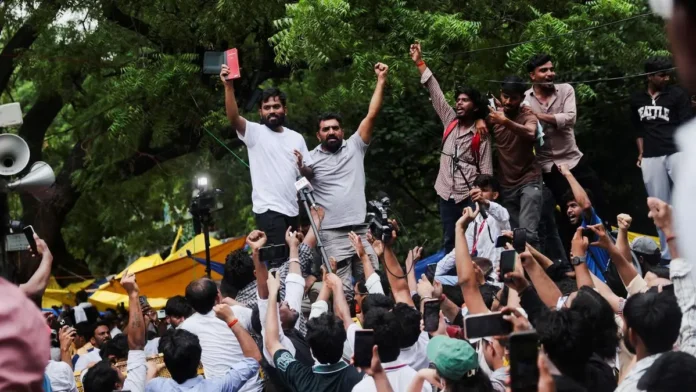
“Beta, tumse na ho payega.”
This is a line I’ve wanted to dedicate to Cockroach Janta Party (CJP) since the day this movement began. This dialogue is from Anurag Kashyap’s Gangs of Wasseypur Part II, and when I heard that the CJP is “calling this movement off,” I felt it was the perfect time to put it up here now, proudly, at the start, because everything that follows is really just the long version of that one sentence.
I have reserved the best, that is: “Sala, jab tak Hindustan mein cinema rahega, log chutiya bante rahenge”, for a different piece. Kashyap wrote that line too, for the same film, and it has aged into the only honest epitaph this entire circus needs. Bollywood’s afterglow did more work for CJP in forty-eight hours than the students’ actual demands managed in three weeks. A fictional character mattered more than the real deaths, and a movement built on borrowed sentiment ran on exactly the fuel Kashyap was mocking.
Let me be plain about where I stand, because I literally have no interest in whataboutery. Pradhan’s resignation won’t help, as it was never sought for a reason. It was selective, and CJP proved it with its own feet.
And get the verb right, because language matters here. CJP did not call off its protest. It “ran away” from it. A movement calls off a fight it believes it’s winning, and calling off looks like a victory lap, a declaration, a permanent change of posture. A movement runs from a fight it’s about to lose, on camera, in front of a bigger crowd than the one it already lost in front of, and running looks like exactly what happened here: quiet, fast, and dressed up afterwards as good faith. What happened at Jantar Mantar was the second one, and no press release calling it a “withdrawal in good faith” changes what the footage actually shows.
This piece has already argued here that reclaiming an insult, the way CJP turned “cockroach” into a banner, sits inside a long, legitimate tradition of Indian political satire: the Panchatantra’s ants uniting against an elephant, Kshemendra’s inversions, Tenali Rama’s riddles. I know it’s not aware of it, ’cause its attitude towards Hindu texts and symbols has not been at its best. However, what that tradition has never tolerated is reclaiming the insult and then running from the follow-through it demands, and that’s exactly the gap I will name.
I predicted as much, like everyone, nationalists mostly, that this movement would either break it or make it. However, when it comes to Indian domestic politics, I stay a little pessimistic, because there’s a dangerous line, nine words, from the president of the hegemonic power that sums up the whole story better than anything written here at home: Ronald Reagan’s “I’m from the government, and I’m here to help.” That line was a joke about bureaucratic overreach when he said it. Applied here, it isn’t a joke at all. It describes CJP with total precision: an INDI alliance proxy-front, AAP and the Communist bloc doing the actual work behind a satirical costume, arriving to “help” with a “printing press failure” while actually extracting political cover for a coalition.
Indeed, the BJP has resolved a two-month crisis with a resignation, a reshuffle and a deferred charter. Obviously, the party has, in other words, said to the CJP: “I’m from the government, and I’m here to help.” However, will their putting a foot forward help solve the actual issue? In my view, no. Because the actual mechanism Article 311, the command chain, the vendor selection process – stays exactly where it was.
The CJP represents a movement that is actually anarchy dressed up as accountability. CJP’s own pages ran heavy on Ambedkar quote graphics through the whole agitation. “Educate. Agitate. Organise.” was the favourite slogan, printed under the cockroach branding as if the two sat comfortably together. They don’t. In his final speech to the Constituent Assembly, delivered on 25 November 1949, the day before the Constitution was adopted, Ambedkar warned against exactly this instinct: that where constitutional methods remain open, resorting to methods outside them, however satisfying the theatre, is nothing but the Grammar of Anarchy, and the sooner such methods are abandoned, the better for everyone. A movement that borrows his slogan for its Instagram grid while running the playbook precisely Ambedkar spent that speech warning against isn’t invoking Ambedkar. It’s quoting him with the meaning surgically removed.
Congress supplies its own version of the same amnesia, and it’s worth naming both instances rather than letting the party’s silence pass as neutrality. In 2011, Rahul Gandhi, now Leader of the Opposition, called the use of a hunger strike to pressure lawmakers into passing a law “a dangerous precedent for democracy,” a direct shot at Anna Hazare’s Jan Lokpal fast. That is precisely the tactic his own party’s MPs stood behind at Jantar Mantar this year; Wangchuk’s fast was treated as legitimate leverage rather than the “dangerous precedent” Rahul once called it. Either the tactic is dangerous, or it isn’t. It cannot be dangerous when a retired anti-corruption crusader does it and democratic when a coalition Congress needs to do it.
Rahul’s sister and MP Priyanka Gandhi supplied the other half of the picture, criticising the BJP government over the NEET leak, only for an old video of her own to resurface from 2024, defending paper leaks under Congress in Rajasthan with the flat admission, “They can’t be stopped.” A party that once shrugged off its own leaks as unstoppable doesn’t get to demand a resignation over someone else’s without that video following it into every studio.
That’s the pattern worth naming plainly: not one party’s hypocrisy, but the whole INDI alliance’s collective habit of applying a standard only when it’s someone else’s minister on the chopping block, Rahul’s 2011 words against Congress’s 2026 conduct, Priyanka’s own escapist logic against her party’s present outrage, and the coalition’s silence on Bangarappa and Harjot Singh Bains against its noise on Pradhan. Selective memory is not an accident here. It’s the operating model.
This was always going to be a “zero-sum game” for the students who started it, win or lose. If CJP had somehow marched all the way to a Prime Ministerial resignation, the printing press would still not be fixed. And if CJP folded at the first sign of exposure, the printing press would still not be fixed. There was never a version of this story where the mechanism actually got repaired, only different versions of the theatre around it. That prediction sat in an earlier piece of mine that never ran, and I’m restating it here because the outcome has now confirmed it exactly.
Twenty million followers. Nearly the entire opposition bench standing behind it. International celebrity endorsements, foreign media sympathy, an alleged ISI angle, Khalistani money reportedly offered, and a government that had already blinked once with a resignation. By every metric a movement measures itself by, CJP was at the absolute peak of its arc.
So why run at the exact moment it had the most leverage it would ever hold? Ask that honestly, and the answer stops being flattering fast.
THE CLIP THAT ENDED IT. Anand Ranganathan said it on air, cornering a CJP representative, Vijeta Dahiya, the burger bachcha, during an NDTV debate alongside Tehseen Poonawalla and others, and the exchange deserves reproducing in full, because it says more in ninety seconds than two months of hunger strikes managed to say honestly. “I, as a citizen of India, am demanding the resignation of all three,” Ranganathan opened, “Bangarappa, Dharmendra Pradhan, and Harjot Singh Bains. Give me thirty seconds. Now go around, go around to the politicians, go around to the spokespersons, ask them: are they also demanding the resignation of all three? The logic is very simple. If three ministers presided over three identical failures, if all three committed the same crime, why demand punishment for just one?”
Ranganathan stressed on the basic fact plainly, and I repeat: if all three committed the same crime, why demand punishment for just one?
The CJP side, the now removed Dahiya, reached for the founding-myth defence: “CJP, as we know it, started as a very organic movement, because of the insensitive remark of the CJI, and just then the NEET paper leak happened.” Ranganathan didn’t let it stand. “Tell me one byte, one single clip, where you’ve demanded the resignation of Bangarappa. You can’t answer now that you’re not even in the party anymore. Resorting to a logical fallacy, are you? Are the students of Karnataka children of a lesser god? Why isn’t AISF out on the streets there? You’re bluntly, today, blatantly, a politician in disguise, sitting comfortably, watching all this from a distance.”
Nobody on that panel had an answer, because there wasn’t one.
One clean, well-aimed question about two non-BJP states (Karnataka and Punjab), on live television, did what the government’s entire two months of “strict action” statements never managed.
It closed the tent.
That this was never running on principle and non-partisan accountability. It was running on a specific address!
The timing tells you everything. That clip amplified fast; Bangarappa and Bains suddenly everywhere, ninety seconds doing more damage to CJP’s credibility than two months of opposition attacks combined. Within hours, CJP announced its retreat. National Spokesperson Ashutosh Ranka, at a joint press conference with Union Ministers JP Nadda and Jitendra Singh, read out the terms: maximum possible compensation for NEET paper leak-related suicides, all FIRs by the Central government and NDA-ruled states withdrawn, and CJP’s five-point exam reform charter to be “considered,” with a further meeting scheduled four weeks out.
Read that list again. Every single item was already sitting on CJP’s own 20 July demand letter: compensation, FIR withdrawal, protection from future action, retroactive protection, all three. The one item that would have actually brought a change in the system or real exam reform wasn’t even mentioned. That is Article 311 reform and the 130th Amendment Bill, which would actually force a Prime Minister, Chief Minister, or minister out of office within thirty-one days of serious criminal detention, no waiting years, alone gives the most solutions.
Article 311 is already present and provides unique immunity to a government employee (not ministers); they can be prosecuted for scams or frauds; however, it’s the provision that has single-handedly delayed justice and made the system moth-eaten. The criminal here faces, at worst, a transfer. Dismissal is rare, and recovering the financial and emotional costs inflicted on lakhs of students and their families is almost never pursued.
The CBI arrested five people within 24 hours of taking the NEET-UG 2026 case on 12 May, thirteen in total by 27 May. That trail should have led to consequences, and here’s a correction I owe to the argument, because the easy version is also the lazy one.
Article 311 doesn’t even reach most of the people who leaked the papers. NTA staff sit outside civil-post protection entirely; that’s precisely why forty-seven officials could be sacked in one sweep the moment the scandal broke, no departmental gridlock, no years-long inquiry, just an instant purge. University professors hold no civil post either; courts have ruled on this plainly, their suspension or dismissal runs through university statutes and employment contracts, not through 311’s protective maze. The private coaching syndicates who actually run these rackets for money were never civil servants to begin with; they get prosecuted as ordinary criminals under the Public Examinations Act and BNS Section 112, no constitutional shield in sight.
Where 311 actually bites is one layer up, and this should make you angrier, not less. The IAS and IPS officers answerable for the entire command chain that let a leak happen under their watch are rarely charged as co-conspirators. They’re found negligent, for failing to secure the system that was their one job to secure, and negligence findings against career bureaucrats are exactly the terrain 311 was built to slow down. The minister answers for the ministry. The ministry answers for the agency. The agency’s own leadership answers to a due-process clause that turns “found negligent” into “transferred, eventually, maybe.”
A resignation at the top changes nothing about the rot sitting three floors below it.
Amending 311 wouldn’t fix this alone either, and honesty requires saying so. A terminated officer still appeals to the Central Administrative Tribunal, then the High Court, then the Supreme Court. Fixing 311 buys speed at the front door. It doesn’t buy a faster judiciary at the back. But there is a working precedent for a sharper lever, and it didn’t come from a constitutional amendment; it came from an administrative order. In 2024, Yogi Adityanath’s Uttar Pradesh government ordered all state employees to declare their movable and immovable assets on the government’s Manav Sampada portal, with a hard deadline, and made continued salary payment conditional on compliance. By February 2026, when compliance still lagged, the state withheld salaries from over 68,000 employees outright not suspended, not transferred, and stopped the money at the source until the paperwork moved. That’s the shape of leverage. 311 currently denies the system entirely. Yogi, on the other hand, sometimes provides better solutions that should’ve come from our policymakers, with confidence backed by our Indian courts; it’s time to see more than the ‘communal angle’, I guess.
None of this is a partisan point. Dhiman Chakma, the 2021-batch IAS officer reinstated by Odisha despite an ongoing corruption investigation. Pooja Singhal, sixteen crore recovered from her CA, thirty-six crore more traced, twenty-eight months in jail and reinstated the day her bail came through. Alok Kumar, reinstated on the Home Ministry’s own instruction citing the three-month rule. Saurabh Tripathi, reinstated over a year later and posted straight into a state intelligence unit. SMH Mirza, arrested by the CBI in 2019 after being caught on camera in the Narada sting. Five different cadres, five different parties, one identical outcome every time: reinstatement, delay, a system that treats scandal as a phase to be waited out rather than a fact to be resolved. Article 311 is irreligious, apolitical architecture. There’s no group to blame here except the clause itself. It’s actually a secular clause that protects all. And this is exactly why reform will never become the cross-party cry it should be.
SO WHAT WAS CJP AIMING AT? None of what follows explains why CJP ran. It explains why running cost the movement absolutely nothing structural to give up, because nothing structural was ever actually on the table to begin with.
Here is what nobody on that stage ever explained: what actually changes now that Pradhan has resigned? The NTA sits under Prof. (Retd.) Pradeep Kumar Joshi; that’s where accountability for the leak was always going to get debated, not in a ministerial chair. A new minister will give the same press conference tomorrow, and the printing-press failure sits exactly where it was, because this was never a ministerial failure alone.
With amendments in Article 311, reforms can be expected; however, what about the ministry? If not fully, the political cushion these executives and the administration rested on definitely had some role in it. The proposed 130th Amendment Bill, as mentioned above, doesn’t come with the Article 311-style maze; it sits with a Joint Parliamentary Committee that TMC, the Samajwadi Party, AAP, and Shiv Sena (UBT) had already declared to boycott along with Congress and RJD. CPI(M) declared it would fight the bill on the floor of Parliament and in the streets. Mamata Banerjee called it a threat to democracy. Owaisi called it a collapse of separation of powers. Only Sharad Pawar’s NCP(SP) actually joined the committee.
If the ball was ever genuinely in the opposition’s court, and on this bill it plainly was, they didn’t miss the goal. They walked off the pitch, the same way CJP just walked off Jantar Mantar.
Accountability was never on their cards either.
FROM DEMANDING THE PM’S HEAD TO WITHDRAWING, SAME EVENING, here’s the part that should actually stop you, because the whiplash itself is the evidence. Pradhan’s exit was never the innings. It was the opening over, and Dipke didn’t even try to hide it. He had already telegraphed, in the weeks before the resignation, that if Pradhan’s exit didn’t come, or once it did, the demand would simply move to PM Modi. It moved. Exactly as predicted, exactly as scripted, and exactly as this piece argued it would, forming the very demand letter that never once made the movement’s charter sound like a policy document.
“We have done it,” Dipke said. “First wicket down.” “Jhukti hai duniya, jhukane wala chahiye,” the world bows if someone makes it bow. “We are cockroaches. Once it enters, it does not leave.” That is not the language of a movement preparing to stand down. That is a movement announcing an open-ended campaign against the country’s Prime Minister, on the record, in celebration.
So what happened to it, suddenly, that same evening?
The honest answer is nothing happened to the movement. Something happened to its cover story. The Ranganathan clip (and similar like-minded reels landed) in the gap between the escalation and the follow-through, and the same coalition that had just celebrated “first wicket down” against Pradhan found itself unable to explain, on camera, why Bangarappa and Bains weren’t also on the scorecard. A movement that had just demanded the Prime Minister’s resignation does not, in any world governed by genuine conviction, fold within hours over an embarrassing television clip.
Genuine movements built on principle absorb bad press and keep marching. This one didn’t absorb anything. It vanished.
That is the real answer to what happened suddenly: nothing about the printing press changed between “first wicket down” and the withdrawal statement. Nothing about Article 311 changed. Nothing about the command chain changed. The only thing that changed was that the coalition’s own selective outrage became too visible to keep marching under, and a movement that can escalate to demanding a Prime Minister’s resignation in the morning and vanish by evening was never running on the conviction it performed. It was running on cover, and the moment the cover burned, so did the campaign.
Rahul Gandhi’s own position, on ministerial accountability and Pradhan’s removal, now sits comfortably alongside Dipke’s. The man who once mocked Rahul’s Bharat Jodo Yatra as a “travel vlog” on his own account now finds his post-resignation demand converging neatly with the Congress line.
Politics makes for interesting company, and interesting amnesia.
And the RSS line came right back with it, on the way out. Dipke’s oldest and most reliable rhetorical weapon, alleging RSS men behind any physical confrontation, any police action, any resistance to the movement, resurfaced the moment the celebration cooled, because a movement built to keep moving the goalpost needs a villain that never actually resigns. A minister can quit. An entire ideological organisation, invoked as a shorthand villain, never has to.
“Don’t make me a hero, the country is ruined by making one person a hero,” Dipke said, in the same breath as calling himself the reason the world bows. Read those two sentences back to back, and you have the entire circus in miniature: humility as costume, escalation as substance, followed within hours by total retreat.
Sit that settlement next to what Dipke was actually saying the day Pradhan resigned, because the two moments sit at polar opposite ends of the same movement, and the contrast in tone is itself the proof this piece has been building toward. That was loud, triumphant, a man promising escalation, a second wicket, a third, a movement that had no intention of ever declaring the fight over. And then, days later, the actual retreat: a spokesperson reading out a list at a joint press conference, no victory lap, no “we won,” no scoreboard update at all, just a compensation figure, some FIRs withdrawn, a charter deferred four weeks, and a request that protesters “return home peacefully.” A movement that genuinely believes it has won does not go quiet. It shouts louder. CJP went quiet, fast, the exact moment the cameras turned toward Bangarappa and Bains instead of toward Pradhan. That silence is not what victory sounds like. It is exactly what fleeing sounds like, dressed up afterwards in the vocabulary of good faith.
But the deeper reason for the sudden flight sits underneath the clip, not just inside it. This was never really an organic movement discovering an inconvenient double standard live on air. It was a coalition, the INDI alliance showing up in bits and pieces under a name that let every party deny formal involvement, Kejriwal backing it publicly then showing up in person, Samajwadi Party MPs, Shiv Sena (UBT), Trinamool, CPI, CPI(ML)-Liberation, RJD, and senior CPI(M) leaders lined up through June and July, Congress staying silent until Wangchuk’s hospitalisation gave it safe cover. The moment 2 or 3 non-BJP state ministers’ questions started trending harder than the Pradhan demand, that entire coalition’s internal contradiction stopped being deniable in real time, to a national audience. A Congress minister and an AAP minister were being protected by the very parties CJP had let onto its stage. Running away wasn’t a strategy discovered late. It was the exit built the day that coalition first assembled, used the moment continuing to march would have meant Congress and AAP spokespersons explaining, on camera, why their own ministers were exempt from the logic CJP had weaponised against one party alone.
This is the unexpected climax. Everything the reclaimed insult, the Bollywood cameo, the borrowed coalition, the foreign amplification, the fasting body used as leverage, was always going to arrive here: at a founder calling a resignation a cricket score, immediately pointing at the next wicket, the Prime Minister himself, and then vanishing from the stage before the sun set on the same news cycle.
The circus didn’t end when Pradhan resigned. It found its punchline the same evening it demanded a bigger one.
THE DOUBLE STANDARD DIDN’T STOP AT MINISTERS. The same selective instinct that spared Bangarappa and Bains showed up again in how the aftermath got policed, and it cuts in an uncomfortable direction for anyone still calling this a clean, symmetrical accountability movement. On 19 July, Punjab Police busted a genuinely sophisticated cheating operation during the Baba Farid University of Health Sciences Pharmacy Officer recruitment exam: pen cameras, Bluetooth devices sewn into clothing and turbans, real-time answer dictation, roughly thirty-five candidates and operators detained, fees running into the lakhs per guaranteed pass. This is AAP’s Punjab, Bhagwant Mann’s government, and BJP leaders rightly criticised it. No CJP hunger strike followed. No stage was built outside Chandigarh.
Three days later, on 22 July, a solidarity event in Kochi’s Panampilly Nagar, held in support of the same Delhi protest, drew an FIR from Ernakulam Town South police naming the event’s organiser and ninety-nine other identifiable people, obstruction of a public way, unlawful assembly, disobedience of lawful orders. Kerala sits under the Congress-led UDF, not the BJP, the government that supposedly represents the “dictatorship” this movement kept naming. Rapper Vedan, who attended, became the visible face of the story; the other ninety-nine became numbers in a case file.
I want to be careful here rather than overstate it, because the honest picture is genuinely mixed, not a clean scandal either way. Being named in an FIR isn’t the same as mass physical arrest, and some Delhi detainees were released too; preventive pick-ups and formal charges are different categories, and outcomes depend on jurisdiction as much as politics. But the pattern is still worth naming plainly: a Congress-run state quietly booked a hundred people over a solidarity gathering, and CJP’s own machinery, so quick to name Pradhan, so quick to allege “RSS goons” and rights violations at every BJP-linked crackdown, had nothing to say about 99 Malayalis facing charges under a government its own coalition partners run. If the movement’s outrage only ever activates when the state doing the policing has a BJP flag on it, that isn’t a principle. It’s the same address problem this piece already caught on live television, just wearing a different uniform.
There are other reasons for running as well.
If you have seen reels of the CJP protests, the reservation topic was raised ‘cause this CJP was sold off as a non-partisan, anti-communal-casteist revolutionary group. It came off as a “holistic problem solver of students”, but it was never. Dipke used his Dalit identity, Baba Saheb, then chose to laugh at Kunal Kamra’s ” Sita ke pati” joke while standing in respect when Prof (Retd) Nandita Narain, wife of Prof (Retd) Rashid Ansari, who is related to the family of former Vice President of India Hamid Ansari, sang in a student’s protest “sirf nam rahega Allah ka”.
Politics is never devoid of religion and identities; and precisely here, a communal angle was brought by the very secular groups who proudly say they are anti-casteist and communal. Seculars are the real Communalists. History is evident.
Coming back to the reels, yes, precisely so the topics of reservation were “sushed”, and instead you have seen Dipke to the Blue army and its followers answering to these critical questions as “you’re a right-winger, godi media, casteist privilege”.
If you have not seen it, then watch it, ‘cause “picture abhi baki hai”.
THE GRIEVANCE NOBODY RAISED in this whole circus included the UGC Equity Regulations Bill 2026, which, as per its clauses 3(1)(c) and 3(1)(e), excluded the General Category students from ever becoming eligible to be subject to discrimination. The CJP never talked about this protection of reversed institutional casteism once, because picking it up would have meant admitting its own coalition had no answer for it either.
Many of us are aware that the opposition parties like Congress, meanwhile, say they will scrap the 50% cap entirely to increase caste reservations further, including in the private sector. The prime example of this was given by the Bhim Army Chief Chandrashekhar Azad “Ravan,” who has separately introduced a bill in the Lok Sabha demanding reservation quotas inside private educational institutions, directly undermining merit and open competition, and who was, at the same time, protesting at CJP for a “fair education system” and “equity.” Equity for some, in his version, simply means engineered inequality for others.
A point that you should know here: Ravan is his chosen title because, per the unscientific Aryan race theory his politics leans on, Ravan gets reframed as a Dravidian or indigenous hero rather than a villain, while Ram gets recast as a nomad who arrived from outside.
These are the politicians fighting for you, and simultaneously against you. Read The Dossier’s article where I have exposed this same logic in the TMC government’s West Bengal state books!
SO WHAT DID CJP ACTUALLY SOLVE? Walk through it honestly. The printing press is not fixed. Nobody has named the vendor selection process that let the leak happen, let alone reformed it. The command chain of officers who were supposed to make leaking impossible in the first place answers to nobody new; they were never the ones resigning to begin with.
The five-point reform charter got kicked four weeks down the road, into exactly the kind of deferred, “under consideration” limbo that swallowed the JPC’s review of the 130th Amendment Bill and every serious Article 311 reform proposal before it. The general-category student’s genuine grievance never made it onto a single demand letter. The country already has an anti-copying law on the books, the Public Examinations (Prevention of Unfair Means) Act, 2024, that criminalises paper leaks, impersonation, and organised cheating with penalties running up to ten years in prison and fines up to a crore. It exists. It was law well before NEET-UG 2026 happened. And CJP’s own five-point charter never once mentioned it, never asked why it hadn’t been invoked more aggressively against the syndicate networks behind this leak, never proposed strengthening its enforcement, never asked for a status report on how many prosecutions it had actually produced since 2024.
A movement that spent two months claiming to want systemic exam reform had a systemic exam reform law sitting in front of it the entire time and looked straight past it toward a minister’s chair instead. Compare that to the actual remedy sitting untouched this whole time. Article 311 reform would bind every future government, present and future, to the same standard: instant consequence on conviction, real speed to conviction, and due process kept fully intact for the officer who refused a corrupt order rather than the one who took the bribe. That reform doesn’t care whose name is trending. It doesn’t produce a scoreboard update. It just quietly makes the next leak, under whichever party governs next, actually cost someone something. Which is precisely why nobody, not CJP, not the coalition that platformed it, ever put it at the top of a single demand letter.
And through all of it, the ordinary citizen keeps doing the one thing that costs nothing and changes nothing: fighting a stranger online over whether supporting the BJP makes you the problem or supporting the Congress-Communist bloc makes you anti-national, both certain they have found the villain, neither noticing the villain is the clause nobody in either camp will touch.
That is not principle. That is politics, plain and simple.
Look at what that chair’s occupant had actually done, because it complicates the celebration considerably. There was no law of this kind before 2024. A crore in penalties, ten years in prison, that came from the Public Examinations Act, and before it, the country had nothing on the books at all. Kapil Sibal tried to bring a version of this law back in 2010, and the government of the day refused to pass it. Pradhan was the first education minister to form a dedicated review committee for the entire examination process, chaired by a former ISRO chief, when no such committee had ever existed before.
That committee returned 101 recommendations, and every one of them was accepted, all implemented except full digitisation, the one item requiring the largest expenditure, which he had promised to deliver by 15 May, the same window in which the paper was leaked a second time. When AIPMT was leaked and cancelled back in 2015, it took a Supreme Court order to force that cancellation. This time, Pradhan cancelled the paper himself, on his own judgement, the moment the leak was confirmed, whether the leak traced back to a paper-setter or, as happened in 2024, a school principal. Within ten days he had the CBI on the case. Within a month, twenty-two lakh candidates sat a re-examination across five thousand centres, reorganised from scratch on that timeline.
And for all of that, the whole country turned on him. The whole country removed him from his chair. And a movement is now celebrating it as a great victory, without once explaining what, precisely, was won.
His pros outweigh his cons, certainly against the man who actually replaced him, the one CJP itself made room for.
Take it as a prediction, before CJP resurfaces, because it will: it will come back to make fools of you again, and some of you will join it again, because you were never actually in this for pro-India, pro-accountability, pro-student politics. You are anti-BJP as a faith, and faith doesn’t ask what it actually accomplished. It just waits for the next occasion to feel righteous.
Accountability in this country remains a contested word rather than a fixed practice, and it is the citizen, every time, who actually pays for that contest, at Shaheen Bagh, in the anti-CAA-NRC protests built on a citizenship scare that was never actually aimed at India’s Muslim citizens, in the farm-law agitation, in whatever comes next, because disinformation-fuelled mass hysteria has a body count and the clause that could prevent the underlying failure has none of the same urgency behind it.
If there is one practical thing worth taking from all this, it is that the Panchatantra is still worth reading past the age of ten, because it was never actually written for children. It is a manual for the powerless on how power actually gets moved, not through a name, a hashtag, or a hunger strike photographed at the right angle, but through the unglamorous, coordinated work the ants do off-page: mapping exactly where the elephant is vulnerable, agreeing on a plan, and not stopping until the job is finished. A generation raised on reels has the reclaiming instinct down perfectly.
So, take it as is: CJP just ran away, profiting from your grief, and you are also partly responsible for this.
Amidst all, Satish Kumar Aggarwal, former Vice-President of the Akhil Bharat Hindu Mahasabha, had already filed a PIL in the Delhi High Court seeking an NIA probe into alleged foreign funding of the CJP protests, the matter mentioned urgently before the court by advocate Barun Kumar Sinha. This should also be read as a legitimate reason why this movement was called off; we will eventually discuss that in the next piece.
Imagine, for a moment, where this actually goes if that probe reaches trial. Every opposition leader who shared a stage with CJP, who called Wangchuk’s fast a victory for democracy, who let Kejriwal, the Samajwadi Party, Shiv Sena (UBT), Trinamool, and the Communist bloc lend their names to this coalition, will abandon it the moment the funding question stops being rhetorical and starts being evidentiary. Not because they suddenly discover principles. Because FCRA is the one subject where every party in that coalition has something to hide.
A genuine NIA probe into CJP’s funding does not threaten one party. It threatens the entire bipartisan arrangement by which foreign money and political convenience have always found a way to coexist quietly in this country, regardless of who’s in government.
So when the trial actually comes, watch how fast the coalition scatters. The same leaders who stood beside Dipke in June and July will discover, with impressive speed, that they barely knew him.
Good luck to CJP. It will need it, standing alone in a courtroom, having already been abandoned once on live television and now abandoned again by the very parties that supplied its march, its optics, and its cover.
Most of the readers already know who will fight these cases. Pun intended.
I keep returning to Sarthak Sidhant and Nisarga Adhikary because they are the cleanest rebuttals this entire circus produced without meaning to. They looked in the current government’s eyes and dared to say “you are wrong!”. All under eighteen, teenagers with a tender document did more real accountability work in an afternoon, comparing bidding rounds line by line, flagging the exact clause changes that favoured a single vendor, than a twenty-million-follower movement managed in two months of hunger strikes, hospital transfers, and Bollywood cameos. Nobody’s chanting their names on a stage. They found the mechanism and pointed at it, quietly, and let the system either respond or expose itself for not responding. That is the case. Everything CJP built was a cause, and a cause, once its usefulness as a headline runs out, doesn’t disappear. It goes dormant.
That is the part worth saying plainly before this piece ends: CJP is not gone. A coalition this well assembled, this well funded, this well rehearsed in the mechanics of turning a grievance into a national stage, does not simply dissolve because one clip embarrassed it for a weekend. It ran, it didn’t die. Expect it back the moment the next opportunistic crack shows up, whichever ministry, whichever scandal, whichever name the meme cycle decides deserves the next hunger strike. But the cause will always be connected to the BJP and not other parties ’cause “jiss thali mai khate hai uss mein ched nahi karte”.
The infrastructure, Dipke’s professional messaging instincts, the INDI alliance’s readiness to lend its bench, the international award ecosystem waiting with its own shortlist, none of that went anywhere. Only the tent did, for now.
You call off a fight you believe you’re winning. You run from one you’re about to lose on camera, in front of a bigger crowd than the one you already lost it in front of. CJP ran, and every deferred charter, every quiet press conference, every unanswered question about Bangarappa and Bains, and every unbooked question about ninety-nine names in a Kochi FIR, is the proof of it.
The education ministry has real work to do, and a transfer memo wouldn’t solve it. It may serve the emotions but will not solve the problems. It is such an issue that it alone touches everyone alike: apoliticals, strategic voters, karyakartas, and propaganda peddlers of all sides alike.
Free advice for our young minds reading this article: it’s not Coachella; you don’t have to dance along to every trending song. “Jo Lanka mein aata hai wahi Raavan hota hai.” Learn to see different perspectives, question everything, and look for basic logic and reasoning before joining a protest physically!
Patriotism and nationalism are not two separate concepts in the Indian context. For India, that is Bharat as a civilisational nation, deserves more; and so do its students. They deserve to be protected, not exploited on the back of a genuine grievance!
That said, neither of them, or together, comes with selective loyalty clauses; period.
Loving a country badly enough to leave the argument at a hashtag isn’t the same as loving it enough to do the boring work.
“Beta Tumse na ho payega!”