

IN MARCH 2026, the Rajasthan Assembly scrapped the rule that had, for more than three decades, barred people with more than two children from contesting local body elections. It passed two bills on consecutive days: one amending Section 24 of the Rajasthan Municipalities Act, 2009, the other making similar changes to the Panchayati Raj Act of 1994. Telangana had done the same in January 2026, and Andhra Pradesh in 2024. Chhattisgarh, Haryana and Madhya Pradesh had done so earlier.
Andhra Pradesh has gone further. On 16 May 2026, Chief Minister N. Chandrababu Naidu announced Rs 30,000 for a third child and Rs 40,000 for a fourth. In a single generation, a state that disqualified the parents of large families from office has started paying them.
The reason is a number. India’s total fertility rate (TFR), the average number of children a woman would have over her lifetime, has fallen to 1.9, according to the Sample Registration System’s Statistical Report 2024, released in May 2026. At 2.1 a population replaces itself. India, home to more than 140 crore people, is now below that line.
For seventy years the Indian state tried to set the size of Indian families by order, and most of the orders came from the Congress: the sterilisation targets of the Emergency, driven by Sanjay Gandhi, and in 1993 a committee chaired by a Congress chief minister that asked for parents of more than two children to be barred from office. The orders did great harm and little good. What brought India’s birth rate down was girls staying in school, infants surviving and women marrying later. Kerala proved it decades before the rest of the country. Now that the numbers have turned, the states are taking apart what the Congress built.
KERALA AND BIHAR tell the story. Between 1961 and 1971, Kerala’s population grew by 26.3 per cent, faster than Uttar Pradesh (19.5 per cent), Bihar (20.9 per cent) and the national average of 24.8 per cent. Then it turned. Kerala’s growth fell to 19.2 per cent in 1971–81 and 14.3 per cent in 1981–91; Tamil Nadu’s fell to 17.5 and 15.4 per cent. Uttar Pradesh rose to 25.4 and 25.6 per cent, and Bihar stayed at 23–24 per cent, according to Census figures compiled by the Ministry of Statistics.
By 1989, Kerala had become the first state in India to bring its TFR down to 2.1. Demographers credit universal schooling, rising female literacy, later marriage, and gains in public health that let more children survive and made each child costlier to raise.
Bihar and Uttar Pradesh began later, for connected reasons. Girls had less schooling and married younger: even in 2019–21, more than 40 per cent of women aged 20–24 in Bihar had been married before 18, according to the fifth National Family Health Survey (NFHS-5). Children died more often, and where parents fear losing children and prefer sons, they keep having them until enough survive. The National Population Policy of 2000 said as much. It put about a fifth of India’s population growth down to “high wanted fertility” caused by high infant mortality, and another fifth to unmet need for contraception.
What the north got instead of schools and clinics was the scalpel.
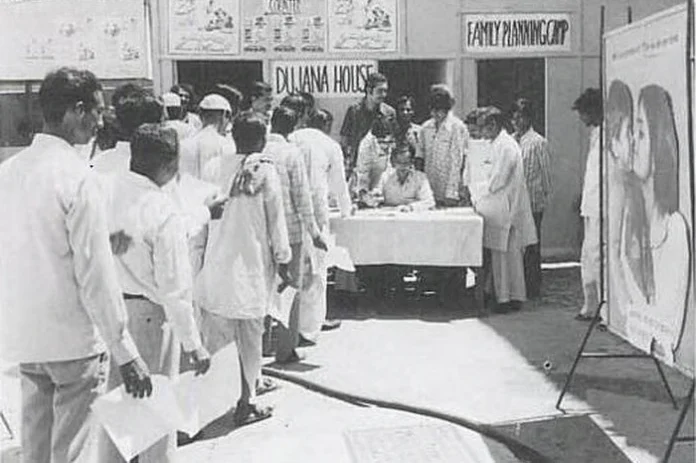
IN 1952, India launched what its own population policy calls the first national family planning programme in the world. Sterilisation soon became its main tool. During the Emergency of 1975–77, under Indira Gandhi’s Congress government, it became coercion.
Sanjay Gandhi, who held no government office, made mass sterilisation the cornerstone of his Five-Point Programme, alongside literacy and slum clearance. To meet targets, governments built an elaborate system of rewards and penalties. Uttar Pradesh told its teachers to be sterilised or lose a month’s salary; couples in which neither partner was sterilised risked losing government jobs and housing; men were paid for vasectomies. In Delhi, more than 1,100 policemen and officers had undergone vasectomy by 20 July 1976.
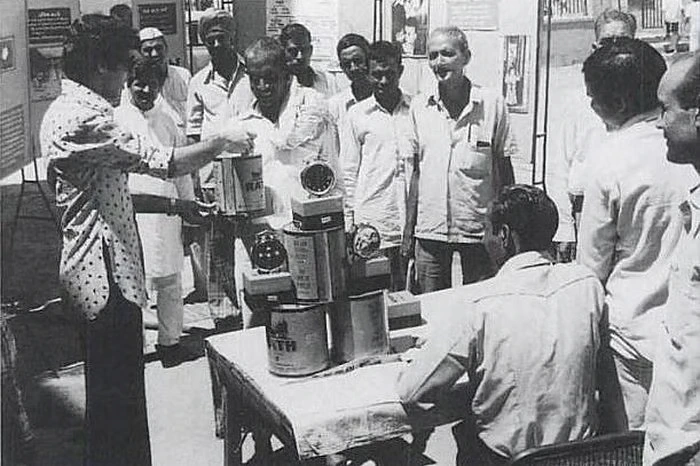
The Shah Commission, set up by the Janata government in 1977, found that beggars and vagrants had been rounded up into clinics by police and Youth Congress workers, and that auto-rickshaw drivers had to show a sterilisation certificate to renew their licences. Between June 1975 and March 1977, about 1.07 crore people were sterilised against a target of 67.4 lakh, the Union government told the Lok Sabha in August 2025, citing the commission. The same answer put the commission’s count at 1,774 deaths linked to sterilisation and 548 complaints of unmarried people being sterilised. The north was pushed hardest: in 1976–77, Bihar sterilised 6.8 lakh people against a target of 3 lakh, and Uttar Pradesh 8.37 lakh against 4 lakh. About seven in ten of the operations were vasectomies.
The drive was interrupted in January 1977 when Indira Gandhi called elections, and the Congress lost in March. The Janata government’s population policy renamed the programme “family welfare” and declared it voluntary. When Indira Gandhi returned to power in 1980, her government tried to recall copies of the Shah Commission’s report. Three years later, in 1983, the United Nations gave its first Population Award jointly to Indira Gandhi and Qian Xinzhong, the head of China’s family planning programme.
The damage outlasted her defeat. Family planning became a phrase politicians avoided, and men stopped coming forward. By 1981, more than three-quarters of sterilisations in India were of women, and the burden has stayed with them. Female sterilisation is still the country’s most common method of contraception: 36.5 per cent of currently married women rely on it, against 0.5 per cent of men, according to the fifth National Family Health Survey (2019–21). The mistrust reached children too. A study published in World Development in 2023 found that in a state where half the sterilisations were excessive, children born after the campaign were 17 per cent less likely than their older siblings to receive any vaccine, and 34 per cent less likely to receive the triple antigen (DPT).
The camps outlasted the Emergency too. In November 2014, more than 80 women were sterilised in a few hours at a government camp in Bilaspur district, Chhattisgarh; 13 of them died. In September 2016, in Devika Biswas v. Union of India, the Supreme Court ordered governments to end camp-based sterilisation within three years and move it to health facilities. The petition had been filed after 53 women were sterilised in unsanitary conditions in a school in Araria district, Bihar. The court also told governments not to set even informal targets that could push health workers into what would amount to forced sterilisation.
THE TWO-CHILD NORM was the same idea in a different form. In 1993, a committee set up by the National Development Council under P.V. Narasimha Rao’s Congress government, and chaired by Kerala’s Congress chief minister, K. Karunakaran, recommended a law barring people with more than two children from holding any post, from the panchayat to Parliament. No national law followed. The rule landed on the panchayats instead, just as the 73rd Amendment, in force from 1993, had reserved seats in them for women, Scheduled Castes and Scheduled Tribes. The people newly given a place in local government were told it depended on how many children they had.
Rajasthan adopted the norm in 1992, Odisha in 1993, Haryana and Andhra Pradesh in 1994, Himachal Pradesh, Madhya Pradesh and Chhattisgarh in 2000, Maharashtra in 2003 and Gujarat in 2005. In Javed v. State of Haryana (2003), the Supreme Court upheld it, in Haryana’s Panchayati Raj Act of 1994, passed under the Congress government of Bhajan Lal. Rejecting challenges under Articles 14, 21 and 25, the court held that contesting elections is a statutory right, not a fundamental one, and that the restriction was a reasonable measure in the national interest of population control.
The norm rested on two assumptions: that a law could make people have smaller families, and that the poor would limit their families to qualify for office. Neither held. A five-state study by former IAS officer Nirmala Buch found no sustained fall in fertility. It found more unsafe and sex-selective abortions, men divorcing their wives, sometimes only on paper, to stay eligible, and children abandoned or given up for adoption. Another five-state study, by the Bhopal group Mahila Chetna Manch, found that about three-quarters of those disqualified were from Scheduled Castes, Scheduled Tribes or backward classes.
The Supreme Court may now undo its own ruling. On 4 August 2026, a bench of Justices P.S. Narasimha and Alok Aradhe reserved judgment on whether Javed needs reconsidering, in a challenge by a former sarpanch disqualified in Maharashtra after her third child. The amicus curiae told the court that seven states have repealed the norm and six, including Maharashtra, Gujarat and Assam, still have it.
The target was overshot. The National Population Policy of 2000 aimed to bring the TFR to replacement level by 2010 and to stabilise the population by 2045. The National Health Policy of 2017 pushed the TFR goal to 2025. The TFR reached 2.0 in 2020 and 1.9 in 2024.
THE FREEZE on Lok Sabha seats is another Emergency inheritance. The 42nd Amendment, passed during the Emergency in 1976, froze each state’s share of Lok Sabha seats at the figures of the 1971 Census. The 84th Amendment of 2001 extended the freeze until the first census taken after 2026. That census has 1 March 2027 as its reference date.
Andhra Pradesh’s Rs 30,000 may fare no better. Japan shows what money cannot buy. Its fertility fell below replacement in 1974 and reached a record low of 1.14 in 2025, despite years of government effort to reverse it.
The machinery of command was built under the Congress: the Emergency’s targets, the camps, the 1993 call to disqualify the parents of a third child. It is being taken apart state by state, and the Supreme Court may yet undo Javed. India learnt the hard way that the state cannot order families to shrink, and cash alone is unlikely to make them grow.
The Congress treated a child as a figure to be cut.
Kerala treated the mother as a person to be educated and the infant as a life to be saved, and its numbers followed. An ageing India needs what Kerala had: schools, clinics and work for women, and pensions and care for the old.
The first seventy years were about how many Indians there would be. The next should be about how well they live.