

AT THE LOS ANGELES premiere of Ramayana on 27 October, Sai Pallavi, who plays Devi Sita in Nitesh Tiwari’s film, was asked what she hoped audiences would take from it. Viewers, she said, should introspect, “see what good and bad exists in you” and correct themselves over time, “because Ravana is not all bad. And it’s important that we spot the Ravana in us, and we make changes over time.”
The second half is unobjectionable: Ravan as the evil within each of us is how Hindus have long read him. It is the first half that does the work. With quiet grace, it reframes the central antagonist of Valmiki’s Ramayan, not as the figure the text records, but as something softer, more balanced, more useful for modern self-reflection. Yet Maharishi Valmiki does not present Ravan as a learned devotee whose virtues somehow offset a lifelong pattern of abduction, coercion and violence. To soften that record is not nuance: it is selective forgetting.
And she is not alone. The film’s director, Nitesh Tiwari, said in an interview with Collider earlier this year that “there was so much to him than just being a black character”. Elsewhere in public discourse, Ravan is celebrated as a formidable scholar, an accomplished ruler and a devoted worshipper of Bhagwan Shiv. We are told that he was not truly evil, that he never touched Devi Sita, and that his character has been unfairly reduced to his defeat at the hands of Bhagwan Ram. His virtues are brought forward, while his conduct is pushed into the background.
So set aside the films and the retellings, and return to the text. What does Maharishi Valmiki record about Ravan’s conduct towards women, and towards Devi Sita in particular?
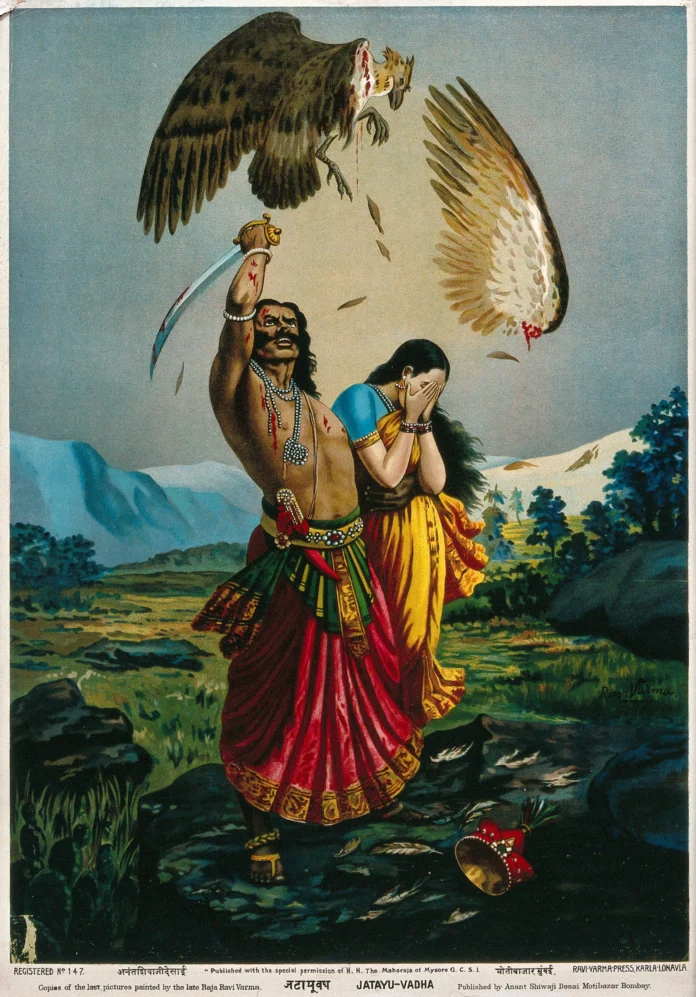
THE CLAIM THAT he never touched Devi Sita does not survive Aranya Kanda, Sarga 49. After the golden deer has lured Bhagwan Ram and Lakshman away from the hermitage, Ravan approaches Devi Sita in the guise of a mendicant. He then abandons the disguise, reveals his true, terrifying form and seizes her by force. Verses 17–20 state: “With his left hand he caught hold of the lotus-eyed Sita by her locks, while with his right hand he clasped her by her thighs. Stricken with fear to see him looking like a mountain-peak in stature and resembling Death himself, endowed as he was with sharp teeth and mighty arms, the sylvan deities ran away… Then, overawing Sita, the princess of the Videha territory, with harsh words, and taking her in his arms, Ravana, who uttered a loud roar, forthwith placed her in the car.”
A woman’s hair is seized so she cannot turn her face away. Her thighs are gripped so she cannot pull free. As the chariot rises into the sky, Devi Sita cries out for Bhagwan Ram and Lakshman. Verses 23–40 record that, “stricken with agony when seized by Ravan, the illustrious Sita cried at the top of her voice, ‘O Ram!’” She calls on the trees, the river Godavari and every creature of the forest to carry word to her husband: “I seek the protection of all the animals of different species, the herds of deer and the flocks of birds, which actually dwell in this forest, and pray: ‘Kindly tell my husband of his beloved spouse, more valuable to him than his very life, being borne away, and add the following: Your Sita has been carried away by Ravana, helpless as she was.’” This is not a desire returned. It is a woman taken by force.
WHY, THEN, did Ravan not go further once she was in Lanka? He answers that himself, in Yuddha Kanda, Sarga 13. When the rakshasa Mahaparshva sees Ravan angry, he advises him to take Devi Sita by force. Verses 4–5 state: “Act in the manner of a cock, using force against her, O ruler endowed with extraordinary might! Assaulting Sita again and again, enjoy her and revel with her. Once you have attained your desired end, what peril will come upon you afterwards? And you will surely be able to meet every risk, no matter whether it is already present or is yet to come.”
Ravan explains why he cannot. In verses 11–15, he tells Mahaparshva: “Once I beheld a celestial nymph, Punjikasthala by name, flashing like a flame and sneaking away for fear of me through the heavens to the abode of Brahma (the grandfather of the entire creation). She was stripped of her garment and ravished by me. She then reached the abode of Brahma, the self-born creator, like a lotus plant violently shaken by an elephant. The aforesaid incident, I presume, came to be known precisely as it had occurred to that exalted soul. Highly enraged, the creator forthwith addressed the following words to me: ‘If you happen to violate any other woman henceforward, your head will be forthwith split into a hundred pieces; there is no doubt about it.’ Hence, afraid as I am of his curse, I do not violently put Sita, a princess of the Videha territory, on my charming bed by force.”
These are Ravan’s own words, and they make the point plainly. He did not refrain from violating Devi Sita out of respect, restraint or any moral awakening. He refrained because of the curse. Fear for his own life, not virtue, was the only barrier. And readers who dismiss the Uttara Kanda as a later addition, the source of several episodes below, must still reckon with this admission: it sits in the Yuddha Kanda, at the heart of the epic.
Nor did he treat her with the courtesy his admirers imagine. In Aranya Kanda, Sarga 56, once she is in Lanka, he gives Devi Sita twelve months to yield. If she does not, he tells her in verse 25, his cooks will cut her into pieces for his breakfast.
PUNJIKASTHALA WAS NOT the only one. Uttara Kanda, Sarga 26 records a second curse, for a second assault. Near Mount Kailas, Ravan sees the apsara Rambha and, inflamed by lust, propositions her (verses 22–27). Shaking with fear, Rambha replies with joined palms in verses 28–29: “Be gracious to me; you ought not to speak in this strain, since you are my elder. I stand in the relation of a daughter-in-law to you from the legal point of view: I tell you this truth. Hence I deserve to be protected by you even from others if I suffer violence at their hands.”
Ravan replies: “If you are my son’s wife, then only you can be my daughter-in-law.” Rambha answers that she is the lawful wife of Nalakubara, son of his brother Kubera, that she is on her way to meet him, and begs: “You should let me go… Walk in the path trodden by the virtuous…” (verses 32–38).
Ravan rejects her plea, saying celestial nymphs have no single husband. He then lays her on the rock and forces himself upon her. Her flower ornaments fall off; with dishevelled hair and trembling hands, shaking with fear and shame, she goes to Nalakubara and falls at his feet (verses 39–47). She tells him: “His mind being overpowered by infatuation born of lust, he would not listen… I was violated by him perforce… A woman’s strength and that of a man are in no way equal.” (verses 48–50)
Nalakubara, his eyes inflamed with anger, takes water in his hand, performs the rites and pronounces this curse: “Since, O blessed lady, you stand violated by him perforce, unwilling as you were, he shall no longer be able to approach for sexual intercourse any other young woman who is unwilling to accept him. When, however, stricken with love, he will violate a woman who is unwilling to approach him, his head will actually be split into seven pieces that very moment.” (verses 51–57)
Hearing this curse, Ravan stops forcing himself on unwilling women, again not from moral reform but from fear for his life.
THE ASSAULTS WERE not exceptions. Uttara Kanda, Sarga 24 describes Ravan returning from his campaigns with his aerial car full of captured women. Verses 1–24 state: “While returning home, highly rejoiced, the said Ravana of perverse soul bore away on the way the virgin daughters of kings, Rsis, gods and Danavas. Killing the kinsfolk of the maiden or woman whom he actually found to be comely, the ogre would forthwith shut her up in his aerial car… Even as an ocean is filled on all sides with streams, that aerial car was filled by all those irreproachable girls with their inauspicious tears born of fear and grief.” The women curse him together: “Since this wretch among the ogres takes delight in the wives of others, hence the evil-minded fellow will undoubtedly meet his death through the sighs of a woman alone.”
The pattern runs through the whole epic. In Aranya Kanda, Sarga 32, as Surpanakha finds Ravan in Lanka, the narrator lists his conquests. Verse 13 records: “Proceeding to the city of Bhogavati (the capital of the Nagas), vanquishing Vasuki (the ruler of the Nagas) and routing Takshaka (a leader of Nagas), he took away the latter’s dear wife.”
HIS ATROCITIES WERE not limited to women. When Bhagwan Ram entered the Dandaka forest, after the departure of the sage Sharabhanga, groups of sages (Vaikhanasas, Valakhilyas and others) approached him and showed him the mutilated bodies of munis killed by the rakshasas. Aranya Kanda, Sarga 6, verses 16–19, state: “Come, see the bodies of many pure minded sages killed by the terrible ogres in several ways in the forest. A great destruction is being wrought of the sages living along the Pampa river, and by the side of Mandakini and also of those having their residence on Citrakuta… Hence we have come to you, who are a fit resort, for protection. Ram, protect us; we are being killed by the ogres, the night-stalkers.” Bhagwan Ram promises to protect them and to kill the rakshasas for the sake of the rishis of Dandakaranya.
These were Ravan’s men. At the close of Uttara Kanda, Sarga 24, Ravan posts fourteen thousand rakshasas in the Dandaka forest under Khara, with Dushana as commander. It was this garrison that Bhagwan Ram destroyed at Janasthana (Aranya Kanda, Sargas 19–30).
Ravan did not leave the killing to his men. Roaming the earth in search of conquest, he arrived where King Marutta was performing a grand sacrifice dedicated to Maheshwara, assisted by the brahmarishi Samvarta (brother of Brihaspati) and surrounded by rishis and brahmins. The gods present were so terrified at the sight of Ravan that they assumed the forms of animals. Ravan challenged Marutta to fight or admit defeat. When the king, restrained by Samvarta, declined combat so as not to interrupt the sacrifice, Ravan’s minister Shuka proclaimed victory on all sides. Then came the ultimate act of impiety, recorded in Uttara Kanda, Sarga 18, verse 20: “Having devoured the celebrated and great sages who had come to the sacrifice and who were still there, and fully sated with their blood, Ravana ranged the earth once more.”
THE EPIC ALSO records, in Uttara Kanda, Sarga 17, how Ravan finds Vedavati, daughter of the Brahmarshi Kushadhvaja, performing austerities in a Himalayan forest. Captivated by her beauty, he asks her to be his wife. When she refuses, he seizes her by the hair. Vedavati cuts off the hair he touched, declares herself defiled by his contact and walks into the fire rather than live with the stain, vowing to be born again for his destruction. The text identifies her rebirth: Devi Sita, found in the earth of Janak’s field.
The woman whose hair Ravan seized in the Himalayas returns as the woman whose hair he seized at Panchavati, and she becomes the cause of his end. This is the Ravan that Valmiki records. He slaughtered and devoured rishis, desecrated their sacrifices, left the forests strewn with the bodies of munis, abducted and violated countless women, and spread terror among gods and sages alike. “Not all bad” is a verdict the weeping women trapped in his chariot never shared. They cursed that he would die through a woman. In the Ramayan, that is exactly what happens.