

*
This is the first in a series on how India elects and governs itself. It looks at voting systems. Later parts take up the anti-defection law and delimitation.
*
THE SPECIAL INTENSIVE REVISION of electoral rolls has dropped 13.3 crore names from the draft voter lists so far. By the Election Commission’s own breakdown, about a fifth of them belonged to voters who had died and most of the rest to voters marked absent or shifted. The opposition calls it mass disenfranchisement, ‘Vote Chori’ has become a slogan, and protesters want the Chief Election Commissioner, Gyanesh Kumar, to resign. Meanwhile, the Centre is reported to be reviving the delimitation bills, withdrawn in April after the accompanying constitutional amendment fell short in the Lok Sabha. They would enlarge the Lok Sabha to 850 seats and redraw its constituencies.
Both sides of the quarrel over the rolls treat the vote as sacred; they disagree about who should hold one. Electoral observers and commentators, the watchdogs of democracy, likewise watch the bookkeeping: the accuracy of the rolls, the cash seized from party workers. The voting system itself is taken for granted. Yet how much can one vote say? Can it carry a ‘plan B’? And how much does it really count? All of this depends on the voting system.
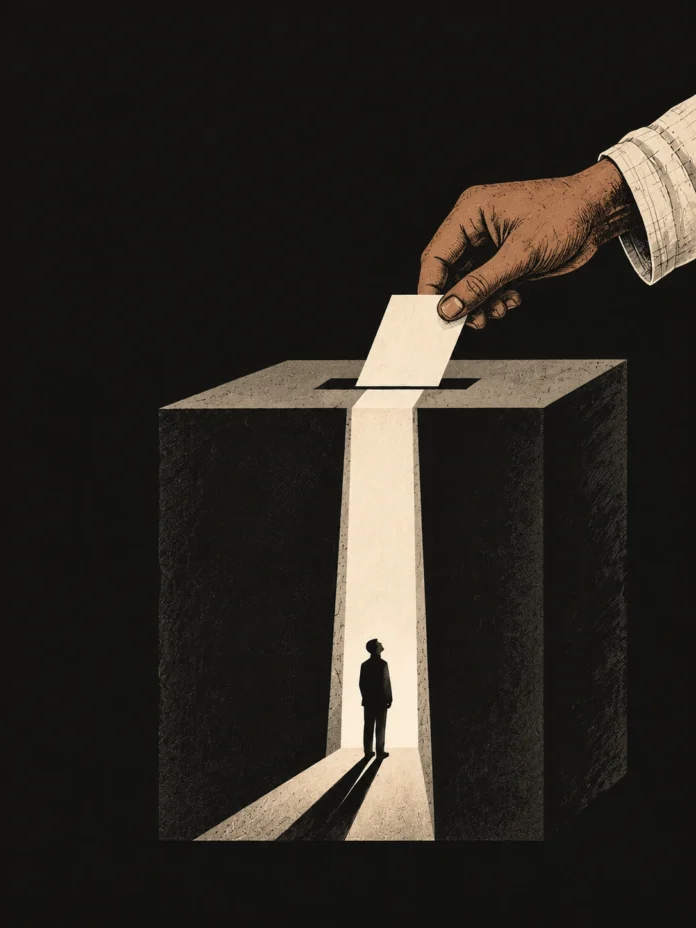
The bigger limit on the Indian voter is not whether his name is on the roll but how little his vote can say once he casts it. Under first-past-the-post, a vote names one candidate. If that candidate loses, the vote counts for nothing in the House, and a divided majority can lose to a united minority. Other democracies let a vote say more: a second choice, a ranking, a party as well as a person. India could adopt some of these by amending an ordinary law; others would need a constitutional amendment. The survey below shows which is which.
INDIA FOLLOWS what is known as the ‘first-past-the-post’ (FPTP) system in both Lok Sabha and Vidhan Sabha elections. A voter presses one of several buttons on the EVM in their polling booth. Each button carries the symbol of a candidate, who may belong to a party or contest as an independent. Whichever candidate polls the most votes wins the constituency, regardless of vote share and regardless of the margin over the runner-up. (If two candidates tie for first place, the winner is decided by drawing lots.)
In psephology, votes cast for anyone other than the winner are called ‘wasted votes’, and under FPTP there are a great many of them. In the 2024 Lok Sabha election, more than 64 crore votes were cast, and the winners took on average only 50.58% of the votes in their constituencies, according to the Association for Democratic Reforms. Roughly half the votes cast, in other words, elected no one. As far as constituting the House goes, then, a single vote does not count for much. The results do send other signals: the runner-up learns how far behind they are. But a third candidate is rarely in the running, because voters don’t want to ‘waste’ their vote.
NOW SUPPOSE three candidates, A, B and C, contest an FPTP election. A and B propose much the same policies; C proposes the opposite. About 60% of the constituency prefers what A and B are offering. C takes the other 40%. A and B split the 60% between them; perhaps A’s personal popularity carries him to 35%, leaving B with 25%. C wins. A and B have split each other’s votes, or, since A did better, B has split A’s.
Vote-splitting punishes candidates whose proposals resemble another’s. FPTP therefore rewards differentiating oneself as sharply as possible from rivals. This can be called polarisation, and it raises the voter’s risk. Take a voter who prefers B but knows that A belongs to a more established party. He may still vote for A, because the alternative to pushing A past the post is C winning on policies opposite to his own. Nor can he choose a party while rejecting its candidate for his constituency.
IN ARGENTINA, some provinces have used a ‘double simultaneous vote’ (party plus candidate), known as the Ley de Lemas, for single-winner posts such as governor. Santa Cruz, its best-known user, abolished it in 2024 after 36 years, and Uruguay elected its presidents this way until a 1996 constitutional reform limited each party to a single presidential candidate. A party may field more than one candidate for a single seat. The party with the most votes wins the seat, and within that party the highest-scoring candidate takes it.
Suppose parties P and Q field three candidates each. P’s A, B and C poll 8,000, 3,000 and 6,000 votes; Q’s D, E and F poll 4,000, 9,000 and 2,000. P’s total is 17,000 and Q’s 15,000, so the seat goes to P, and to A, P’s highest scorer. E polled more votes than A but does not win, because Q’s other candidates polled too few.
The system puts independents, who can field only one candidate (themselves), and smaller parties at a slight disadvantage. But Indian elections already see a cruder version of the multi-candidate trick. In Mahasamund in 2014, ten independents named Chandu Lal Sahu contested against the BJP’s Chandu Lal Sahu; the BJP blamed his Congress rival, Ajit Jogi.
IN FRANCE, a presidential candidate must win more than 50% of the vote. If no one does, the top two meet in a second round. Elections to the National Assembly are also held in two rounds. Any candidate backed by 12.5% of registered voters goes through, so the second round is usually a two-way contest but can be a three-way one: after the first round in 2024, 306 constituencies were headed for three-way contests, and withdrawals brought that down to 89. The first round lets voters vote sincerely rather than strategically, which sometimes gives a newcomer a better chance. Emmanuel Macron won the presidency in 2017 with a movement founded only the year before.
AUSTRALIA used FPTP for its House of Representatives until 1918. It still has single-member constituencies, in which each party fields at most one candidate and independents can contest too. But instead of choosing one favourite, the voter ranks the candidates in order of preference. This is known as ‘instant run-off voting’ (IRV). Our own presidential election works on the same principle.
A candidate with more than 50% of first preferences wins at once. If no one has that many, the candidate with the fewest first preferences is eliminated, and each of his ballots goes to its next choice. If there is still no majority, the next-lowest is eliminated and his ballots are passed on, each to its next choice still in the race. This continues until someone crosses 50%.
IRV removes the need for strategic voting. A voter can give his first preference to a promising newcomer and his second to his favourite among the established candidates, without risking a split vote. In the A-B-C example above, if B’s voters ranked A second, A would win with 60%.
IRELAND LETS voters say more still. Its constituencies elect between three and five members each, and voters rank as many candidates as they like, from across parties. Winners are chosen by the single transferable vote (STV), the system used in our Rajya Sabha elections, in which members of the Vidhan Sabhas are the voters.
In a four-member constituency, any candidate with more than 20% of first preferences (100 divided by four plus one) is elected. A winner’s votes beyond that quota are ‘transferred’ (hence the name) to the other candidates, in proportion to the second preferences on his ballots. Suppose there are exactly one lakh voters. Candidate A gets 30,000 first preferences; on those ballots, 12,000 name B second, 10,500 name C, 4,500 name D and 3,000 name E. These are 40%, 35%, 15% and 10% of A’s ballots. A needed only 20,000, so his surplus of 10,000 is shared out in the same proportion: 4,000 to B, 3,500 to C, 1,500 to D and 1,000 to E. If E had 19,500 first preferences, the transfer takes him past the quota, and he is elected too.
When no remaining candidate reaches the quota, the lowest-placed is eliminated, as in IRV, and his ballots pass on in full; only a winner’s surplus needs the proportional calculation. Because candidates can come from any party, the system can elect very popular candidates even from less popular parties.
FIRST-PAST-THE-POST inflates whoever is ahead. In 1984, the Congress won 404 of the 514 seats then contested, more than three-quarters, on 49.10% of the vote. Small parties lose out: in 2014, the Aam Aadmi Party won 2.05% of the vote and four seats, when its proportional share would have been 11. Proportional representation (PR) wastes few votes, apart from those lost to thresholds, the minimum vote share a party needs to win any seats at all. If the 2014 Lok Sabha had been proportional, AAP would have needed to send seven more members. How would they be chosen? Usually from a party list.
IN GERMANY, each voter casts two votes: one for a constituency candidate and one for a party, which need not be the candidate’s party. Parties submit ranked lists before the election. The party vote decides each party’s share of seats, and candidates from its list fill the seats its constituency winners leave over, starting from the top. Until 2023, a party that won more constituencies than its party vote entitled it to kept the extra ‘overhang’ seats, and other parties got compensating seats, which swelled the Bundestag. Since a 2023 reform, the surplus constituency winners with the lowest shares of the vote in their constituencies are not seated. The two votes come in handy: a voter in Tamil Nadu could back the local AIADMK candidate and give his party vote to the BJP.
Japan runs a ‘parallel’ system. Most members of its lower house are elected in Indian-style single-member constituencies; the rest come from eleven regional multi-member blocks, in which voters vote for a party. The two tiers are counted separately, and the party’s list, submitted to the election commission before polling, alone decides which of its candidates fill its block seats.
PR CAN ALSO give voters a say over candidates. Such systems usually avoid nationwide constituencies, to keep the ballot manageable, and keep proportionality within each district. Brazil uses its states as multi-member districts: São Paulo elects 70 deputies and had 1,540 candidates in 2022. (As an aside, 1,033 candidates contested the single-member Modakurichi seat in Tamil Nadu in 1996.) Sri Lanka has 22 multi-member districts, the largest electing about 19 members. In Brazil, a voter casts a single vote, for either a candidate or just a party; in Sri Lanka, he votes for a party and may mark preferences for up to three of its candidates. Each party’s seats in a district follow its vote share there: in a ten-member district, a party with 40% of the vote wins four seats, and they go to the four of its candidates with the most personal votes.
| Voting system | Granularity of vote | Risk handling / ‘plan B’ | Vote wastage |
| FPTP | Minimal | No | High |
| Ley de Lemas | Low-medium | Limited (inside party) | Medium |
| France (two rounds) | Low | Partial | Medium |
| IRV (Australia) | Good | Strong | Low |
| STV (Ireland) | High | Strong | Low |
| Closed list (Germany / Japan) | Medium | Medium | Low |
| Open list (Brazil / Sri Lanka) | Medium-high | Medium | Low |
THE IDEA THAT India’s voting system could be redesigned is not new. In its 170th Report (1999), the Law Commission of India examined the distortions of pure FPTP: the large number of wasted votes and the mismatch between vote share and seats. Its main structural proposal was to keep the existing single-member seats and add 25% more seats (136 in the Lok Sabha) filled by proportional representation from party lists, not unlike Japan’s parallel system. A party polling less than 5% of the valid votes in the country would get no seats at all. It also proposed that a candidate be declared elected only on winning 50% of the votes plus one, with a run-off between the top two if no one did, as in French presidential elections, and asked the government to examine whether that was practicable. More than twenty-five years later, none of this has been implemented, though the Law Commission’s 255th Report (2015) asked the government to examine it again.
It is usually assumed that changing the voting system would need a constitutional amendment. But how much of our electoral system does the Constitution actually dictate?
Article 81 sets out the composition of the Lok Sabha, and Article 170 that of the Vidhan Sabhas. Article 81 allots seats to each State in proportion to its population (except for States with under six million people). Both require members to be chosen ‘by direct election from territorial constituencies’, and both require the ratio between a constituency’s population and the number of seats allotted to it to be, so far as practicable, the same throughout the State. Note that wording: the Constitution does not say each constituency must elect one member. In the 1952 and 1957 elections, India had multi-member constituencies (in 1952, 86 two-member Lok Sabha seats and one three-member seat), in which one member was general and the others reserved, until the Two-Member Constituencies (Abolition) Act, 1961 made every constituency single-member.
The laws that actually govern elections, the Representation of the People Acts of 1950 and 1951 and the Delimitation Act, are ordinary laws, which Parliament can change by a simple majority.
That allows a rough sorting of the options above into three groups. The first needs only modest changes to the RPA and the election rules: the French two-round system, Australian IRV and the Ley de Lemas, all of which work inside today’s single-member seats.
The second covers systems that need multi-member constituencies, provided each constituency lies wholly within one State. That would mean substantial changes to the RPA, but no constitutional amendment, since a constituency inside a State is still a territorial one and the Constitution already allows a constituency more than one seat, though the claim would almost certainly be tested in court. The Irish, Brazilian and Sri Lankan systems fall in this group. Reserved seats are hard to fit into multi-member constituencies, though: in 1957, V V Giri lost the two-member Parvathipuram seat despite outpolling his general-seat rival, because two reserved-category candidates polled more than him and both were declared elected.
Closed lists, in which voters choose a party and the party chooses the member, raise a further question. The Constitution requires ‘direct’ election, and a closed list could be challenged on that ground. Spain and Portugal, though, both require direct election in their constitutions and still elect their parliaments from closed lists.
The third group needs a constitutional amendment: any system whose seats cross State boundaries. That includes the Law Commission’s own proposal: national list seats would cut across the State-wise allocation in Article 81, and 136 extra seats would breach the Lok Sabha’s present ceiling of 550 elected members, which the 131st Amendment Bill proposed to raise. Of the list systems described above, Japan’s regional blocks could be drawn within Indian States, though Japan is a unitary country and its parallel tier would need seats of its own. Germany works out each party’s share of seats nationally before filling them from State lists, which would cut across the State-wise allocation just as the Law Commission’s proposal does.
Of the options that need only changes to ordinary law, the Ley de Lemas would put independents at a slight disadvantage; then again, independents have all but disappeared from our Vidhan Sabhas and the Lok Sabha anyway. The French two-round system would cost more, though if ‘One Nation, One Election’ comes about, a single second round could serve every election at once.
The obvious objection to IRV and STV is the EVM itself, which has become an inseparable part of the Indian voter’s experience. India’s EVMs record a single button press and cannot record a ranking, which is why Rajya Sabha and presidential elections, both decided on preferences, are still held on paper. Ranked voting for the Lok Sabha would need either a redesigned EVM that lets a voter mark first, second and third choices, with a VVPAT slip showing him the ranking he cast, or a return to paper ballots. Counting would change too: transfers cannot begin until every ballot in a constituency is in, so results would take longer. The two-round system and the Ley de Lemas avoid the problem, since each needs only one press per round.
None of this would settle the quarrel over the rolls. A voter whose name has been struck off has a grievance under any system. But a voter whose name is safely on the roll still casts a vote that can say only one thing, and for a large share of voters it elects no one. For the simplest fixes, no new constitution is needed, only an amendment to the RPA. The harder question comes after the vote, when the member it elected reaches the House. How far he may vote his own mind there is decided by the Tenth Schedule, the subject of the next part.