

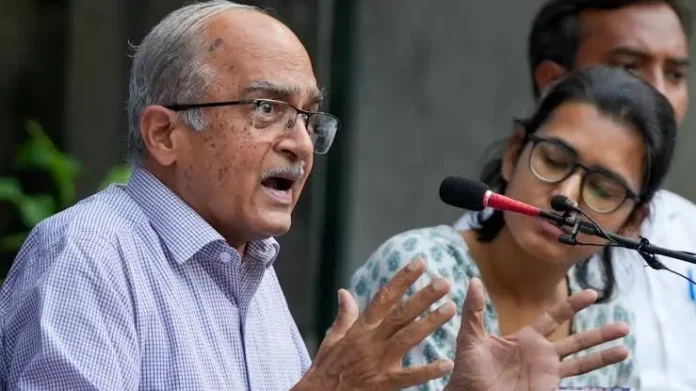
PRASHANT BHUSHAN leaned towards the microphone at the Press Club of India on 15 October. Around him sat Abhijeet Dipke of the Cockroach Janta Party, AISA president Neha Bora, the actor Prakash Raj and the Rajya Sabha MP Kapil Sibal. “The government alleges the opposition wants a regime change,” the senior advocate said, and then, a few sentences later: “Yes, we all want regime change.” Spreading disaffection against a government, he added, is no crime.
The demands printed for that press conference were more modest: the resignation of Chief Election Commissioner Gyanesh Kumar, the release of detained protesters, an end to police action, and Jantar Mantar restored as a protest site. The distance between the demand on paper and the demand at the microphone is the story of the vote chori campaign. Each time its evidence has failed, it has aimed at something larger: first the voting machines, then the count, then the voter rolls, then the referee. At the Press Club, one of its loudest voices named the last target himself.
THE CAMPAIGN’S current number is 13 crore: the Indians the opposition says the BJP government has stripped of the vote. It has travelled as far as Washington, where on 14 October the US Congresswoman Pramila Jayapal said she was “deeply concerned” about the Indian government’s move “to purge 130 million people from the voting rolls“.
The number comes from the Election Commission itself. Under the Special Intensive Revision, or SIR, the Commission has been checking India’s voter lists door to door, in three phases since June 2025. It reviewed 95.40 crore names, and at the draft stage marked 13.39 crore as Absent, Shifted, Dead or Duplicate, or put them in an “other” category. Of those, 6.30 crore had permanently shifted, 3.01 crore were absent or untraceable, 2.80 crore were dead and 1.02 crore were registered more than once. Nearly half had moved; one in five had died; a crore were listed twice.
Removing the name of a dead man, a name entered twice, or the name of someone who left for Pune a decade ago is housekeeping, not theft.
The Commission’s position is that 13 crore is a draft-stage count, not a tally of final deletions. It says more than 10 lakh booth-level officers checked the lists, which were then shared booth by booth with over 22 lakh agents of political parties, and that voters had a month to claim their way back on. By early October, with the figure being quoted everywhere as 13 crore stolen votes, the Commission put out an FAQ calling the claim misleading.
The critics do have one strong point. As ThePrint has reported, all eight earlier intensive revisions added voters to the rolls; this is the first to shrink them. The explanation lies in 2004.
AFTER INDIA’S last nationwide intensive revision in 2004, the voter roll held 2.8 crore more names than there were adults in the country: 4.4% too many. Ten years later it was still about 3.1% too many, by the economist Surjit Bhalla’s count. Picture a village of 1,000 adults with 1,044 names on its voter list. Forty-four of those voters cannot exist. That was India in 2004, at national scale, and nobody accused the Election Commission of doctoring the rolls then.
West Bengal shows what a roll looks like after two decades without proper scrutiny. When the Commission cross-checked it against the 2002 list in December 2025, it found about 85 lakh voters, roughly one in nine, whose father’s name was wrong or didn’t match; about 13.5 lakh whose father and mother had the same name; nearly 12 lakh whose father was, on paper, less than 15 years older than them; and 3.45 lakh who had become grandparents before 40. One man in Barabani was recorded as the father of 389 voters, another in Sankrail as the father of 310.
These are not 85 lakh fake voters. Officials have said some of the links came from automated matching that grouped similar names into one family, and the Supreme Court made the Commission publish the 1.25 crore flagged names so that each person could be heard. They are 85 lakh records that nobody had checked. That is the case for an audit, not against one.
How many eligible voters actually lost their vote? Bhalla, a former member of the Prime Minister’s Economic Advisory Council, has tried to count. In the states where the SIR is final, he estimates that about 70 lakh eligible voters were removed without adequate explanation. That is a real problem for each of them, and most appeals decided so far have found the voter eligible; those names should go back on the roll, and quickly. But by Bhalla’s reckoning seven of every eight removals were justified, and the unexplained ones amount to fewer than one in every 100 adults, not the one in seven the headlines imply.
Seventy lakh is no mouse. But it is not thirteen crore. Why, then, does the charge persist? Because 13 crore is not a new accusation, only the latest version of an old one.
THE MACHINES came first. After the BJP won Uttar Pradesh in 2017, opposition parties including the Congress, the BSP and AAP blamed electronic voting machines. That June the Election Commission held an open challenge and invited every national and state party to tamper with them. Only the NCP and the CPI(M) signed up, and on the day neither tried; both said they only wanted to understand how the machines worked. The demand moved to counting VVPAT paper slips, and by 2019 to bringing back ballot papers.
Then the count. In the 2024 Lok Sabha election, critics noted that the final turnout, released days after each phase, was 5 to 6 percentage points higher than the polling-evening estimate, and alleged that votes had been added in the gap. The Commission’s answer, given to the Supreme Court, was that the turnout figures it publishes during polling are provisional; the legal record is Form 17C, completed at each polling station when voting ends, signed by the presiding officer and handed to every candidate’s agent. Remote booths, late closings and patchy networks delay the final figure. They do not change the votes in the machine, and any candidate holding a Form 17C copy could show a booth where the numbers fail to match.
Then the rolls. After losing Maharashtra and Haryana in 2024, the opposition said its voters had been struck off, and Rahul Gandhi began presenting constituency case files: an “atom bomb” in August 2025, a “hydrogen bomb” in November.
In Mahadevapura, an assembly segment of Bengaluru Central, he alleged 1,00,250 stolen votes. His most striking exhibit was House No. 35 in Muni Reddy Garden, one small room with 80 registered voters. Reporters found a delivery worker from Bengal living there with his family. The landlord, Jayaram Reddy, told ThePrint that most of those registered there had moved out around the Covid lockdown. The exhibit showed exactly what the SIR exists to clean up: names of people who no longer live where the roll says they do.
On 5 November came the “H Files” on Haryana: 25 lakh fake entries, Gandhi said, among them a Brazilian model’s photograph used 22 times across 10 booths in Rai under names such as Sweety, Seema and Saraswati. He also mocked the Commission’s explanation of “house number zero”. The Commission replied that the number is used where panchayats and municipalities have not assigned one, which describes much of rural India, where a home is “the house with the neem tree behind the temple”. It added that there had been zero appeals against Haryana’s rolls while they were open for objections, and that the evidence belonged in the election petitions pending in the High Court. A photograph used 22 times is a real error. It is also precisely the kind of duplicate a revision removes.
EVERY CHARGE needs an expert, and this one found Sabyasachi Das, then an assistant professor of economics at Ashoka University. In July 2023 he posted a working paper, “Democratic Backsliding in the World’s Largest Democracy“, on SSRN, a site for unpublished research. It had not been peer-reviewed.
Das examined the 2019 Lok Sabha seats decided by the narrowest margins and found the BJP won far more of them than it lost, especially in states it governed. Think of an exam with a pass mark of 33: students scoring 32 and 33 should be much alike, so if one school’s students keep landing on 33 and never on 32, something is going on at that school. Das weighed two explanations, manipulation or a party organised enough to predict tight races and pour workers into them, and argued the data leaned towards manipulation. His own estimate of the effect was about 11 seats, somewhere between 9 and 18, too few to change who formed the government.
The paper, then, describes a statistical pattern, in one election, across about eleven seats, seven years ago. It offers no witness, no audit and no tampered machine, and it says nothing about the 2025–26 SIR. Yet a probability about a dozen seats in 2019 now serves as the academic backdrop to a 13 crore charge it never examined.
WHEN THE evidence does not hold, the next target is the referee. The protests now demand Gyanesh Kumar’s resignation. If his independence is in question, the record of those who held the job before him is fair game.
T. N. Seshan became Cabinet Secretary under Rajiv Gandhi in 1989 before he was made CEC; in 1999, retired, he contested Gandhinagar against L. K. Advani as the Congress candidate. M. S. Gill was CEC until 2001; in 2004 he entered the Rajya Sabha from Punjab as a Congress member, was re-elected in 2010, and became a minister under Manmohan Singh. Navin Chawla’s conduct during the Emergency was severely criticised by the Shah Commission. The UPA made him an Election Commissioner in 2005. In January 2009 the sitting CEC, N. Gopalaswami, sent the President a 93-page recommendation for his removal, reportedly listing about a dozen instances of partisan conduct in the Congress’s favour, including leaking the Commission’s internal discussions. The UPA government rejected it, and Chawla became CEC that April and ran the general election.
None of this places Gyanesh Kumar beyond question. It shows that the party now calling the Commission compromised once defended a commissioner whom his own CEC had accused of partisanship, and did not think the question mattered then.
WHEN THE referee holds, the campaign looks for an audience abroad. Jayapal’s full post read: “I am deeply concerned about the actions of the Indian government to purge 130 million people from the voting rolls. This appears to be a similar playbook to what the Trump Administration is doing here at home to undermine voting rights in a democracy.” She added that she stood with Indians holding non-violent protests. India’s foreign ministry called the remarks unwarranted and uninformed.
Her verb was “purge”. Not drafted, not flagged: purged. In the words of a sitting US lawmaker, a draft-stage count had become a final and deliberate act, and nobody along the way had checked.
The same week, Neha Bora had sent a video message to the sixth national conference of Bangladesh’s Socialist Students’ Front. “The Gen Z movement we are seeing everywhere in this country first started in Bangladesh,” she said, “and congratulations to you for showing us the way.” Her defenders say she was praising a movement for democratic and voting rights, and against religious fundamentalism, rather than calling for violence.
Take her at her word. The movement she congratulated ended in August 2024 with an elected prime minister fleeing the country and an unelected interim government taking her place. It did not change a government at an election. It removed one outside it. That is what she held up as the way.
WHICH BRINGS us back to Bhushan. He began with a condition. The protest, he said, was for properly conducted elections, but “if this kind of brutality continues, there will certainly be regime change”. By the end of his answer the condition had gone: “That is why this is now really a fight for regime change against a dictatorial government.” His defence was a question: “What is wrong with that?” Wanting a government out, he said, is every citizen’s democratic right.
He is right about the right and wrong about the word.
Political scientists use “regime change” for removing or replacing a country’s ruling order outside its constitutional process: by foreign intervention, a coup, covert operations or an uprising in the streets. The Arab Spring was one; Bangladesh in 2024 was another. When voters remove a ruling party at a scheduled election, that is a change of government. Indians are offered one every five years, at the press of a button.
Bhushan chooses words for a living. He chose this one at a press conference whose printed demand was a CEC’s resignation, beside a student leader who had just thanked Bangladesh for showing the way, and he paired it with “disaffection”, the very word of the old sedition law.
Machines, then the count, then the rolls, then the referee; and finally, at the microphone, the regime. The vote chori headlines said 13 crore. Where the SIR is final, the data shows about 70 lakh eligible voters removed without adequate explanation, a real failure the Commission should fix. And one of the protest’s leading voices has told the cameras which of the two things he wants. He did not say a change of government. He said regime change.