

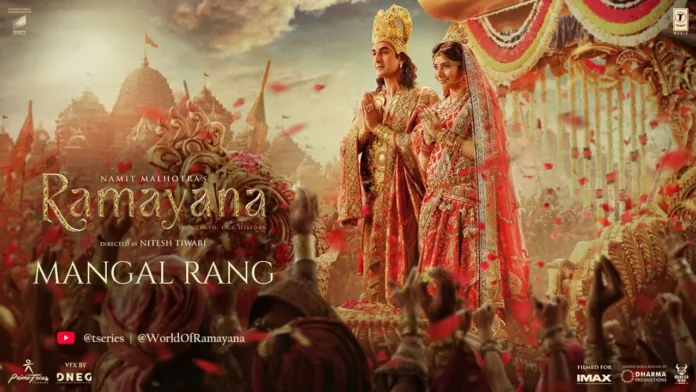
Mangal Rang was released on 25 October, eleven days before Nitesh Tiwari’s Ramayana reaches theatres. It celebrates the union of Bhagwan Ram and Devi Sita and her arrival in Ayodhya. Composed by A.R. Rahman, written by Kumar Vishwas, and sung by Arijit Singh and Shreya Ghoshal, the song quickly acquired a label among listeners on X: qawwali.
They heard rhythmic clapping, call-and-response intensity, and a soaring, almost ecstatic energy associated with a Sufi mehfil. They pointed to the chorus, a guitar line that recalls the bulbul tarang, and the title’s image of “rang.” Several compared it directly to Kun Faya Kun, which Rahman composed for Rockstar (2011). For many, the first reaction was not joy or simple admiration. It was a quiet, almost involuntary recognition that something familiar had been displaced.
The word alone proves nothing. Rang is at home in Braj, where Holi songs to Krishna are drenched in colour. What listeners objected to was the setting around the word: the chorus, the clap, the swelling build. That is the grammar of the mehfil. It is not the grammar of the mangal geet sung for generations at north Indian weddings.
In the Bhojpuri-speaking belt, mangal geet, also called vivah geet or biyah geet, are a living tradition. They are mostly women’s folk songs, sung in local dialect at each stage of a wedding, from haldi and the baraat to the kanyadaan and the pheras, usually to a dholak. Many of them place the family’s own wedding inside the Ramayana’s. Raja Dashrath becomes the ideal father-in-law, Kaushalya the ideal mother-in-law, and Devi Sita and Bhagwan Ram the perfect jodi. Their register is the household’s: a blessing sung by the women of the family, warm and auspicious. Mangal Rang reaches for something else, the rapture of the mehfil.
The film itself has already shown it knows the difference. On 14 September, Ganesh Chaturthi, its makers released Jai Jai Ram: same composer, same lyricist, same two singers. It was built like an aarti. Rahman said he wanted to keep the purity and intimacy of a prayer while letting it grow into a film song. The film has demonstrated that it can score devotion in the idiom devotees recognise. For the wedding sequence, it chose a different one. That is a choice, and choices can be judged. This is not an objection to the composer’s faith: the same man composed both tracks. The question is one of idiom, not identity.
Vishwas’s only response so far has not addressed that question. He expressed gratitude for the words he had used, a defence of craft and good faith, which no one has seriously questioned. He has also said the song will be played at weddings. If it is, it will teach families how Bhagwan Ram and Devi Sita’s wedding should sound.
Music is never background. It is an emotional instruction manual. A wedding scene scored in one tradition carries a different moral and emotional weight from the same scene scored in another. When the music evokes associations far from the devotional memory in which the story has lived for generations, the film is not simply retelling. It is quietly reframing. The claim that “it is only a movie” does not dissolve that effect. It merely declines responsibility for it.
Cultural exchange and cultural substitution are not the same thing, though they are often confused. Indian musical and narrative traditions have borrowed, blended, and cross-pollinated for centuries. That history is real and should not be denied. The issue is not some imaginary purity. It is whether the experiment serves the gravity of the subject, or whether the subject is being asked to serve the experiment and the market.
The pattern is older than this film. Commercial cinema, the Hindi film industry in particular, has developed a distinctive confidence with Hindu epic material. The names remain. The outline of the plot remains, and so do the costumes and the iconography. What is freely redesigned is the interpretive atmosphere: the music, the emotional grammar, the sense of occasion, the way the audience is told to feel.
Adipurush is the nearest precedent. Released in June 2023, it gave Hanuman lines in pedestrian, colloquial Hindi, and its makers removed them only after the film was in theatres. Hearing petitions against the film later that month, the Allahabad High Court asked whether the censor board had done its job; in July, the Supreme Court stayed the proceedings pending against it in the high courts.
Satires such as OMG – Oh My God! and PK are a different matter: they announced that they were questioning faith, and could be argued with on those terms. Reverent epics are harder to argue with, because they claim devotion while changing its register. Either way, the defence is almost always identical. Cinema is art. Art requires freedom. Audiences must evolve.
The filmmaker’s imagination is entitled to unlimited experiment; the devotee’s unease must first pass an examination in progressive tolerance.
Hindu practice is open and decentralised. It has no single authority to object on its behalf, so the objection falls to the ordinary listener, who is then told he is fragile. If the Ramayana, its gods and its rituals are merely content, no one should be surprised when people who still hold them as more than content object to the terms of their packaging. If they remain culturally charged, those who adapt them inherit a responsibility, whether they acknowledge it or not.