

A Tamil television channel, Vasanth TV, frequently plays its signature song, ‘Engal Desam India!’ (‘Our country, India!’). One of its lines runs:
மேற்கு நாடு வேட்டையாட கல் எடுத்த காலையில் – கல்குடைந்து சிலை வடித்த கலையின் தேசம் இந்தியா
‘Merku naadu vettaiyaada kal edutha kaalaiyil, kal kudaindhu silai vadittha kalaiyin Desam India.’
When the West picked up stone to hunt with, it says, India, the land of art, was sculpting stone into statues.
Bollywood knows the image too. In ‘Hai Preet Jahan Ki Reet Sada’ from Purab Aur Pachhim (1970): ‘Jab zero diya mere Bharat ne… duniya ko tab ginti aayi’, only when Bharat gave the world zero did the world learn to count.
Which age are these songs talking about? Not the European Middle Ages. Those were hard times, but they were not a stone age: medieval society was feudal, agricultural and settled, and its ploughs, weapons and armour were made of iron. Nor antiquity, when Greece and Rome had cities, literature, drama, music and dance, sculpture and architecture.
One reason such primitivity gets pinned on early Europe may be that it makes it easier to brush aside what happened as Christianity spread, events Catherine Nixey details in The Darkening Age. If Europe had little to lose, its losses can be understated.
That is why the myth matters to us. Pre-Christian Europe and the pre-Columbian Americas were advanced societies, and Christianity (prophetic monotheism in general) reshaped them beyond recognition. The same force threatens our civilisation.
Consider what these societies knew. Many of us know that the Church tried Galileo Galilei for championing the heliocentric model. But how many know that Aristarchus of Samos proposed a heliocentric model in the 3rd century BCE, some 1,800 years before Copernicus?
Or take Eratosthenes, who around 240 BCE estimated the circumference of the Earth from the angle of the noon sun at Alexandria and the distance to Syene, and came remarkably close to the modern value. This was centuries before Christianity.
Nor was this confined to Europe. In Mesoamerica, maize was being cooked with alkali, a process known as nixtamalisation, by around 1500 BCE. It releases niacin (vitamin B3) and so prevents deficiency diseases such as pellagra. When maize later spread across the world, the process was largely left behind, and populations that came to rely on untreated maize paid for it with pellagra epidemics, from southern Europe to the American South.
Then came the destruction. On 12 July 1562, the Franciscan friar Diego de Landa ordered the burning of Maya codices and cult images at Maní in Yucatán. By his own count, 27 books went into the fire. Of a literature that recorded Maya astronomy, history and ritual, only three codices and fragments of a fourth survive. The destruction was deliberate and irretrievable. We do not even know what was lost.
Europe’s losses were just as deliberate. Catherine Nixey’s The Darkening Age records the systematic dismantling. In 391–392 CE the great Serapeum of Alexandria was torn down by a Christian mob roused by Theophilus, bishop of Alexandria, after the emperor Theodosius had outlawed pagan worship. The Serapeum was a temple that had housed the ‘daughter’ of the great Library of Alexandria, one of the last repositories of classical learning. Its cult statue was hacked apart and burnt.
In 415 CE, the philosopher and mathematician Hypatia was murdered by a Christian mob, again in Alexandria. Nixey reads her death as a public warning that open pagan scholarship would no longer be tolerated.
Imperial legislation accelerated the process. Theodosius’s laws of the 390s criminalised sacrifice and ordered the closure of temples across the empire. Pagan festivals were banned, priesthoods dissolved, and the revenues of the old cults redirected. In 529 Justinian closed the Academy in Athens, the last institutional centre of classical philosophy, and forbade pagans from teaching.
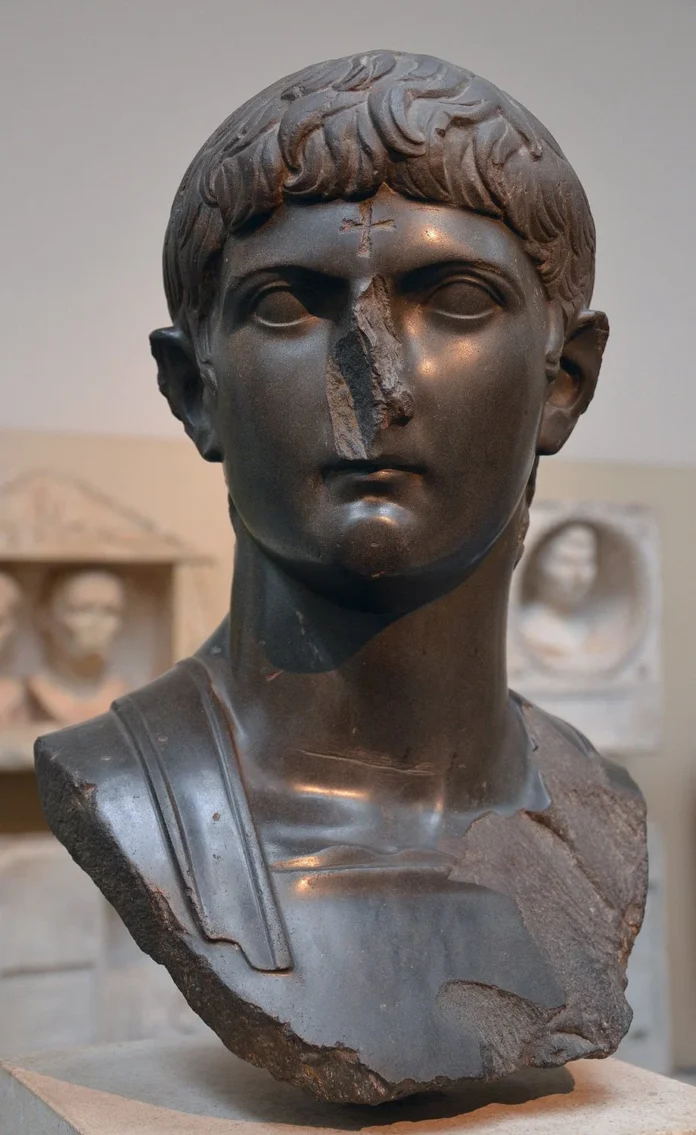
The most visible destruction was of the statues themselves. Across the Mediterranean, marble gods and goddesses that had stood for centuries were beheaded, defaced or toppled. Eyes were gouged out, noses smashed, limbs broken. What a civilisation had once carved with care was now systematically mutilated so that the old gods could no longer “see” or “speak.”
The same stone that, in the Tamil song, India was sculpting into art was, in Christian Europe, being reduced to rubble.
The survival of Bharatiya civilization all these centuries is often credited to some intrinsic greatness or robustness, a greatness sometimes said to differ in kind from that of other pre-Christian civilisations. This breeds overconfidence, even a sense of invulnerability.
Christianity began without a state, but by the time it converted Europe it had captured the Roman Empire. Today it is the world’s largest religion, with many sovereign nations and multinational corporations at its back.
Nor is Bharat immune to such losses. Take wootz steel. Once produced across southern India and traded as far as Persia and the Mediterranean, it was renowned for blades of exceptional hardness and edge. Its end came under colonial rule. After the 1857 uprising the British disarmed India, through the Arms Acts of 1857, 1860 and 1878 and the destruction of large numbers of Indian-made swords and weapons. By the later nineteenth century the practical knowledge of making true wootz had effectively disappeared. For generations the surviving blades could be admired, but the process itself could no longer be reproduced.
Unlike Europe or the Americas, Bharat had had substantial experience with Islam before major contact with Christianity. This “reverse order” of contact with sects of prophetic monotheism is almost unique. Islam came as open conquest, and centuries of it taught Hindu society to recognise the threat and resist it. Christianity, particularly Protestantism, exerts its influence in strategic manoeuvres that bypass mechanisms that trigger resistance. A shift is made to look like a political or economic (“market”) shift while the significant social and theological impacts manifest later. This makes “conversion” seem like a mere “adaptation” to an evolving economic scenario. Since adaptation to deśa and kāla is itself a recognised feature of Dharmic tradition, resistance to a craftily designed shift can become limp. Monogamy was one ideal among several in Hindu tradition; the Hindu Marriage Act of 1955 made it the law for Hindus, while Muslim personal law in most of India still permits more than one wife. Today many Hindus treat monogamy as a sacred norm. Economics has also played a part in normalising small, nuclear families.
A note on language, too. We routinely use terms with a geographical origin, such as ‘Europe’, ‘the West’ or ‘Eurocentric’, as if they named one civilisation stretching unbroken from classical antiquity to the present. But pre-Christian Europe and the pre-Columbian Americas were markedly different societies from the world that emerged after prophetic monotheism spread. Using these labels as though nothing broke is an imprecise euphemism, one that softens the scale of the rupture.
Only when we admit that prophetic monotheism fundamentally reshaped societies as advanced as ancient Bharat will we realise how severe the dangers around us are.