

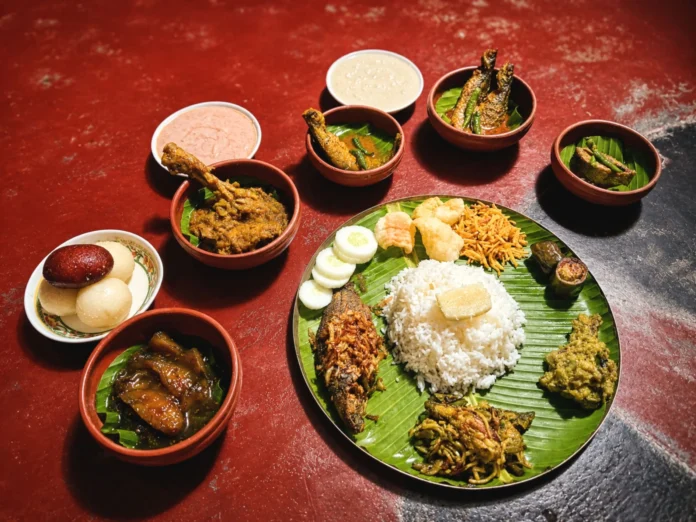
Every Navratri, someone says it again: meat must not be eaten while the Devi is worshipped. It is said from katha stages, on television panels and in WhatsApp forwards, and it lands hardest on Bengal, where Durga Puja and a plate of mangsho arrive together. For a household that keeps a sattvik fortnight, abstinence is a discipline worth keeping. The trouble begins when a practice woven into one region’s worship is told, by many voices at once, that it must stop. That is no longer a question of diet. It is a step away from the diversity that is Hinduism’s own nature.
Bengal’s usual reply makes a mistake of its own. Kolkata eats kosha mangsho with luchi and goat on Navami while the rest of Hindu India fasts, the line goes, as if a Bengali plate were a rebellion against a national rule. It is a good line for a dinner table and a bad line for a civilisation.
There is no single, binding Hindu dietary rule for every sect, shrine and household. Behind the quarrel lies an older trick: take one tradition, select the practices that look respectable to outsiders, push the rest into the shadows, and announce that the edited version is the only authentic one.
Did outsiders teach us that? In part. Missionaries portrayed sacrificial worship as backwardness, and the Orientalist picture of the Hindu as inherently non-violent and vegetarian is a portrait drawn by colonial observers, not a description of what Bengal ate. Macaulay’s 1835 Minute ranked European learning above Indian, and the habit of ranking outlived the empire. No one today needs to have read Macaulay for it to survive. A hierarchy can outlive its authors.
The Devi’s own temples settle the question before any text is opened. At Kamakhya, goats, pigeons, ducks and buffaloes are offered; a priest said at least twelve to fourteen buffaloes are sacrificed at Durga Puja, and the temple’s Bar Doloi called sacrifice part of the daily worship. The buffalo is the demon’s own animal; its meat is not cow beef. The cow is not offered, and the tradition draws that line itself. Kamakhya also serves a non-vegetarian bhog alongside the vegetarian one.
At Puri, one of the Char Dham, Jagannath’s kitchen is vegetarian, but his food is not complete until it is also offered to Vimala. Fish from the Markanda tank is cooked for her in a temporary kitchen and carried in before Jagannath wakes, though the goat is disputed. One sacred complex keeps two ritual obligations without making either the enemy of the other. A civilisation that could not tolerate this would have to abolish one kitchen to protect the other.
The Devi does not keep one kitchen either. Ambika, Chandi and Kali accept bali; Vaishno Devi refuses meat and liquor. In her legend, a tantric figure demands both at a feast and the Devi turns him away; pilgrims seek his blessing at a separate shrine. Each form keeps its own rule, and the devotee follows the form, not a national menu.
Vivekananda, in a conversation recorded in Volume 5 of his Complete Works, told a disciple to “eat large quantities of fish and meat”, adding that “all liking for fish and meat disappears when pure Sattva is highly developed”. Abstinence, in his telling, is the fruit of sadhana, not a rule to be imposed.
Durga Puja does not sit outside Navratri. Both belong to the same bright fortnight of Ashwin and culminate in Vijayadashami. Gujarat dances the garba and largely fasts, Bengal builds a pandal and brings the daughter home with her children, and Himachal takes a sheep at a hillside jatar: one calendar in many accents, not a Bengali secession from a northern original. Bengal also keeps spring Navratri as Basanti Puja, and in one Howrah household a lemon is sacrificed in the autumn rite and a watermelon in the spring one. The tithi is shared; the cooking is not. The Devi made the rivers and mountains, and each of her forms keeps its own kitchen.
The first confusion is between discipline and law. Flesh is tamasic, as any sadhak will say, and no form of Krishna accepts it; for those who worship him, that settles the plate. Sattvik food is a meaningful ritual and philosophical discipline. It is not synonymous with every Hindu’s diet. A household may keep it for life, and a temple may require it for offerings. The mistake begins when one community’s discipline becomes the test by which every other Hindu must prove authenticity.
Ayurveda points the same way. Charaka sorts food by quality, processing, combination, quantity, land, season, the rules of eating and the eater (Vimanasthana 1.21), and lists meat among the classes of food (Sutrasthana 27). Shuddha and ashuddha concern ritual fitness; pathya and apathya belong to Ayurveda; adhikara concerns the person’s fitness. There is no Hindu equivalent of haram, because that word requires a single lawgiver.
The law books also resist a universal commandment. Manusmriti 5.56 praises abstention for its greater fruit, yet says there is no fault in eating meat, drinking liquor or sex, for such is the natural bent of creatures. Many Kshatriya kulas, and many worshippers of the Devi, eat meat to this day.
Vaishnava vegetarianism has its own deep history, shaped by Agamic purity rules, geography, Ayurveda and ahimsa, which also shapes Jain and Buddhist eating. It is binding within its sampradaya. It is not the day all of Sanatana adopted one diet. Drift in one sampradaya does not repeal another’s shastra.
If eating meat in the Devi’s festival made a Hindu a hypocrite, the verdict would run far beyond Assam, Odisha and Bengal. In Kashmir, Pandits are traditionally non-vegetarian and cook fish and mutton rogan josh for Herath, the Shivaratri observance, though many families have moved towards sattvik practice. Himachal’s jatars give sheep and goat to Hadimba, Chamunda and Bhima Kali; the High Court banned the practice in temples in 2014, yet Kullu Dasehra won interim relief from the Supreme Court. In Rajasthan, an officer recalls a Rajput soldiers’ Navami where a goat was sacrificed and meat and rum were offered to Kali. In Kerala, Muthappan accepts fish, meat and toddy.
Kashmiri, Rajput, Assamese, Odia, Malabari, Bengali: each stands at its own goddess’s door. They are no deviation. They are the tradition’s range.
When the nation wanted a war-goddess, it did not ask her to be vegetarian. Vivekananda’s call to eat meat came partly from the struggle against the colonisers, and from the need for the Indian body to be strong enough to match them. The Anushilan Samiti drew on Anandamath and the Shakta worship of Chandi and Bhavani. Not every fighter was a Shakta, but in her fierce forms the Mother seeks sacrifice.
Bengal holds both orthodoxies. Some East Bengali families offer Lakshmi a pair of hilsa, while other households keep sattvik offerings. Keep three layers apart: the sanctum’s bhog, the household’s Navami goat and the street’s meat stall. Sarbojanin bhog is often niramish khichuri, and the home kitchen is another matter. If eating meat at Puja were uniquely Bengali defiance, there would be something to boast about, but the claim is flattering and false. The Bengali who claims ownership of it makes the abstainer’s mistake in reverse: both turn a shared inheritance into one region’s property, one for pride, the other for a ban.
Hindu life has never had a pope, a single canon of law or an office empowered to expel. It runs through kula, village, matha, akhara, temple committee and household, each with its own deity, custom and limits. Hindus hear everyone: gurus, kathavachaks, akharas, and the Shankaracharyas of the four mathas at Sringeri, Dwarka, Puri and Jyotirmath. Dwarka’s seat is even called the Kalika Math, a Shakta name for one of the most Vedantic institutions. Hearing all is an old Hindu habit. Obeying one voice is not.
No Vaishnava matha, Shaiva matha or Shankaracharya has walked into another region’s festival and declared its plate un-Hindu. A guru’s word binds those who took his mantra, not those who took another’s.
Ecology decides the plate before any television dharma does: fish for a delta goddess, goat at a hill jatar, meat in cold Kashmir. A faith with no centre cannot be decapitated: remove one matha and the others continue, ban one temple’s rite and the household keeps its own. Madhu Kishwar notes that with no single canon and no Hindu pope to legitimise a uniform code, the British had Warren Hastings hire eleven pandits in 1772 to produce one.
A monopoly works the other way: every difference becomes heresy, and whoever holds the centre holds the faith. At the extremes, some Sunni groups declare Shias non-Muslim, and Catholics and Protestants fought wars over the true Church. Hindu traditions have had their own rivalries and purity rules, but differences ran along regional and lineage lines, and no excommunicating body sat above them. Telling a region that its worship is not Hindu enough borrows that method.
Asking is not blasphemy. Gargi questions Yajnavalkya in open assembly, and the Nasadiya Sukta asks ko addha veda, who really knows. Tantra names the obstacle: ahamkara, the ego that mistakes itself for the measure of reality. Chhinnamasta holds her own severed head because the head that will not bow is the last obstacle. Kali is no imported horror in the Bengali imagination; she is Mother, time, death and protection.
Who, then, is a Hindu? India has never kept one central list for every sect, shrine and household. That absence frustrates those who want a clean boundary, but it lets many traditions live without a single institution controlling them. The Devi Mahatmya does not end with a male god defeating Mahishasura. The gods fail, their powers gather, and the Devi takes the field. The tradition that worships her cannot be reduced to one food rule. Leave the plate to the deity and the household. Leave diksha to the guru and the lineage that transmits it.
So keep your own kitchen. A Vaishnava who keeps a sattvik plate for life stands on legitimate ground, and no Bengali needs to persuade him to eat meat. But he gains no right to call another household’s offering impure. Nor does the Shakta gain a right to carry his plate into a Vaishnava’s temple. Support every tradition; mix none of them. Eat, as the prasad of a particular pitha, kula or household, not to win a television argument. A civilisation can contain a goat, a fish, a bowl of liquor, a pot of khichuri and a lifetime of sattvik discipline without demanding that one erase the others.
A civilisation that taught that truth is one, and the wise call it by many names, can ask the same of everyone who speaks for it: learn from the ancestors how to disagree about the plate without closing the door.