

IN THE SMALL HOURS of 27 March 1992, Sister Abhaya, a twenty-one-year-old pre-degree student, got up to study for her examinations at St Pius X Convent in Kottayam. At around four, according to the case the prosecution would eventually make, she went down to the kitchen for water from the refrigerator. By daybreak she was at the bottom of the convent well. In the kitchen, the prosecution said, lay her veil and one of her slippers; the refrigerator door stood open, and there was water on the floor. The local police, and then the Crime Branch, treated the death as a suicide. The file seemed headed for the shelf where unexplained deaths are quietly forgotten.
Her family never believed it. Nor did the handful of activists and journalists who began to look closely at the investigation. There were injuries on her body that suicide did not explain. Evidence was mishandled. Successive agencies reached contradictory conclusions. In January 1994, Varghese P. Thomas, a deputy superintendent with the Central Bureau of Investigation who had quit the agency the previous month with a decade of service left, said publicly that he had been pressured to record the death as a suicide.
The questions were simple, and for years no one in authority answered them. If Abhaya had taken her own life, how had she come by the injuries on her body? Why had evidence been overlooked or mishandled? Why did one agency after another reach a different conclusion? And why did the investigation, at stage after stage, seem more interested in closing the file than in finding out what had happened? Each year without answers deepened the suspicion that the official story was hiding something worse.
The case would haunt Kerala for nearly three decades. It passed from the local police to the Crime Branch to the CBI, which more than once asked the court to close it for want of evidence and was turned down each time. It was kept alive above all by Jomon Puthenpurackal, an activist who led the Sister Abhaya Action Council and refused, through every setback, to let it go. In 2008 the CBI finally arrested two priests, Father Thomas Kottoor and Father Jose Puthrikayil, and a nun, Sister Sephy.
The prosecution’s account, as finally argued in court, was this: Abhaya had walked into the kitchen and seen the two priests and Sephy in what the charge sheet called a compromising position. She was struck on the head, and her body was thrown into the well. One of its key witnesses was a petty thief, Adakka Raju, who had slipped into the convent compound that night to steal and saw the priests there. Over the years, by his widely reported account, he turned down both pressure and money to change his story. Puthrikayil was discharged in 2018 for lack of evidence.
In December 2020, twenty-eight years after Abhaya died, a special CBI court in Thiruvananthapuram rejected the suicide theory that had stood for almost three decades. It convicted Kottoor and Sephy of her murder and sentenced both to life imprisonment.
It was a vindication, and an incomplete one. Witnesses had grown old, evidence had been lost or compromised, investigators had come and gone. Abhaya’s brother told reporters the family had sensed from the very beginning that something was terribly wrong. They had lost a daughter and a sister, and with them their faith in the institutions that were supposed to find out what happened. Even the verdict did not hold for long. In June 2022, the Kerala High Court suspended both life sentences and released Kottoor and Sephy on bail pending the outcome of their appeals.
The case had taught Kerala something it would have to learn again: when allegations touch a powerful religious institution, accountability travels a very long road. It had also shown that the road could be travelled, by a family that would not accept the official story, an activist who would not give up, and a thief who would not be bought.
FOR YEARS, Abhaya’s death was treated as an aberration, a singular crime that had shaken Kerala’s conscience. It became harder to see it that way. Over the next two decades, women from different congregations, with no connection to one another, began to describe strikingly similar lives. They spoke of a hierarchy in which obedience was not merely a virtue but the organising principle of every day; in which assignments, travel, education and even friendships were decided from above; and in which complaints of harassment or abuse disappeared into internal channels where, they said, the institution’s reputation counted for more than the truth. Not every allegation has been tested in court. But the accounts kept echoing one another.
Kerala has long projected itself as a model of social progress. It has the country’s highest literacy rate, and every election season its politicians reach for the language of women’s empowerment. The women behind convent walls rarely figure in that story. They teach children, nurse the sick, care for orphans and the old, and are revered as emblems of sacrifice. Yet when some of them questioned authority, the consequences, by their own accounts, were severe: transfers, isolation, slander, the loss of their allowances, expulsion.
The silence is all the more striking for what it sits beside. Whenever an incident involving Christians occurs anywhere in India, sections of the political establishment, activist groups and the media are quick to present it as evidence of persecution: statements are issued, fact-finding teams dispatched, television debates organised. The prolonged anguish of nuns inside the Church’s own institutions has drawn nothing comparable. Their allegations rarely trigger televised debates; their suffering rarely inspires candlelight marches. And church leaders who speak readily, and with moral authority, about social justice and human rights, and who are often vocal about the failings of Hindu society, have shown far less urgency when the allegations come from within their own walls. Taken one by one, each case can be made to look like an isolated episode. Taken together, they form a pattern.
The first to set it all down, from deep inside, was a woman few could dismiss.
SISTER JESME left her convent in 2008, after thirty-three years of religious life. She carried no banners and organised no protest. She had belonged to the Congregation of the Mother of Carmel, one of Kerala’s most respected orders, and had been a teacher, a scholar and principal of St Mary’s College, Thrissur. The following year she published Amen: The Autobiography of a Nun. It became one of the most argued-over books in Kerala’s recent memory.
Her writing was measured rather than sensational, reflective rather than vindictive. Jesme insisted that she was writing against neither Christianity nor religious life, only against what the institution had made of its own ideals. The convent, she wrote, was not always the sanctuary that society imagined. Decisions about every part of a nun’s life, from her assignments and education to her personal choices, were made by a rigid hierarchy. Young nuns were expected to give up independent thought in the name of discipline. The vow of obedience, she argued, could become an instrument of psychological domination when it was exercised without accountability.
She described humiliation, bullying and isolation and, more gravely, sexual harassment by members of the clergy that she said was neither isolated nor adequately addressed. Those who kept quiet were counted loyal. Those who asked questions, she wrote, could find themselves transferred to distant convents, stripped of responsibilities or quietly slandered. Such measures, she argued, did not encourage open dialogue; they enforced conformity and discouraged dissent.

Admirers called her brave. Critics said she had betrayed the order to which she had given most of her life. Jesme paid for the book with years of isolation and hardship. But she had done something that could not be undone: she had made the inner life of the convent a matter of public conversation.
Jesme maintained throughout that telling the truth was a moral obligation, and that silence could not be justified merely to protect an institution’s prestige. In time, Kerala went back to her book. As new cases surfaced over the following decade, readers found in her pages descriptions that matched what was now in the newspapers: the isolation of the woman who complains, the transfer that follows soon after, the slow erosion of a reputation. What some had dismissed in 2009 as one woman’s grievance began to look like an early warning.
ON 17 SEPTEMBER 2015, Sister Amala, sixty-nine, was found dead in her room at the Lisieux Carmel Convent in Pala. At first the death was taken to be natural. The post-mortem said otherwise: she had been struck on the head. The police traced the killing to Satheesh Babu, a man who had broken into the convent to steal. Under interrogation, investigators said, he also admitted to killing another elderly nun, Sister Jose Maria, earlier that year, a death that had likewise been assumed to be natural.
Investigators said the injuries could not be reconciled with an accidental fall; the wounds pointed to deliberate violence. They reconstructed the scene and followed the forensic trail to a suspect. Officers involved in such cases later reflected that the hardest part was often not identifying a culprit but working around what had already been lost: delays in reporting, evidence that had deteriorated, and hesitation on the part of the institutions concerned. Once the first crucial hours were gone, reconstructing the truth became far more difficult.
A trial court sentenced him to life imprisonment for Sister Amala’s murder in December 2018. In December 2023, the High Court upheld the sentence but set aside his conviction for rape, holding that the charge had not been proved. His confession to Sister Jose Maria’s killing did not survive the courtroom: in April 2024 a sessions court in Kottayam acquitted him of her murder for want of evidence. Suspicion, confession and legal proof are not the same thing.[C1]
The Pala killings were not the Church’s doing; the killer was an intruder. What they shared with Abhaya’s death was something else: in each case, the first and quietest explanation was the one accepted. Two elderly women’s deaths were first taken to be natural. A young woman’s was filed away as a suicide. It took a post-mortem in one case, and three decades of agitation in the other, to establish what had actually happened.
IN JUNE 2018, a nun of the Missionaries of Jesus congregation went to the police in Kottayam. She accused Franco Mulakkal, then Bishop of Jalandhar, of raping her repeatedly during his visits to the order’s convent at Kuravilangad between 2014 and 2016. She had not gone to the police first.
For months she had waited for the Church’s own machinery to respond. Her complaints went to her superiors and up the hierarchy to senior Church authorities. According to the survivor and those who stood by her, nothing suggested that any of it would lead to action. Only when that hope ran out did she go to the police.
For weeks it seemed that nothing would happen outside the Church either. There was no arrest. The question being asked in Kerala was blunt: would an ordinary man accused of crimes this grave have been handled with such patience?
The case was becoming larger than a criminal complaint. Reform-minded Christians, women’s groups and civil-society organisations began asking publicly why the investigation seemed so cautious. It had turned into a test of whether ecclesiastical authority would answer to the same law, and the same standards of accountability, as every other institution in a democracy.
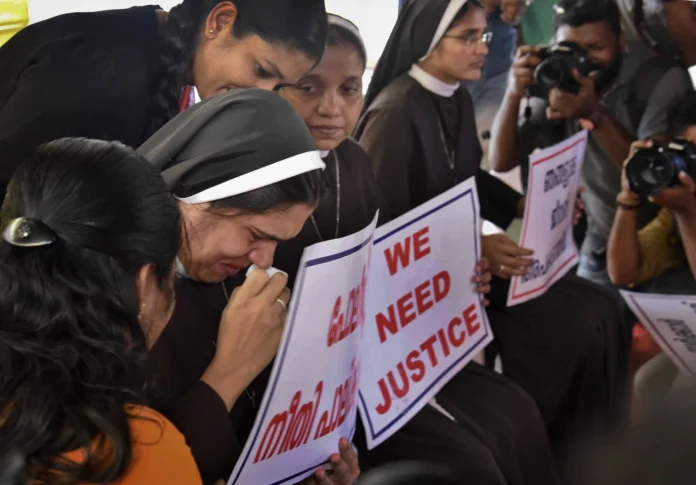
ON 8 SEPTEMBER 2018, five nuns from the Kuravilangad convent sat down in their habits at Vanchi Square in Kochi, beside the Kerala High Court. They were Sisters Anupama Kelamangalathuveliyil, Alphy, Ancitta, Josephine and Neena Rose. They had lived with the survivor, heard her account and watched what they believed was the institution’s indifference. Staying silent, they decided, would make them complicit. It was, by most accounts, the first time serving nuns in India had protested in public against a bishop.
For nuns, the step was harder than it looks from outside. Convent life had trained them in silence and obedience: silence was a virtue, obedience a form of holiness, deference to authority an act of faith. To challenge a superior in public, let alone a bishop, was very nearly unthinkable. They did it anyway, knowing what it might cost them.
The protest was marked not by slogans or confrontation but by quiet dignity and restraint. Here were women who had taken a vow of obedience, sitting in public to question one of the most powerful men in the Indian Church. They were joined by the Save Our Sisters (SOS) Action Council, a coalition of reform-minded Christians, lawyers, activists and some clergy led by Father Augustine Vattoly, and by Sister Lucy Kalappura, a nun from another congregation. Pictures of the sit-in travelled across the country.
Civil-society groups rallied behind the protesters; women’s organisations, lawyers, academics and retired judges began openly questioning the delay, and national media that had at first treated the story cautiously stepped up its coverage. On 21 September 2018, after nearly two weeks of protest, the Kerala Police arrested Mulakkal. He was the first Catholic bishop in India to be arrested on a charge of sexual abuse.
THE TRIAL took more than three years. On 14 January 2022, the Additional Sessions Court in Kottayam acquitted Mulakkal of all charges, finding that the prosecution had not proved its case. Judge G. Gopakumar held that the survivor’s testimony could not be relied upon without corroboration. The survivor and the State appealed. In January 2026 the government appointed a special prosecutor, B.G. Hareendranath, to argue the appeal in the High Court, where it is pending. In 2023, Mulakkal stepped down as Bishop of Jalandhar; reports said the Vatican had asked him to.
The verdict disappointed the survivor’s supporters and reopened arguments about the quality of the investigation, the protection of witnesses and the preparation of the prosecution. Mulakkal’s defenders answered that a criminal court must convict on evidence that proves guilt beyond reasonable doubt, not on the strength of public feeling, and that the presumption of innocence had prevailed as it should.
The nuns said their protest had never been about one man. It was about a culture that taught women to stay quiet and put the protection of authority before the truth. Their quarrel, they said, was with a system that had long failed to give women the confidence that they could speak without fear of reprisal.
THE PRICE came quickly. In January 2019, four of the protesting nuns were ordered out of Kuravilangad, three to convents in Punjab, Bihar and Jharkhand and one to Kannur. They refused to go, and in February, under public pressure, the orders were put on hold. Officially, such transfers are routine. To the nuns and their supporters, a transfer is the oldest instrument of discipline in religious life, a way of breaking up dissent without confronting it. For a nun, it is not a change of workplace. It takes her away from the only community she has, the women she has lived and prayed with for years.
By 2025, according to a report in The South First, three of the five had left religious life. One was Neena Rose, who had been badly hurt in a road accident. Josephine was said to be living a private life in Bengaluru. Anupama, the most recognisable face of the protest, renounced her vows that year. Alphy and Ancitta stayed on at Kuravilangad, with the survivor.
SISTER LUCY KALAPPURA, of the Franciscan Clarist Congregation, paid in a different way. She had joined the protest, spoken to television channels and said plainly that nuns, like any other citizens, could seek justice in the civil courts.
Her congregation then accused her of breaching canon law. Among the charges: she had learned to drive and obtained a licence, bought a car, published a book of poems, and appeared on television without permission. In August 2019, she was dismissed. The Vatican rejected her appeals. Lucy said the charges were a pretext and that her real offence was standing with the survivor. The congregation maintained that it had acted only on breaches of religious discipline.
Taken one by one, the charges concerned matters of internal discipline. Set against her prominence in the protest, many observers saw in them something else: a contest between institutional authority and individual conscience, settled in favour of authority. Her dismissal became one of the most widely discussed disciplinary actions in the recent history of the Church in Kerala.
In a memoir, Karthavinte Namathil (In the Name of the Lord), and in interviews, she described humiliation and hostility from sections of the clergy and the laity. She did not retreat. To her supporters, she came to stand for conscience over obedience; to her critics, for a nun who had defied the authority she had vowed to accept. Either way, she could not be ignored.
WHAT HAD BEGUN as five women on a pavement became a campaign. The SOS Action Council kept up demonstrations near the High Court, petitioned the government for a fair investigation and for protection for the protesting nuns, and pressed for things the Church had never conceded: independent investigation of allegations against clergy, working mechanisms for complaints of sexual harassment, and openness in church administration. Its most lasting achievement was simpler. It kept the story from fading, and with it the questions the nuns had raised.
THE WORD that recurs most often in the testimonies of former nuns is silence. The vow of obedience is meant to cultivate humility. In practice, they say, it can slide into submission to whoever holds authority. Complaints against superiors or clergy are expected to stay inside; young nuns are encouraged to settle problems internally rather than go to the police. Over time, women who have left say, the habit of silence shapes not only how they behave but how they think.
Reformers argue that this psychological climate is a deeper problem than any single crime or scandal. Those who adapt are welcomed as loyal members of the community. Those who question are marginalised. Conformity, women who have left say, is quietly internalised, until obedience without dissent becomes a way of life.
Retaliation rarely announces itself. A transfer, the loss of a post, a refused chance to study further, exclusion from decisions, slow isolation: each can be presented as routine administration. Together, former nuns argue, they teach everyone watching what dissent will cost.
Equally disturbing are the allegations about money. Most nuns have no income, savings or property of their own; the congregation provides food, shelter and medical care, and the vow of poverty makes this a matter of faith. But some women who challenged authority say their allowances were cut or stopped, and that they survived by growing vegetables, stitching clothes or relying on well-wishers. In 2020, Lucy Kalappura publicly accused her convent of denying her food. Church authorities dispute such accounts, and they are not universally accepted. But activists and women’s rights groups argue that the sheer consistency of these stories, told by different women over many years, demands independent scrutiny.
Leaving offers no clean escape. Women who walk out are sometimes called madhil chaadi, ‘those who jumped the wall’, a label that follows them and warns others against following.
Speaking up carries its own punishment. During the Mulakkal case, the survivor herself became the object of intense public scrutiny. Much of the talk turned from her allegations to her motives, her credibility and her character, as so often happens to women who report sexual abuse. Nuns say that women who question authority inside religious institutions are cast as rebellious, unstable, ambitious or lacking in faith. The fear of that kind of vilification, they argue, deters as effectively as any formal sanction.
THE CHURCH has its answers. Its leaders reject the idea that these cases are representative of religious life. During the Mulakkal case, they insisted on the presumption of innocence and warned against trial by media. They maintain that the action against Lucy Kalappura was a matter of canon law, not reprisal; her supporters reply that the timing tells a different story. The Catholic Bishops’ Conference of India did adopt guidelines on sexual harassment in September 2017, requiring dioceses and congregations to set up complaints committees. But those guidelines were already in force when the Kuravilangad nun says she was complaining through church channels, and by her account nobody acted. Reformers say many priests and nuns have never heard of the committees and doubt that they exist outside the policy document.
Guidelines, critics argue, are the easy part. Lasting change would need independent oversight and something harder to legislate: the confidence of a young nun that if she complains, she will be heard impartially, her complaint investigated fairly, and her life inside the community left intact. As long as that confidence is missing, rules on paper will inspire little trust.
The demands that reformers, women’s organisations, lawyers and former clergy have pressed over the years are by now familiar: independent investigation of allegations involving religious institutions, legal protection for survivors and witnesses, open disciplinary and grievance procedures, and wider awareness among women religious of the rights they already have under the law. The SOS Action Council has argued that none of this can be achieved by treating each criminal case in isolation.
Beneath the arguments about guidelines lies a harder question: can any institution impartially investigate allegations against its own senior leaders? Many reformers have concluded that it cannot. Hence the demand for something beyond the Church’s own walls. For years, reformers in Kerala have called for a Church Act that would bring the temporal affairs of Christian institutions (property, finances, appointments) under law, much as statutes govern Hindu temples in several States. Two of Kerala’s most respected jurists drafted such legislation: the late Justice V.R. Krishna Iyer, as chairman of the State’s Law Reforms Commission, and the former Supreme Court judge K.T. Thomas, who headed the same commission, in 2019. Both drafts left matters of faith to the Church. Both were shelved. Their proponents argued that statutory oversight would also protect the most vulnerable members of these institutions, women religious above all, and open complaints of abuse to impartial inquiry. Neither the LDF, which was in power when both drafts were produced, nor the UDF, which now governs Kerala, has acted on them. In a State where the churches carry real political weight, both fronts have always avoided reforms that touch the institutions of minorities, Christian and Muslim alike.
None of this is an indictment of the thousands of women who have spent their lives in Kerala’s convents teaching children, nursing the sick and caring for the old, nor of the faith they serve. It is precisely because their service commands such respect that the treatment of those among them who spoke up matters. An institution’s moral authority rests, in the end, not on the reverence it receives but on how honestly it deals with its own failures.
THE WELL at Kottayam gave up its secret in the end, though it took twenty-eight years, and the two people convicted are free on bail pending appeal. The nuns who sat at Vanchi Square broke a silence that had lasted generations, and the bishop they accused was acquitted. Of the six women who once lived together at Kuravilangad, three stayed on: the survivor and the two sisters who stood by her, in the convent they had once been ordered to leave, while the appeal against the acquittal waits in the High Court.
Silence may preserve reputations for a while; it cannot bury the truth for ever. Faith is never diminished by truth. It is strengthened by it. And justice, if it is to keep its meaning, must reach every individual, without fear, without favour, and without stopping at the gates of a convent.