
In August 2026, a letter began circulating with the kind of detail no distant propagandist could invent. It named roughly half a dozen Kashmiri Pandits living in Jammu, complete with house numbers, street names, and in some cases vehicle details. It called them “white-collar terrorists” and “traitors” working for their masters in Delhi, and it made a point of specifying that “Jammu”, a non-Muslim majority region, would not save them.
“Wherever you are and wherever you go, we are watching your every move”, reads a letter. A so-called Soldier of Resistance named Ahmad Bilal signed this letter on behalf of a group calling itself the United Liberation Council (ULC), which security agencies assess as a Lashkar-e-Taiba shadow front mimicking a secular group yet carrying the same old religious threat.
This letter is only the newest entry on a list that has never closed.
The public chronology of the 2026 letters is now reasonably clear. On 7 August, a ULC letter named six Kashmiri Pandits in the J&K Revenue Department and published their phone numbers, warning them to “change their ways” and also threatening police; it followed the 31 July killing of two migrant workers in Kulgam, after which departments told some Pandit staff to stay home. On 23 August, the second letter, signed by Ahmed Bilal, named about six more people and listed Jammu house numbers and streets, and in some reports vehicle numbers, and declared that Jammu would not save them.
On 27 August, the third letter tied the threats to the reopening of 1990s massacre investigations and demanded probes into Bijbehara, Gawkadal, Sopore and Handwara. Further letters in early and mid-September, including one around 10 September after a Srinagar protest for transit housing, carried photographs of employees and called the camps an “Israeli settlement plan.” Community representatives counted five or six communications in the sequence. Agencies have been examining authenticity, Telegram circulation, and how personal data leaked. PM Package employees wrote to the Chief Secretary and later to Home Minister Amit Shah seeking investigation and a security audit.
The letter drew one careful distinction. The letter did not mention all Kashmiris but Kashmiri Pandits who had stayed in the Valley or Jammu region. Not Muslims, not Sikhs. Those who had left, or who supported the community’s return and rehabilitation, were declared “outright enemies.” That distinction is the whole story in miniature.
This was never a campaign against all Kashmiris or Hindus existing as dhimmis since the exodus in the Jammu area (ghetto), but Hindus and Hindus alone reclaiming their lands, homes, and their leftover identity through state programs and rehabilitation in the Kashmir valley. It was, from its first night, a campaign against Kashmiri Hindus asserting the right to exist there on their own terms, with their own land, their own jobs, their own presence intact. Not as dhimmis or subordinate but as equal right-owners, as equal citizens under the Indian “secular” constitution. The chronology of the letters proves the pattern.
I have traced this same doctrinal continuity at length in my monograph on the Baisaran Valley massacre, which is now available on Amazon Kindle. There I argue that the sparing of women and children in April 2025 was not restraint but a delivery mechanism: a message meant to travel back to every Pandit household still weighing whether return was survivable, and more broadly to Hindus across India.
The meaning is older. Understanding why the killing has never actually stopped requires seeing the distinction that has held for thirty-six years: between the Hindu who stays quiet—or accepts a subordinate, dhimmi presence—and the Hindu who asserts the right to be there. Baisaran was that distinction spoken with a rifle.
A deeper reason explains why this distinction has never softened.
There is a particular cruelty in betrayal by those who share your blood, your language, your soil, and the same ancestral memory of the Valley. Kashmiri Pandits and Kashmiri Muslims are not two separate peoples who arrived from different continents to contest the same soil. Population genetics research on the Valley consistently shows substantial shared pre-Islamic local ancestry between the two communities; the additional Central Asian and West Asian admixture visible in many Kashmiri Muslim genomes reflects centuries of gene flow during Islamic rule, not a wholesale replacement of the original population. DNA is treated as secondary or as an absolute inconvenience.
That finding is treated, in the dominant Valley narrative, as secondary at best and an outright inconvenience at worst, because the demography of the Valley was violently reshaped through successive waves of Arab, Turkic, Persian, and Afghan conquest and conversion, and the pre-Islamic civilisational layer beneath it – its temples, its Sanskrit scholarship, its Hindu, Sikh, and Buddhist inheritance – was systematically recast as Jahiliyyah, an age of ignorance to be overwritten rather than a shared ancestral past to be claimed.
The result is two parallel realities inside a single country: one in which the indigenous Hindu past is erased or criminalised, and another in which solidarity flows easily outward, toward causes thousands of miles from the Valley itself.
RECAP: THE NIGHT THE LOUDSPEAKERS SPOKE. The pattern did not begin in 2026, or in 2019, or even with the massacres of the 1990s that most people vaguely remember. It began on a specific, documented night: 19 to 20 January 1990, when loudspeakers mounted on mosques across Srinagar and the wider Valley came alive in what survivors uniformly describe as a coordinated broadcast. Around 9 or 10 p.m., in the freezing dark, families locked their doors, switched off lights, and huddled together. Many women and girls were hidden in attics or inner rooms. In some homes, poison or kerosene was prepared.
Sanjay Tickoo, then a young man in Habba Kadal and one of the very few who ultimately refused to leave, has described sitting in front of his television as the nearby mosque loudspeaker began to blare, the volume climbing for hours until it reached fever pitch by eleven that night. Rajni Dhar, in Chota Bazar, recalled the electricity already cut, a stone shattering a window, then the loudspeakers starting as if in an orchestrated sequence, calling for Kashmir without Hindu men but with Hindu women, until army and BSF columns finally arrived near two in the morning. Hradey Nath Pandita remembered the announcement stripped to its bare choice: convert, leave, or be killed.
The message needed no interpretation. Ralive, Tsaliv ya Galive: convert, leave, or die, the same three-choice ultimatum that Yazidis, Kurds, and other targeted minorities elsewhere would be handed decades later under different flags but an identical logic. Other slogans demanded Nizam-e-Mustafa, the rule of the Prophet. Still others called for Kashmir to become Pakistan.
And then the line survivors still recite with a specific kind of horror, because of what it revealed about intent rather than mere expulsion: variations of a chant promising Pakistan, or Kashmir as Pakistan, with the Pandit women left behind but without their men. Survivors still recite with particular horror the Kashmiri formulation Asi gachchi Pakistan, Batao roas te Batanev san—we want Pakistan (or Kashmir as Pakistan) with the Pandit women but without their men. Leave the women behind. Other accounts describe mothers preparing to protect daughters’ honour at any cost and men ready to burn their own houses rather than let the crowd in.
This was not a spontaneous riot. Targeted killings of prominent Pandits had already begun in the preceding weeks. Newspaper notices from militant groups had already ordered Hindus to leave. The loudspeaker night converted a campaign of selective terror into a public, unmistakable demonstration of collective intent, and within months it worked exactly as designed. While the exact wording of every mosque cannot be forensically recorded from that pre-smartphone era, and some former officials have disputed the content or framing of that night, the overall climate of intimidation is well attested by the volume of first-person accounts.
Official figures from the Ministry of Home Affairs and the state’s Relief and Rehabilitation Commissioner record roughly 64,000 to 65,000 registered migrant families who fled the Valley, of whom close to 43,600 settled in Jammu and its adjoining areas and about 19,300 went to Delhi and the National Capital Region, with large government camps and colonies established at Jagti, Muthi, Purkhoo, and Nagrota. Jammu district (2011 Census) is roughly 84 per cent Hindu, 7.5 per cent Sikh, and 7 per cent Muslim.
The broader Jammu Division is Hindu-majority overall, with significant Sikh presence in the urban and plains areas where most Pandit families settled. Most expected to return within weeks. The security environment never allowed it, and what began as flight hardened into permanent exile. This was conflict-induced displacement, not gradual or voluntary self-segregation, and describing it as natural ghettoisation erases the documented cause. Government reports, contemporary records, and academic literature describe the movement as conflict-induced internal displacement—flight under the fear of targeted violence.
THE RHYTHM THAT NEVER STOPPED. What followed was not a catastrophe that concluded and became history. It became a rhythm, and the rhythm has never fully broken. Sangrampora in 1997. Wandhama on the night of 25 January 1998, twenty-three Pandits were killed inside their own homes in Ganderbal district, including nine women and four children, on the eve of Republic Day and during Shab-e-Qadr. Nadimarg in 2003. Each massacre punctuated a decade in which the community’s presence in the Valley was treated as a problem requiring periodic, violent correction. The Wandhama case sat unresolved for nearly three decades until the state’s own Investigation Agency reopened it in August 2026 alongside the long-dormant 1989 assassination of BJP leader Tika Lal Taploo, the killing widely regarded as the opening shot of the exodus itself, and the murders of Justice Neelkanth Ganjoo, nurse Sarla Bhat, and the poet Sarwanand Kaul Premi and his son. Raids were recently conducted at multiple locations in the Valley to identify terrorists and over-ground workers allegedly involved. That a state agency needed twenty-eight years to formally reopen these files says as much about the scale of the original crime as any single massacre does.
After 2019, when the abrogation of Article 370 and the accompanying PM Package created the real possibility that some of that 1990 demographic settlement might begin to reverse, the killings resumed in a calibrated, lower-signature form. Makhan Lal Bindroo was shot inside his own pharmacy in Srinagar in October 2021. Supinder Kour and Deepak Chand were separated from Muslim colleagues inside a government school and executed.
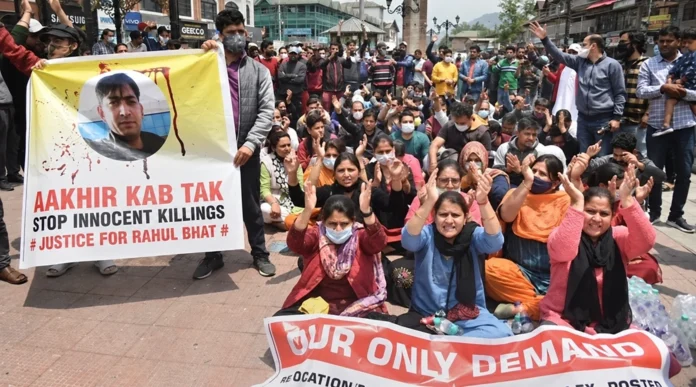
Rahul Bhat, a revenue official working under the PM Package, was shot at his desk in Chadoora, Budgam, on 12 May 2022, targeted in part, police said, because of his access to disputed land records; it was, notably, one of the first instances of an international wire service explicitly describing the response as a minority Hindu community protesting the killing of one of its own. Then Baisaran Valley in April 2025, where twenty-six men were sorted by faith, tested on the kalima and on circumcision, and shot when they failed, while the women and children were deliberately spared and told, in the phrase that has since defined the massacre, to go tell Modi what they had seen.
Parliamentary data recorded roughly fourteen to twenty-one minority civilians killed in terrorist incidents in the years immediately following Article 370’s abrogation, even as large-scale conventional militancy declined on several metrics. That gap is not a contradiction. Hybrid militants, local youths with clean records using pistols rather than assault rifles, made the campaign cheaper, quieter, and just as effective at sustaining dread among a community still deciding whether return was survivable.
WHO SUPPLIES THE DETAILS. The precision in the August 2026 letter, the house numbers, the street names, the vehicle information, is not something Pakistan-based handlers can produce alone. It requires people inside the Valley: over-ground workers with access to revenue records, neighbourhood familiarity, and knowledge of exactly which family lives where and drives what. This is not speculation. Since 2021, the Jammu and Kashmir administration has terminated the services of more than eighty government employees, invoking Article 311(2)(c) of the Constitution, after investigations by the J&K Police, the State Investigation Agency, and the NIA established active links to Pakistan-backed terror outfits.
The list includes school teachers, laboratory technicians, police constables, assistant linemen, forest department staff, health department drivers, and stockmen, individuals who drew state salaries while procuring weapons on the directions of Pakistan-based handlers, facilitating infiltration across the Line of Control, transporting weapons and narcotics, radicalising youth, and maintaining contact with ISI-linked networks. In several cases, the evidence included recovered pistols, grenades, cash, and digital communications with handlers across the border. That “within” includes people drawing government salaries. The technology and the specific targets have updated; the reliance on people “within” has not disappeared.
The Baisaran attack showed the same pattern on the ground. On 22 April 2025, gunmen hit tourists at the meadow near Pahalgam. Twenty-six people were killed: twenty-five tourists and the local pony operator Syed Adil Hussain Shah, who tried to wrestle a weapon away to protect the people in his care. Reporting and the later NIA chargesheet describe men being sorted by faith—asked for the kalima, checked—and shot when they failed. Women and children were left alive and told to carry what they had seen.
The Resistance Front claimed the attack that day and retracted after international pressure. India had already banned TRF as a Lashkar-e-Taiba proxy. The NIA chargesheet names LeT and TRF together, treats the massacre as a Pakistan-directed operation, and identifies the three gunmen as Pakistani LeT operatives. They were later killed. Two Pahalgam pony operators, Parvaiz Ahmad Jothar and Bashir Ahmad Jothar, were arrested for harbouring them at a seasonal hut the night before. Investigators say they were paid Rs 3,000 for food and shelter, saw the same men again hours before the shooting, and did not call the police. The NIA questioned hundreds of local service providers, including other pony operators; early inputs also pointed to a wider circle of south Kashmir over-ground workers. That sum is the price of a night’s logistics, not the meaning of the crime. Shah’s death is the other half of the same trade: facilitation and resistance in one valley, sometimes in one profession.
Land records are a particularly useful channel for this facilitation. When a displaced Pandit owner files an application for title verification or challenges a disputed mutation, that application itself becomes traceable information. Reporting by News18 in August 2026, citing top intelligence and security sources, described a documented nexus between illegal occupiers of migrant property, often called the land mafia, and proxy terror networks, in which a claimant’s attempt to reclaim ancestral land is tracked and, in some cases, answered with threats designed specifically to force the claim to be dropped. Rahul Bhat’s position gave him access to exactly this kind of record. It is difficult to read his killing as unconnected to that fact.
This is also why land recovery, the part of this story rarely discussed with the same urgency as the killings, matters as much as it does. When the community fled in 1990, they left houses and orchards behind. Some were sold at a fraction of their real value under distress. Many were simply occupied, mutated through forged or manipulated revenue records, or absorbed into informal local control.
In March 2026, Jammu and Kashmir’s Chief Minister Omar Abdullah informed the state Assembly that land measuring 3,729 kanals and 4 marlas belonging to Kashmiri migrants had been retrieved and restored under the 1997 Migrant Immovable Property Act, of which 844 kanals and 4 marlas had been cleared since November 2024 alone. The largest recoveries were reported in Shopian at 283 kanals, Baramulla at 225 kanals, and Ganderbal at 146 kanals, with smaller amounts across Kulgam, Pulwama, and other districts.
An online grievance portal had logged more than ten thousand applications, most of which the government said were disposed of. Yet Pandit returnees and activists continue to report that cases marked resolved on paper remain contested on the ground, blocked by delayed mutations, disputed possession, or quiet local intimidation. The obstruction of property recovery and the campaign of threats against returning employees are not two separate stories. They are the same refusal, expressed through different instruments, sustained as much by compromised revenue processes as by outright violence. The 2026 letters and the post-2019 killings look like current affairs.
They are not. They are the latest enforcement of a question left open by conquest, conversion, Partition, Article 370, and the post-2019 recoding of return as colonialism. Pakistan’s claim on the Valley, mobilisation against the abrogation of Article 370, and hostility to Pandits reclaiming houses are not three files. They are one unfinished map: who is native, who is a guest, and whether a Hindu who asserts land is a returnee or a settler. Judge a murder in Chadoora or a house number in Jammu without that history, and you will call it an incident. Put the history back, and it is a policy.
WHY THE KILLINGS CANNOT BE JUDGED IN ISOLATION. It is tempting to treat each killing as a security failure: more guards, better cameras, another leave order after the next poster. That is necessary, but not sufficient. A state can guard a clerk and still lose the meaning of his death. The meaning is historical. Conquest taught the Valley to treat the older Hindu past as ignorance.
Partition taught Pakistan to treat a Muslim-majority valley as unfinished nationhood. Article 370 taught two generations that land and jobs could be ring-fenced as “identity.” After 2019, a borrowed academic idiom taught the world to call the people who fled “settlers.” Once those lessons are in place, a Pandit who walks back through his own gate is not a neighbour returning. He is a problem of sovereignty. Killings that look isolated are how that problem is managed.
Four inheritances sit under that sentence. They are not the same event. Writing them as one word—colonialism—turns the argument into fog. They have to be stacked in order.
The first inheritance is conquest, not the British Raj. From the Shah Mir sultanate onward, Islamic rule remade the Valley’s public religion. Temples were broken or emptied, Sanskrit scholarship was pushed to the margin, and the pre-Islamic layer was recast as jahiliyyah. Shared ancestry between Pandits and Kashmiri Muslims is treated as an inconvenience because the political story requires a rupture: the Hindu who remains Hindu is no longer a co-owner of the soil, only a remnant. Conversion changed the god. It did not change the genome.
The ideology needed the genome to stop counting. The same move that recasts temples as ignorance recasts return as theft. Fourteen hundred years of political Islam is treated as the start of legitimate time; everything before it is darkness. That is not history. It is a statute of limitations written by the winner of a conquest. The world did not begin fourteen hundred years ago, and it did not begin twenty-five hundred years ago either. Those dates are the autobiographies of particular faiths, not the age of the ground.
Non-proselytising communities that kept memory in temple, grove, language and law—and that did not treat conversion as a civilising mission—were overwritten by theopolitical systems that do. Many of those older peoples are now exhibits, place-names or folklore. Calling all of that “mythology” is how the winner’s calendar is made to look like geology. Some of it is myth. Mass flight, broken temples, renamed towns, and a living minority asked to justify its return are not. A doctrine that needs history to start at revelation will always call the rest darkness. That is convenience, not a date. It is a child teaching history to the grandparents and insisting the lesson is true because it feels true in the child’s head. Elders know the sequence. A slogan that makes a modern state feel primordial does not make it primordial. It only makes the grandchild certain.
The second inheritance is the princely state. Dogra rule placed a Hindu dynasty over a Muslim-majority peasantry and left a real memory of extraction. That memory is not invented. What is invented is the leap from that memory to the claim that a family driven out of Habba Kadal in 1990 continues Gulab Singh. A clerk shot at his desk in Chadoora is not a Dogra governor. Stretching nineteenth-century state power across a community that fled mosque loudspeakers is how grievance becomes a hunting licence.
The third inheritance is Partition. The two-nation theory did not describe the Valley’s long mix. It described a programme: Muslims as a nation, contiguous Muslim-majority land as that nation’s unfinished estate. Kashmir became the prize that would prove the programme true. Pakistan still tells the United Nations that Jammu and Kashmir “never was, is not, and never will be” an integral part of India. That line is not anti-colonialism in the sense of 1857. It is irredentism. It needs the file to stay open. A closed file would mean the 1947 map was allowed to settle. For a state whose founding story is religious nationhood, a settled map is a theological problem.
THE FOURTH INHERITANCE. The post-colonial bargain became a wall. Articles 370 and 35A were not an ancient indigenous treaty. They were a 1947–50 compromise after accession: limited integration, separate rules on residency and land. In Valley politics that bargain hardened into the meaning of “Kashmiri identity.” In practice it also froze a later settlement—the settlement of 1990—in which the people who fled could not easily reclaim land, jobs or presence. When Parliament read the articles down in August 2019, two clocks struck at once. Delhi heard the end of an internal Partition. Srinagar heard the end of the last legal instrument that had kept return exceptional. The mobilisation that followed—blackout, detentions, stone-pelting, the annual “Black Day” marked by NC, PDP and Congress—was not only about federalism. It was about who would be allowed to become ordinary again.
THEN THE COSTUME ARRIVED. After 2019, a literature already fluent in Palestine borrowed the term settler colonialism and laid it on the Valley. Abrogation became annexation. Domicile certificates became replacement. Transit camps and PM Package flats became settlements. Retrieval of migrant orchards under the 1997 Act became dispossession of those who had occupied them. In that vocabulary, the 1990 refugee is the settler and the person who took his house is the native. The vocabulary travels because it is already prestigious. It does not travel because it fits.
The pairing is not accidental. A doctrine that treats pre-Islamic civilisation as jahiliyyah and land once under Muslim rule as permanently Muslim will call any Hindu title after 1990 “settler colonialism” and any refusal of that story “Islamophobia.” Pakistan and a slice of the Palestine discourse run on the same clock: a twentieth-century state or national claim is spoken as if it were always there, because the legitimating event is the Islamic conquest, not the older geology of the place.
Official Pakistani and OIC speech now places “Occupied Palestinian Territories” and “Indian Illegally Occupied Jammu and Kashmir” in one sentence and calls the parallels “stark.” If history begins at the moment of Muslim victory, then asking for the land back is framed as racism. That is the convenience. A framework built for planters arriving from a metropole cannot explain the loudspeakers of January 1990, a slogan that wanted Pandit women without Pandit men, Wandhama on the eve of Republic Day, or a 2026 letter that exempts those who stayed in the Valley and marks those who support rehabilitation. If the theory cannot explain violence that predates abrogation by a generation and targets people who were already native, it is not interpreting Kashmir. It is laundering it.
These four layers now run the politics that surrounds a funeral.
Pakistan needs the wound open because the two-nation map is a claim, not a closed archive. Valley electoral politics needs 370 remembered as sacred because without that wall, return and title become administrative questions instead of civilisational ones. Indian integrationist politics needs 2019 remembered as completion because a Muslim-majority region held outside the ordinary constitution looked like Partition inside the Republic. International English needs “settler” because Nizam-e-Mustafa and Ralive, Tsaliv ya Galive do not pass a human-rights conference. Each machine feeds the next.
The man who prints house numbers in Jammu does not need to have read a journal article. He only needs the local knowledge and the permission structure the machines provide. Isolation is how that system hides. A pistol in a tehsil office becomes “militancy.” A Telegram poster becomes “online radicalisation.” A donation drive for Tehran becomes “humanitarian feeling.” Silence on PoJK becomes an oversight. Separate them, and each looks small enough to manage with a leave order. Put them back on the same table, and the pattern is a sorting rule. Solidarity flows out to the ummah and the “resistance” axis. Accountability does not flow back to the loudspeakers, the occupied orchards, or the named migrant in Jammu.
Shatrubodh—who belongs, who does not—outruns Shia–Sunni fracture the moment the file marked Hindu return is opened.
Colonial and Partition history explain how the doctrine learned to speak. They do not turn a returning native into a colonist. A theory that calls the exile a settler and the occupier of his house a native is not a theory of decolonisation. It is a theory of who is allowed to exist.
THE DOCTRINE BENEATH THE FACILITATION. None of this operates on purely secular or nationalist logic, and it is worth being precise about that, because the vocabulary used to describe the campaign has shifted even as its content has not. Hizbul Mujahideen, founded in 1989 as the armed wing of Jamaat-e-Islami, framed its objective from the outset in explicitly religious terms: the establishment of Nizam-e-Mustafa and Kashmir’s accession to Pakistan under an Islamic dispensation. Lashkar-e-Taiba and Jaish-e-Mohammed carry the same doctrinal architecture. Later fronts, The Resistance Front and the United Liberation Council, have adopted deliberately secular-sounding names for international audiences, but Indian security assessments treat them as extensions of the same Pakistan-based organisations pursuing the same religious objective under a rebranded vocabulary.
As I set out in the monograph, this rebranding is not incidental packaging. It is the mechanism by which a campaign rooted in explicitly religious doctrine gets exported internationally as a secular anti-colonial struggle, a costume that survives precisely because so few readers ask why a purely political movement still opens its communications with religious salutations or still flies a flag bearing a declaration of faith. The religious motivation is not incidental to this ecosystem; it is the exclusive or dominant self-justification offered by the armed groups and by significant sections of separatist leadership that continues to draw emotional and logistical support from within the Valley’s own institutions and society.
The rebrand matters because it explains how a campaign with this doctrinal foundation has been successfully repackaged, for international consumption, as an anti-colonial struggle. The return of Kashmiri Pandits, or even the routine administrative recovery of their own ancestral orchards, is now regularly described in separatist discourse, Pakistani state media, OIC-aligned forums, and segments of international academia as settler colonialism. India under Modi is labelled as the Zionist of the East; Zionism is equal to Hindutva and an occupier of Kashmir, which is supposedly the Palestine of the East (Southeast Asia).
Trust me, only Pakistan and OIC nations have such IQs. Article 370 is defended as protection of Kashmiri identity, even though in practice it operated, functioning almost as a Sharia-adjacent framework, to entrench a majoritarian order in land, employment, and political power that treated native non-Muslims as permanent outsiders in their own homeland/ rajya.
These linguistic frames are not fringe positions confined to militant pamphlets; they circulate among separatist leaders and sections of the local establishment, bureaucracy, and political class, and remain emotionally alive across the Valley. Conversion changed what god a family prayed to. It did not touch the genome, and it did not touch the claim to soil that predates the first Islamic conquest of the Valley by millennia.
WHERE THE SOLIDARITY ACTUALLY FLOWS. The flow is not geography. It is a file marked Muslim land. Palestine and Kashmir are open; PoJK, Pandits, and the pre-Islamic layer are not. This is where the pattern becomes most visible, because solidarity in the Valley is unevenly distributed, and that distribution tells you something the killings alone cannot. Large sections of Valley opinion express closer emotional and political identification with Pakistan, Iran, and Palestine than with the rest of India, an orientation that looks consistently westward and northwestward rather than toward the Indian Union that has paid the blood price of holding the territory.
Every International Quds Day, the last Friday of Ramadan, thousands gather across Budgam, often the largest gathering, along with Magam, Hassanabad in Srinagar, parts of Baramulla district, and Kargil, organised primarily through Shia institutional structures under the Anjuman-e-Sharie Shian leadership, carrying Palestinian flags, portraits of Iranian leaders, and calls for the liberation of Al-Aqsa (that stands on the only site of worship of Jews, the Temple Mount). During Muharram processions, flags of Iran and Hezbollah have appeared alongside Palestinian symbols, prompting police to register cases under the Unlawful Activities Prevention Act. The slogan Kashmir banega Hezbollah, and its ideological variants, has surfaced in this same current.
In March 2026, when Iran faced conflict, a donation drive organised inside the Valley raised an estimated six hundred crore rupees in cash, gold, jewellery, livestock, vehicles, and personal belongings within days, cutting across Shia and Sunni lines.
No comparable mobilisation has ever been organised for the Indian soldiers who have died holding that same territory. None has been organised for the victims of repeated attacks on the Amarnath Yatra. None has been organised for the Kashmiri Pandits themselves, whose exodus and subsequent decades of targeted killing receive, from the same public sphere so quick to mobilise for Gaza and Tehran, comparative silence.
And despite the well-documented repression, internet blackouts, and anti-terror crackdowns faced by the Joint Awami Action Committee and other protesters demanding basic rights inside Pakistan-occupied Jammu and Kashmir, no equivalent street mobilisation has emerged in the Valley against the Pakistani administration of that territory.
This is not simply about misdirected external solidarity. Internal Shia-Sunni divisions within the Valley’s Muslim community are real and have at times turned brutal, most infamously in the 1801 attack on Zadibal under Afghan governor Abdullah Khan, when the Imambara was burned, houses looted, women assaulted, and roughly a hundred and fifty Shia men publicly humiliated, their noses pierced and linked by a single string before being paraded through the bazaars.
Organisational rivalries between Shia clerical families persist, and intra-Shia clashes during Muharram still occur. Yet these fractures recede whenever a sharper boundary is activated: the recognition of who belongs to the fold and who does not, what might be called shatrubodh, and that recognition has proven more decisive than sectarian difference in determining where solidarity actually flows.
The same civilisational sorting has surfaced beyond Kashmir entirely, in diaspora rallies across Western capitals, London among them, carrying chants calling to globalise the intifada, importing the vocabulary and imagery of a distant conflict thousands of miles from either Gaza or Srinagar. That the language transplants so easily, while the specific, documented, named persecution of Kashmiri Pandits draws no equivalent international march, is not incidental. What is mourned, what is funded, what is protested, and what is ignored together map a civilisational sorting that has held steady for decades.
THE WORD WITHHELD. When Kashmiri Pandits describe this history, and the fear it still produces, the common response is to treat their account as majoritarian paranoia, discounted because they belong to India’s Hindu majority nationally—as though a census could undo what happened inside one valley. It cannot. That majority did not stop the loudspeakers in 1990, the massacres that followed, the killings of returnees after 2019, or the letters that still arrive with house numbers attached. A family that can produce dates, names, slogans, body counts and the street addresses on a 2026 threat letter is still told to prove its fear is not exaggeration.
Claims of Islamophobia elsewhere often travel on climate alone. If demographic size can turn named targeting into paranoia, the same test should apply wherever large-scale persecution is alleged without dated local evidence. Islam is the world’s second-largest religion; it does not get a lighter standard. Consistency is not bigotry. It is honest language, withheld from this community for thirty-six years.
India remains a constitutional republic with equal rights on paper. The Valley problem should not be inflated into nationwide persecution under a Hindu Rashtra since 2014, nor dismissed as fantasy. Fear after named letters and named killings is not a national theology. Hindutva and Zionism are yoked in pamphlets; they are not the same structure. One is a majoritarian project inside an already majority country. The other is a state built by a persecuted minority on contested land. Use the yoke as a warning about ummah sorting and conquest-title, not as a theory that the world began with the last revelation that won a state. The record is dated, named and local. A census has never cancelled it.
HOW MANY MORE TIMES? How many more nights of loudspeakers, how many more named letters, how many more revenue officials shot at their desks, how many more faith-sorted executions, how many more local networks and government employees supplying the intimate details that turn distant ideology into personal terror? How many more cycles of social media images of brotherhood followed by ground-level obstruction of return and property recovery? How many more times must the indigenous Hindu past be treated as Jahiliyyah, the returnees branded as settlers, and the blood price paid by Indian soldiers and civilian victims of terrorism in the Valley met with silence while solidarity flows outward to Iran, Palestine, and Hezbollah?
The betrayal is not only external. It is the silence, or in some documented cases the active facilitation, of those who share the same blood and the same land yet have chosen a different civilisational allegiance. Conversion changed what god a portion of the Valley’s population prays to. It did not change ancestry, and it did not change the indigenous claim to soil that predates every wave of conquest by millennia. Framing the return of that population, or the recovery of its own ancestral land, as an act of colonisation is not analysis. It is inversion, and it has done exactly the job it was built to do: it has let a documented campaign of religious cleansing travel internationally dressed in the language of resistance, while the community it targets is asked, again and again, to justify why it still feels afraid.
On social media, one may encounter carefully framed images of Kashmiri Muslims greeting returning Hindus, offered as proof of enduring brotherhood. Individual acts of protection or quiet help by neighbours have occurred and deserve acknowledgement. But the larger ground reality, documented in modest retrieval figures relative to the scale of original loss, in the targeting of revenue officials, and in the sustained campaign of named threats against those who pursue claims, is different. Large-scale return, comprehensive land audits, and the reassertion of Pandit presence threaten the arrangements that grew up after 1990. The welcome, when it appears, is often selective or limited to those who accept a subordinate presence.
The list has never actually closed. It is only ever updated, with new names, new addresses, new methods, and the same underlying demand it has carried since the loudspeakers first spoke: that Kashmiri Pandits accept either permanent absence or permanent fear as the price of the land their ancestors never left.
The killings have not stopped because the demand behind them has not changed.
The question was never really whether the record exists. It is how many more entries the list will need before the word betrayal is allowed to mean exactly what the evidence shows, and before the blood brothers of the Valley are asked, without evasion, what kind of home they are actually prepared to share.