

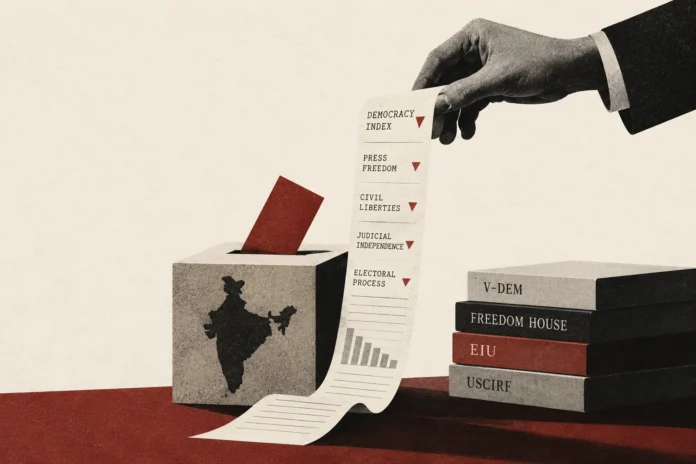
There has been much debate, of varying intensity, about the degree of ‘freedom’ that exists in India. The question has resurfaced in recent times following the deliberate engagement of a Norwegian journalist with the Indian delegation in a manner that was, to put it mildly, unprofessional. One can imagine a similar spectacle unfolding around the Chinese delegation at a BRICS summit, with journalists sympathetic to the causes of two nations beginning with the letter T being permitted to turn the occasion into a controlled display of insult. India, however, prevented any such untoward incident, demonstrating the civility expected of a nation hosting an event of such repute.
But I digress. Questions surrounding democracy, press freedom and the validity of elections in India are as old as the institutions themselves. A nation born with constitutional guardrails on free speech, as documented in Tripurdaman Singh’s Sixteen Stormy Days, can hardly claim to have been founded on an absolutist conception of freedom. Perhaps a society of our kind requires certain guardrails for its sustenance.
The socialist planned economy that chooses to follow again is antithetical to freedom.
The how of that is out of scope of this article, but can be found extensively discussed in the book I recently read, ‘Road to Serfdom’ by F.A.Hayek. Now, with the socialist spirit and the inbuilt guardrails out of the highway, let us take a trip across the gorgeous autobahn of the three ‘reputed’, ‘cited’, almost revered in ‘liberal’ circles indexes.
The first requirement to measure something is Data. From the United States Commission on International Religious Freedom (USCIRF) to V-Dem, the Economist Intelligence Unit(EIU), and Freedom House, all of them exclusively rely on small panels of anonymous or semi-anonymous revered personalities or ‘experts’, answering questions that are more inclined toward judgement of intent or perception. This includes questions such as media bias, judicial independence, and whether there is institutional pressure behind the scenes. Now, as Ramachandra Guha, with his strong prose in a Caravan Magazine article around 10 years ago, suggested, ‘In Absentia: Where Are Conservative Intellectuals Of India’, the right wing of this nation lacks ‘intellectuals’ and ‘experts’ in social science with the exception of the economic domain, to a certain extent. Building on this, the words of an eminent liberal intellectual, institutions like V-Dem, EIU and Freedom House, for all their data collection, reach out to eminent experts who are diametrically opposed to virtually everything this democratically elected Government represents and provide them a platform to voice their biased grievance of not having their ideology in power – perfect opportunity for the festering of bias.
Additionally, these institutions decide to convert unverifiable subjective inputs into hard data, converting the impressions into precise numeric scores, presenting a rigour that the data doesn’t concur with, presenting a false precision on which the ecosystem is left with the company of the Royal Indian Congress and co.
The data is unreliable and maybe the experts are too; however, to restore faith in the democratic essence, the triad works on presenting details of people working on these all-important rankings where Indian democracy has been getting in Gen Z or Alpha lingo-mogged for the previous decade, right?
Well, let us explore step by step; let us look at V-Dem first. V-Dem publishes coder counts along with running a ‘statistical bias-correction model’; this is the most reliable of the three and the number of experts it surveys is usually 5. With the 5, as discussed, most likely inclined and incentivised to portray a grim picture. Next, Freedom House does not really disclose anything; in the true spirit of protectionism, it protects all its secrets, and the Economist Intelligence Unit (EIU) is able to beat Freedom House to the punch in being opaque. The EIU Democracy Index relies on expert opinions for approximately 45 of its 60 indicators. The EAC-PM paper on ‘Why India Does Poorly on Global Perception Indices’ highlights a significant lack of transparency, noting that the EIU does not reveal the nationality, credentials, or specific field of expertise of these experts
So, in addition to being an uninvited party discussing our circus, these monkeys judging our circus do not engage in even entertaining the idea of displaying how they decide: why our circus is decent, good, getting worse or pillaged.
These published studies can be equated to a 3 line review of a movie review on IMDb, of a movie, based on a book. All of it dressed up with institutional validity of the kind that centuries of colonial institutional memory of the West has blessed with.
Now, in addition to the sharp score drops for India cluster right around 2014 and after 2019, which correlates with a change in ruling party rather than with any interruption to elections, transfers of power, or court functioning. In addition to the issue with the pace of decline outrunning what verifiable institutional changes would predict, unless, of course, it is The ‘Iron Lady’s’ emergency year, there are internal inconsistencies in V-Dem’s sub-indices. The ‘liberal’ and ‘egalitarian’ components stayed flat, with ‘liberal democracy’ indices falling sharply, which is hard to reconcile with the ‘fact’ of structural authoritarian shift that is supposedly occurring, as by the ‘intellectual’ royalty of India.
Moving away from the house of cards of V-Dem, let us take a look at EIU’s excellence in categorisation, ensuring no stone is left unturned in mockery of Asia, or rather, 26% of the world’s population.
They have built six subsets for categorising 40% of the world’s population; however have ensured to lump the 26% that South Asia holds into a neat and simple-to-understand category for a British school kid: ‘Asia and Australasia’. This framework looks like it was meant to help EIU make sense of things according to their worldview. Maybe for them, this is a great mechanism, but is it an objective mechanism we should care about? Probably not.
Can we even score well if we don’t choose the party they want us to? The simple answer is no, but I don’t think that is a surprise for anyone reading this. However, for the sake of entertaining the thought, let us take a look at why it is not possible. Firstly, starting with V-Dem, the formal/objective indicators award full marks to countries with even uncompetitive elections. This means even countries with only one party can outscore India on ‘objective’ categories, while India loses ground specifically on the subjective ones, which, as I have demonstrated earlier, is the least verifiable part of the index. Laughable, right?
Next, there is a feedback loop; though it may be understated, it is present. A plausible feedback loop where ‘India is backsliding’ becomes the prevailing frame and subsequent panel judgments drift to match it, rather than independently re-deriving the score each year.
Finally, Freedom House’s horrible usage of freedom. Freedom House scores Jammu & Kashmir separately from India. The gravity of this cannot be emphasised enough. This is a methodological choice that is reflective of the political choice this index makes and it carries political weight, independent of the underlying civil-liberties data.
This is a choice of repelling the will of our civilization’s claim over the region.
The Freedom House is able to indulge in this action as it was founded with an explicit ‘pro-democracy’ advocacy mission and receives US government funding. Its India write-ups also use editorialising language such as ‘tragically driving India toward authoritarianism’ that reads as a verdict rather than a neutral summary.
I want to be clear: this examination is not a rebuttal built on counter-data, as I am a humble student of engineering with not enough institutional capacity to engage in such an endeavour meaningfully. The only thing I hope to demand is a simple demand that the same rigour these institutions claim to enforce upon India be turned inward upon themselves.
A panel of five anonymous coders, an undisclosed roster of forty-five contributors, an index that scores a full-marks single-party state above the world’s largest democracy on the ‘objective’ metrics while docking it on the unfalsifiable ones is, as I earlier said, a Twitter review of a movie review on IMDb of a movie based on a book. This is essentially monkeys not of this circus trying to dress a narrative in the borrowed authority of a spreadsheet.
I do not contest that India’s institutions are beyond criticism; I shall be the first to engage in such, as no democracy of 1.4 billion people governing itself across every fault line of language, faith, and class is above scrutiny. And my call is not for exemption from it. My hill that I wish to perish on is for the scrutiny to be mutual.
If V-Dem, EIU, and Freedom House wish to sit in judgment of the world’s largest electorate, they might first submit their own coders, their own funding, and their own categorical choices to the same public audit they demand of everyone else. Until then, apart from the ‘saviour of democracy’ larping of Left-Liberal Raj, these opaque, occasionally funded by interested governments, and drawn from a narrow ideological well, indices have no reverence in this Indian’s mind.