

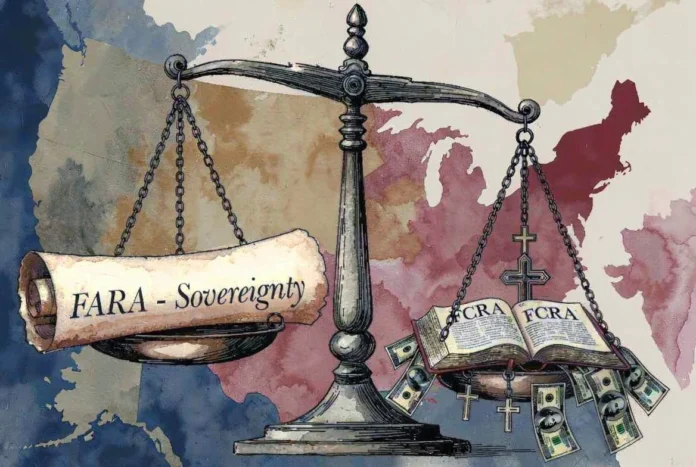
On 4 August 2026, Riley Moore, a Catholic member of the United States Congress from West Virginia, posted a statement on X about India’s FCRA amendments. He opened by invoking St. Thomas the Apostle’s arrival on the Malabar Coast, decades after the Resurrection, as though nineteen centuries of Christian presence in Kerala settles a 2026 question about how India regulates foreign money entering its own institutions.
That claim is itself contested. The detailed South Indian narrative rests mainly on the early-3rd-century apocryphal Acts of Thomas (which places him primarily with the Indo-Parthian king Gondophares in the northwest) and later ecclesiastical traditions. Modern scholarly consensus treats the specific Kerala founding story as largely legendary due to the complete absence of contemporary 1st-century evidence. Then came the line that actually mattered: he called the amendments “a clear attack against Christians,” and warned that if the bill proceeded, it “would be a point of major concern in our bilateral relationship with India.”
Read that sentence again, slowly. A member of a foreign legislature, sitting seven thousand miles from Delhi, telling a sovereign nation that its own domestic financial oversight law will be treated as a strategic problem in the relationship between two countries, unless India regulates its own institutions the way a section of Capitol Hill prefers.
This is not a fringe voice. This is not a think tank paper that nobody reads. This is a Congressman’s own account, posted from his own phone, on the day this piece was written.
Moore’s post also told you something else worth sitting with. He didn’t quote the FCRA bill’s actual text. He didn’t cite a single Indian church shut down for its faith. He reached straight past a decade of documented compliance failures, past the contested historical status of the very apostolic tradition he invoked, and straight to the threat of diplomatic consequence.
That is not how a genuine legal argument gets made. That is how a religious argument gets dressed up as a legal one, because the people making it were never really talking about compliance in the first place.
It has always been a religious hegemonic power. America marks its 250 years of Independence from the British, while being a settler colonialist in Native American lands. The fight was originally between Catholics vs Protestants, and the latter got settled in Native American lands by mass executing and converting them, and in today’s century they cry persecution. It is indeed ironic.
Jews and Parsis never felt this way when they came as refugees under the Hindu kingdom (monarchy); however, Proselytising religions, which are the world’s largest demography of all, are crying persecution? This is abnormal in the Indian case; like Muslim and Communist countries, people are not killed for owning a Bible or practising Christianity. Then what is it?
AMERICA WAS NEVER SECULAR. NOT UNDER EITHER PARTY. Americans like to think there is a wall between church and state, written into their own First Amendment. Then it is worth asking, plainly, whether the record actually supports that description, or only supports it within America’s own borders, and stops the moment American power extends beyond them.
Start with where the country came from. The Puritans who settled New England did not see themselves as building a secular republic. John Winthrop, in 1630, called his colony “a city upon a hill,” a phrase drawn straight from the Gospel of Matthew, meant to describe a community whose entire purpose was religious. Two centuries later, the idea that America was destined to expand across the continent, “Manifest Destiny,” was not treated as ordinary land-grabbing. It was treated as something God had assigned to the nation, “allotted by Providence,” in the words of the man who coined the phrase. American expansion westward, including the displacement of Native nations, was carried out by people who genuinely believed they were fulfilling a divine plan, not merely pursuing territory.
None of that is ancient history confined to a textbook. It is the direct ancestor of the machinery running today, and the machinery has never respected which party sits in the White House.
A Democratic president, Bill Clinton, signed the International Religious Freedom Act into law in October 1998, a bill built by an evangelical lobbying campaign that began at a hotel prayer summit two years earlier. A Republican president, George W. Bush, created the White House Office of Faith-Based and Community Initiatives within weeks of taking office, opening federal money directly to religious organisations at home and abroad. His own Secretary of State, Colin Powell, told a room of NGO leaders in October 2001 that American charities were “such a force multiplier for us, such an important part of our combat team.” He added the sentence that still does the real work: “Always, we must respect your independence. After all, it is the very fact of your being independent and not an arm of government that makes you so valuable.”
That is not a slip of the tongue. That is the man running American foreign policy describing religious and civic organisations as an extension of the state, and admitting that the appearance of independence is what gives the channel its power.
A Democratic administration under Barack Obama did not dismantle any of this machinery. USCIRF kept issuing its annual reports through his two terms. A Democratic congresswoman, Pramila Jayapal, hosted a 2019 briefing that took the same caste-discrimination argument built by an evangelical lobby in 2002 and gave it a home inside progressive politics instead. The theology changed its address, from a church basement to a university seminar room, but the underlying claim, that America has standing to judge and correct another nation’s internal religious and social arrangements, never once went out of fashion, regardless of who held the gavel.
This is the point worth making plainly, without hedging. It does not matter whether a Republican or a Democrat occupies the White House when this argument comes to India’s door. The vocabulary shifts, human rights on one side, religious freedom on the other, but the underlying conviction stays exactly the same: that America’s values are not simply America’s own business; they are everyone’s business, and any nation that regulates them within its own borders has committed an offence requiring correction.
That is not secularism. That is a proselytising expansionist religion wearing a secular civil coat, and it has worn that coat under six presidents from both parties without ever once taking it off.
Samuel Huntington, writing in the 1990s about the limits of Western universalism, put the same problem more sharply: “In the emerging world of ethnic conflict and civilizational clash, Western belief in the universality of Western culture suffers three problems: it is false; it is immoral; and it is dangerous.” What is universalism to the West is often experienced as imperialism by the rest. The FCRA fight is one more instance of that collision.
THE DIRECTOR WHO ADMITTED IT, IN HIS OWN NAME. If proof is needed that this arrangement was never accidental, it exists in America’s own Senate record, confirmed by America’s own investigators, not alleged by anyone in India.
The 1975 Church Committee, formed after a decade of intelligence abuses came to light, confirmed that the CIA had covertly used American clergy and missionaries abroad as intelligence assets, documenting the operational use of twenty-one individuals, four of them still active at the time. Some past relationships involved payments and participation in covert-action projects directed at “competing with communism in the Third World.” One pastor in a Third World country was used as a principal agent, spotting, recruiting, collecting political information, and passing along propaganda, while receiving a salary for over a decade. Facing that exposure, George H.W. Bush, then Director of the CIA, issued a policy directive in 1976 formally forbidding paid contractual relationships between the agency and American missionaries or clergy.
Read what the policy actually allowed, because that is where the real story sits. It still permitted the CIA to accept intelligence volunteered by American clergy at any time. It still permitted the agency to initiate contact with them on US soil. And it did not apply at all to pastors or missionaries from other countries operating anywhere in the world. A man who would go on to become President of the United States signed his own name to an arrangement that gave American religious workers deniability without meaningfully closing the door it appeared to shut.
The same logic continued, only now in the open. Allen Weinstein, one of the founding architects of the National Endowment for Democracy, stated plainly in 1991 that “a lot of what we do today was done covertly 25 years ago by the CIA,” openly confirming that the network of American-funded NGOs and democracy-promotion outfits was designed to perform, in public view, the same political-influence and regime-change functions that the CIA had earlier pursued through covert channels—including the documented operational use of American clergy and missionaries. The same logic appeared in the words of Keith Schuette of the National Republican Institute, who described the work in 1986 as “almost missionary work,” revealing how the older missionary infrastructure and the newer NGO architecture have long functioned as overlapping instruments of American power projection abroad.
That is not an Indian suspicion. That is Washington’s own documented history, confirmed under oath before its own Senate, a quarter century before any Colorado boardroom existed to carry the same instinct forward into the caste debate.
The same era produced the classic “triple-pass” funding technique: agency money to a dummy front foundation, then to a legitimate, prominent foundation, then to the final recipient, often without the recipient knowing the ultimate source. Of roughly seven hundred large grants by non-Big-Three foundations between 1963 and 1966, at least one hundred and eight involved partial or complete CIA funding; nearly half the international-activity grants carried the same fingerprint. Foundations were preferred precisely because they could move money with plausible private cover.
WHAT FARA ACTUALLY DOES, AND WHAT AMERICA NEVER LETS ANYONE FORGET ABOUT IT. Here is where the hypocrisy becomes measurable rather than merely felt. The United States passed the Foreign Agents Registration Act in 1938, specifically to track Nazi propaganda operating inside America. The law requires anyone acting on behalf of a foreign government, party, or organisation to register with the Department of Justice, disclose exactly where their money comes from, and label their communications as foreign-influenced material. Fail to comply, and you face criminal prosecution, not a fine. Washington enforces this law constantly, against lobbyists, against foreign-funded think tanks, against media outlets, and nobody in America calls FARA an attack on free speech or a violation of anyone’s right to associate. It is simply understood, correctly, as a country protecting its own political process from money it cannot see or trace.
FCRA does, for India, exactly what FARA does for America. Not a ban. A requirement. Register the source. Report where the money goes. Get clearance before it moves. That is the entire architecture, and it existed in a milder form since 1976, tightened gradually by every government since, Congress and BJP alike, because both parties eventually reached the same conclusion: that unregulated foreign money flowing into Indian institutions is a national concern regardless of which government happens to be in office when the scrutiny lands.
India’s own Supreme Court, in the 2022 Noel Harper judgment upholding key 2020 amendments, stated the principle without ambiguity: there is no fundamental right to receive foreign contributions. Such contributions “could have a material impact on the socioeconomic structure and polity of the country.” Organisations, the Court said, may instead focus on donors within the country “to obviate influence of foreign country owing to foreign contribution.” That is not a fringe opinion. It is the highest court of a democracy describing the same sovereignty logic America claims for itself under FARA.
The 2026 amendments extend that architecture in one specific direction. If an organisation’s registration lapses, and it built assets, buildings, land, schools, using foreign money, the state can take provisional control of those assets rather than letting them sit in limbo or quietly pass to unaccountable hands. That is not a seizure of functioning institutions. It is what happens after an organisation has already stopped complying with a law it agreed to follow when it registered in the first place. The maximum prison sentence for violations has actually been reduced from five years to one, an inconsistency critics will rightly press, but the core architecture remains transparency and accountability after lapse, not persecution of faith.
The India Matrix notes that India alone accounts for 29.35% of all NGOs across the G20 with an estimated 37 lakh organisations, followed by other European countries (excluding France, Germany and Italy) at 14.40% (18.15 lakh), the United States and France each at 11.90% (15 lakh each), Brazil at 6.98% (8.79 lakh), China at 6.97% (8.78 lakh), Germany at 4.88% (6.15 lakh), Italy at 2.92% (3.68 lakh), South Africa at 2.22% (2.80 lakh), Russia at 1.76% (2.22 lakh), the United Kingdom at 1.47% (1.85 lakh), Argentina at 1.35% (1.70 lakh), Indonesia at 0.84% (1.05 lakh), Turkey at 0.81% (1.02 lakh), Canada at 0.68% (85,360), Australia at 0.43% (53,641), Japan at 0.39% (48,988), Mexico at 0.35% (44,000), Saudi Arabia at 0.29% (36,151), and South Korea at 0.11% (14,016), adding up to a total of approximately 1.26 crore NGOs across all G20 nations. And as per records and investigation, it’s said that the funds which are donated are not utilised for its designated goal. So the question stands, where is it being used in India?
So ask the plain question, the one this piece keeps returning to because nobody in Washington has ever offered an honest answer to it. If FARA is sovereignty, why is FCRA persecution? Both laws do the same job. Both exist to let a government see its own information and funding space clearly. The only difference between them is which country is doing the regulating, and which country is used to being regulated rather than doing the regulating itself. That is not a legal distinction. It is a habit, built over centuries of one side giving instructions and the other side being expected to receive them, and it has outlasted communism, outlasted the Cold War, outlasted every American president since Roosevelt signed FARA into law.
THE SYMPTOMS: WHAT AMERICAN PRESSURE ACTUALLY LOOKS LIKE ONCE ITS INTERESTS ARE TOUCHED. Once you know what to watch for, the pattern stops looking like coincidence and starts looking like a checklist. This piece is not the first to notice it. The people who built the machine described it themselves, in their own words, and their own words are the best evidence available.
The first symptom is language that treats civil society as an extension of state power rather than as independent from it. Colin Powell already gave this piece its clearest example, calling American NGOs “such a force multiplier for us, such an important part of our combat team,” while noting that their independence is precisely what makes them valuable. That is not a slip of the tongue from an obscure official. That is the Secretary of State of the United States, on the record.
The second symptom is the admission, once caught, that the covert and open versions were always doing the same job. Allen Weinstein, one of the founding architects of the National Endowment for Democracy, told the Washington Post in 1991, plainly, that “a lot of what we do today was done covertly twenty-five years ago by the CIA.” Carl Gershman, NED’s long-time president, put the same point more operationally: the endowment was created so that democratic groups would not have to be seen as subsidised by the CIA.
That sentence was not extracted under pressure. They said it because by 1991 there was no longer any need to hide it.
The third symptom is a foundation or an institution being named directly in its own government’s investigation, then continuing to operate exactly as before. The Church Committee found that between 1963 and 1966 alone, of seven hundred grants over ten thousand dollars issued by major American foundations for international work, one hundred and eight involved CIA funding routed through them, precisely because a foundation could move money without alerting even its own recipient organisation to where it had actually come from. That is not ancient history confined to a Senate transcript. It is the exact mechanism India’s own Home Ministry has been watching for in recent years, placing Ford Foundation under a prior-permission category in 2015 after concerns its funds reached non-registered entities, and doing the same to George Soros’s Open Society Foundations in 2016, a designation that led directly to an Enforcement Directorate raid in Bengaluru in March 2025 over roughly three hundred crore rupees allegedly moved specifically to bypass that restriction. The architecture is not limited to churches. Secular foundations, democracy-promotion outfits, and development NGOs have long served parallel functions.
The fourth symptom is money reaching exactly the places that make a country most vulnerable, not the places that make the headlines look best. The Enforcement Directorate’s investigation into the Timothy Initiative, an American church-planting organisation, found that of the more than ninety crore rupees it moved into India without ever registering under FCRA, roughly six to six and a half crore rupees reached Bastar and Dhamtari specifically, districts sitting inside India’s Left-Wing Extremism corridor. A single ATM in Dhamtari processed 3,200 separate ten-thousand-rupee withdrawals, structured precisely to stay under reporting limits. The Enforcement Directorate’s own language did not soften this finding, describing the emergence of “a cash-based parallel economy in Naxal-affected zones” as posing “a serious threat to India’s security and financial integrity.” A Congressman in West Virginia can quote St. Thomas the Apostle. He cannot explain Dhamtari.
The fifth symptom is timing that arrives with more precision than coincidence usually allows. On 17 July 2026, three days before Parliament’s Monsoon Session began, the US Embassy in Delhi issued a security advisory stating that a massive crowd would gather at Jantar Mantar, Parliament House, and Kisan Ghat on 20 and 21 July specifically, naming an alliance of roughly 250 farmer organisations expected to converge on those exact dates. Those were the exact two days FCRA was first tabled for introduction, and the protest that followed unfolded almost precisely as the advisory described. This does not prove the protest itself was created for that purpose; its underlying grievance, the NEET paper leak, was real and had been building publicly since June. But an embassy predicting unrest with that level of geographic and dated precision, three days before it happened, on the exact days a sovereignty law reached the floor, is not the kind of detail a serious observer waves away. It is the kind of detail worth naming plainly and watching closely the next time it happens, because a pattern that shows up once might be chance. A pattern that keeps showing up on schedule is a method.
None of these five symptoms require believing in a single coordinated conspiracy directing every event to the letter. They require only reading the people who built this machine in their own words, and noticing that the same behaviour keeps appearing, in different countries, under different administrations, whenever something India, or any other nation, does touches an American interest that Washington did not expect to lose control of.
The pattern is older than Washington and broader than churches. When the Soviet Union had the resources, it ran its own parallel architecture of front organisations, peace movements, and selective funding. China today prefers different instruments: large-scale infrastructure lending that creates leverage, Confucius Institutes, and United Front work. Post-colonial European powers largely lost the capacity for sustained influence operations of this scale. The United States retains unique residual advantages; the deepest private philanthropic sector, the most extensive faith-based transnational networks, the largest formal democracy-promotion bureaucracy, the global reserve currency, and the densest web of foundations and NGOs that can move money and ideas with plausible deniability, which is why FCRA-type regulation collides most visibly with American actors and American rhetoric, and why American interests are hurt more when those channels are constrained; hegemonic capacity, not unique moral exceptionalism, explains the volume and persistence of the pressure. Political scientists such as Inderjeet Parmar have analysed how major American foundations function as instruments of cultural and institutional influence in non-Western societies, while economist Michael Hudson has described the broader pattern as a form of financial imperialism that deploys debt leverage, international financial institutions, and related networks including foundations and NGOs to shape the policies of other countries. India’s Supreme Court has underscored that free and uncontrolled inflow of foreign contribution has the potential of impacting the sovereignty and integrity of the nation, its public order and the interests of the general public, and that no one can claim a vested right to accept foreign donation. Successive governments have pointed to concrete patterns in which such networks prolonged opposition to national projects: the Narmada Bachao Andolan’s international campaign that helped force the World Bank’s 1993 withdrawal from the Sardar Sarovar Dam, the Kudankulam nuclear plant delays about which then Prime Minister Manmohan Singh publicly stated that foreign-funded NGOs were behind the agitation, foreign-supported litigation and protests against mining, steel, coal and thermal-power projects that intelligence assessments linked to economic costs, and the continuing contestation over the strategically vital Great Nicobar development in the Andaman and Nicobar Islands.
THE ROOM WHERE INDIA’S DALIT RESERVATION FIGHT GOT BUILT FOR AN AMERICAN AUDIENCE. One part of this fight deserves special attention, because it shows exactly how the theo-political machine actually operates in practice, not in theory.
In 2002, an Indian Christian leader, Joseph D’Souza, co-founded an organisation called the Dalit Freedom Network with an American partner in Greenwood Village, Colorado. Look at who sat on its founding board, and the picture becomes clear immediately. An executive from the Anschutz Corporation. An advisor to a sitting American congressman. A figure from the Moody Bible Institute. Members of a Christian rock band. Not one Indian civil servant. Not one Dalit rights activist without a church affiliation. Not one person who ever had to answer to a single Indian voter. Reservation is an internal matter. So is caste. Mind you.
By October 2005, D’Souza was sitting under oath before a United States Congressional committee at a hearing about India’s caste system, telling American lawmakers that denying reservation benefits to Christian converts was “illegal and immoral.” Nobody in India sent him there. An American organisation, funded with American money, invited by an American committee chairman, put him in that chair. And what he said in that room did not stay in that room. It travelled back into India as though it had always been a purely domestic grievance, even though its first formal statement, in exactly that language, occurred before an American hearing.
This matters because the demand itself deserves to be understood honestly, on its own terms, separate from who is carrying it. India’s Constitution, under the 1950 Presidential Order, restricts Scheduled Caste status to Dalits who remain Hindu, Sikh, or Buddhist. Convert to Christianity or Islam, and the status disappears. Christianity and Islam claim no such hierarchy exists inside their own theology at all, which is exactly why the constitutional line was drawn where it was drawn.
What it means is that the demand to simply delete that constitutional line, and the specific American vocabulary used to push it, “illegal and immoral”, arrived from a Colorado boardroom before it arrived from any Indian courtroom.
The standpoint also holds that classifying Scheduled Castes and Scheduled Tribes outside the Hindu fold has balkanised Hindu society. The majority of tribals remain dharmic: they share the same rituals, nature worship and festivals that form the living core of the broader tradition. Hinduism has never been reducible to idol worship. Bihar’s massive non-idolatrous Chhath sun puja, Ganga puja, the universal observances of Purnima, and the rites of Govardhan Puja all demonstrate cultural continuity between these communities and the wider dharmic fold.
Converted reserved communities, especially Scheduled Tribes whose status remains religion-neutral, secure a dual advantage: they retain caste or tribal reservations while simultaneously claiming minority-institution benefits under Article 30. This dual space is amplified by a foreign superiority complex and by visas that have long functioned as colonial-era inducements and continue to do so. Churches in border tribal areas and in Punjab actively encourage reserved communities and Sikhs to retain dharmic social markers, turbans, caste identities, customary practices, precisely so that both advantages can be claimed at once.
The social cost is sharper still among matrilineal tribes. Upon conversion, many of these communities are pushed into a patrilineal order in which women, who once held central rights over lineage, property and decision-making, are reduced to secondary subjects. Christianity’s own doctrines on women’s status and equality remain unsettled across denominations and centuries; the practical outcome on the ground is the erosion of indigenous matrilineal systems and the imposition of a hierarchy that places women lower than they stood before. The resulting pattern of conversion further complicates social structures, proves especially damning for cohesion in sensitive border and Sikh regions, and, if left unchecked, can be expected to escalate toward civil conflict. That is precisely why anti-conversion laws were enacted: to protect the diversity of a civilisation that has never possessed a proselytising mechanism of its own. It is also why the FCRA framework has been steadily strengthened. And Western Christian and Islamic Nations have particularly called it “Minority Abuse”.
Bishop Joseph D’Souza and the Dalit Freedom Network, funded from American institutions and Church networks, remain the most visible advocates for extending Scheduled Caste status to converts. They frame conversion as liberation from caste while simultaneously insisting that caste-based benefits should follow the convert. The logic collapses under its own ambition: if conversion truly dissolves caste, the demand for continued caste reservation becomes incoherent; if caste persists after conversion, the claim of liberation is exposed as incomplete. That position also sits in real tension with B.R. Ambedkar’s own choice in 1956. After decades of weighing conversion as an answer to untouchability, he led a mass conversion to Buddhism, explicitly rejecting Christianity and Islam, on the ground that Dalits needed an indigenous, casteless spiritual identity rather than absorption into a foreign faith carrying its own hierarchies and its own external patronage networks.
There is a further complication in the conversion argument that deserves to be stated honestly, because it cuts against the framing that Christian and Muslim communities offer converts a unified escape from caste division. They do not. They have bigger caste issues called sects and denominations, which are a larger pool of discrimination and legitimise the practice of Untouchability. A Shia Muslim cannot pray in a Sunni mosque under many traditional interpretations, and a Sunni cannot be buried in a Shia cemetery. A Protestant cannot take communion in a Catholic mass. All sects and denominations within both faiths maintain their own internal separations, exclusions, and hierarchies of legitimacy, even as both traditions claim a single God and a single brotherhood of believers. Separate burial grounds for each denomination and sub-sect are common. Recently in India, a Dalit Christian was denied cemetery space. So who is responsible for it? Upper caste Hindus do not go to the cemetery, do they? Pasmanda Muslims are still fighting for their rights with upper caste Muslims, which is purely based on blood, as to who is closer to the Arab and Prophet’s lineage.
The irony is if the promise of conversion was an escape from division into unity, that promise does not fully hold even within the receiving faith. It is less an exit from hierarchy than a transfer into a larger, theologically sanctioned pool of discrimination. Muslims remain divided into Shia and Sunni and further into sub-sects that declare one another kufr; Christians have been divided between Catholic and Protestant since the Reformation. World history is evidence enough; these divisions have shaped the societies we live in today.
A sharper distinction sits underneath that observation, one that Ambedkar’s actual choice already pointed toward.
Caste is a social condition produced by human history within the Indian society; it is not birth-based, but its Varna-Jati rigidity that has evolved over years. Discrimination is real, and even our Dharma gurus never denied it; hence, Jainism, Buddhism, Sikhism, and other reformist Arya Samaj and bhakti movements took place within Hindu society; they did not need an outside force to make amendments. If all go by Gotra identification, the so-called caste issue will vanish tomorrow cause all are children of the same rishis. Hence, the discrimination within the Hindu society exists in mind, not in blood. Thus, Social conditions that can, in principle, be unmade by the same human effort that made them. That is precisely the ground on which Hindu religious reformers and the entire reform tradition stood.
Conversion, by contrast, trades a changeable social wrong for an unchangeable theological one: identity is now anchored in divine commandment rather than social history, within a framework in which doctrine, not evolving social consensus, decides who belongs and who does not, who is legitimate and who is illegitimate.
There is a reason communities were converted in the first place, and it deserves to be said plainly rather than left as an unspoken backdrop. Proselytising Abrahamic traditions, in their own doctrinal self-understanding, offer something the varna framework never claimed to offer: a single path to a singular truth, and a heaven reserved for those who take it. That is precisely what gave colonial and missionary conversion its pulling power among communities already made to feel that their native identity carried no comparable promise, only social exclusion with no offered exit.
That mechanism is not unique to India. Aboriginal Australians, subjected to forced Christianisation and the near-total displacement of their own spiritual frameworks through missionary and settler institutions, would recognise this exact playbook. Native American nations, run through mission schools built explicitly to erase indigenous belief and replace it with the promise of a Christian heaven, their own cosmologies never having been structured around exclusive salvation, would recognise it too. The pre-Islamic populations of West Asia, Zoroastrian Persia, the various polytheistic and syncretic traditions of the pre-Islamic Arabian Peninsula, and the wider Levant absorbed the same theological offer at the point of conquest.
In every one of these cases, a genuinely indigenous, non-exclusivist framework met a theology built on exclusive truth and eternal reward, and the conversions that followed were shaped by a real, felt asymmetry: one side offering belonging within an existing, complicated social order, the other offering an exit from it altogether, with heaven attached.
India has actually tried to answer this question twice, seriously, through its own institutions, and both attempts deserve credit that almost never gets given. The Ranganath Misra Commission investigated for three years and reported in 2007, recommending that the constitutional line be deleted entirely. Every government since then rejected the recommendation, with the Centre later telling the Supreme Court that the report had been written without proper field study. A second commission, under former Chief Justice K.G. Balakrishnan, spent four years gathering the empirical data the first commission’s critics said was missing. Its report is believed complete and remains unreleased, even as the Supreme Court ruled on the underlying question in March 2026 without waiting for it.
Say plainly what that sequence actually shows. Two full commissions. Years of fieldwork. More empirical seriousness than any American hearing room has ever brought to this question. India investigated its own conscience twice, using its own institutions, answerable to its own Parliament and courts. Whatever criticism belongs to Washington’s machinery in this piece, none of it belongs to Delhi’s. The problem was never that India refused to look at itself honestly. It is that the loudest external voices in this fight have never once done comparable work before demanding that India follow their conclusions instead of its own.
One more fact belongs here, because every side of this argument reaches for the same name and almost nobody sits with what he actually did. B.R. Ambedkar spent decades weighing conversion as an answer to untouchability. When he finally converted in 1956, months before his death, he chose Buddhism, having explicitly looked at Islam and Christianity and set them aside as options that carried a foreign institutional structure he judged wrong for the emancipation he wanted for his people. He built his answer from inside the Indian tradition, not from outside it.
That is the one fact the Colorado network’s own founding literature, which invokes his name freely, has never been able to explain away.
WHY THE LOYALTY QUESTION IS NOT AN ACCUSATION. It is a design feature. There is one more layer to this that most commentary skips over, because it sounds harsh stated plainly, and yet it comes straight from the theology’s own founding text rather than from any outside critic’s suspicion.
The New Testament itself states where a convert’s ultimate loyalty lies, without leaving it open to interpretation. Philippians 3:20 reads, “our citizenship is in heaven.” Not a metaphor used occasionally for comfort, but a structural claim about where final political allegiance belongs once conversion happens. Every earthly nation, inside this theology, is by definition temporary and secondary, and the convert’s primary loyalty transfers to a kingdom that outranks it. That is not an extreme or distorted reading of the doctrine. It is the doctrine, in its own words, and it explains something India’s own Rege Committee found back in 1956, describing a convert who had become “Christian first and then an Indian.” The committee was not describing a personal flaw. It was describing the theology doing exactly what it was built to do.
Watch where that transferred loyalty actually lands, because it does not land the same way on every nation, and that unevenness is the real proof. The Mizo National Front’s own 1966 draft constitution placed Jesus Christ explicitly as head of Mizoram, not as a spiritual guide but as constitutional sovereign. The Naga National Council’s founding slogan was not a general call to serve God. It was “Nagaland for Christ,” a homeland dedicated by name to a faith that arrived from elsewhere rather than to the nation itself. And when the same evangelical tradition looks toward Israel, it does not treat that country as one nation among many either.
Dispensationalism, the belief system built around a countdown to the end of the world, holds that a modern Jewish return to that land is a required piece of a religious timetable, not a foreign-policy preference. That is why the same tradition that treats a hymn to India’s own motherland as something worth resisting, seen in Naga church councils opposing mandatory Vande Mataram, treats a pilgrimage to Israel as an act of devotion without a moment’s hesitation.
That is not an inconsistency. It is the loyalty transfer, showing its actual shape once both ends are placed side by side. One nation earns unconditional reverence because a religious story requires it to exist. The other earns doctrinal suspicion because nothing in that same story requires it at all. A belief system that tells its converts their true home is elsewhere, that funds multiplying churches through foreign boards rather than local ones, and that reserves its only unconditional earthly patriotism for one specific nation chosen by scripture rather than by a convert’s own birth, was never accidentally producing divided loyalty as an unfortunate side effect of otherwise ordinary faith.
It was the product the whole architecture was built to deliver.
THE MACHINERY THAT KEEPS THE PRESSURE COMING BACK, YEAR AFTER YEAR. Riley Moore’s tweet did not come from nowhere. It came from a machine built specifically to make sure this kind of pressure never runs out of fuel.
In January 1996, a summit at Washington’s Mayflower Hotel produced a document called the Statement of Conscience on Worldwide Religious Persecution, signed by the National Association of Evangelicals, representing over forty thousand congregations. It pledged that evangelicals would force the American government to treat religious persecution abroad as a foreign-policy priority. Frank Wolf, a Republican congressman, carried that pledge into legislation, and it became the International Religious Freedom Act, signed by a Democratic president in October 1998. That law created the US Commission on International Religious Freedom, an independent body that produces an annual report grading every other country’s religious conduct and recommends which nations should be punished for falling short.
Since roughly 2020, USCIRF has recommended, every single year, that India be placed on its worst list, the same category reserved for countries that jail people for praying the wrong way. The State Department has declined every single year, because even Washington’s own diplomats can see the difference between a democracy that regulates and a country that persecutes.
Here is where the selectivity becomes impossible to miss. Saudi Arabia bans the public practice of any faith except Islam. It punishes leaving Islam with death, as an available penalty under its own law. No church, no temple, no gurdwara is permitted to operate openly anywhere in the kingdom. And Saudi Arabia has mostly avoided this same worst designation in recent years, for one simple reason: its oil and strategic relationship with Washington is worth more than the principle being claimed. India, a democracy with functioning churches, courts that hear religious-freedom cases, and an opposition that openly debates these exact questions in its own Parliament, is recommended for the harshest category every single year instead. If religious freedom were actually the measure used, Saudi Arabia would have the worst record by a wide margin. It doesn’t, because the measure was never really the point. It is a lever, pulled where it serves American interest, and left alone where pulling it would cost something. Huntington’s observation about the “hypocrisy, double standards, and ‘but nots’” that are the price of universalist pretensions fits the record with uncomfortable precision.
That machine has since gone further still. Recent USCIRF reports have recommended sanctions, asset freezes and travel bans against specific Indian institutions, including India’s own foreign intelligence agency, the Research and Analysis Wing. A body that began at a hotel prayer meeting in 1996 is now formally asking Washington to punish the intelligence service of a nuclear-armed democracy it calls a strategic partner in the same breath. It’s not over its colonial hangover.
There is a reason none of this ever loses momentum regardless of which party holds power in Washington, and it has a name almost nobody in Indian commentary ever uses: dispensationalism. It is a way of reading the Bible, developed in the 1830s and spread widely through study Bibles from the early 1900s onward, that treats history as a countdown. One of its central beliefs is that a specific verse, Matthew 24:14, means the world must hear the Christian message preached to it before the end of the world can arrive. Inside that belief, a regulation that slows down missionary funding is not simply an annoying compliance rule. It is an obstacle standing between the world and a religious event its believers consider literally inevitable and urgently near. That is not a fringe reading confined to a handful of preachers. It runs through a meaningful part of the American evangelical world that funds and staffs the very institutions this piece has been describing, and it explains an urgency that ordinary political self-interest alone never fully accounts for.
WHERE INDIAN CHURCH LEADERSHIP LEARNED THE SAME PLAYBOOK. None of this stayed confined to Washington. Parts of it travelled back into India and were adopted here too, and this is the part of the story that deserves to be said plainly rather than softened.
On 10 July 2026, a delegation from the Catholic Bishops’ Conference of India, led by Cardinal Anthony Poola and Archbishop Anil Couto, met Home Minister Amit Shah and handed him a memorandum. It bundled four separate issues into a single package: the FCRA amendments, state anti-conversion laws, Dalit Christian reservation, and the situation in Manipur.
Look closely at that bundling, because it is not accidental. It is the exact same technique D’souza used in his 2005 testimony: fold a funding question, a constitutional question, and a persecution claim into one moral package, and press all of it at once regardless of whether the underlying legal issues have anything to do with each other. FCRA is a law about foreign money and transparency. Dalit reservation is a constitutional question about a specific historical category. They are not legally connected, and no Indian court has ever treated them as connected. The Church’s own memorandum connected them anyway, because the connection was never meant as a legal argument. It is an advocacy technique, learned in the same American hearing room, adopted by people who reached for a template built abroad rather than building one from within India’s own constitutional language.
This does not mean every Indian Christian institution is disloyal, and it would be wrong and unfair to say so. Most of these institutions run genuine schools and hospitals that deserve to be defended on their own terms. What it means is narrower and more precise: when Indian church leadership needed a strategy to press its case with the Indian government, it reached for the strategy built in a Colorado boardroom and tested on Capitol Hill twenty-one years earlier, rather than one built from inside India’s own courts and Parliament. That instinct, to internationalise first and negotiate at home second, is the actual sync this piece has been naming from its very first line: not a betrayal of faith, but a strategic habit borrowed wholesale from an American source.
That habit is not confined to a single memorandum in Delhi. The Council of Churches in Mizoram, representing nine denominations, called a public march in Aizawl for 11 August against the FCRA bill, the first coordinated street demonstration by the state’s church bodies on this issue. Chief Minister Lalduhoma has since met church leaders and agreed that the bill, in its current form, is unacceptable, with the state government now preparing its own memorandum to send to the Centre. A sitting state government has aligned itself with foreign-funded church institutions against a law passed by its own Parliament, using precisely the same bundle of grievances that the CBCI memorandum used a month earlier.
The template built in Colorado in 2002 is not a piece of history sitting in an archive. It is running in Aizawl this month, and Riley Moore’s tweet from the day this piece went to print sits directly upstream of it.
WHAT ACTUALLY CHANGES NOW THAT FCRA HAS ADVANCED. The FCRA Amendment Bill has been listed and pressed through the Monsoon Session, so the question of what happens next is no longer theoretical.
Three things change in practice. First, if an organisation’s registration lapses or is cancelled, the government can now take provisional control of assets built with foreign money, rather than leaving that property in limbo. Second, no FCRA investigation can begin without the Central Government’s approval first, which centralises the decision in Delhi rather than leaving it open to scattered state-level action. Third, and this is the detail critics will keep returning to, the maximum prison sentence for violations has actually been reduced, from five years to one. That single change gives opponents their strongest argument in the months ahead, since a law genuinely built to punish serious foreign-fund diversion does not usually lower the ceiling on the punishment for it, and expect that specific contradiction to be argued in court far more than it was argued in Parliament, since the political vote itself is now over or imminent.
Expect American pressure to continue rather than fade, and expect it to sharpen around exactly this asset-control provision, since “the government can now take over churches and hospitals” travels much further with an American audience than “the government requires registration,” even though the seizure power only ever activates after an organisation has already let its own registration lapse. Expect USCIRF’s next report to cite the amendments by name. Expect at least one more Congressional statement in the same register as Riley Moore’s within the coming year. None of that changes the case this piece has made. It only confirms it, since the pressure was never really about the specific text of the bill in the first place. It was about whether India gets to decide these questions for itself at all, and that argument does not end just because one vote in Parliament did.
DIABOLICAL MORAL AUTHORITY OF RATING. And while USCIRF continues its annual ritual of grading every other nation, it has never once turned the same moral spotlight on the United States itself. By design under the International Religious Freedom Act of 1998, its mandate is strictly international; it monitors religious freedom abroad only and has no authority or practice of examining conditions inside America. The country that created this body still sits on the dispossessed lands of Native American nations. Of the roughly 370 treaties ratified between 1778 and 1871, the United States repeatedly broke its word: the 1868 Fort Laramie Treaty guaranteeing the Black Hills to the Sioux was torn up once gold was found, leading the Supreme Court in 1980 (United States v. Sioux Nation) to rule the seizure illegal and award compensation the Sioux have refused to this day, insisting on the return of the land; the Treaty of New Echota was used to force the Cherokee onto the Trail of Tears, where some four thousand died; the Standing Rock Sioux saw the Dakota Access Pipeline driven across treaty lands despite their opposition; the sacred Apache site of Oak Flat (Chi’chil Bildagoteel) was handed over for a copper mine without free, prior and informed consent; and the Dawes Allotment Act of 1887–1934 reduced the Native land base from 138 million acres to roughly 48 million. Overall, Indigenous nations lost more than 99 per cent of their original homelands. These communities continue to face systemic denial of equal rights, sovereignty and justice.
The same body that lectures the world on religious freedom and minority rights somehow finds no occasion to examine this unfinished colonial ledger at home. That selective silence is not an oversight. USCIRF was born from an evangelical mobilisation: the 1996 National Association of Evangelicals’ Statement of Conscience and the Wolf-Specter bill that became the International Religious Freedom Act were driven primarily by concern for the persecution of Christians abroad. Its commissioners have repeatedly been dominated by Christian appointees, and critics, from the Freedom From Religion Foundation to Human Rights Watch, have long noted that its priorities and recommendations consistently reflect Christian missionary interests while claiming to reflect universal principles. The grading was never about universal principle. It was always about power, and about who gets to hold the moral measuring stick while remaining exempt from its application.
THE CLOSE. Go back to where this piece started. A Congressman posts a statement invoking a first-century apostle to argue against a 2026 Indian law, and skips over every actual fact the law contains. That is not carelessness. That is what happens when the underlying belief was never really about facts to begin with.
America built a law, FARA, in 1938, to protect itself from exactly the kind of unregistered foreign influence it now calls persecution when India tries the same thing under FCRA. A future President signed his own name to a 1976 policy admitting American clergy had already been used as intelligence assets abroad, and left the door open wide enough to keep doing it. It built a Dalit reservation argument in a Colorado boardroom in 2002 and tested it in a Congressional hearing in 2005, using language that then travelled back into India dressed as a domestic grievance. A theology running through a meaningful part of that same network teaches its own converts that their true citizenship lies elsewhere entirely, a belief visible in a Mizo constitution that named Christ as head of state and in a Naga slogan that named a foreign faith over a homeland. It built an entire government machine, starting with a hotel prayer meeting in 1996, signed into law by a Democratic president, expanded by a Republican one, sustained without pause through every administration since, that grades India’s conduct every year while quietly sparing a Saudi kingdom that bans every other faith outright, because the grading was never really about the grade. And when its funding trail is finally traced all the way through, it does not end at a school or a hospital. It ends, at least once, in Dhamtari, in a district the Indian state has spent four decades trying to secure, moved through an ATM in withdrawals sized specifically to stay invisible.
India investigated its own hardest questions honestly, through two full commissions, using its own institutions, answerable to its own citizens. It has now advanced a law that asks for nothing more than what America already demands of itself. And still, on the day this piece went to print, a sitting member of a foreign legislature felt entitled to tell India what to do with its own Parliament.
Atithi Devo Bhava asks a guest to be treated like God. It was never a promise that the guest gets to run the house.