

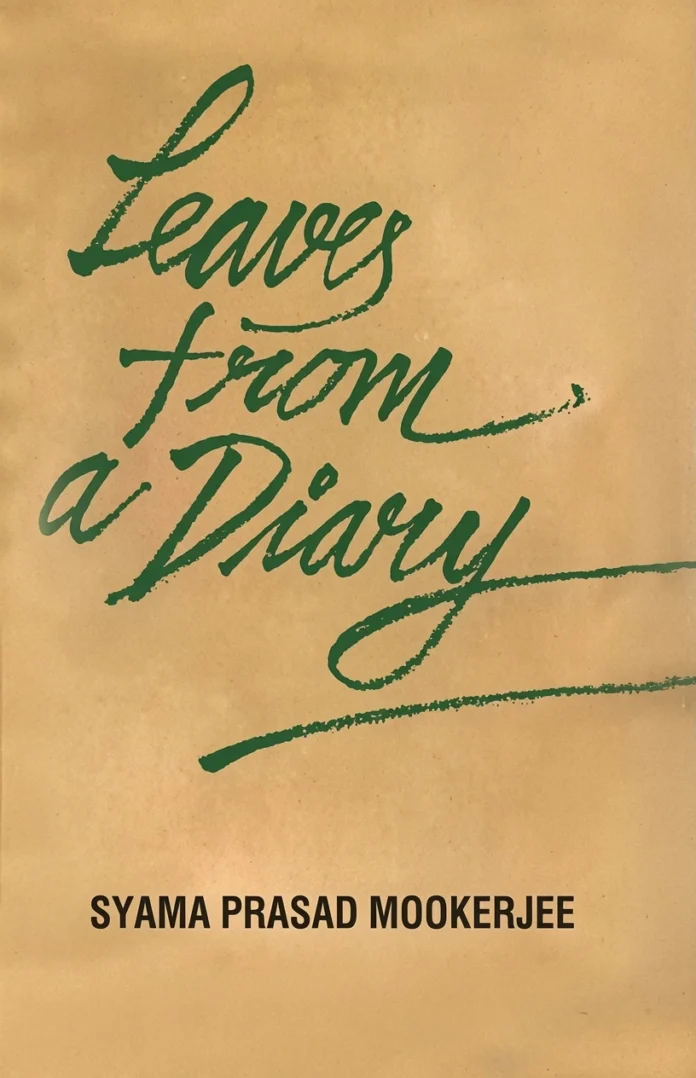
This forgotten diary illuminates our understanding of the pre-independence past and makes us ponder the arenas of nationhood and religion.
The diary titled ‘Leaves from a Diary’ by veteran leader Syama Prasad Mookerjee consists of his thoughts on political happenings, religion and nationhood, family affairs and reminiscences, minor daily occurrences, and the freedom movement. The diary was written in English, with later parts in his mother tongue, Bengali, where his thoughts are expressed with much freedom, touching on personal life. There are five letters in the appendix section that illuminate our understanding of Mookerjee’s reaction to the 1942 movement. Put together, they provide an intimate portrait of the Hindu Mahasabha leader who played a significant role later in the formation of the Bharatiya Jan Sangh.
The recollection of events and memories related to Mookerjee’s family, the text evokes a very tender note within the reader’s heart. He has poured out his heart in his mother tongue, as one would naturally expect. There is a great deal of nostalgia that Shyama Prasad must have felt while writing about his wife, whom he lost in the most unfortunate manner: pneumonia, as his biographer Tathagata Roy has pointed out. Just like C. Rajagopalachari, who also lost his wife quite early and never married again, Shyama Prasad had a similar inclination regarding a second marriage. Justifying his choice not to marry again, he wrote poignantly: “In 1933, when I lost Sudha, the pace of life had not become so hectic… The loss affected me more emotionally than physically. I am emotionally so dependent that I don’t find any stability unless I have someone by my side to lend me strength. I did not consider marrying again, not only because of my intense love for Sudha, but because I had my children’s welfare at heart.”
For Shyama Prasad, his father, Ashutosh Mookerjee, a well-known personality in Bengal, was his strength. His father’s role in shaping the course of his life could hardly be doubted. If not for his guidance, Shyama Prasad would not have become the youngest Vice Chancellor of Calcutta University, a post that was also held by his father, who was the first Indian to assume the position. Allegations of nepotism inevitably surfaced at his appointment, notwithstanding the fact that his father had passed away 10 years before he assumed the position. Shyama Prasad also recounts his early childhood days in Madhupur. Reminiscing about those days, he narrates how “food was cheap and plentiful,” and how his playful tricks of bursting the tires of a car owner’s vehicle enlivened his friends. His tone becomes full of grief when such thoughts lead him to reflect on what he has lost: “My grandmother, father, and elder sister were still alive.”
The stream of nostalgic reflections drowned him, coming as he was on the back of the Hindu Mahasabha’s defeat in the 1946 elections. The wound of defeat carries an extra edge due to the ‘remembrance of things past,’ to borrow from Proust.
Partaking in his poignant memories immediately assumes significant proportions when he despairs at the void that has shrouded him after the loss of Sudha, his wife. Now, books have become his companions. He would like a book buddy with whom he could discuss the content of the books he reads. Antu, his son, is the one with whom he shares his thoughts, but he is yet to mature. As Shyama Prasad writes: “He is intelligent but is not interested in studying regularly.” Shyama Prasad is very thankful to his elder sister-in-law, whom he fondly calls Boudi (elder sister), for giving his children motherly affection. He graciously recognizes her role in providing inspiration to him. Verily, she could feel his inner sentiments without Shyama Prasad voicing his inner agony. Shyama Prasad also acknowledges that he’s an introvert, one of the reasons why he’s recording a diary.
His introverted nature has quite hindered him from having a close friend in his life. The friends that he made in college have all gone their own ways. The meeting of friends brings in the realization of the deep chasm that has grown over the years. He gives words to the sentiment that: “I have made very few people who have associated with me without any personal motives.” His deepest urge is to have someone by his side who would treat him just as a human without any expectations. Voicing a truism, he writes: “Only a relationship bereft of all self-interest can be lasting.”
The question of faith, of belief in God, occupied a vital space in the thoughts of almost every major leader and thinker of the past century in India. The problem of man’s suffering, which is intimately connected with the belief in God, occupied the thoughts of Shyama Prasad too. He was no Buddha; he could not have contemplated being an ascetic. Like many freedom fighters of the time, he held Vedantic views, which are reflected in his simple solution to the problem of suffering. Shyama Prasad posits that it is ego, the “consciousness of ‘me’ and ‘mine’,” that is the root cause of man’s suffering. If it could be eliminated, his mind could attain peace. The lines of distinction—caste, creed, or religion—should not be taken into account. True fraternity would come when life is based on principles of “complete equality and unity.”
Unlike Hindu nationalist Savarkar, who had agnostic views on God, Shyama Prasad believed in the existence of God, though he didn’t have any faith in the theory of the reincarnation of gods. Indeed, he was not a devotee of any particular deity (though he prayed to Ma Kali), but he clarifies suddenly, lest he be assumed to be a Brahmo: “I don’t misunderstand those who do worship particular deities.” Echoing Vivekananda, he argues that an image of God may be helpful to the devotee to facilitate concentration. His religiosity leaned away from pompous rituals, as he believed in the simple power of prayer.
When one turns to Shyama Prasad’s political philosophy, one is bound to admire his intellectual vigor and vitality that underpins his views on nationhood. The Cripps Mission had to be rejected because it contemplated India’s vivisection, as he puts it. The nation was not merely a geographical expression; it was sacred. This sense of the sacred was not altogether absent in the Congress leaders of that time, but for Shyama Prasad, Congress failed to put up a formidable challenge against the scheme of Pakistan.
While Gandhi was prepared to give a blank check to Jinnah, Shyama Prasad was aghast at this attitude of servility that had affected him and the majority of the Congress members. Joining the Hindu Mahasabha meant a refusal to surrender to the whims of the Muslim League, whose demands expanded like the mouth of Surasa. He stoically accepted that the Hindu Mahasabha was not acceptable to the majority of Hindus, but he would still follow his duty: “I shall go on working according to the dictates of my conscience and shall strive to serve the country to the best of my ability. Perhaps everybody will not understand the joy one gets from working selflessly without an eye to the reward.”
There are moments of gloomy cynicism where, frustratingly, he asks Hindus to introspect: “What could be the future of a community that was blindly edging towards its own ruin; which took no pride in itself and fought shy of building a Hindu nation for fear of being dubbed communal?” The Hindus were themselves to be blamed for the pitiable situation they were in now. This did not deter him from vouching for the preservation of Indian culture if Hindus and Muslims could solve their differences amicably. Though he realized it was made difficult because Muslims had ruled over Hindus for 700 years, and despite most Muslims being Hindu converts, they wanted the resurrection of Muslim rule in the form of Pakistan.
The Hindus would have to think about protecting themselves from such fanaticism. The direct action day would later become a reality, proving him correct. He recounts in his diary how the Hindus of Dacca were treated by Muslims, but Congress remained utterly indifferent to their fate and made no efforts to check the fanatical outburst. He was oddly prescient in his claim that Congress would never be able to solve the Hindu-Muslim problem. With the establishment of Pakistan, Congress leaders naively believed the Hindu-Muslim problem would extinguish in the subcontinent. The four wars and innumerable terrorist attacks that Pakistan continues to fund against India show how absurd such a belief was and how Shyama Prasad’s oracle had turned out to be true.
For Shyama Prasad, without Hindu unity, nothing could be achieved. The differences of caste had made them weaker. Thus, “Until the Hindus of India realize that they are one, they will not be able to establish a Hindu state, gain sway, or build a nation. The great spirit of Hinduism could not flourish unless we effect a social and economic revolution.”
He wished to establish an organization that could serve Indian culture. He envisioned that organization to be ‘a center for the study of Sanskrit.’ This was to be done because ‘whatever is of abiding value in our culture is preserved in Sanskrit’ and so that the masses could access that vast repository of knowledge. The ill effects of Macaulayism in education and on Indian cultural identity are still very relevant and form a central point in the debates concerning decolonization. Shyama Prasad foresaw it, given he had been a Vice Chancellor of Calcutta University. For him, the Indian identity could rest solely and firmly on Indian culture alone. As he puts it: “This nation can never come into its own if its search for an identity is not founded on its own culture.”
The detractors of Shyama Prasad have left no stone unturned in portraying him as a betrayer of the national cause during the Quit India Movement and even as a sellout to the British government. Such a malicious hit job is enacted through the employment of selective quotations from his letters to the British governor. Take, for instance, how a small part of his letter to the governor of Bengal on 26 July 1942 is interpreted. One crucial detail that his detractors never mention is that this was written before the beginning of the Quit India Movement.
He writes, paying lip service to soothe the feelings of the governor: “Anybody who, during the war, plans to stir up mass feelings resulting in internal disturbances or insecurity must be resisted by any government that may function for the time being.” The detractor abruptly stops the quotation, implicating him as one who wants to enable government repression. The omitted next line, however, says: “But mere repression is no remedy when the promoters of the movement assert and make people believe that they too want to resist the impending attacks of the enemy, not as a slave country but as a free one; but the Ruling Authority is determined not to transfer real power to the children of the soil.”
Here, he clearly objects to such repressive policies of the government, and this, in effect, dilutes the first statement itself. Concealing his condemnation of repressive activities, the act of lip service is highlighted to demonize him. Further, the repressive policies of the government are mocked by Shyama Prasad as a “good model to those deeply attached to totalitarian rules of conduct.” Indeed, in the aftermath of the Quit India movement, he declares unhesitatingly: “We have as much right to throw off the yoke of British domination as England is anxious to save herself from Hitler’s profane hands.”
He doesn’t mince his words to Viceroy Linlithgow, exhorting him to grant “free political status immediately” to India. The cooperation with the Allied powers is made conditional upon the fulfillment of this objective. He also cautions the government not to paint the Congress demand as an invitation to Japan and further disorder and chaos. Indeed, the demands of Congress constituted “the national demand of India.” Shyama Prasad points out to the viceroy that it would be disastrous for the government not to deal with the real demands of the people. The duty to ensure there is no chaos didn’t fall on Congress alone, but on the British too, and “an immediate transfer is essential for the solution of the Indian deadlock.” The British are blamed for the chaos throughout the letter, and such unrelenting criticism of the government mounted by him has been given no importance by those who wish to discredit his ideology through incredulous slanders.
Shyama Prasad’s diary consists of one defect: barring Bose’s victory over Gandhi in the Congress election of 1939, much of the political events are narrated in hindsight. His procrastination and busy schedule hindered him from regularly updating the diary. Though he makes gigantic efforts in the diary to cover the defect with examples of the candid frankness that diaries are characterized by. His displeasure at Gandhi’s treatment of Bose goes to the extent of labelling it as ‘low type of Fascism.’ He also explains how his entry into politics came to be through the Secondary Education Bill, or as he terms it, the ‘Black Bill.’ Education had become infected with the virus of communalism and needed to be rescued. He also mentions Savarkar’s visit to Bengal and how “some of us were drawn to Savarkar’s influence.”
Shyama Prasad’s membership in the Hindu Mahasabha owed, at least partly, to the ideas of Savarkar. The political battles he fought with Bose’s Forward Bloc and the failure of the alliance between the two are described with frankness and honesty. The unusual alliance between the Hindu Mahasabha and the Krishak Praja Party under Fazlul Haq has been portrayed by Shyama Prasad as a heroic attempt to stop the Muslim League’s capture of the Bengal government and to promote cooperation between Hindus and Muslims.
However, one feels that political expediency may have been a chief factor in cementing such an alliance, since the ideological underpinnings of both parties were radically distinct. The reader finds in the diary how politicians navigate the pitfalls of politics. The devastation of the Bengal famine and its causes are analyzed with peculiar precision. Even the financial troubles that Shyama Prasad faced find mention in the diaries. He has also mentioned the lectures of Jiddu Krishnamurti, whom he found brilliant, but “there was not much in what he said.” The espousal of honesty surrounding the events of his life and the stormy events of the 1940s makes for brilliant reading.
There are few diaries of politicians from the pre-independence era that survive. Shyama Prasad’s diary is one of them. This feature renders it an absolute treasure trove. It consists not only of how he viewed the major political events and leaders of the country but also of the internal happenings of his soul. Its major strength lies in its uninhibitedness and unabashedness in expressing one’s feelings. Be that as it may, the gaze into the description of events in a diary is conventionally regarded as direct, immediate, and spontaneous. Most of the narratives in the diary have been written in hindsight, making it a weakness of the diary. Despite this limitation, one would readily admit that the portions dealing with his views on religion and philosophy make it a vital read for our times.