

*
This is the second in a series on how India elects and governs itself. The first, on voting systems, can be read here. This one takes up the anti-defection law and how it works with first-past-the-post and the parliamentary system. The next part turns to the judiciary.
*
In the last part, we saw how our Lok Sabha and Vidhan Sabhas, and equivalents in other extant democracies, are constituted through popular vote.
Before we discuss what these Sabhas do, a brief word about the ‘separation of powers’. This concept, usually traced to the French philosopher Montesquieu, is closely related to the ‘rule of law’ doctrine, and separates the powers of the State into three organs: one that frames laws (the legislature), one that “interprets” laws (the judiciary) and one that implements laws (the executive).
In India, the executive is the administrative machinery of our government, “led” by the council of ministers – headed by the Prime Minister in the Union government, and by the Chief Minister in the respective State. ‘Government’ is also sometimes used to refer to the executive alone – and sometimes even just its political leadership.
The legislature is the Parliament – the Lok and Rajya Sabhas – for the Union, and the Vidhan Sabha and the Vidhan Parishad (in States that have one) for the respective State.
India follows a ‘parliamentary’ system, where it is said that we have a ‘responsible’ executive. By ‘responsible’ executive, we mean that the council of ministers needs the ‘confidence’ of the Lower House of the respective legislature (Lok Sabha or Vidhan Sabha) to continue in office.
In contrast, in a ‘presidential’ system, the executive head of government is independently elected by the people for a fixed term. Removing them from office until this term ends is sometimes provided for as an extraordinary process.
As a quick example, let’s look at Britain, which has a parliamentary system. In 2024, the Labour Party won a parliamentary majority, making its leader, Keir Starmer, the Prime Minister. In 2026, Starmer stepped down amid dissatisfaction within the Labour Party, and Andy Burnham replaced him as Prime Minister without a general election. Labour still holds more than 400 of the 650 seats in the House of Commons (the Lower House of the UK Parliament).
Likewise, while the Conservatives secured a 360+ mandate in the 2019 election, Boris Johnson and later Liz Truss had to step down. Unlike Boris Johnson, who faced serious allegations of wrongdoing, Liz Truss lost the confidence of her parliamentary party over policy: her mini-budget had sparked market turmoil.
In contrast, the USA saw Obama administrations from 2009–13 and 2013–17, Trump administration from 2017–21, Biden administration from 2021–25 and they again have a Trump administration now.
This contrast illustrates the central feature of the parliamentary system: the executive’s survival depends on continuous support inside the legislature (and, more immediately, inside its own party). The Constituent Assembly regarded this continuous “accountability” as desirable.
Alladi Krishnaswami Ayyar warned the Constituent Assembly on 10 December 1948 that “an infant democracy cannot afford, under modern conditions, to take the risk of a perpetual cleavage” between the legislature and the executive — a structural hazard of a rigid separation of the two. Recent American experience has underlined the point. In 2023 the United States came within days of a sovereign default because the President and a divided Congress could not agree on raising the debt ceiling. As an aside, many presidential systems, notably the United States, intersperse legislative elections within the presidential term. These mid-terms can shift the balance in the legislature and sometimes ease a deadlock. Even when the mid-term expands the opposition, it serves as a public signal that can pressure the President to moderate or seek accommodation for the remainder of the term.
The Constituent Assembly’s choice of the parliamentary system was also shaped by familiarity: Indian elites who were in public life then already had experience of the Westminster model through the provincial legislatures and the limited responsible governments of the late colonial period. At the same time, the memory of the earlier Executive Council–Legislative Council arrangement — in which an unelected executive could ignore or override the legislature — remained a cautionary experience. The executive would, in a presidential democracy, be elected by the same citizenry, but once bitten, twice shy!
In the early 1950s, when we were a fledgling republic, Parliament largely gave Nehru’s government a smooth sail, though not without dissent, even from the Congress benches. During the debate on the First Amendment, Deshbandhu Gupta on 17 May 1951 opposed the curbs it placed on free speech, observing that the Prime Minister was showing little faith in the people of the country. On 21 September 1951, Thakur Das Bhargava called clause 4 the most contentious clause of the Hindu Code Bill. BR Ambedkar’s resignation from the cabinet that year is another early example of turbulence: his statement of 10 October 1951 faulted, among other things, the government’s handling of the Hindu Code Bill and its Kashmir policy. Article 35A was inserted subsequently, in 1954, by a Presidential Order, without being passed by Parliament. In the late 1950s, Atal Bihari Vajpayee and other Jan Sangh leaders and socialist leaders such as JB Kripalani repeatedly attacked the government on the China policy, corruption allegations and spiralling inflation.
The China policy drew criticism from within Congress as well. After Chinese troops overran the Longju post in August 1959, Ram Subhag Singh, a senior Congress MP, asked in the Lok Sabha whether the area could be bombed to win it back — talk that Nehru himself chided a fortnight later. In an even more telling example, when the Indus Waters Treaty was brought to the Parliament for “discussion” (not ratification), it saw scathing, open-floor criticism from within the Congress party, from leaders such as HC Mathur, and from the Praja Socialist Party’s Asoka Mehta, who as much as labelled it a “second partition” “reopening the wounds of 1947”. Pressure from within the party following the 1962 Chinese aggression led to having to replace VK Krishna Menon as defence minister.
The Indira Gandhi government again faced intra-party rifts. In 1969, when she moved to nationalise the major banks, Finance Minister and Deputy Prime Minister Morarji Desai opposed the step. He was stripped of the Finance portfolio; the banks were then nationalised by ordinance. The confrontation deepened the existing divide and soon led to the formal split of the party, with the Congress (O) breaking away from Mrs Gandhi’s leadership. All Congress MPs in that Parliament had been elected on the same undivided Indian National Congress ticket in 1967; yet after the 1969 split, the Congress (O) MPs sat on the opposition benches and voted against Mrs Gandhi’s Privy Purses amendment in September 1970.
Then while the 1971 war rallied nationwide support behind Mrs Gandhi, the Emergency followed a few years later, which saw Constitutional Amendments 38, 39 and especially 42, which considerably reduced parliamentary and judicial oversight on the government. The government repeatedly strengthened the Maintenance of Internal Security Act (MISA) through a series of amending ordinances, widening the power to detain persons without ordinary safeguards. In addition to opposition leaders, even dissenting Congressmen, such as Chandra Shekhar and Ram Dhan, who had criticised the leadership or resisted the Emergency measures, were jailed.
Post emergency, the Janata Party got a majority in the 6th Lok Sabha. It enacted the 43rd and 44th Constitutional Amendments, restoring parliamentary oversight. And then – the Janata Party split too!
Some years hence came a major turning point in our democracy: the Tenth Schedule of 1985. Added by the 52nd Constitutional Amendment, it is popularly known as the anti-defection law. In essence, it provides that a Member of Parliament or of a State legislature may be disqualified if he or she voluntarily gives up membership of the party on whose ticket the election was won, or – more significantly – votes (or abstains from voting) contrary to any direction issued by the political party to which he or she belongs. The decision on disqualification rests with the Speaker or Chairman of the House. The stated purpose was to curb the “aya ram, gaya ram” culture of legislators switching sides for personal or political advantage. The practical effect was to place a member’s legislative conduct under the formal discipline of the party.
There have been subsequent judicial interventions on the Schedule. In Prakash Singh Badal vs Union of India, a minority view in the Punjab and Haryana High Court observed that ‘If the expression : “any direction” is to be literally construed then it would make the people’s representative a wholly political party’s representative, which decidedly he is not.’ This was more significantly factored in by the Supreme Court in the Kihoto Hollohan case (1992), which held (1) that paragraph 7, which barred courts from reviewing disqualification decisions, needed ratification by the State legislatures and, not having received it, was invalid, making the Speaker’s decision subject to judicial review; and (2) that ‘any direction’ “would have to be limited to a vote on motion of confidence or no confidence in the Government or where the motion under consideration relates to a matter which was an integral policy and programme of the political party on the basis of which it approached the electorate”.
Yet the proof of the pudding is in the eating: in the decades since, this “integral policy and programme” test has remained largely unexplored, even at the Speaker’s level, let alone in the courts. In practice, the law has been wielded over votes on which a government’s survival turns. In February 2024, the Himachal Pradesh Speaker disqualified six Congress MLAs who stayed away from the budget vote, reasoning that the budget is business on which the government’s continuation depends. On ordinary bills, the threat alone does the work: few legislators dare test the Supreme Court’s ‘integral policy and programme’ carve-out. This is in stark contrast to the pre-1985 era, when Congress MPs openly opposed their own government on measures such as the Hindu Code Bills in the 1950s, and when MPs elected on the Congress ticket in 1967 could break away and vote against the 1970 Privy Purses amendment. Because the Speaker remains the sole initial judge of what counts as “integral policy”, and judicial review applies only after a member has already been unseated, no legislator dares test where the line is drawn: membership is forfeited until the judiciary arrives at a decision.
Most parliamentary democracies impose no statutory disqualification for defying a whip, treating party discipline as a political convention. Of the roughly 40 countries with anti-defection laws, most target members who leave their party rather than those who vote against it. Even where voting-based rules exist, as in Pakistan (Article 63A of the Constitution) or Israel (Section 6A of Basic Law: The Knesset, where the penalty is losing a place on the party list at the next election), they are typically confined to survival and constitutional votes. Papua New Guinea enacted a similarly limited restriction on votes to elect the Prime Minister, confidence votes, budgets and constitutional amendments (in its Organic Law on the Integrity of Political Parties and Candidates, 2001), only for its Supreme Court to strike down the voting provisions in 2010 as an unconstitutional infringement on legislators’ freedom of conscience. Such rules typically reach only votes of confidence and supply (budgetary matters sanctioning allocation of government funds) — the questions that directly determine whether a government continues in office. Speeches made on the floor of the House are almost never brought under the same disciplinary net. India’s Tenth Schedule goes further than the common international pattern: its text covers “any direction” of the party, and even as read down in Kihoto Hollohan, the threat of disqualification hangs over a member’s conduct far beyond the narrow class of confidence motions. Bangladesh, under Article 70 of its Constitution, is another exception placing very broad restrictions on legislators, and Fiji’s 2013 Constitution went the same way.
Fiji’s experience shows just how stubbornly such anti-defection rules can entrench themselves once enacted. Section 63(1)(h) of its 2013 Constitution automatically vacates an MP’s seat for voting or abstaining contrary to a party directive without prior permission, and the Constitution is shielded by Section 160’s extraordinary amendment threshold, requiring both a three-quarters majority in Parliament and approval by three-quarters of all registered voters. When Fiji’s elected coalition government moved in March 2025 to lower that threshold, its amendment bill secured 40 of 55 votes yet failed by a single vote to clear the 75 per cent bar. Only after Fiji’s Supreme Court read down those supermajority hurdles in August 2025, to two-thirds in Parliament and a simple referendum majority, could lawmakers move forward: on 2 October 2026, Parliament passed a replacement constitutional amendment bill at its second reading, setting the course for a national referendum.
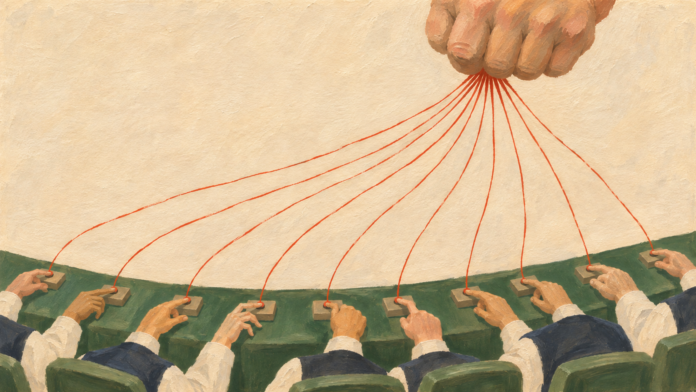
The anti-defection law was enacted in the name of stability. In practice it transferred decisive control over a member’s legislative conduct from the elected representative — and therefore from the voter who chose that representative — to the party organisation. An MP or MLA who votes against the party whip on a significant matter now risks disqualification.
After Rajiv Gandhi’s term ended, India entered a long phase of coalition politics. While the Tenth Schedule mandated discipline within each alliance partner, there was some room for divergent views between the alliance partners. From 1989 until 2014, no single party secured a clear majority in the Lok Sabha. In the meantime, the Vajpayee government tightened the law further through the 91st Constitutional Amendment in 2003, previously a split of one-third of party members at once into another faction would avoid disqualification from membership, post this amendment, only a merger with another party, backed by two-thirds of the legislature party, escapes disqualification.
Only in 2014 did a single party again obtain a majority of its own. That return of single-party dominance has brought greater governmental stability, yet it has also intensified the effects of the Tenth Schedule.
Political discourse has made even our largest political parties nearly synonymous with their one leader. Each side cultivates a sycophantic loyalty to its own figure while casting the other as a bugbear — presenting the opposing leader as an unacceptable risk. This is, in a sense, ‘polarisation’ playing out on a national scale.
The deeper consequence is a latent transfer of sovereignty. In a democracy, sovereignty is understood to vest in the people. In representative democracy, the elected representative is meant to carry that popular will into the State’s august portals of power. Under the present arrangement, citizens still elect a candidate, yet once elected that candidate’s ability to act on the floor of the House is governed less by the expectations of the constituency than by the directives of the party. Even if an MP receives representations from voters that run contrary to the party line, the Tenth Schedule and party discipline require the member to abide by the party’s will rather than the people’s. The vote that was cast for a person is, in significant measure, converted into a vote for a party machine.
A further consequence follows. When individual legislators retain meaningful autonomy, any interest seeking to shape legislation — domestic or external — must persuade or pressure a large number of independently minded members. Under the Tenth Schedule the decisive locus of power shifts upward. It becomes sufficient to convince a handful of party leaders who control the whip. The number of people who must be brought on board for a measure to pass shrinks dramatically, and with it the number of points at which it can be stalled or amended.
Observe the interplay of three design choices: first-past-the-post (FPTP), the parliamentary system, and the Tenth Schedule.
FPTP already makes it difficult for a new party or an independent to break through at the constituency level. Even when that barrier is somehow overcome, the parliamentary system and the Tenth Schedule together strip the victory of much of its force.
A candidate elected on a party ticket enters the House already bound by the Tenth Schedule. The law converts the elected representative into something closer to a party delegate: voting against the whip, or even sustained public dissent, risks disqualification. The member’s legislative will is subordinated to the party organisation.
An independent fares little better. In a parliamentary system the government commands the bulk of legislative time and the bureaucratic machinery needed to draft and pilot bills. An independent is almost automatically consigned to the opposition benches and to the narrow, precarious category of private members’ business. Private members’ bills receive little official drafting support and only a slender, easily crowded-out window for discussion. The independent may speak, but seldom legislates.
Thus the three elements reinforce one another. FPTP filters out most challengers. The Tenth Schedule disciplines those who enter on a party label. The parliamentary system marginalises those who enter without one. The citizen’s original choice — whether for a party candidate or for an independent alternative — survives only in attenuated form by the time it reaches the floor of the House.
The same triad raises a high barrier to entry for new political forces. In a more open system, the scale of the Congress’s defeats in 2014 and 2019 (and the parallel setbacks suffered by parties such as the Samajwadi Party and the Rashtriya Janata Dal) would ordinarily have created space for a new front to emerge and consolidate. Instead, the electoral arithmetic of FPTP, the organisational grip reinforced by the Tenth Schedule, and the marginalisation of any independent or fledgling group in parliamentary set-up combined to keep the field largely closed. The federal setup has allowed some alternatives — such as the Aam Aadmi Party and Tamilaga Vettri Kazhagam — to take root in individual States. At the national level, however, while the old parties were weakened, the path for new alternatives has remained narrow.
The upcoming Delimitation exercise may enlarge the total strength of the Lok Sabha. On the one hand, a larger House could ‘crowd out’ independents and smaller parties, on the other, it also raises the theoretical possibility that a greater absolute number of independents could, if elected, begin to coordinate among themselves and exercise a collective voice.
The design of the ballot and the design of the legislative process are therefore not separate questions. Together they determine how much of the citizen’s original choice survives the journey from the polling booth to the floor of the House.
In the next part of this series, we will examine the interplay of the legislature and the executive with the third organ of the State: the judiciary.
