

From the 90s Pandit massacre to the 2025 Pahalgam target killings of Hindu men and now the November 2026 Kulgam attack; this article highlights the real architecture of Pakistan-sponsored terrorism that extends far beyond the gunmen born out of poverty and state-sponsored apartheid cries.
It is sustained by finance, local civilian support, high-ranking societal status, and, most importantly, an ideological cause with spiritual benefits in the afterlife, which has created an ecosystem that has repeatedly adapted to India’s counter-terrorism operations.
There’s a persistent analytical error in discussions of terrorism in Kashmir; it tends to measure the threat primarily by counting the number of armed militants still at large. That metric is incomplete.
A terrorist organisation does not disappear when its gunmen are eliminated; instead, it can regenerate itself through facilitators, financial channels, ideological recruiters, cross-border handlers and civilian support networks that allow its remaining operatives to survive, strike and disappear.
Lashkar-e-Taiba (LeT) understood this architecture decades before the term hybrid terrorism entered India’s national security academic vocabulary. The Kulgam attack on a Central Reserve Police Force (CRPF) checkpoint on 11 November 2026 near Mir Bazar is the latest reminder of this issue.
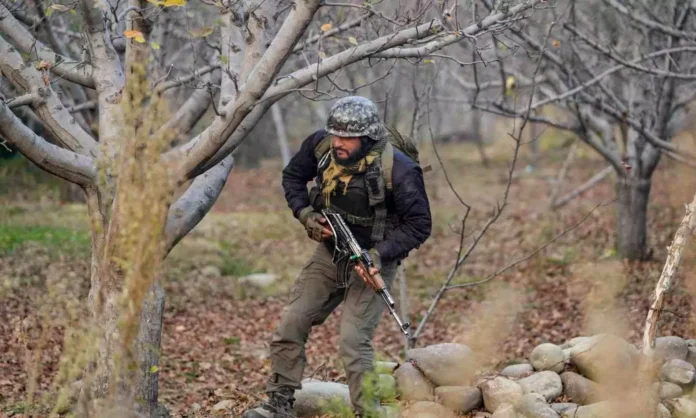
Preliminary reports suggested that two heavily armed attackers emerged from a wooded area around 2:15 pm and opened fire on personnel of the 46th Battalion. Later, ThePrint and Oneindia reported that the attackers came on motorcycles, whereas some reports also suggested that they were three and, of the three, two were allegedly foreign.
Three CRPF jawans were injured. One of them, Constable Santosh Chandru, was reported to be in critical condition. The attackers escaped through the dense forest. Prominent media outlets like India Today and The Times of India reported that investigators recovered cartridge casings matching earlier incidents and a Motorola phone with a SIM card.
Two days earlier, a Class 10 student had approached the same checkpoint and warned the personnel, according to an India Today article: “Hum tumhe chhodenge nahi”, literally meaning “We will not spare you”. The same was also noted by Aaj Tak Hindi, Dainik Jagran and other regional media such as the JK Media.
After the attack, security agencies identified Mohammed Lateef Bhat, a 22-year-old, son of Mushtaq Ahmad Bhat of Khrewan Chader, Kulgam, as the prime suspect in the Mir Bazar attack and one of the last active local militants then operating in the Valley. He studied at Government Degree College, Kulgam, then worked as a carpenter and glazier before going missing in November 2025. Later that month, the Kashmir Revolutionary Army (KRA), widely judged to be a LeT proxy like The Resistance Front (TRF), announced in a poster that Lateef had joined it. It was also reported that Lateef was influenced by the late LeT commander Zakir Ahmad Ganai and linked to Pakistan-based handlers. Police say his associate Umar Nisar Dar, a local baker whose family had reported him missing, sheltered him for nearly six months
On 12 November, NDTV reported that Lateef specialised in shoot-and-scoot strikes with an AK-47, relied on overground networks for shelter and movement, and carried a Rs 15 lakh reward. The National Investigation Agency (NIA) also visited the site and questioned suspected overground workers, Greater Kashmir reported. On 16 November, security forces killed Umar, suspected of joining Lateef in the attack, in an encounter at Laroo in Kulgam. Lateef escaped, but was killed two days later, on 18 November, after he took shelter in a mosque in Zangalpora, Devsar.
Before liberals grow emotional over a 22-year-old Kashmiri boy, they should note this: Lateef was not driven by poverty; he went to college and had a trade. The pull, for him, was ideological. It is not a baseless acquisition; the groups will not induct anyone unless they believe in their philosophy and recite the shahada. Thus, Lashkar’s Ahl-e-Hadith framework presents the fight against Indian forces in Kashmir as a religious obligation: this life is a temporary struggle; the permanent reward is Jannah for those who wage Jihad.
One must focus on the spiritual calculus and not just the economic grievance, as it explains why a college dropout from Kulgam, or an educated professional elsewhere, can be drawn in to do jihad. A recent example is from Pune. An anaesthetist with a Doctor of Medicine, Dr Adnan Ali Sarkar, was sentenced to six years in November 2026 after pleading guilty to radicalising youth and furthering ISIS activities under the guise of religious preaching.
So if one understands the pattern, Lateef is neither the first nor the last.
The same ideology or mindset that animated the local facilitators during the 1990 Pandit exodus, the harbourers who paid a few thousand rupees in Pahalgam, and residual stay-behind modules in South Kashmir continues to regenerate cadres; these remain investigative patterns. The bigger question is how such operatives keep functioning.
Overground Workers (OGWs) provide the non-combat support without which armed militants cannot operate for long. They also support by providing accommodation, transport, food, cash in hand or crypto, communications, local intelligence and escape routes, which are effectively part of it. The economy that fuels this terrorism business also has a so-called spiritual essence.
Thus, OGWs rarely carry weapons. Their value lies in remaining below the threshold of conventional detection. This is not unique to Kashmir alone. Every sustained insurgency has relied on civilian facilitators. In Kashmir, the requirement became acute in the late 1980s when foreign militants needed local guides, shelter and knowledge of security deployments. The spiritual essence of these attacks became a chronic cause, with sermons by muftis and maulanas; for example: Jaish-e-Mohammad (JeM)’s Maulana Masood Azhar and Abdul Rauf Asghar (Mufti Rauf Asghar), accused in the 2001 Indian Parliament attack, 2016 Pathankot attack and 2019 Pulwama attack; Zaffar Hussain Bhat (Mohd. Zafar Khan / Moulvi / Khursheed Ibrahim) accused under UAPA for serving as Hizbul Mujahideen’s deputy chief and financial handler, allegedly coordinating militant operations in Jammu and Kashmir and transferring funds to operatives in the Kashmir Valley.
The Kashmiri Pandit exodus of 1989–90 remains the most searing illustration. The assassination of BJP leader and advocate Tika Lal Taploo on 14 September 1989, followed by the killing of retired judge Justice Neelkanth Ganjoo on 4 November 1989, signalled that prominent members of the community were fair game. Targeted killings, threats and the collapse of security produced a rapid flight in January 1990. Estimates of those displaced range between 1 lakh and 1.5 lakh. Indian Express article stated that the role of militant organisations and their collaborators was already documented. Thus, what could be allegedly deciphered is that the infrastructure of intimidation and facilitation was already in place.
Security forces of India improved their capacity through the 1990s and 2000s; LeT and other such groups adapted to such developments. Large groups of foreign militants became harder to sustain. Smaller modules, individual local recruits and hybrid operators who could maintain civilian appearances became more valuable.
Therefore, yes, an OGW may never fire a weapon, but a hybrid operative may live among the population and participate in attacks when activated. Hence, both categories explain why simply counting active militants understates the residual threat.
LeT has never been a purely or ordinary territorial separatist, nor what their “secular-named” youth-led fronts such as KRA and TRF call themselves, a “revolutionary” group. Founded in the late 1980s as the militant wing of Markaz-ud-Dawa-wal-Irshad and rooted in an Ahl-e-Hadith orientation, its leadership has repeatedly articulated a broader Islamist agenda aimed at India as a whole.
Hafiz Muhammad Saeed’s statements are on the record. In 1999, he declared that “jihad is not about Kashmir only” and spoke of breaking up India. In 2001, he said the struggle would continue even after Kashmir’s “liberation” because “we still have to take revenge for East Pakistan.” These declarations are examined in Carnegie Endowment’s March 2012 study titled The Menace That Is Lashkar-e-Taiba, and in a compilation of his anti-India rhetoric by the Counter Extremism Project.
This is not just anti-India rhetoric but anti-Hindu too. On 22 April 2025, terrorists attacked specifically Hindu tourists at Baisaran near Pahalgam, killing 26 people. Survivors reported that attackers asked about religious identity and, in some accounts, demanded recitation of Islamic declarations. In July 2025, the United States designated TRF as a Foreign Terrorist Organisation and Specially Designated Global Terrorist, explicitly describing it as a LeT front and proxy.
The overground network once again proved decisive. The National Investigation Agency (NIA)’s 1,597-page chargesheet named Lashkar-e-Taiba and The Resistance Front as legal entities, identified Pakistan-based handler Sajid Jatt (Habibullah Malik), named the three Pakistani gunmen later killed in Operation Mahadev, and charged two residents for harbouring the attackers.
According to the NIA chargesheet, Parvaiz Ahmad Jothar and Bashir Ahmad Jothar (two local pony riders) knowingly harboured the three Pakistani terrorists the night before the attack, provided them food and shelter in a seasonal hut near Baisaran, and shared details of security deployments. For this assistance that enabled the selective killing of 26 people, the terrorists paid Parvaiz Rs 3,000.
Twenty-six lives priced at Rs 3,000. The gunmen came from across the border; the final, indispensable link that made the cheap slaughter possible was allegedly local will.
This is the true measure of the OGW problem: not abstract ideology, but the cold commercialisation of betrayal at a price so low it insults the dead.
Recently, Pasdaran-e-Hurriyat Kashmir (PeHK)—which translates to “Guardians of Freedom”—is a newly floated, virtual propaganda front used by Lashkar-e-Taiba (LeT) handlers under a fabricated spokesperson named Mohammad Omar Azzam to issue anti-state threats, portray cross-border terrorism as local resistance, and divert intelligence attention away from key ground operative Lateef. It works alongside sister proxies like TRF and KRA. Indian assessments and the US designation treat TRF as a LeT proxy. Thus, changing names from communal to secular ones, such as TRF and KRA, is a standard technique to create deniability and present the act of violence centred around local grievances; on the contrary, the attacks are ideologically motivated and well calculated based on the group’s philosophies as discussed above. The elements that are interwoven in the core philosophies of each of these groups are “India out from Kashmir”, “Kashmir is muslim land/Palestine of the East”, India is the Hindutvawadi aggressor like Zionist Israel.
Therefore, an operative like Lateef offers youth’s zeal, physical power, geographical familiarity and social access. In recent years, there has been a significant drop in militant activity which is indeed a security achievement; however, this does not mean that the infrastructure has disappeared.
No terrorist organisation can sustain operations without money. Historically, channels have included hawala via Gulf and Southeast Asian routes; front charities that solicit zakat donations and local collections have also been diverted to such ideologically motivated Islamist groups. Small transactions can sustain clandestine networks when distributed across intermediaries. Thus, financial investigation must accompany kinetic operations; otherwise, one cell is disrupted while the pipeline remains. This situation also highlights the immediate need for FCRA 2.0 which will trace the use of Gulf and Zakat money, and where it actually bleeds.
Nevertheless, a technologically advanced channel has also emerged along the international border, that is, the use of drones to drop narcotics and ammunition. This phenomenon has become very common, for example several incidents in 2025 and 2026, particularly in the Jammu sector (Arnia, RS Pura and Samba), security forces recovered consignments of heroin, opium, pistols and ammunition that were air-dropped from across the border. Police investigations have linked some of these modules to Pakistan-based handlers.
While these operations are geographically concentrated near the Jammu border rather than in the South Kashmir hinterland where Lateef was active, they form part of the same larger ecosystem. Narcotics provide funds, weapons and ammunition sustain the remaining armed modules of groups like LeT. The method reduces the need for traditional infiltration and further complicates interdiction.
It is another illustration of how the support infrastructure continuously evolves even as the number of local gunmen declines.
Recruitment combines ideology, personal networks, propaganda and, at times, coercion. LeT’s framing of the conflict as a religious obligation against India is designed to radicalise; however, most Kashmiri Muslims reject this narrative.
Effective counter-terrorism depends on distinguishing active facilitators from the broader population. Collective suspicion is both unjust and counterproductive.
OGW networks are often decentralised and compartmentalised. One person may provide a room without knowing the ultimate commander. Another may pass information without participating in an attack. This fragmentation makes the problem persistent and explains why sustained intelligence, financial tracking and credible prosecution matter more than episodic cordon-and-search operations alone.
The pattern has become unmistakable. The 1990 exodus showed what targeted intimidation and local facilitation can achieve. In 2025, Pahalgam showed that religious selection of civilian victims remains part of the repertoire, and that the overground network that made the massacre possible could be bought for a few thousand rupees. Kulgam shows that even a small number of remaining local operatives, supported by overground networks and guided by LeT’s long-declared ideology, can still strike security forces.
LeT has repeatedly stated its motivations. Its proxies rebrand. Its financial and logistical networks adapt. The gunman is the visible face of terrorism.
The OGWs, the supporters of such Islamist groups who live among ordinary Kashmiris and share the belief that Kashmir and India are two separate entities, are the most enduring machinery. Until that machinery—ideology, money, facilitation and cross-border command—is dismantled with the same determination applied to the armed operative, the pattern will continue to reappear.
The task is not collective punishment. It is systematic, evidence-based dismantling of proven networks while protecting the vast majority of ordinary citizens who want nothing to do with terrorism.
Anything less would leave the overground shadow intact.