

Not everyone goes to the mandir to worship god? This was the question that arose in my mind when my landlord’s daughter asked me to accompany her to a Gurudwara. ‘It’s a place where we pray, Suraj. It’s a place of remembering Sri Guru Nanak Sahib’, she said. ‘You’ll get langar there. Ghee wala suji ka halwa and sharbat, too’. ‘Waheguru di sau,’ she added. And I went with her.
When I returned home, I asked my mother, ‘Why do our landlord’s family visit the Gurdwara and not the mandir to worship god?’ My mother replied, ‘Because their dharma is different.’ ‘Dharma, what is that?’, I said. ‘Those who believe in Waheguru are Sikhs, and those who believe in Shivji are Hindus,’ my mother told me.
‘So, when we “believe” in something, it becomes our dharma?,’ I curiously asked my mother. ‘And also, if I pray to Waheguru and eat the halwa, will I also become a Sikh?’ She laughed and said, ‘No, no. The family someone is born into becomes their dharma. Our family belongs to the Hindu dharma, so your dharma is also Hindu’. ‘Anyway, you don’t need to change your religion just to eat halwa. You can go to the Gurudwara whenever you feel like and eat it,’ my mother concluded.
I was relieved. I smiled and jumped with happiness. I was 7 at that time. It was the first time that I had heard the word dharma.
Two years later, I remember it was on Dusshera that I again came across this term. I was watching the Aaj Tak news channel, on which there was a programme going on featuring an Astrologer. In the programme, the Astrologer said that Dusshera signifies the victory of dharma over adharma.
When I heard this, my definition of dharma took a pause. I got into thinking that, wasn’t dharma just about believing? And also, what was this new word, adharma, now? Something wasn’t adding up. Astrologer came of help. He said Ravana did wrong, and so he was killed and added that Ravana was an unrighteous and sinful king. That Ramji freed the world from Ravana’s tyranny and adharma. These sentences of his changed my definition of dharma to ‘righteousness’.
As a result, supporting what is right is dharma. Stopping what is wrong and doing what is right for everyone is dharma. These phrases occupied my conscience strongly.
In my seventh class Mahabharata became a part of my school syllabus; and like this, dharma struck me for the third time. This time, in the strongest possible sense.
1,660,020,000 (1.6 billion) people are said to have been killed in the Mahabharata war. The war was ultimately fought over who would rightfully inherit and rule Kurukshetra. The Pandavas could have avoided this destruction by renouncing their claim and stepping away. How could this mass killing be justified?
Duryodhana was cruel as a person, but as a king, there is no mention that he wasn’t fulfilling his duties. Then, how can he be declared wrong? What was dharma in this situation?
If the war was fought in the name of dharma, did the lives of so many people not matter? Isn’t dharma supposed to be about what is right for people and the greater good of society? What exactly is meant by dharma?
I was trapped.
Śānti Parva, Chapter 110, verse 11 of the Mahabharata says this for dharma:
dhāraṇāt dharmaḥ iti āhuḥ dharmeṇa vidhṛtāḥ prajāḥ
yat syāt dhāraṇasaṃyuktam saḥ dharmaḥ iti niścayaḥ
Meaning:
Dharma is so called because it sustains; it is that which upholds all beings.
The word dharma comes from the root dhṛ (धृ ), meaning to hold, support, or uphold.
In Sanskrit, dharma is defined by the aphorism ‘Yaḥ dhārayati saḥ dharmaḥ’—that which sustains is dharma.
Dharma is not a set of pre-defined rules, ideology, or hypothesis; it is the ‘underlying principle’ (for lack of better words) that ‘sustains’.
But, it sustains what?
Let’s understand through an example. In the human body, countless processes happen at the same time. The heart circulates blood. The blood supplies oxygen and nutrients to more than 30 trillion cells, which perform their microscopic functions continuously. Other organs coordinate seamlessly with one another, each supporting and regulating the others as part of a ‘unified whole’.
Life continues because all these parts remain aligned in a subtle harmony. Their activities are interconnected. Together, they maintain balance, uniformity and continuity.
And this ‘underlying principle’ – the harmony, design, and functional blueprint that allows each part to serve the ‘whole’ to sustain the body – is what can be understood as dharma.
To be specific, dharma is the principle that sustains a system by guiding each component toward its proper function to achieve a goal.
When dharma operates through an individual, it is called ‘svadharma’. Svadharma consists of the specific roles, responsibilities, and duties an individual must fulfill to sustain the cosmic order, constituting their unique contribution to the grand design. Just as the svadharma of the heart is to pump blood to sustain the body, the svadharma of an individual is to uphold their ‘specific position’ to sustain the whole.
What is that specific position?
Bhagavad Gita 18.41 says:
Brāhmaṇa-kṣatriya-viśāṁ śūdrāṇāṁ ca paran-tapa
karmāṇi pravibhaktāni svabhāva-prabhavair guṇaiḥ
Meaning:
O Arjuna, the duties of Brahmanas, Kshatriyas, Vaishyas, and Shudras are divided according to gunas born of their svabhava.
Svabhāva means one’s inherent nature—the natural qualities and tendencies —that arise from one’s inner constitution.
Just like the nature of fire is heat, the nature of water is coolness, and of air is movement. Similarly, the svabhav of humans is decided by guna and karma and is independent of the family someone is born into or the people they are surrounded by.
It is when the identification of the self happens according to the gunas and karma. It creates duties for the individual.
If a person says, I am a teacher. Then his/her dharma is to educate and share knowledge. He can’t let go of the duty which he himself identifies with. If a person is identified as a father, his duty becomes to nurture and grow his children. Here, in all, the identification isn’t based on thinking or belief, but gunas and karma.
When two people come together with a goal to lead life, to support each other in tough times and to celebrate happiness. Each partner sustains the relationship by fulfilling their svadharma. If either of them betrays or withdraws from their responsibilities, the relationship eventually ceases to exist, and the goal isn’t achieved.
If the goal isn’t achieved. Then, the impact will not just be on them but their children, parents and close relatives as well. We can look at this as a failure of the ‘microsystem’. And if this repeats on a mass scale, the entire system of society will collapse. We know the amount of pain and suffering a child has to go through if, for any reason, his/her parents are separated.
Society is a complex system. Each part does its function and nothing exists in isolation. Four forces constitute a society: power, wisdom, wealth, and service. When these four move in harmony, the social order remains in place. When they get separated, the decay begins.
The Kshatriya represents power — the courage to act and the will to protect. But power cannot decide its own direction. It needs clarity. That clarity comes from the Brahmana — the voice of knowledge and conscience. Knowledge and conscience that never steps into reality becomes fragile. So, it needs resources. These resources come from the Vaishya — the creator of wealth. Then, it is the wealth that keeps society breathing. But if wealth becomes the goal instead of the service, it slowly starts controlling everything. Lastly, the Shudra grounds this entire structure through action and skill.
Ideas, protection, and wealth mean little if no one carries them into reality. There, service is what makes society functional. In a nutshell, these are not four separate groups — these are four necessary principles.
The strength of society does not lie in equality of roles, but in harmony of roles. Each must stay connected to the others.
When each force acts in harmony, aligned with its svadharma, the entire system remains harmonious. The goal of an ideal society is to create an environment that provides security and resources to everyone. Where every person performs different duties that are interconnected, which provide protection, knowledge, food and support.
So that people could shift their consciousness from survival to expression of art, music, philosophy and ultimately shift their consciousness towards self-realization.
Coming to the moral values. Moral values are the principles that keep any society functional. Just like the immune system of the human body.
A society where women are not respected, unequally treated, or limited to as objects of pleasure, that society is bound to fail. Such a society will lack expression of feminine energy like love, care and softness – the tools of healing.
It is the responsibility of the masculine energy to offer the seed and to consciously root itself within the feminine field, creating the ground upon which she can fully unfold and express her creative power.
Within her resides the Shakti — the sacred capacity to receive a single seed and transform it into living existence. What enters as potential, she nurtures into life. From her depth, a new being takes form and is born into the world. The Ardhanaarishwar form of Lord Shiva is what you should consider to understand what I mean.
You know what would happen if even a single cell out of 30 trillion cells that we talked about earlier started behaving independently and not aligned with the whole system? With an aim to grow and make more like it, in medical terms, that condition is known as ‘cancer’.
In terms of human beings. When a community or group of people with certain beliefs aim to break the harmony with other people and with the aim to make more people like them, using any means, which can involve killing or essentially doing something that harms the dharma of others, are the cancers which need to be treated, or else the whole system will collapse sooner or later.
There, it becomes the ‘svadharma’ of each person to stand against the thoughts, beliefs, and actions that are like cancer to the system.
Many say our svadharma is not perfect.
Bhagavad Gita 18.47 says:
śreyān sva-dharmo viguṇaḥ para-dharmāt sv-anuṣṭhitāt
svabhāva-niyataṁ karma kurvan nāpnoti kilbiṣam
Meaning:
Better is one’s own duty, though imperfect, than another’s duty well performed. By acting according to one’s own nature, one does not incur fault.
The real meaning here is about alignment. Every being has a certain nature, a certain responsibility within the larger order. Harmony is preserved not when everyone tries to do the most impressive role, but when each fulfills the role that truly belongs to him/her.
Imagine a system where the heart refuses to pump because it envies the brain. The body would not admire its ambition — it would collapse. The cells would be deprived of oxygen, and life would slowly fade. The heart may not be perfect; it may beat slowly or irregularly. Yet as long as it performs its essential function, the system survives.
The point is that everyone should perform their duties. Not influenced by others, they have to be aligned with their own nature. When this happens, the dharma manifests itself.
Human societies have witnessed endless wars, crimes, and destruction. There have been times when people of certain beliefs committed atrocities against those of other beliefs, just to fulfill their animal instincts and selfish desires and were willing to cross any limit for it. And they still are.
Yet, despite all of this, societies have survived to this day. A resilient society has emerged—far better than the past. There is something that never allows societies to completely vanish. Something that protects dharma.
A state of consciousness—that manifests itself to protect dharma. The one whom the Hindu scriptures describe as the protector of this universe: Shri Hari Vishnu.
Bhagavad Gita 4.7 says:
yadā yadā hi dharmasya glānir bhavati bhārata
abhyutthānam adharmasya tadātmānaṁ sṛjāmy aham
Meaning:
Whenever there is a decline in (Dharma) and a rise in (Adharma), O descendant of Bharata, at that time I manifest myself.
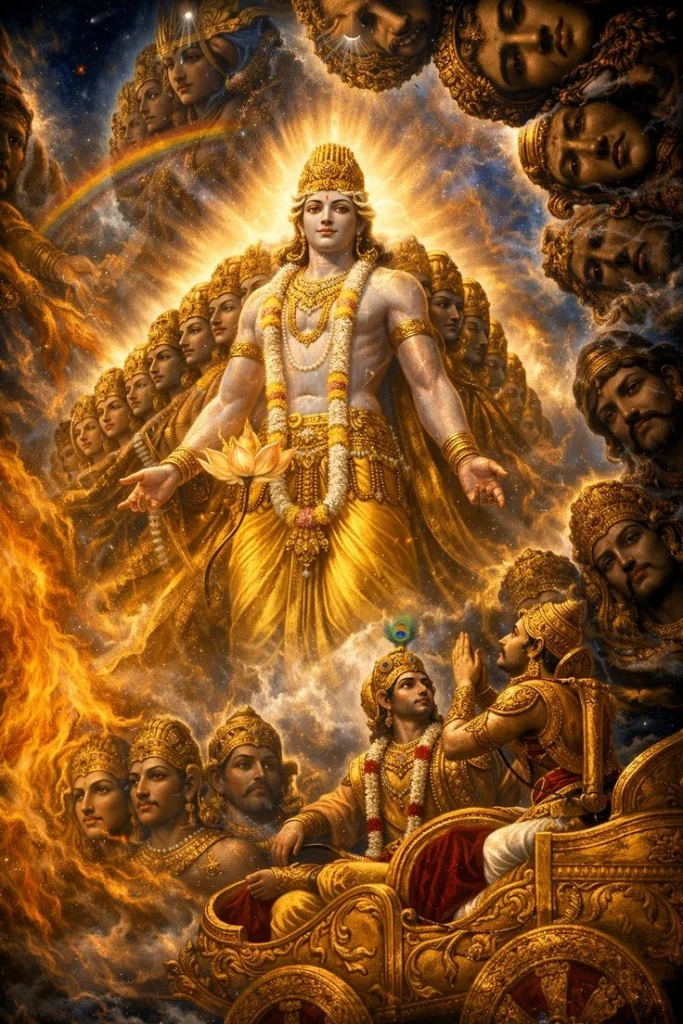
Whenever, for some circumstance, the dharma is not able to sustain itself, the protector of the universe, Shri Vishnu, takes forms and manifests himself.
The manifestation depends upon how severe the level of adharma is. As described by my Guru, Shri Krishna was not a human; it was Param Brahma manifested in a human body. But that event is extremely rare and only happens when dharma comes to the verge of extinction.
But it (since it’s not a human) can manifest itself in almost any form. It can manifest as a thought in some people, as a desire in some, as a purpose in some, and it could manifest itself as a personality in some people, too or if it wishes or when needed, manifests itself in the form of a human as well. Lord Ram, Lord Parshuram and Lord Krishna, to name some.
But it, without fail, manifests itself.
Such is His glory that merely by the touch of His lotus feet, life is able to sprout in this mundane world.
