

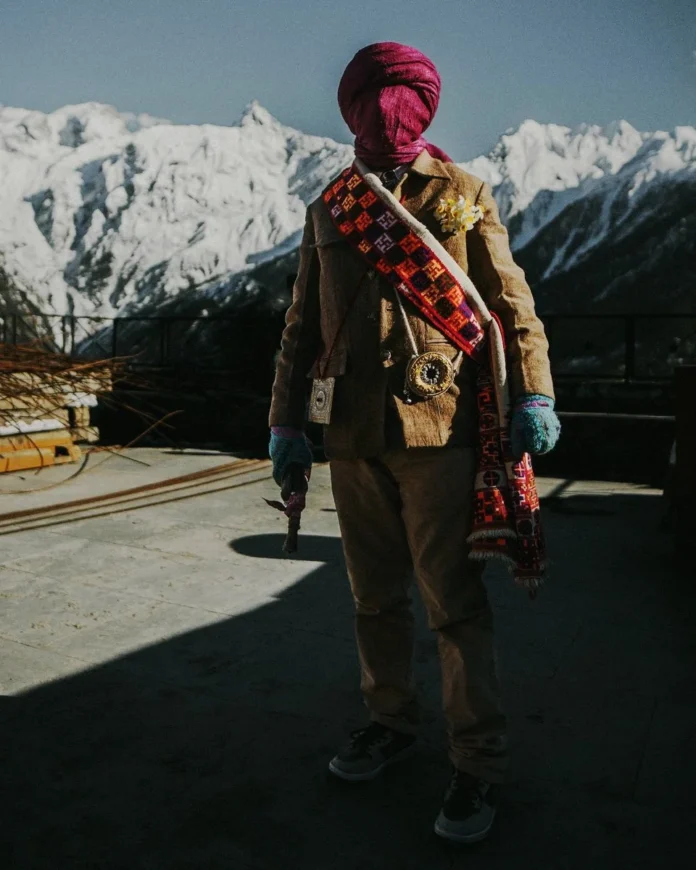
Faces hidden, yet the Himachali aesthetic alone steals the show. In November 2025, these words, paired with mesmerising photographs, flooded timelines across Instagram, X and YouTube shorts.
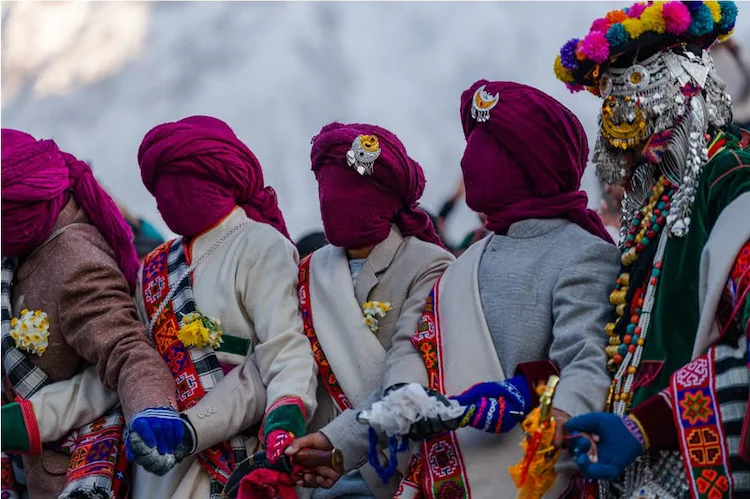
Captured were the enigmatic figures draped in vibrant Kinnauri Pattu shawls, layered with heavy silver jewellery and crowned with flowers, while their faces remained hidden behind the deep red gacchi (a cloth used to cover the face), which quickly captured the attention of the internet. The mystery was intoxicating: who were these people?
Within days, reels racked up millions of views. ‘Himachali aesthetic goals’, ‘Mountain fairies IRL’, ‘India’s hidden gem’ – comments poured in by the culture buffs.
What no one anticipated was that this sudden spotlight would begin to reshape a ritual that was never meant for public spectacle.
A tradition, preserved for centuries in the mountains of Kinnaur in Himachal Pradesh, performed quietly for the spirits of the land and the local community, was suddenly pushed into the glare of viral attention. The name was Raulane – a nearly 5000-year-old winter festival celebrated in Kalpa, Kinnaur district of Himachal Pradesh.
For me, some traditions and festivals are better left away from the spotlight. The moment they come into the public glare, it becomes content. And so, I view this festival going viral as a tragedy.
Why? To understand the tragedy, one must first step into the world of the villagers that the festival protects. Raulane is not a ‘festival’ in the modern sense of lights, music and tourism. It is a ‘living ritual’, rooted in the oral memory of Kinnaur’s people.
Local belief holds that every alpine meadow (high-altitude grasslands), known as a Kanda, has its own guardian spirits called Saunie, often described as mountain fairies and that these spirits protect their villages, people, their fields and their animals from natural calamities and harsh mountain conditions.
According to village lore, these spirits descend from the high meadows and remain with villagers throughout the harsh winter months. When the season of Holi approaches and the snow begins to recede, Saunie are believed to return to the higher pastures. The ceremony is distinctive.
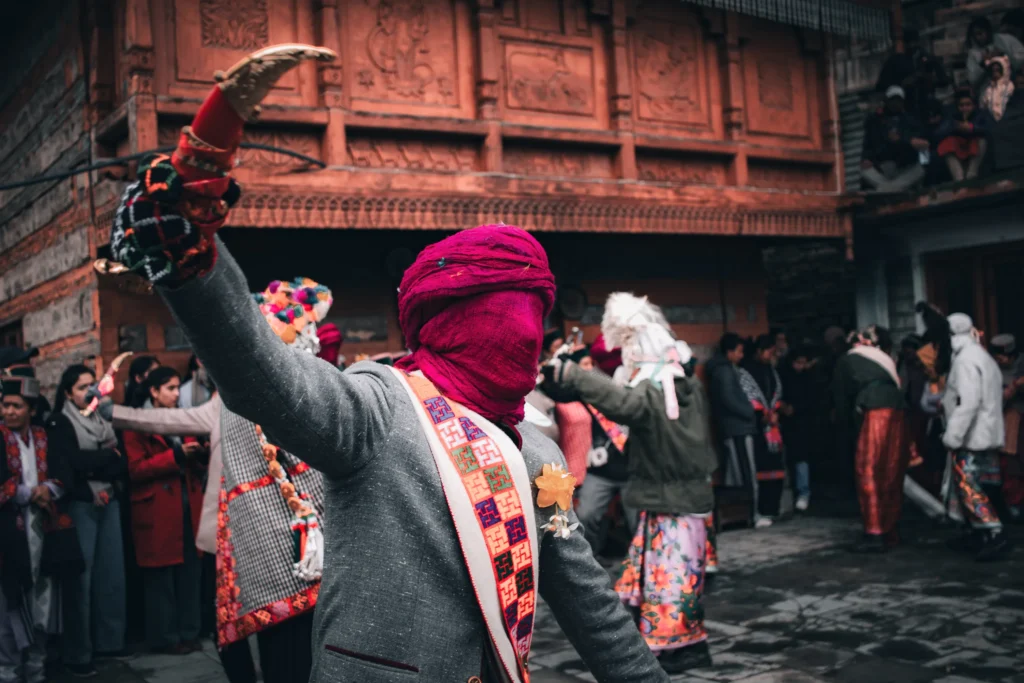
Only men participate, but they appear in the full attire of Kinnauri women – pattu (waist shawl), doru (Kinnauri shawl), choli (coat-like top) and traditional jewellery. In this role, they are called Raulane (bride). Their counterparts, known as Raula (groom), cover their entire face and body with a red cloth called gacchi, ensuring complete anonymity.
Why anonymity, you might wonder? The villagers believe that if a spirit made direct eye contact with them, then the spirit might become attached and would take them along or bring misfortune. Now, just think up to the level to which this anonymity has been breached after the arrival of the content creators.
The ritual unfolds around the village deity temple in Kalpa, Kinnaur, where prayers, rhythmic dances and community participation transform the space into a living expression of Kinnaur’s indigenous worldview.
By early 2026, as the festival neared, the shift was visible. Homestays in Kalpa were booked out months in advance. The usual suspects: influencers from Delhi, Mumbai and beyond arrived. Drones hovered over the temple. Creators pushed cameras in the faces of dancers and blocked space for locals. They literally hijacked Raulane – streets packed, sacred spaces crowded, instructions ignored. What was a 5-7 day community event became a backdrop for ‘aesthetic’ content. Locals who once danced freely now navigated through selfie sticks and 360-degree rigs.
A ritual once performed in gratitude to the mountain spirits protecting the valley through winter was now reduced to content fodder. The anonymity meant for spiritual immersion, faces hidden behind the red gacchi, was constantly broken by outsiders asking for ‘one more shot’, turning a sacred tradition into a spectacle for reels. One can only imagine what the locals must have endured while witnessing this entire spectacle unfold before their eyes.
The problem is not limited to Kinnaur. Across India, several sacred spaces are facing the same takeover. Rituals turning into spectacles once they become viral content. Take Dev Deepawali in Varanasi. Celebrated on Kartik Purnima, it commemorates the victory of Lord Shiva over the demon Tripurasur. Traditionally, known as the ‘Diwali of the Gods’, the festival once reflected ‘quiet devotion’ where thousands of diyas illuminated the ghats and their reflections trembling on the waters of the Ganges. Social media reframed it as something ‘surreal’ and ‘dreamlike’.
The result of all this? Peak nights of these festivals now witness crowds of nearly 4,00,000-500,000 people. Pushing, suffocation, injuries and sudden collapses have become common. What viewers see online are golden hour frames and glowing lamps. What they never see is the chaos, the crushed devotees, the litter, the urine-soaked steps and the panic that replaces prayer.
A similar distortion is visible every year in Masan Holi, also called Masane ki Holi at Manikarnika Ghat. The festival was traditionally meant for Aghoris and Sadhus, which is connected to their spiritual practices at the cremation grounds. But now it has been turned into a spectacle. The pattern is clear. Reels generate hype – so make them, and sacred landscapes look aesthetic – so capture them.
Spaces meant for worship have slowly begun to resemble content studios.
This reel culture even forced locals to shut the side doors of Someshwar Mahadev Temple, located at Someshwar Ghat for a few days in January 2026, because content creators repeatedly turned the garbhagriha into a filming location. A place meant for devotion had to be closed simply to protect its sanctity. I’m not in support of filming the celebrities in the garbhagriha, either – just to be clear.
For years, the growing obsession with filming reels, livestreaming prayers and staging selfies inside temple premises has steadily disturbed the sanctity of pilgrimage spaces. As a result, by March 2025, the authorities of Char Dham were finally compelled to intervene at Kedarnath Temple in Uttarakhand.
To preserve the sanctity of the shrine, strict restrictions were introduced – mobile phones and cameras were banned within a 30 metre radius of the temple. I remember watching a reel a few years back, in which a female content creator could be seen proposing to her partner on her knees outside the Kedarnath Temple.
Now, to all those who say that it is not mentioned in Hinduism that people cannot propose outside the Kedarnath temple. Folks, there is also nowhere mentioned that you can propose either. Also, there is something called basic manners. See how it applies.
Last year, I visited Gurudwara Bangla Sahib in New Delhi and it was my first time ever visiting a gurudwara. I saw none, I repeat none, to roam around without their heads covered. Because anyone who goes to a Gurudwara is immediately told to cover their head, and so your senses make it a basic manner for you.
Doesn’t this logic extend to the case of the Hindu temples? After all, I’m sure your parents must have also taken you to the temples and told you about the basics of worshipping.
In all, Hindus who visit gurudwaras respect their rules wholeheartedly. But when it comes to many of their own temples and festivals, the same seriousness about maintaining sanctity often disappears. Instead of discipline and reverence, the sacred spaces are treated casually, sometimes even reduced to backdrops for trends and reels.
This is not just a problem of crowds or tourism. It is a problem of mindset. Reel culture has slowly trained people to see everything through a 9:16 screen. Temples, ghats and tirth kshetras are being approached like locations on a content checklist. This done, that done, all done.
I am not saying people shouldn’t click photos or record memories. That has always been part of travel and pilgrimage. The issue begins when the purpose itself changes. When visiting a tirth kshetra, if the kshetra becomes less about prayer and more about producing reels, chasing trends, then something fundamental has gone wrong.
Devotion turns into performance, rituals become visual props. One viral video sets the tone and soon hundreds of thousands arrive trying to recreate the same frame, same caption, same aesthetic. That they will go viral and they will also get followers.
What the content creators must remember is that every tirth carries centuries of tapasya, faith and spiritual presence. The value of such a place cannot be reduced to just another reel or a trending clip.
My message: take photos, record memories, but do not reduce devotion into content. Because when everything is reduced to content, experience itself disappears. What remains is only performance!
And to all the performance masters, practice your act where you’ll get appreciated. Do not ruin the sacred Hindu festivals. Also, if you felt offended reading this, the Himachalis must have also felt offended when you went up to them and destroyed their ritual. So, be it.
